CWE-319: Cleartext Transmission of Sensitive Information
Weakness ID: 319
Vulnerability Mapping:ALLOWEDThis CWE ID may be used to map to real-world vulnerabilities Abstraction:
BaseBase - a weakness that is still mostly independent of a resource or technology, but with sufficient details to provide specific methods for detection and prevention. Base level weaknesses typically describe issues in terms of 2 or 3 of the following dimensions: behavior, property, technology, language, and resource.
View customized information:
For users who are interested in more notional aspects of a weakness. Example: educators, technical writers, and project/program managers.For users who are concerned with the practical application and details about the nature of a weakness and how to prevent it from happening. Example: tool developers, security researchers, pen-testers, incident response analysts.For users who are mapping an issue to CWE/CAPEC IDs, i.e., finding the most appropriate CWE for a specific issue (e.g., a CVE record). Example: tool developers, security researchers.For users who wish to see all available information for the CWE/CAPEC entry.For users who want to customize what details are displayed.
×
Edit Custom Filter
Description
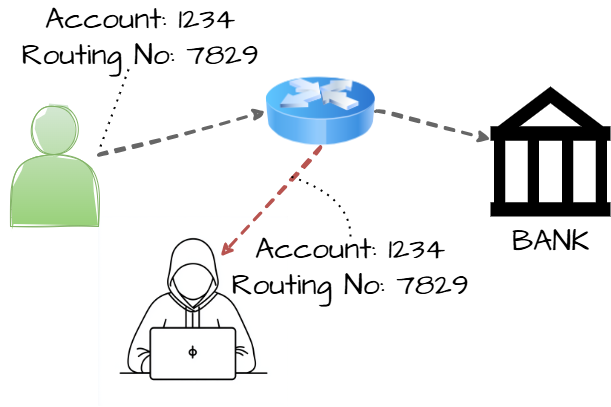
The product transmits sensitive or security-critical data in cleartext in a communication channel that can be sniffed by unauthorized actors.
Common Consequences
This table specifies different individual consequences
associated with the weakness. The Scope identifies the application security area that is
violated, while the Impact describes the negative technical impact that arises if an
adversary succeeds in exploiting this weakness. The Likelihood provides information about
how likely the specific consequence is expected to be seen relative to the other
consequences in the list. For example, there may be high likelihood that a weakness will be
exploited to achieve a certain impact, but a low likelihood that it will be exploited to
achieve a different impact.
Impact
Details
Read Application Data; Modify Files or Directories
Scope: Integrity, Confidentiality
Anyone can read the information by gaining access to the channel being used for communication. Many communication channels can be "sniffed" (monitored) by adversaries during data transmission. For example, in networking, packets can traverse many intermediary nodes from the source to the destination, whether across the internet, an internal network, the cloud, etc. Some actors might have privileged access to a network interface or any link along the channel, such as a router, but they might not be authorized to collect the underlying data. As a result, network traffic could be sniffed by adversaries, spilling security-critical data.
Read Application Data; Modify Files or Directories; Other
Scope: Integrity, Confidentiality
When full communications are recorded or logged, such as with a packet dump, an adversary could attempt to obtain the dump long after the transmission has occurred and try to "sniff" the cleartext from the recorded communications in the dump itself. Even if the information is encoded in a way that is not human-readable, certain techniques could determine which encoding is being used, then decode the information.
Potential Mitigations
Phase(s)
Mitigation
Architecture and Design
Before transmitting, encrypt the data using reliable, confidentiality-protecting cryptographic protocols.
Implementation
When using web applications with SSL, use SSL for the entire session from login to logout, not just for the initial login page.
Implementation
When designing hardware platforms, ensure that approved encryption algorithms (such as those recommended by NIST) protect paths from security critical data to trusted user applications.
Testing
Use tools and techniques that require manual (human) analysis, such as penetration testing, threat modeling, and interactive tools that allow the tester to record and modify an active session. These may be more effective than strictly automated techniques. This is especially the case with weaknesses that are related to design and business rules.
Operation
Configure servers to use encrypted channels for communication, which may include SSL or other secure protocols.
Relationships
This table shows the weaknesses and high level categories that are related to this
weakness. These relationships are defined as ChildOf, ParentOf, MemberOf and give insight to
similar items that may exist at higher and lower levels of abstraction. In addition,
relationships such as PeerOf and CanAlsoBe are defined to show similar weaknesses that the user
may want to explore.
Relevant to the view "Research Concepts" (View-1000)
Nature
Type
ID
Name
ChildOf
Class - a weakness that is described in a very abstract fashion, typically independent of any specific language or technology. More specific than a Pillar Weakness, but more general than a Base Weakness. Class level weaknesses typically describe issues in terms of 1 or 2 of the following dimensions: behavior, property, and resource.
Variant - a weakness that is linked to a certain type of product, typically involving a specific language or technology. More specific than a Base weakness. Variant level weaknesses typically describe issues in terms of 3 to 5 of the following dimensions: behavior, property, technology, language, and resource.
J2EE Misconfiguration: Data Transmission Without Encryption
ParentOf
Variant - a weakness that is linked to a certain type of product, typically involving a specific language or technology. More specific than a Base weakness. Variant level weaknesses typically describe issues in terms of 3 to 5 of the following dimensions: behavior, property, technology, language, and resource.
Sensitive Cookie in HTTPS Session Without 'Secure' Attribute
ParentOf
Base - a weakness that is still mostly independent of a resource or technology, but with sufficient details to provide specific methods for detection and prevention. Base level weaknesses typically describe issues in terms of 2 or 3 of the following dimensions: behavior, property, technology, language, and resource.
Relevant to the view "Weaknesses for Simplified Mapping of Published Vulnerabilities" (View-1003)
Nature
Type
ID
Name
ChildOf
Class - a weakness that is described in a very abstract fashion, typically independent of any specific language or technology. More specific than a Pillar Weakness, but more general than a Base Weakness. Class level weaknesses typically describe issues in terms of 1 or 2 of the following dimensions: behavior, property, and resource.
The different Modes of Introduction provide information
about how and when this
weakness may be introduced. The Phase identifies a point in the life cycle at which
introduction
may occur, while the Note provides a typical scenario related to introduction during the
given
phase.
Phase
Note
Architecture and Design
OMISSION: This weakness is caused by missing a security tactic during the architecture and design phase.
Architecture and Design
For hardware, this may be introduced when design does not plan for an attacker having physical access while a legitimate user is remotely operating the device.
Operation
System Configuration
Applicable Platforms
This listing shows possible areas for which the given
weakness could appear. These
may be for specific named Languages, Operating Systems, Architectures, Paradigms,
Technologies,
or a class of such platforms. The platform is listed along with how frequently the given
weakness appears for that instance.
Languages
Class: Not Language-Specific
(Undetermined Prevalence)
Technologies
Class: Not Technology-Specific
(Undetermined Prevalence)
Class: Cloud Computing
(Undetermined Prevalence)
Class: Mobile
(Undetermined Prevalence)
Class: ICS/OT
(Often Prevalent)
Class: System on Chip
(Undetermined Prevalence)
Test/Debug Hardware
(Often Prevalent)
Likelihood Of Exploit
High
Demonstrative Examples
Example 1
The following code attempts to establish a connection to a site to communicate sensitive information.
(bad code)
Example Language: Java
try {
URL u = new URL("http://www.secret.example.org/"); HttpURLConnection hu = (HttpURLConnection) u.openConnection(); hu.setRequestMethod("PUT"); hu.connect(); OutputStream os = hu.getOutputStream(); hu.disconnect();
} catch (IOException e) {
//...
}
Though a connection is successfully made, the connection is unencrypted and it is possible that all sensitive data sent to or received from the server will be read by unintended actors.
Example 2
In 2022, the OT:ICEFALL study examined products by 10 different Operational Technology (OT) vendors. The researchers reported 56 vulnerabilities and said that the products were "insecure by design" [REF-1283]. If exploited, these vulnerabilities often allowed adversaries to change how the products operated, ranging from denial of service to changing the code that the products executed. Since these products were often used in industries such as power, electrical, water, and others, there could even be safety implications.
Multiple vendors used cleartext transmission of sensitive information in their OT products.
Example 3
A TAP accessible register is read/written by a JTAG based tool, for internal use by authorized users. However, an adversary can connect a probing device and collect the values from the unencrypted channel connecting the JTAG interface to the authorized user, if no additional protections are employed.
Example 4
The following Azure CLI command lists the properties of a particular storage account:
(informative)
Example Language: Shell
az storage account show -g {ResourceGroupName} -n {StorageAccountName}
The enableHttpsTrafficOnly value is set to false, because the default setting for Secure transfer is set to Disabled. This allows cloud storage resources to successfully connect and transfer data without the use of encryption (e.g., HTTP, SMB 2.1, SMB 3.0, etc.).
Azure's storage accounts can be configured to only accept requests from secure connections made over HTTPS. The secure transfer setting can be enabled using Azure's Portal (GUI) or programmatically by setting the enableHttpsTrafficOnly property to True on the storage account, such as:
(good code)
Example Language: Shell
az storage account update -g {ResourceGroupName} -n {StorageAccountName} --https-only true
The change can be confirmed from the result by verifying that the enableHttpsTrafficOnly value is true:
Note: to enable secure transfer using Azure's Portal instead of the command line:
Open the Create storage account pane in the Azure portal.
In the Advanced page, select the Enable secure transfer checkbox.
Selected Observed
Examples
Note: this is a curated list of examples for users to understand the variety of ways in which this
weakness can be introduced. It is not a complete list of all CVEs that are related to this CWE entry.
Product sends file with cleartext passwords in e-mail message intended for diagnostic purposes.
Weakness Ordinalities
Ordinality
Description
Primary
(where the weakness exists independent of other weaknesses)
Resultant
(where the weakness is typically related to the presence of some other weaknesses)
Detection
Methods
Method
Details
Black Box
Use monitoring tools that examine the software's process as it interacts with the operating system and the network. This technique is useful in cases when source code is unavailable, if the software was not developed by you, or if you want to verify that the build phase did not introduce any new weaknesses. Examples include debuggers that directly attach to the running process; system-call tracing utilities such as truss (Solaris) and strace (Linux); system activity monitors such as FileMon, RegMon, Process Monitor, and other Sysinternals utilities (Windows); and sniffers and protocol analyzers that monitor network traffic.
Attach the monitor to the process, trigger the feature that sends the data, and look for the presence or absence of common cryptographic functions in the call tree. Monitor the network and determine if the data packets contain readable commands. Tools exist for detecting if certain encodings are in use. If the traffic contains high entropy, this might indicate the usage of encryption.
Automated Static Analysis
Automated static analysis, commonly referred to as Static Application Security Testing (SAST), can find some instances of this weakness by analyzing source code (or binary/compiled code) without having to execute it. Typically, this is done by building a model of data flow and control flow, then searching for potentially-vulnerable patterns that connect "sources" (origins of input) with "sinks" (destinations where the data interacts with external components, a lower layer such as the OS, etc.)
Effectiveness: High
Memberships
This MemberOf Relationships table shows additional CWE Categories and Views that
reference this weakness as a member. This information is often useful in understanding where a
weakness fits within the context of external information sources.
Nature
Type
ID
Name
MemberOf
Category - a CWE entry that contains a set of other entries that share a common characteristic.
The CERT Oracle Secure Coding Standard for Java (2011) Chapter 16 - Platform Security (SEC)
MemberOf
View - a subset of CWE entries that provides a way of examining CWE content. The two main view structures are Slices (flat lists) and Graphs (containing relationships between entries).
OWASP Top Ten 2025 Category A04:2025 - Cryptographic Failures
Vulnerability Mapping Notes
Usage
ALLOWED
(this CWE ID may be used to map to real-world vulnerabilities)
Reason
Acceptable-Use
Rationale
This CWE entry is at the Base level of abstraction, which is a preferred level of abstraction for mapping to the root causes of vulnerabilities.
Comments
Carefully read both the name and description to ensure that this mapping is an appropriate fit. Do not try to 'force' a mapping to a lower-level Base/Variant simply to comply with this preferred level of abstraction.
Notes
Other
Applicable communication channels are not limited to software products. Applicable channels include hardware-specific technologies such as internal hardware networks and external debug channels, supporting remote JTAG debugging. When mitigations are not applied to combat adversaries within the product's threat model, this weakness significantly lowers the difficulty of exploitation by such adversaries.
Taxonomy
Mappings
Mapped Taxonomy Name
Node ID
Fit
Mapped Node Name
PLOVER
Plaintext Transmission of Sensitive Information
The CERT Oracle Secure Coding Standard for Java (2011)
SEC06-J
Do not rely on the default automatic signature verification provided by URLClassLoader and java.util.jar
The CERT Oracle Secure Coding Standard for Java (2011)
SER02-J
Sign then seal sensitive objects before sending them outside a trust boundary
Michael Howard, David LeBlanc and John Viega. "24 Deadly Sins of Software Security". "Sin 22: Failing to Protect Network Traffic." Page 337. McGraw-Hill. 2010.
Center for Internet Security. "CIS Microsoft Azure Foundations Benchmark version 1.5.0". Sections 3.1 and 3.10. 2022-08-16.
<https://www.cisecurity.org/benchmark/azure>.
(URL validated: 2023-01-19)


 Description
 This table specifies different individual consequences
associated with the weakness. The Scope identifies the application security area that is
violated, while the Impact describes the negative technical impact that arises if an
adversary succeeds in exploiting this weakness. The Likelihood provides information about
how likely the specific consequence is expected to be seen relative to the other
consequences in the list. For example, there may be high likelihood that a weakness will be
exploited to achieve a certain impact, but a low likelihood that it will be exploited to
achieve a different impact.
This table specifies different individual consequences
associated with the weakness. The Scope identifies the application security area that is
violated, while the Impact describes the negative technical impact that arises if an
adversary succeeds in exploiting this weakness. The Likelihood provides information about
how likely the specific consequence is expected to be seen relative to the other
consequences in the list. For example, there may be high likelihood that a weakness will be
exploited to achieve a certain impact, but a low likelihood that it will be exploited to
achieve a different impact.