Vulnerability Mapping:ALLOWEDThis CWE ID may be used to map to real-world vulnerabilities Abstraction:
BaseBase - a weakness that is still mostly independent of a resource or technology, but with sufficient details to provide specific methods for detection and prevention. Base level weaknesses typically describe issues in terms of 2 or 3 of the following dimensions: behavior, property, technology, language, and resource.
View customized information:
Shows the description and diagram, platforms, mitigations, consequences, relationships, memberships, and content history.For users who are interested in more notional aspects of a weakness. Example: educators, technical writers, and project/program managers.For users who are concerned with the practical application and details about the nature of a weakness and how to prevent it from happening. Example: tool developers, security researchers, pen-testers, incident response analysts.For users who are mapping an issue to CWE/CAPEC IDs, i.e., finding the most appropriate CWE for a specific issue (e.g., a CVE record). Example: tool developers, security researchers.For users who wish to see all available information for the CWE/CAPEC entry.For users who want to customize what details are displayed.
×
Edit Custom Filter
More information is available — Please edit the custom filter or select a different filter.
Description
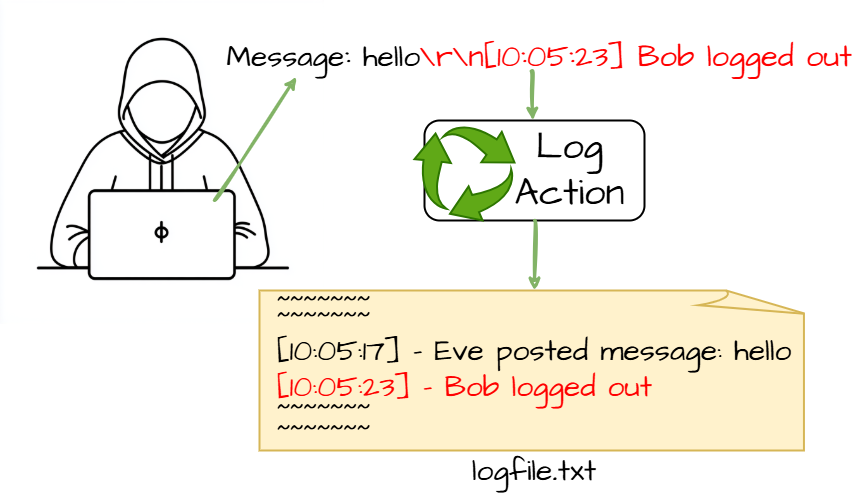
The product constructs a log message from external input, but it does not neutralize or incorrectly neutralizes special elements when the message is written to a log file.
Alternate Terms
Log forging
An attack-oriented term that could be used in cases in which the adversary can add additional log entries or modify how a log entry is parsed.
Common Consequences
This table specifies different individual consequences
associated with the weakness. The Scope identifies the application security area that is
violated, while the Impact describes the negative technical impact that arises if an
adversary succeeds in exploiting this weakness. The Likelihood provides information about
how likely the specific consequence is expected to be seen relative to the other
consequences in the list. For example, there may be high likelihood that a weakness will be
exploited to achieve a certain impact, but a low likelihood that it will be exploited to
achieve a different impact.
Impact
Details
Modify Application Data; Hide Activities; Execute Unauthorized Code or Commands
Interpretation of the log files may be hindered or misdirected if an attacker can supply data to the application that is subsequently logged verbatim. In the most benign case, an attacker may be able to insert false entries into the log file by providing the application with input that includes appropriate characters. Forged or otherwise corrupted log files can be used to cover an attacker's tracks, possibly by skewing statistics, or even to implicate another party in the commission of a malicious act. If the log file is processed automatically, the attacker can render the file unusable by corrupting the format of the file or injecting unexpected characters. An attacker may inject code or other commands into the log file and take advantage of a vulnerability in the log processing utility.
Potential Mitigations
Phase(s)
Mitigation
Implementation
Strategy: Input Validation
Assume all input is malicious. Use an "accept known good" input validation strategy, i.e., use a list of acceptable inputs that strictly conform to specifications. Reject any input that does not strictly conform to specifications, or transform it into something that does.
When performing input validation, consider all potentially relevant properties, including length, type of input, the full range of acceptable values, missing or extra inputs, syntax, consistency across related fields, and conformance to business rules. As an example of business rule logic, "boat" may be syntactically valid because it only contains alphanumeric characters, but it is not valid if the input is only expected to contain colors such as "red" or "blue."
Do not rely exclusively on looking for malicious or malformed inputs. This is likely to miss at least one undesirable input, especially if the code's environment changes. This can give attackers enough room to bypass the intended validation. However, denylists can be useful for detecting potential attacks or determining which inputs are so malformed that they should be rejected outright.
Implementation
Strategy: Output Encoding
Use and specify an output encoding that can be handled by the downstream component that is reading the output. Common encodings include ISO-8859-1, UTF-7, and UTF-8. When an encoding is not specified, a downstream component may choose a different encoding, either by assuming a default encoding or automatically inferring which encoding is being used, which can be erroneous. When the encodings are inconsistent, the downstream component might treat some character or byte sequences as special, even if they are not special in the original encoding. Attackers might then be able to exploit this discrepancy and conduct injection attacks; they even might be able to bypass protection mechanisms that assume the original encoding is also being used by the downstream component.
Implementation
Strategy: Input Validation
Inputs should be decoded and canonicalized to the application's current internal representation before being validated (CWE-180). Make sure that the application does not decode the same input twice (CWE-174). Such errors could be used to bypass allowlist validation schemes by introducing dangerous inputs after they have been checked.
Relationships
This table shows the weaknesses and high level categories that are related to this
weakness. These relationships are defined as ChildOf, ParentOf, MemberOf and give insight to
similar items that may exist at higher and lower levels of abstraction. In addition,
relationships such as PeerOf, Overlaps, and CanAlsoBe are defined to show similar weaknesses that the user
may want to explore.
Relevant to the view "Complete Weakness Hierarchy" (View-1000)
Nature
Type
ID
Name
ChildOf
Class - a weakness that is described in a very abstract fashion, typically independent of any specific language or technology. More specific than a Pillar Weakness, but more general than a Base Weakness. Class level weaknesses typically describe issues in terms of 1 or 2 of the following dimensions: behavior, property, and resource.
Base - a weakness that is still mostly independent of a resource or technology, but with sufficient details to provide specific methods for detection and prevention. Base level weaknesses typically describe issues in terms of 2 or 3 of the following dimensions: behavior, property, technology, language, and resource.
Relevant to the view "Seven Pernicious Kingdoms" (View-700)
Nature
Type
ID
Name
ChildOf
Class - a weakness that is described in a very abstract fashion, typically independent of any specific language or technology. More specific than a Pillar Weakness, but more general than a Base Weakness. Class level weaknesses typically describe issues in terms of 1 or 2 of the following dimensions: behavior, property, and resource.
Applications typically use log files to store a history of events or transactions for later review, statistics gathering, or debugging. Depending on the nature of the application, the task of reviewing log files may be performed manually on an as-needed basis or automated with a tool that automatically culls logs for important events or trending information.
Modes
Of Introduction
The different Modes of Introduction provide information
about how and when this
weakness may be introduced. The Phase identifies a point in the life cycle at which
introduction
may occur, while the Note provides a typical scenario related to introduction during the
given
phase.
Phase(s)
Note
Implementation
REALIZATION: This weakness is caused during implementation of an architectural security tactic.
Applicable Platforms
This listing shows possible areas for which the given
weakness could appear. These
may be for specific named Languages, Operating Systems, Architectures, Paradigms,
Technologies,
or a class of such platforms. The platform is listed along with how frequently the given
weakness appears for that instance.
Type
Applicable Platforms
Notes
Languages
Class: Not Language-Specific
(Undetermined Prevalence)
Python
(Undetermined Prevalence)
Likelihood Of Exploit
Medium
Demonstrative Examples
Example 1
The following web application code attempts to read an integer value from a request object. If the parseInt call fails, then the input is logged with an error message indicating what happened.
(bad code)
Example Language: Java
String val = request.getParameter("val"); try {
int value = Integer.parseInt(val);
} catch (NumberFormatException) {
log.info("Failed to parse val = " + val);
} ...
If a user submits the string "twenty-one" for val, the following entry is logged:
INFO: Failed to parse val=twenty-one
However, if an attacker submits the string "twenty-one%0a%0aINFO:+User+logged+out%3dbadguy", the following entry is logged:
INFO: Failed to parse val=twenty-one
INFO: User logged out=badguy
Clearly, attackers can use this same mechanism to insert arbitrary log entries.
Example 2
The following code records an error if a username's attempt at registration fails.
The above PHP code logs the username directly without sanitization. An attacker can inject newline (%0A) characters in the username parameter, causing log injection. For example, submitting:
(attack code)
hacker%0AAdmin+Access+Granted
would result in a manipulated log entry:
(result)
User registration failed: hacker
Admin Access Granted
This could trick administrators into believing that false events occurred or even bypass security monitoring systems.
This weakness could be addressed by removing all control characters.
(good code)
Example Language: PHP
function sanitize_for_log(string $input): string {
// Remove all control characters including newlines, carriage returns, tabs, etc.
$sanitized = preg_replace('/[[:cntrl:]]/', '', $input);
// Trim leading/trailing whitespace
return trim($sanitized);
}
function validate_username(string $input): string {
// Sanitize first to strip any injected control characters
$clean = sanitize_for_log($input);
// Enforce max length
if (strlen($clean) > 20) {
throw new Exception("Username too long");
}
// Allowlist: only alphanumeric characters and underscores
if (!preg_match('/^[a-zA-Z0-9_]+$/', $clean)) {
throw new InvalidArgumentException("Username contains invalid characters");
Note: this is a curated list of examples for users to understand the variety of ways in which this
weakness can be introduced. It is not a complete list of all CVEs that are related to this CWE entry.
Chain: inject fake log entries with fake timestamps using CRLF injection
Weakness Ordinalities
Ordinality
Description
Primary
(where the weakness exists independent of other weaknesses)
Detection
Methods
Method
Details
Automated Static Analysis
Automated static analysis, commonly referred to as Static Application Security Testing (SAST), can find some instances of this weakness by analyzing source code (or binary/compiled code) without having to execute it. Typically, this is done by building a model of data flow and control flow, then searching for potentially-vulnerable patterns that connect "sources" (origins of input) with "sinks" (destinations where the data interacts with external components, a lower layer such as the OS, etc.)
Effectiveness: High
Memberships
This MemberOf Relationships table shows additional CWE Categories and Views that
reference this weakness as a member. This information is often useful in understanding where a
weakness fits within the context of external information sources.
Nature
Type
ID
Name
MemberOf
Grouping - a CWE entry that contains a set of other entries that share a common characteristic.
View - a subset of CWE entries that provides a way of examining CWE content. The two main view structures are Slices (flat lists) and Graphs (containing relationships between entries).
OpenSSF Secure Coding Guide for Python (2026) - 06 Logging
Vulnerability Mapping Notes
Usage
ALLOWED
(this CWE ID may be used to map to real-world vulnerabilities)
Reason
Acceptable-Use
Rationale
This CWE entry is at the Base level of abstraction, which is a preferred level of abstraction for mapping to the root causes of vulnerabilities.
Comments
Carefully read both the name and description to ensure that this mapping is an appropriate fit. Do not try to 'force' a mapping to a lower-level Base/Variant simply to comply with this preferred level of abstraction.
Taxonomy
Mappings
Mapped Taxonomy Name
Node ID
Fit
Mapped Node Name
7 Pernicious Kingdoms
Log Forging
Software Fault Patterns
SFP23
Exposed Data
The CERT Oracle Secure Coding Standard for Java (2011)
Katrina Tsipenyuk, Brian Chess and Gary McGraw. "Seven Pernicious Kingdoms: A Taxonomy of Software Security Errors". NIST Workshop on Software Security Assurance Tools Techniques and Metrics. NIST. 2005-11-07.
<https://cwe.mitre.org/documents/sources/SevenPerniciousKingdoms.pdf>.
[REF-52]
Greg Hoglund and Gary McGraw. "Exploiting Software: How to Break Code". Addison-Wesley. 2004-02-27.
<http://www.exploitingsoftware.com/>.


 Description
 This table specifies different individual consequences
associated with the weakness. The Scope identifies the application security area that is
violated, while the Impact describes the negative technical impact that arises if an
adversary succeeds in exploiting this weakness. The Likelihood provides information about
how likely the specific consequence is expected to be seen relative to the other
consequences in the list. For example, there may be high likelihood that a weakness will be
exploited to achieve a certain impact, but a low likelihood that it will be exploited to
achieve a different impact.