Vulnerability Mapping:DISCOURAGEDThis CWE ID should not be used to map to real-world vulnerabilities Abstraction:
ClassClass - a weakness that is described in a very abstract fashion, typically independent of any specific language or technology. More specific than a Pillar Weakness, but more general than a Base Weakness. Class level weaknesses typically describe issues in terms of 1 or 2 of the following dimensions: behavior, property, and resource.
View customized information:
For users who are interested in more notional aspects of a weakness. Example: educators, technical writers, and project/program managers.For users who are concerned with the practical application and details about the nature of a weakness and how to prevent it from happening. Example: tool developers, security researchers, pen-testers, incident response analysts.For users who are mapping an issue to CWE/CAPEC IDs, i.e., finding the most appropriate CWE for a specific issue (e.g., a CVE record). Example: tool developers, security researchers.For users who wish to see all available information for the CWE/CAPEC entry.For users who want to customize what details are displayed.
×
Edit Custom Filter
Description
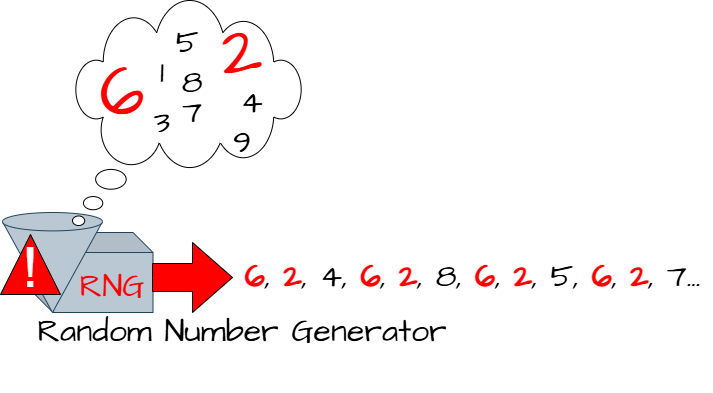
The product uses insufficiently random numbers or values in a security context that depends on unpredictable numbers.
Common Consequences
This table specifies different individual consequences
associated with the weakness. The Scope identifies the application security area that is
violated, while the Impact describes the negative technical impact that arises if an
adversary succeeds in exploiting this weakness. The Likelihood provides information about
how likely the specific consequence is expected to be seen relative to the other
consequences in the list. For example, there may be high likelihood that a weakness will be
exploited to achieve a certain impact, but a low likelihood that it will be exploited to
achieve a different impact.
Impact
Details
Other
Scope: Confidentiality, Other
When a protection mechanism relies on random values to restrict access to a sensitive resource, such as a session ID or a seed for generating a cryptographic key, then the resource being protected could be accessed by guessing the ID or key.
Bypass Protection Mechanism; Other
Scope: Access Control, Other
If product relies on unique, unguessable IDs to identify a resource, an attacker might be able to guess an ID for a resource that is owned by another user. The attacker could then read the resource, or pre-create a resource with the same ID to prevent the legitimate program from properly sending the resource to the intended user. For example, a product might maintain session information in a file whose name is based on a username. An attacker could pre-create this file for a victim user, then set the permissions so that the application cannot generate the session for the victim, preventing the victim from using the application.
Bypass Protection Mechanism; Gain Privileges or Assume Identity
Scope: Access Control
When an authorization or authentication mechanism relies on random values to restrict access to restricted functionality, such as a session ID or a seed for generating a cryptographic key, then an attacker may access the restricted functionality by guessing the ID or key.
Potential Mitigations
Phase(s)
Mitigation
Architecture and Design
Use a well-vetted algorithm that is currently considered to be strong by experts in the field, and select well-tested implementations with adequate length seeds.
In general, if a pseudo-random number generator is not advertised as being cryptographically secure, then it is probably a statistical PRNG and should not be used in security-sensitive contexts.
Pseudo-random number generators can produce predictable numbers if the generator is known and the seed can be guessed. A 256-bit seed is a good starting point for producing a "random enough" number.
Implementation
Consider a PRNG that re-seeds itself as needed from high quality pseudo-random output sources, such as hardware devices.
Architecture and Design; Requirements
Strategy: Libraries or Frameworks
Use products or modules that conform to FIPS 140-2 [REF-267] to avoid obvious entropy problems. Consult FIPS 140-2 Annex C ("Approved Random Number Generators").
Relationships
This table shows the weaknesses and high level categories that are related to this
weakness. These relationships are defined as ChildOf, ParentOf, MemberOf and give insight to
similar items that may exist at higher and lower levels of abstraction. In addition,
relationships such as PeerOf and CanAlsoBe are defined to show similar weaknesses that the user
may want to explore.
Relevant to the view "Research Concepts" (View-1000)
Nature
Type
ID
Name
ChildOf
Pillar - a weakness that is the most abstract type of weakness and represents a theme for all class/base/variant weaknesses related to it. A Pillar is different from a Category as a Pillar is still technically a type of weakness that describes a mistake, while a Category represents a common characteristic used to group related things.
Base - a weakness that is still mostly independent of a resource or technology, but with sufficient details to provide specific methods for detection and prevention. Base level weaknesses typically describe issues in terms of 2 or 3 of the following dimensions: behavior, property, technology, language, and resource.
Base - a weakness that is still mostly independent of a resource or technology, but with sufficient details to provide specific methods for detection and prevention. Base level weaknesses typically describe issues in terms of 2 or 3 of the following dimensions: behavior, property, technology, language, and resource.
Base - a weakness that is still mostly independent of a resource or technology, but with sufficient details to provide specific methods for detection and prevention. Base level weaknesses typically describe issues in terms of 2 or 3 of the following dimensions: behavior, property, technology, language, and resource.
Incorrect Usage of Seeds in Pseudo-Random Number Generator (PRNG)
ParentOf
Base - a weakness that is still mostly independent of a resource or technology, but with sufficient details to provide specific methods for detection and prevention. Base level weaknesses typically describe issues in terms of 2 or 3 of the following dimensions: behavior, property, technology, language, and resource.
Use of Cryptographically Weak Pseudo-Random Number Generator (PRNG)
ParentOf
Class - a weakness that is described in a very abstract fashion, typically independent of any specific language or technology. More specific than a Pillar Weakness, but more general than a Base Weakness. Class level weaknesses typically describe issues in terms of 1 or 2 of the following dimensions: behavior, property, and resource.
Base - a weakness that is still mostly independent of a resource or technology, but with sufficient details to provide specific methods for detection and prevention. Base level weaknesses typically describe issues in terms of 2 or 3 of the following dimensions: behavior, property, technology, language, and resource.
Use of Invariant Value in Dynamically Changing Context
ParentOf
Base - a weakness that is still mostly independent of a resource or technology, but with sufficient details to provide specific methods for detection and prevention. Base level weaknesses typically describe issues in terms of 2 or 3 of the following dimensions: behavior, property, technology, language, and resource.
Base - a weakness that is still mostly independent of a resource or technology, but with sufficient details to provide specific methods for detection and prevention. Base level weaknesses typically describe issues in terms of 2 or 3 of the following dimensions: behavior, property, technology, language, and resource.
Use of Predictable Algorithm in Random Number Generator
CanPrecede
Base - a weakness that is still mostly independent of a resource or technology, but with sufficient details to provide specific methods for detection and prevention. Base level weaknesses typically describe issues in terms of 2 or 3 of the following dimensions: behavior, property, technology, language, and resource.
Relevant to the view "Weaknesses for Simplified Mapping of Published Vulnerabilities" (View-1003)
Nature
Type
ID
Name
MemberOf
View - a subset of CWE entries that provides a way of examining CWE content. The two main view structures are Slices (flat lists) and Graphs (containing relationships between entries).
Weaknesses for Simplified Mapping of Published Vulnerabilities
ParentOf
Base - a weakness that is still mostly independent of a resource or technology, but with sufficient details to provide specific methods for detection and prevention. Base level weaknesses typically describe issues in terms of 2 or 3 of the following dimensions: behavior, property, technology, language, and resource.
Base - a weakness that is still mostly independent of a resource or technology, but with sufficient details to provide specific methods for detection and prevention. Base level weaknesses typically describe issues in terms of 2 or 3 of the following dimensions: behavior, property, technology, language, and resource.
Incorrect Usage of Seeds in Pseudo-Random Number Generator (PRNG)
ParentOf
Base - a weakness that is still mostly independent of a resource or technology, but with sufficient details to provide specific methods for detection and prevention. Base level weaknesses typically describe issues in terms of 2 or 3 of the following dimensions: behavior, property, technology, language, and resource.
Computers are deterministic machines, and as such are unable to produce true randomness. Pseudo-Random Number Generators (PRNGs) approximate randomness algorithmically, starting with a seed from which subsequent values are calculated. There are two types of PRNGs: statistical and cryptographic. Statistical PRNGs provide useful statistical properties, but their output is highly predictable and forms an easy to reproduce numeric stream that is unsuitable for use in cases where security depends on generated values being unpredictable. Cryptographic PRNGs address this problem by generating output that is more difficult to predict. For a value to be cryptographically secure, it must be impossible or highly improbable for an attacker to distinguish between it and a truly random value.
Modes
Of Introduction
The different Modes of Introduction provide information
about how and when this
weakness may be introduced. The Phase identifies a point in the life cycle at which
introduction
may occur, while the Note provides a typical scenario related to introduction during the
given
phase.
Phase
Note
Architecture and Design
Implementation
REALIZATION: This weakness is caused during implementation of an architectural security tactic.
Applicable Platforms
This listing shows possible areas for which the given
weakness could appear. These
may be for specific named Languages, Operating Systems, Architectures, Paradigms,
Technologies,
or a class of such platforms. The platform is listed along with how frequently the given
weakness appears for that instance.
Languages
Class: Not Language-Specific
(Undetermined Prevalence)
Technologies
Class: Not Technology-Specific
(Undetermined Prevalence)
Likelihood Of Exploit
High
Demonstrative Examples
Example 1
This code attempts to generate a unique random identifier for a user's session.
(bad code)
Example Language: PHP
function generateSessionID($userID){
srand($userID); return rand();
}
Because the seed for the PRNG is always the user's ID, the session ID will always be the same. An attacker could thus predict any user's session ID and potentially hijack the session.
This example also exhibits a Small Seed Space (CWE-339).
Example 2
The following code uses a statistical PRNG to create a URL for a receipt that remains active for some period of time after a purchase.
(bad code)
Example Language: Java
String GenerateReceiptURL(String baseUrl) {
Random ranGen = new Random(); ranGen.setSeed((new Date()).getTime()); return(baseUrl + ranGen.nextInt(400000000) + ".html");
}
This code uses the Random.nextInt() function to generate "unique" identifiers for the receipt pages it generates. Because Random.nextInt() is a statistical PRNG, it is easy for an attacker to guess the strings it generates. Although the underlying design of the receipt system is also faulty, it would be more secure if it used a random number generator that did not produce predictable receipt identifiers, such as a cryptographic PRNG.
Selected Observed
Examples
Note: this is a curated list of examples for users to understand the variety of ways in which this
weakness can be introduced. It is not a complete list of all CVEs that are related to this CWE entry.
Chain: insufficient precision (CWE-1339) in
random-number generator causes some zero bits to be reliably
generated, reducing the amount of entropy (CWE-331)
Application generates passwords that are based on the time of day.
Weakness Ordinalities
Ordinality
Description
Primary
(where the weakness exists independent of other weaknesses)
Detection
Methods
Method
Details
Black Box
Use monitoring tools that examine the software's process as it interacts with the operating system and the network. This technique is useful in cases when source code is unavailable, if the software was not developed by you, or if you want to verify that the build phase did not introduce any new weaknesses. Examples include debuggers that directly attach to the running process; system-call tracing utilities such as truss (Solaris) and strace (Linux); system activity monitors such as FileMon, RegMon, Process Monitor, and other Sysinternals utilities (Windows); and sniffers and protocol analyzers that monitor network traffic.
Attach the monitor to the process and look for library functions that indicate when randomness is being used. Run the process multiple times to see if the seed changes. Look for accesses of devices or equivalent resources that are commonly used for strong (or weak) randomness, such as /dev/urandom on Linux. Look for library or system calls that access predictable information such as process IDs and system time.
Automated Static Analysis - Binary or Bytecode
According to SOAR [REF-1479], the following detection techniques may be useful:
This MemberOf Relationships table shows additional CWE Categories and Views that
reference this weakness as a member. This information is often useful in understanding where a
weakness fits within the context of external information sources.
Nature
Type
ID
Name
MemberOf
Category - a CWE entry that contains a set of other entries that share a common characteristic.
OWASP Top Ten 2025 Category A04:2025 - Cryptographic Failures
Vulnerability Mapping Notes
Usage
DISCOURAGED
(this CWE ID should not be used to map to real-world vulnerabilities)
Reason
Abstraction
Rationale
This CWE entry is a level-1 Class (i.e., a child of a Pillar). It might have lower-level children that would be more appropriate
Comments
Examine children of this entry to see if there is a better fit
Notes
Relationship
This can be primary to many other weaknesses such as cryptographic errors, authentication errors, symlink following, information leaks, and others.
Maintenance
As of CWE 4.3, CWE-330 and its descendants are being
investigated by the CWE crypto team to identify gaps
related to randomness and unpredictability, as well as
the relationships between randomness and cryptographic
primitives. This "subtree analysis" might
result in the addition or deprecation of existing
entries; the reorganization of relationships in some
views, e.g. the research view (CWE-1000); more consistent
use of terminology; and/or significant modifications to
related entries.
Maintenance
As of CWE 4.5, terminology related to randomness, entropy, and
predictability can vary widely. Within the developer and other
communities, "randomness" is used heavily. However, within
cryptography, "entropy" is distinct, typically implied as a
measurement. There are no commonly-used definitions, even within
standards documents and cryptography papers. Future versions of
CWE will attempt to define these terms and, if necessary,
distinguish between them in ways that are appropriate for
different communities but do not reduce the usability of CWE for
mapping, understanding, or other scenarios.
Taxonomy
Mappings
Mapped Taxonomy Name
Node ID
Fit
Mapped Node Name
PLOVER
Randomness and Predictability
7 Pernicious Kingdoms
Insecure Randomness
OWASP Top Ten 2004
A2
CWE More Specific
Broken Access Control
CERT C Secure Coding
CON33-C
Imprecise
Avoid race conditions when using library functions
CERT C Secure Coding
MSC30-C
CWE More Abstract
Do not use the rand() function for generating pseudorandom numbers
CERT C Secure Coding
MSC32-C
CWE More Abstract
Properly seed pseudorandom number generators
WASC
11
Brute Force
WASC
18
Credential/Session Prediction
The CERT Oracle Secure Coding Standard for Java (2011)


 Description
 This table specifies different individual consequences
associated with the weakness. The Scope identifies the application security area that is
violated, while the Impact describes the negative technical impact that arises if an
adversary succeeds in exploiting this weakness. The Likelihood provides information about
how likely the specific consequence is expected to be seen relative to the other
consequences in the list. For example, there may be high likelihood that a weakness will be
exploited to achieve a certain impact, but a low likelihood that it will be exploited to
achieve a different impact.
This table specifies different individual consequences
associated with the weakness. The Scope identifies the application security area that is
violated, while the Impact describes the negative technical impact that arises if an
adversary succeeds in exploiting this weakness. The Likelihood provides information about
how likely the specific consequence is expected to be seen relative to the other
consequences in the list. For example, there may be high likelihood that a weakness will be
exploited to achieve a certain impact, but a low likelihood that it will be exploited to
achieve a different impact.