Vulnerability Mapping:ALLOWEDThis CWE ID may be used to map to real-world vulnerabilities Abstraction:
BaseBase - a weakness that is still mostly independent of a resource or technology, but with sufficient details to provide specific methods for detection and prevention. Base level weaknesses typically describe issues in terms of 2 or 3 of the following dimensions: behavior, property, technology, language, and resource.
View customized information:
For users who are interested in more notional aspects of a weakness. Example: educators, technical writers, and project/program managers.For users who are concerned with the practical application and details about the nature of a weakness and how to prevent it from happening. Example: tool developers, security researchers, pen-testers, incident response analysts.For users who are mapping an issue to CWE/CAPEC IDs, i.e., finding the most appropriate CWE for a specific issue (e.g., a CVE record). Example: tool developers, security researchers.For users who wish to see all available information for the CWE/CAPEC entry.For users who want to customize what details are displayed.
×
Edit Custom Filter
Description
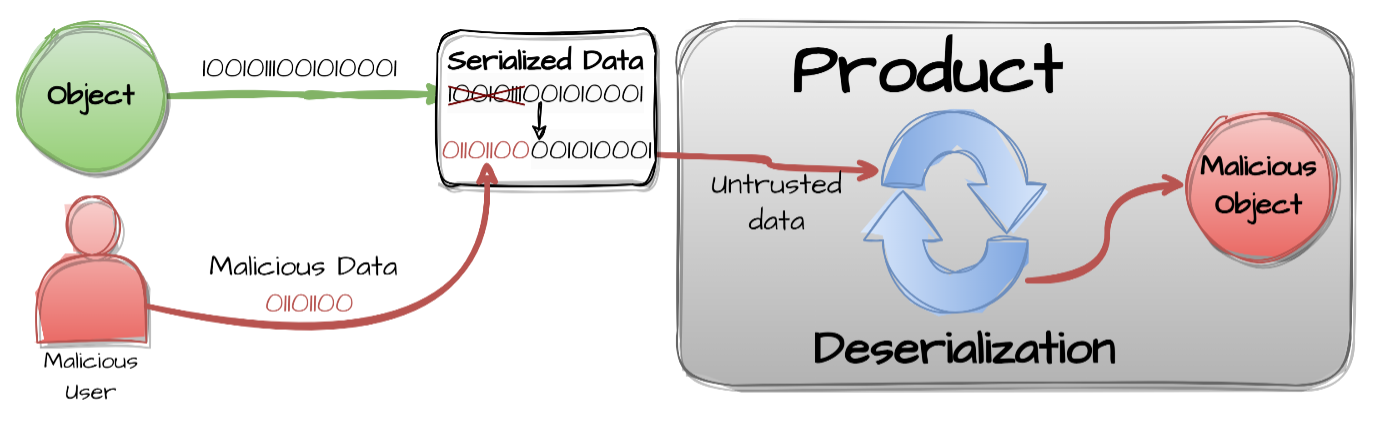
The product deserializes untrusted data without sufficiently ensuring that the resulting data will be valid.
Marshaling and unmarshaling are effectively synonyms for serialization and deserialization, respectively.
Pickling, Unpickling
In Python, the "pickle" functionality is used to perform serialization and deserialization.
PHP Object Injection
Some PHP application researchers use this term when attacking unsafe use of the unserialize() function; but it is also used for CWE-915.
Common Consequences
This table specifies different individual consequences
associated with the weakness. The Scope identifies the application security area that is
violated, while the Impact describes the negative technical impact that arises if an
adversary succeeds in exploiting this weakness. The Likelihood provides information about
how likely the specific consequence is expected to be seen relative to the other
consequences in the list. For example, there may be high likelihood that a weakness will be
exploited to achieve a certain impact, but a low likelihood that it will be exploited to
achieve a different impact.
Impact
Details
Modify Application Data; Unexpected State
Scope: Integrity
Attackers can modify unexpected objects or data that was assumed to be safe from modification. Deserialized data or code could be modified without using the provided accessor functions, or unexpected functions could be invoked.
DoS: Resource Consumption (CPU)
Scope: Availability
If a function is making an assumption on when to terminate, based on a sentry in a string, it could easily never terminate.
Varies by Context
Scope: Other
The consequences can vary widely, because it depends on which objects or methods are being deserialized, and how they are used. Making an assumption that the code in the deserialized object is valid is dangerous and can enable exploitation. One example is attackers using gadget chains to perform unauthorized actions, such as generating a shell.
Potential Mitigations
Phase(s)
Mitigation
Architecture and Design; Implementation
If available, use the signing/sealing features of the programming language to assure that deserialized data has not been tainted. For example, a hash-based message authentication code (HMAC) could be used to ensure that data has not been modified.
Implementation
When deserializing data, populate a new object rather than just deserializing. The result is that the data flows through safe input validation and that the functions are safe.
Implementation
Explicitly define a final object() to prevent deserialization.
Architecture and Design; Implementation
Make fields transient to protect them from deserialization.
An attempt to serialize and then deserialize a class containing transient fields will result in NULLs where the transient data should be. This is an excellent way to prevent time, environment-based, or sensitive variables from being carried over and used improperly.
Implementation
Avoid having unnecessary types or gadgets (a sequence of instances and method invocations that can self-execute during the deserialization process, often found in libraries) available that can be leveraged for malicious ends. This limits the potential for unintended or unauthorized types and gadgets to be leveraged by the attacker. Add only acceptable classes to an allowlist. Note: new gadgets are constantly being discovered, so this alone is not a sufficient mitigation.
Architecture and Design; Implementation
Employ cryptography of the data or code for protection. However, it's important to note that it would still be client-side security. This is risky because if the client is compromised then the security implemented on the client (the cryptography) can be bypassed.
Operation
Strategy: Firewall
Use an application firewall that can detect attacks against this weakness. It can be beneficial in cases in which the code cannot be fixed (because it is controlled by a third party), as an emergency prevention measure while more comprehensive software assurance measures are applied, or to provide defense in depth [REF-1481].
Effectiveness: Moderate
Note: An application firewall might not cover all possible input vectors. In addition, attack techniques might be available to bypass the protection mechanism, such as using malformed inputs that can still be processed by the component that receives those inputs. Depending on functionality, an application firewall might inadvertently reject or modify legitimate requests. Finally, some manual effort may be required for customization.
Relationships
This table shows the weaknesses and high level categories that are related to this
weakness. These relationships are defined as ChildOf, ParentOf, MemberOf and give insight to
similar items that may exist at higher and lower levels of abstraction. In addition,
relationships such as PeerOf and CanAlsoBe are defined to show similar weaknesses that the user
may want to explore.
Relevant to the view "Research Concepts" (View-1000)
Nature
Type
ID
Name
ChildOf
Class - a weakness that is described in a very abstract fashion, typically independent of any specific language or technology. More specific than a Pillar Weakness, but more general than a Base Weakness. Class level weaknesses typically describe issues in terms of 1 or 2 of the following dimensions: behavior, property, and resource.
Improper Control of Dynamically-Managed Code Resources
PeerOf
Base - a weakness that is still mostly independent of a resource or technology, but with sufficient details to provide specific methods for detection and prevention. Base level weaknesses typically describe issues in terms of 2 or 3 of the following dimensions: behavior, property, technology, language, and resource.
Relevant to the view "Weaknesses for Simplified Mapping of Published Vulnerabilities" (View-1003)
Nature
Type
ID
Name
ChildOf
Class - a weakness that is described in a very abstract fashion, typically independent of any specific language or technology. More specific than a Pillar Weakness, but more general than a Base Weakness. Class level weaknesses typically describe issues in terms of 1 or 2 of the following dimensions: behavior, property, and resource.
Serialization and deserialization refer to the process of taking program-internal object-related data, packaging it in a way that allows the data to be externally stored or transferred ("serialization"), then extracting the serialized data to reconstruct the original object ("deserialization").
Modes
Of Introduction
The different Modes of Introduction provide information
about how and when this
weakness may be introduced. The Phase identifies a point in the life cycle at which
introduction
may occur, while the Note provides a typical scenario related to introduction during the
given
phase.
Phase
Note
Architecture and Design
OMISSION: This weakness is caused by missing a security tactic during the architecture and design phase.
Implementation
Applicable Platforms
This listing shows possible areas for which the given
weakness could appear. These
may be for specific named Languages, Operating Systems, Architectures, Paradigms,
Technologies,
or a class of such platforms. The platform is listed along with how frequently the given
weakness appears for that instance.
Languages
Java
(Undetermined Prevalence)
Ruby
(Undetermined Prevalence)
PHP
(Undetermined Prevalence)
Python
(Undetermined Prevalence)
JavaScript
(Undetermined Prevalence)
Technologies
Class: Not Technology-Specific
(Undetermined Prevalence)
Class: ICS/OT
(Often Prevalent)
AI/ML
(Often Prevalent)
Likelihood Of Exploit
Medium
Demonstrative Examples
Example 1
This code snippet deserializes an object from a file and uses it as a UI button:
(bad code)
Example Language: Java
try {
File file = new File("object.obj"); ObjectInputStream in = new ObjectInputStream(new FileInputStream(file)); javax.swing.JButton button = (javax.swing.JButton) in.readObject(); in.close();
}
This code does not attempt to verify the source or contents of the file before deserializing it. An attacker may be able to replace the intended file with a file that contains arbitrary malicious code which will be executed when the button is pressed.
To mitigate this, explicitly define final readObject() to prevent deserialization. An example of this is:
(good code)
Example Language: Java
private final void readObject(ObjectInputStream in) throws java.io.IOException { throw new java.io.IOException("Cannot be deserialized"); }
Example 2
In Python, the Pickle library handles the serialization and deserialization processes. In this example derived from [REF-467], the code receives and parses data, and afterwards tries to authenticate a user based on validating a token.
(bad code)
Example Language: Python
try {
class ExampleProtocol(protocol.Protocol): def dataReceived(self, data):
# Code that would be here would parse the incoming data # After receiving headers, call confirmAuth() to authenticate
def confirmAuth(self, headers): try: token = cPickle.loads(base64.b64decode(headers['AuthToken'])) if not check_hmac(token['signature'], token['data'], getSecretKey()): raise AuthFail self.secure_data = token['data'] except: raise AuthFail
}
Unfortunately, the code does not verify that the incoming data is legitimate. An attacker can construct a illegitimate, serialized object "AuthToken" that instantiates one of Python's subprocesses to execute arbitrary commands. For instance,the attacker could construct a pickle that leverages Python's subprocess module, which spawns new processes and includes a number of arguments for various uses. Since Pickle allows objects to define the process for how they should be unpickled, the attacker can direct the unpickle process to call Popen in the subprocess module and execute /bin/sh.
Selected Observed
Examples
Note: this is a curated list of examples for users to understand the variety of ways in which this
weakness can be introduced. It is not a complete list of all CVEs that are related to this CWE entry.
Web browser allows execution of native methods via a crafted string to a JavaScript function that deserializes the string.
Weakness Ordinalities
Ordinality
Description
Primary
(where the weakness exists independent of other weaknesses)
Resultant
(where the weakness is typically related to the presence of some other weaknesses)
Detection
Methods
Method
Details
Automated Static Analysis
Automated static analysis, commonly referred to as Static Application Security Testing (SAST), can find some instances of this weakness by analyzing source code (or binary/compiled code) without having to execute it. Typically, this is done by building a model of data flow and control flow, then searching for potentially-vulnerable patterns that connect "sources" (origins of input) with "sinks" (destinations where the data interacts with external components, a lower layer such as the OS, etc.)
Effectiveness: High
Memberships
This MemberOf Relationships table shows additional CWE Categories and Views that
reference this weakness as a member. This information is often useful in understanding where a
weakness fits within the context of external information sources.
Nature
Type
ID
Name
MemberOf
Category - a CWE entry that contains a set of other entries that share a common characteristic.
The CERT Oracle Secure Coding Standard for Java (2011) Chapter 15 - Serialization (SER)
MemberOf
View - a subset of CWE entries that provides a way of examining CWE content. The two main view structures are Slices (flat lists) and Graphs (containing relationships between entries).
SEI CERT Oracle Secure Coding Standard for Java - Guidelines 14. Serialization (SER)
MemberOf
View - a subset of CWE entries that provides a way of examining CWE content. The two main view structures are Slices (flat lists) and Graphs (containing relationships between entries).
View - a subset of CWE entries that provides a way of examining CWE content. The two main view structures are Slices (flat lists) and Graphs (containing relationships between entries).
Weaknesses in the 2021 CWE Top 25 Most Dangerous Software Weaknesses
MemberOf
View - a subset of CWE entries that provides a way of examining CWE content. The two main view structures are Slices (flat lists) and Graphs (containing relationships between entries).
View - a subset of CWE entries that provides a way of examining CWE content. The two main view structures are Slices (flat lists) and Graphs (containing relationships between entries).
OWASP Top Ten 2021 Category A08:2021 - Software and Data Integrity Failures
MemberOf
View - a subset of CWE entries that provides a way of examining CWE content. The two main view structures are Slices (flat lists) and Graphs (containing relationships between entries).
View - a subset of CWE entries that provides a way of examining CWE content. The two main view structures are Slices (flat lists) and Graphs (containing relationships between entries).
Weaknesses in the 2023 CWE Top 25 Most Dangerous Software Weaknesses
MemberOf
View - a subset of CWE entries that provides a way of examining CWE content. The two main view structures are Slices (flat lists) and Graphs (containing relationships between entries).
Weaknesses in the 2024 CWE Top 25 Most Dangerous Software Weaknesses
MemberOf
View - a subset of CWE entries that provides a way of examining CWE content. The two main view structures are Slices (flat lists) and Graphs (containing relationships between entries).
General Software Weaknesses that Appear in Products that Use or Support AI/ML Technology
Vulnerability Mapping Notes
Usage
ALLOWED
(this CWE ID may be used to map to real-world vulnerabilities)
Reason
Acceptable-Use
Rationale
This CWE entry is at the Base level of abstraction, which is a preferred level of abstraction for mapping to the root causes of vulnerabilities.
Comments
Carefully read both the name and description to ensure that this mapping is an appropriate fit. Do not try to 'force' a mapping to a lower-level Base/Variant simply to comply with this preferred level of abstraction.
Notes
Maintenance
The relationships between CWE-502 and CWE-915 need further exploration. CWE-915 is more narrowly scoped to object modification, and is not necessarily used for deserialization.
Taxonomy
Mappings
Mapped Taxonomy Name
Node ID
Fit
Mapped Node Name
CLASP
Deserialization of untrusted data
The CERT Oracle Secure Coding Standard for Java (2011)
SER01-J
Do not deviate from the proper signatures of serialization methods
The CERT Oracle Secure Coding Standard for Java (2011)
SER03-J
Do not serialize unencrypted, sensitive data
The CERT Oracle Secure Coding Standard for Java (2011)
SER06-J
Make defensive copies of private mutable components during deserialization
The CERT Oracle Secure Coding Standard for Java (2011)
SER08-J
Do not use the default serialized form for implementation defined invariants


 Description
 This table specifies different individual consequences
associated with the weakness. The Scope identifies the application security area that is
violated, while the Impact describes the negative technical impact that arises if an
adversary succeeds in exploiting this weakness. The Likelihood provides information about
how likely the specific consequence is expected to be seen relative to the other
consequences in the list. For example, there may be high likelihood that a weakness will be
exploited to achieve a certain impact, but a low likelihood that it will be exploited to
achieve a different impact.
This table specifies different individual consequences
associated with the weakness. The Scope identifies the application security area that is
violated, while the Impact describes the negative technical impact that arises if an
adversary succeeds in exploiting this weakness. The Likelihood provides information about
how likely the specific consequence is expected to be seen relative to the other
consequences in the list. For example, there may be high likelihood that a weakness will be
exploited to achieve a certain impact, but a low likelihood that it will be exploited to
achieve a different impact.