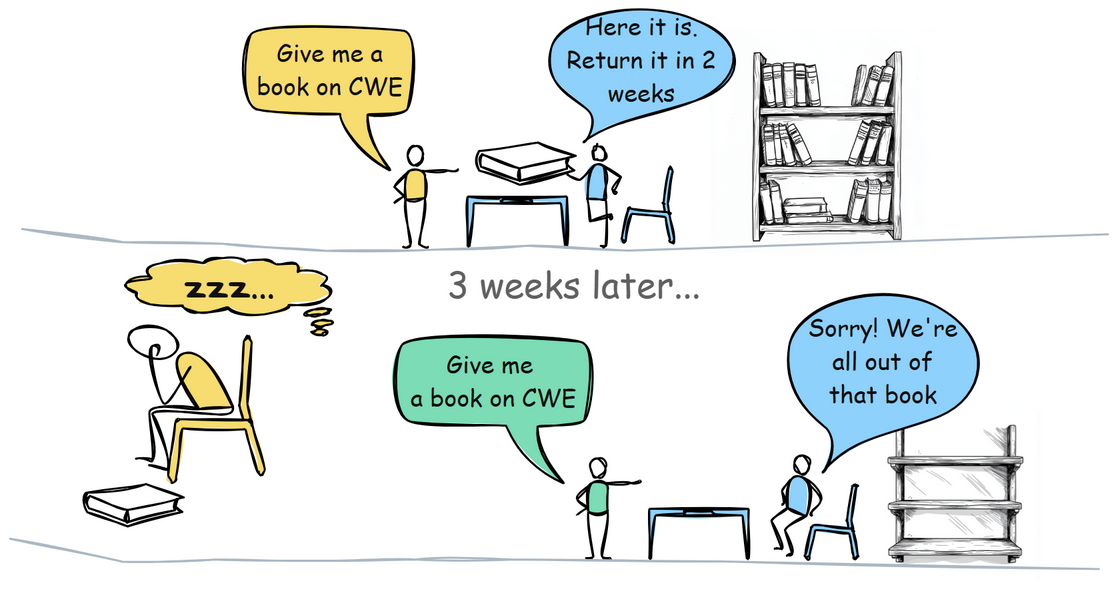
CWE-772: Missing Release of Resource after Effective Lifetime
Weakness ID: 772
Vulnerability Mapping:ALLOWEDThis CWE ID may be used to map to real-world vulnerabilities Abstraction:
BaseBase - a weakness that is still mostly independent of a resource or technology, but with sufficient details to provide specific methods for detection and prevention. Base level weaknesses typically describe issues in terms of 2 or 3 of the following dimensions: behavior, property, technology, language, and resource.
View customized information:
For users who are interested in more notional aspects of a weakness. Example: educators, technical writers, and project/program managers.For users who are concerned with the practical application and details about the nature of a weakness and how to prevent it from happening. Example: tool developers, security researchers, pen-testers, incident response analysts.For users who are mapping an issue to CWE/CAPEC IDs, i.e., finding the most appropriate CWE for a specific issue (e.g., a CVE record). Example: tool developers, security researchers.For users who wish to see all available information for the CWE/CAPEC entry.For users who want to customize what details are displayed.
×
Edit Custom Filter
Description
The product does not release a resource after its effective lifetime has ended, i.e., after the resource is no longer needed.
Common Consequences
This table specifies different individual consequences
associated with the weakness. The Scope identifies the application security area that is
violated, while the Impact describes the negative technical impact that arises if an
adversary succeeds in exploiting this weakness. The Likelihood provides information about
how likely the specific consequence is expected to be seen relative to the other
consequences in the list. For example, there may be high likelihood that a weakness will be
exploited to achieve a certain impact, but a low likelihood that it will be exploited to
achieve a different impact.
An attacker that can influence the allocation of resources that are not properly released could deplete the available resource pool and prevent all other processes from accessing the same type of resource. Frequently-affected resources include memory, CPU, disk space, power or battery, etc.
Potential Mitigations
Phase(s)
Mitigation
Requirements
Strategy: Language Selection
Use a language that does not allow this weakness to occur or provides constructs that make this weakness easier to avoid.
For example, languages such as Java, Ruby, and Lisp perform automatic garbage collection that releases memory for objects that have been deallocated.
Implementation
It is good practice to be responsible for freeing all resources you allocate and to be consistent with how and where you free resources in a function. If you allocate resources that you intend to free upon completion of the function, you must be sure to free the resources at all exit points for that function including error conditions.
Operation; Architecture and Design
Strategy: Resource Limitation
Use resource-limiting settings provided by the operating system or environment. For example, when managing system resources in POSIX, setrlimit() can be used to set limits for certain types of resources, and getrlimit() can determine how many resources are available. However, these functions are not available on all operating systems.
When the current levels get close to the maximum that is defined for the application (see CWE-770), then limit the allocation of further resources to privileged users; alternately, begin releasing resources for less-privileged users. While this mitigation may protect the system from attack, it will not necessarily stop attackers from adversely impacting other users.
Ensure that the application performs the appropriate error checks and error handling in case resources become unavailable (CWE-703).
Relationships
This table shows the weaknesses and high level categories that are related to this
weakness. These relationships are defined as ChildOf, ParentOf, MemberOf and give insight to
similar items that may exist at higher and lower levels of abstraction. In addition,
relationships such as PeerOf and CanAlsoBe are defined to show similar weaknesses that the user
may want to explore.
Relevant to the view "Research Concepts" (View-1000)
Nature
Type
ID
Name
ChildOf
Class - a weakness that is described in a very abstract fashion, typically independent of any specific language or technology. More specific than a Pillar Weakness, but more general than a Base Weakness. Class level weaknesses typically describe issues in terms of 1 or 2 of the following dimensions: behavior, property, and resource.
Variant - a weakness that is linked to a certain type of product, typically involving a specific language or technology. More specific than a Base weakness. Variant level weaknesses typically describe issues in terms of 3 to 5 of the following dimensions: behavior, property, technology, language, and resource.
Missing Release of Memory after Effective Lifetime
ParentOf
Variant - a weakness that is linked to a certain type of product, typically involving a specific language or technology. More specific than a Base weakness. Variant level weaknesses typically describe issues in terms of 3 to 5 of the following dimensions: behavior, property, technology, language, and resource.
Missing Release of File Descriptor or Handle after Effective Lifetime
ParentOf
Base - a weakness that is still mostly independent of a resource or technology, but with sufficient details to provide specific methods for detection and prevention. Base level weaknesses typically describe issues in terms of 2 or 3 of the following dimensions: behavior, property, technology, language, and resource.
Base - a weakness that is still mostly independent of a resource or technology, but with sufficient details to provide specific methods for detection and prevention. Base level weaknesses typically describe issues in terms of 2 or 3 of the following dimensions: behavior, property, technology, language, and resource.
Relevant to the view "Weaknesses for Simplified Mapping of Published Vulnerabilities" (View-1003)
Nature
Type
ID
Name
ChildOf
Class - a weakness that is described in a very abstract fashion, typically independent of any specific language or technology. More specific than a Pillar Weakness, but more general than a Base Weakness. Class level weaknesses typically describe issues in terms of 1 or 2 of the following dimensions: behavior, property, and resource.
Relevant to the view "CISQ Quality Measures (2020)" (View-1305)
Nature
Type
ID
Name
ChildOf
Class - a weakness that is described in a very abstract fashion, typically independent of any specific language or technology. More specific than a Pillar Weakness, but more general than a Base Weakness. Class level weaknesses typically describe issues in terms of 1 or 2 of the following dimensions: behavior, property, and resource.
Relevant to the view "CISQ Data Protection Measures" (View-1340)
Nature
Type
ID
Name
ChildOf
Class - a weakness that is described in a very abstract fashion, typically independent of any specific language or technology. More specific than a Pillar Weakness, but more general than a Base Weakness. Class level weaknesses typically describe issues in terms of 1 or 2 of the following dimensions: behavior, property, and resource.
The different Modes of Introduction provide information
about how and when this
weakness may be introduced. The Phase identifies a point in the life cycle at which
introduction
may occur, while the Note provides a typical scenario related to introduction during the
given
phase.
Phase
Note
Implementation
Applicable Platforms
This listing shows possible areas for which the given
weakness could appear. These
may be for specific named Languages, Operating Systems, Architectures, Paradigms,
Technologies,
or a class of such platforms. The platform is listed along with how frequently the given
weakness appears for that instance.
Technologies
Class: Mobile
(Undetermined Prevalence)
Likelihood Of Exploit
High
Demonstrative Examples
Example 1
The following method never closes the new file handle. Given enough time, the Finalize() method for BufferReader should eventually call Close(), but there is no guarantee as to how long this action will take. In fact, there is no guarantee that Finalize() will ever be invoked. In a busy environment, the Operating System could use up all of the available file handles before the Close() function is called.
(bad code)
Example Language: Java
private void processFile(string fName) {
BufferReader fil = new BufferReader(new FileReader(fName)); String line; while ((line = fil.ReadLine()) != null) {
processLine(line);
}
}
The good code example simply adds an explicit call to the Close() function when the system is done using the file. Within a simple example such as this the problem is easy to see and fix. In a real system, the problem may be considerably more obscure.
(good code)
Example Language: Java
private void processFile(string fName) {
BufferReader fil = new BufferReader(new FileReader(fName)); String line; while ((line = fil.ReadLine()) != null) {
processLine(line);
} fil.Close();
}
Example 2
The following code attempts to open a new connection to a database, process the results returned by the database, and close the allocated SqlConnection object.
(bad code)
Example Language: C#
SqlConnection conn = new SqlConnection(connString); SqlCommand cmd = new SqlCommand(queryString); cmd.Connection = conn; conn.Open(); SqlDataReader rdr = cmd.ExecuteReader(); HarvestResults(rdr); conn.Connection.Close();
The problem with the above code is that if an exception occurs while executing the SQL or processing the results, the SqlConnection object is not closed. If this happens often enough, the database will run out of available cursors and not be able to execute any more SQL queries.
Example 3
This code attempts to open a connection to a database and catches any exceptions that may occur.
(bad code)
Example Language: Java
try {
Connection con = DriverManager.getConnection(some_connection_string);
} catch ( Exception e ) {
log( e );
}
If an exception occurs after establishing the database connection and before the same connection closes, the pool of database connections may become exhausted. If the number of available connections is exceeded, other users cannot access this resource, effectively denying access to the application.
Example 4
Under normal conditions the following C# code executes a database query, processes the results returned by the database, and closes the allocated SqlConnection object. But if an exception occurs while executing the SQL or processing the results, the SqlConnection object is not closed. If this happens often enough, the database will run out of available cursors and not be able to execute any more SQL queries.
The following C function does not close the file handle it opens if an error occurs. If the process is long-lived, the process can run out of file handles.
(bad code)
Example Language: C
int decodeFile(char* fName) {
char buf[BUF_SZ]; FILE* f = fopen(fName, "r"); if (!f) {
printf("cannot open %s\n", fName); return DECODE_FAIL;
} else {
while (fgets(buf, BUF_SZ, f)) {
if (!checkChecksum(buf)) {
return DECODE_FAIL;
} else {
decodeBlock(buf);
}
}
} fclose(f); return DECODE_SUCCESS;
}
Selected Observed
Examples
Note: this is a curated list of examples for users to understand the variety of ways in which this
weakness can be introduced. It is not a complete list of all CVEs that are related to this CWE entry.
Chain: anti-virus product encounters a malformed file but returns from a function without closing a file descriptor (CWE-775) leading to file descriptor consumption (CWE-400) and failed scans.
Chain: Return values of file/socket operations are not checked (CWE-252), allowing resultant consumption of file descriptors (CWE-772).
Weakness Ordinalities
Ordinality
Description
Primary
(where the weakness exists independent of other weaknesses)
Resultant
(where the weakness is typically related to the presence of some other weaknesses)
Detection
Methods
Method
Details
Automated Static Analysis
Automated static analysis, commonly referred to as Static Application Security Testing (SAST), can find some instances of this weakness by analyzing source code (or binary/compiled code) without having to execute it. Typically, this is done by building a model of data flow and control flow, then searching for potentially-vulnerable patterns that connect "sources" (origins of input) with "sinks" (destinations where the data interacts with external components, a lower layer such as the OS, etc.)
Effectiveness: High
Memberships
This MemberOf Relationships table shows additional CWE Categories and Views that
reference this weakness as a member. This information is often useful in understanding where a
weakness fits within the context of external information sources.
Nature
Type
ID
Name
MemberOf
Category - a CWE entry that contains a set of other entries that share a common characteristic.
CERT C++ Secure Coding Section 14 - Concurrency (CON)
MemberOf
View - a subset of CWE entries that provides a way of examining CWE content. The two main view structures are Slices (flat lists) and Graphs (containing relationships between entries).
SEI CERT C Coding Standard - Guidelines 09. Input Output (FIO)
MemberOf
View - a subset of CWE entries that provides a way of examining CWE content. The two main view structures are Slices (flat lists) and Graphs (containing relationships between entries).
(this CWE ID may be used to map to real-world vulnerabilities)
Reason
Acceptable-Use
Rationale
This CWE entry is at the Base level of abstraction, which is a preferred level of abstraction for mapping to the root causes of vulnerabilities.
Comments
Carefully read both the name and description to ensure that this mapping is an appropriate fit. Do not try to 'force' a mapping to a lower-level Base/Variant simply to comply with this preferred level of abstraction.
Notes
Theoretical
Vulnerability theory is largely about how behaviors and resources interact. "Resource exhaustion" can be regarded as either a consequence or an attack, depending on the perspective. This entry is an attempt to reflect one of the underlying weaknesses that enable these attacks (or consequences) to take place.
Maintenance
"Resource exhaustion" (CWE-400) is currently treated as a weakness, although it is more like a category of weaknesses that all have the same type of consequence. While this entry treats CWE-400 as a parent in view 1000, the relationship is probably more appropriately described as a chain.
Taxonomy
Mappings
Mapped Taxonomy Name
Node ID
Fit
Mapped Node Name
CERT C Secure Coding
FIO42-C
CWE More Abstract
Close files when they are no longer needed
CERT C Secure Coding
MEM31-C
CWE More Abstract
Free dynamically allocated memory when no longer needed


 Description
 This table specifies different individual consequences
associated with the weakness. The Scope identifies the application security area that is
violated, while the Impact describes the negative technical impact that arises if an
adversary succeeds in exploiting this weakness. The Likelihood provides information about
how likely the specific consequence is expected to be seen relative to the other
consequences in the list. For example, there may be high likelihood that a weakness will be
exploited to achieve a certain impact, but a low likelihood that it will be exploited to
achieve a different impact.
This table specifies different individual consequences
associated with the weakness. The Scope identifies the application security area that is
violated, while the Impact describes the negative technical impact that arises if an
adversary succeeds in exploiting this weakness. The Likelihood provides information about
how likely the specific consequence is expected to be seen relative to the other
consequences in the list. For example, there may be high likelihood that a weakness will be
exploited to achieve a certain impact, but a low likelihood that it will be exploited to
achieve a different impact.