Vulnerability Mapping:ALLOWEDThis CWE ID may be used to map to real-world vulnerabilities Abstraction:
BaseBase - a weakness that is still mostly independent of a resource or technology, but with sufficient details to provide specific methods for detection and prevention. Base level weaknesses typically describe issues in terms of 2 or 3 of the following dimensions: behavior, property, technology, language, and resource.
View customized information:
For users who are interested in more notional aspects of a weakness. Example: educators, technical writers, and project/program managers.For users who are concerned with the practical application and details about the nature of a weakness and how to prevent it from happening. Example: tool developers, security researchers, pen-testers, incident response analysts.For users who are mapping an issue to CWE/CAPEC IDs, i.e., finding the most appropriate CWE for a specific issue (e.g., a CVE record). Example: tool developers, security researchers.For users who wish to see all available information for the CWE/CAPEC entry.For users who want to customize what details are displayed.
×
Edit Custom Filter
Description
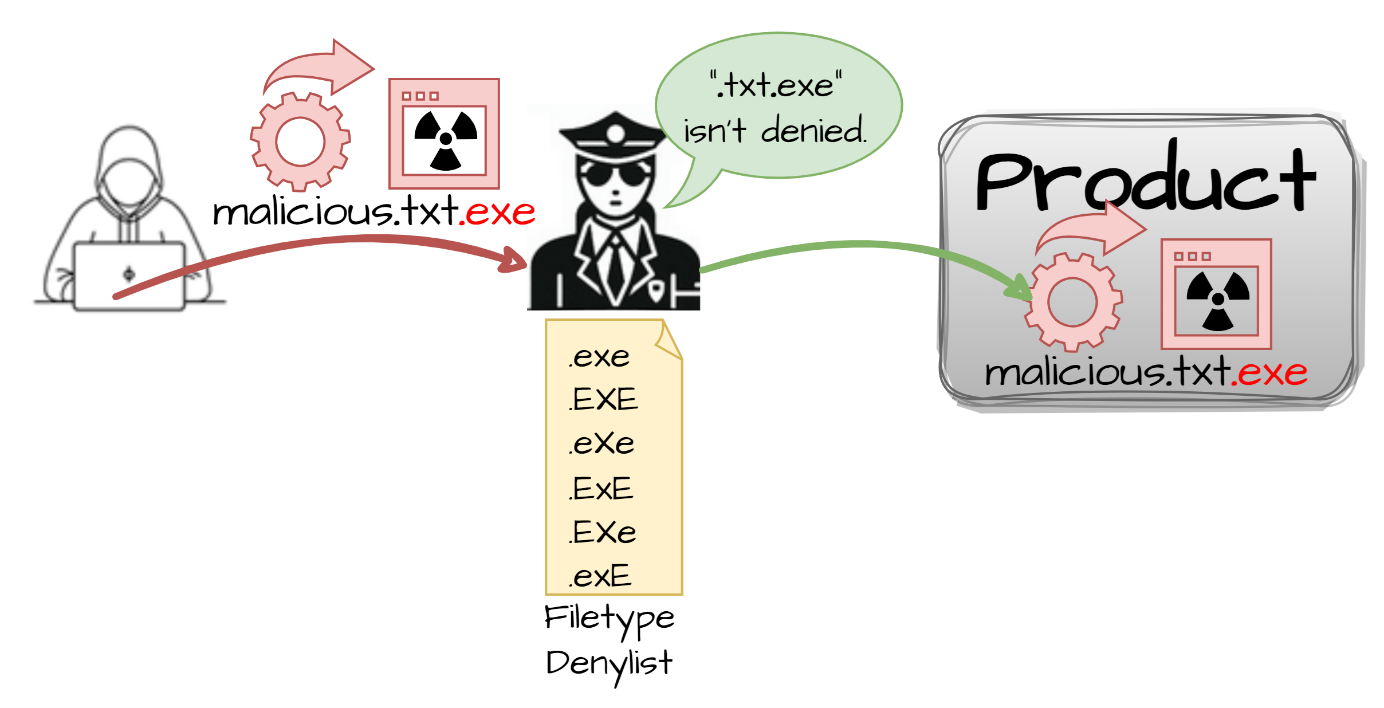
The product implements a protection mechanism that relies on a list of inputs (or properties of inputs) that are not allowed by policy or otherwise require other action to neutralize before additional processing takes place, but the list is incomplete.
Alternate Terms
Denylist / Deny List
This is used by CWE and CAPEC instead of other commonly-used terms. Its counterpart is allowlist.
Blocklist / Block List
This is often used by security tools such as firewalls, email or web gateways, proxies, etc.
Blacklist / Black List
This term is frequently used, but usage has been declining as organizations have started to adopt other terms.
Common Consequences
This table specifies different individual consequences
associated with the weakness. The Scope identifies the application security area that is
violated, while the Impact describes the negative technical impact that arises if an
adversary succeeds in exploiting this weakness. The Likelihood provides information about
how likely the specific consequence is expected to be seen relative to the other
consequences in the list. For example, there may be high likelihood that a weakness will be
exploited to achieve a certain impact, but a low likelihood that it will be exploited to
achieve a different impact.
Impact
Details
Bypass Protection Mechanism
Scope: Access Control
Attackers may be able to find other malicious inputs that were not expected by the developer, allowing them to bypass the intended protection mechanism.
Potential Mitigations
Phase(s)
Mitigation
Implementation
Strategy: Input Validation
Do not rely exclusively on detecting disallowed inputs. There are too many variants to encode a character, especially when different environments are used, so there is a high likelihood of missing some variants. Only use detection of disallowed inputs as a mechanism for detecting suspicious activity. Ensure that you are using other protection mechanisms that only identify "good" input - such as lists of allowed inputs - and ensure that you are properly encoding your outputs.
Relationships
This table shows the weaknesses and high level categories that are related to this
weakness. These relationships are defined as ChildOf, ParentOf, MemberOf and give insight to
similar items that may exist at higher and lower levels of abstraction. In addition,
relationships such as PeerOf and CanAlsoBe are defined to show similar weaknesses that the user
may want to explore.
Relevant to the view "Research Concepts" (View-1000)
Nature
Type
ID
Name
ChildOf
Pillar - a weakness that is the most abstract type of weakness and represents a theme for all class/base/variant weaknesses related to it. A Pillar is different from a Category as a Pillar is still technically a type of weakness that describes a mistake, while a Category represents a common characteristic used to group related things.
Class - a weakness that is described in a very abstract fashion, typically independent of any specific language or technology. More specific than a Pillar Weakness, but more general than a Base Weakness. Class level weaknesses typically describe issues in terms of 1 or 2 of the following dimensions: behavior, property, and resource.
Chain - a Compound Element that is a sequence of two or more separate weaknesses that can be closely linked together within software. One weakness, X, can directly create the conditions that are necessary to cause another weakness, Y, to enter a vulnerable condition. When this happens, CWE refers to X as "primary" to Y, and Y is "resultant" from X. Chains can involve more than two weaknesses, and in some cases, they might have a tree-like structure.
Variant - a weakness that is linked to a certain type of product, typically involving a specific language or technology. More specific than a Base weakness. Variant level weaknesses typically describe issues in terms of 3 to 5 of the following dimensions: behavior, property, technology, language, and resource.
Improper Neutralization of Invalid Characters in Identifiers in Web Pages
PeerOf
Base - a weakness that is still mostly independent of a resource or technology, but with sufficient details to provide specific methods for detection and prevention. Base level weaknesses typically describe issues in terms of 2 or 3 of the following dimensions: behavior, property, technology, language, and resource.
Base - a weakness that is still mostly independent of a resource or technology, but with sufficient details to provide specific methods for detection and prevention. Base level weaknesses typically describe issues in terms of 2 or 3 of the following dimensions: behavior, property, technology, language, and resource.
Improper Neutralization of Special Elements used in an OS Command ('OS Command Injection')
CanPrecede
Base - a weakness that is still mostly independent of a resource or technology, but with sufficient details to provide specific methods for detection and prevention. Base level weaknesses typically describe issues in terms of 2 or 3 of the following dimensions: behavior, property, technology, language, and resource.
Improper Neutralization of Input During Web Page Generation ('Cross-site Scripting')
CanPrecede
Variant - a weakness that is linked to a certain type of product, typically involving a specific language or technology. More specific than a Base weakness. Variant level weaknesses typically describe issues in terms of 3 to 5 of the following dimensions: behavior, property, technology, language, and resource.
Improper Control of Filename for Include/Require Statement in PHP Program ('PHP Remote File Inclusion')
CanPrecede
Base - a weakness that is still mostly independent of a resource or technology, but with sufficient details to provide specific methods for detection and prevention. Base level weaknesses typically describe issues in terms of 2 or 3 of the following dimensions: behavior, property, technology, language, and resource.
The different Modes of Introduction provide information
about how and when this
weakness may be introduced. The Phase identifies a point in the life cycle at which
introduction
may occur, while the Note provides a typical scenario related to introduction during the
given
phase.
Phase
Note
Implementation
Developers often try to protect their products against malicious input by checking against lists of known bad inputs, such as special characters that can invoke new commands. However, such lists often only address the most well-known bad inputs. As a quick fix, developers might rely on these lists instead of addressing the root cause of the issue. See [REF-141].
Architecture and Design
The design might rely solely on detection of malicious inputs as a protection mechanism.
Applicable Platforms
This listing shows possible areas for which the given
weakness could appear. These
may be for specific named Languages, Operating Systems, Architectures, Paradigms,
Technologies,
or a class of such platforms. The platform is listed along with how frequently the given
weakness appears for that instance.
Languages
Class: Not Language-Specific
(Undetermined Prevalence)
Technologies
Class: Not Technology-Specific
(Undetermined Prevalence)
Demonstrative Examples
Example 1
The following code attempts to stop XSS attacks by removing all occurences of "script" in an input string.
(bad code)
Example Language: Java
public String removeScriptTags(String input, String mask) {
return input.replaceAll("script", mask);
}
Because the code only checks for the lower-case "script" string, it can be easily defeated with upper-case script tags.
Example 2
This example takes user input, passes it through an encoding scheme, then lists the contents of the user's home directory based on the user name.
The programmer attempts to encode dangerous characters, however the denylist for encoding is incomplete (CWE-184) and an attacker can still pass a semicolon, resulting in a chain with OS command injection (CWE-78).
Additionally, the encoding routine is used inappropriately with command execution. An attacker doesn't even need to insert their own semicolon. The attacker can instead leverage the encoding routine to provide the semicolon to separate the commands. If an attacker supplies a string of the form:
(attack code)
' pwd
then the program will encode the apostrophe and insert the semicolon, which functions as a command separator when passed to the system function. This allows the attacker to complete the command injection.
Selected Observed
Examples
Note: this is a curated list of examples for users to understand the variety of ways in which this
weakness can be introduced. It is not a complete list of all CVEs that are related to this CWE entry.
Chain: AI agent platform does not restrict pathnames containing internal "/./" sequences (CWE-55), leading to an incomplete denylist (CWE-184) that does not prevent OS command injection (CWE-78)
Chain: API for text generation using Large Language Models (LLMs) does
not include the "\" Windows folder separator in its denylist (CWE-184)
when attempting to prevent Local File Inclusion via path traversal
(CWE-22), allowing deletion of arbitrary files on Windows systems.
Detection of risky filename extensions prevents users from automatically executing .EXE files, but .LNK is accepted, allowing resultant Windows symbolic link.
"\" not in list of disallowed values for web server, allowing path traversal attacks when the server is run on Windows and other OSes.
Weakness Ordinalities
Ordinality
Description
Primary
(where the weakness exists independent of other weaknesses)
Detection
Methods
Method
Details
Black Box
Exploitation of a vulnerability with commonly-used manipulations might fail, but minor variations might succeed.
Memberships
This MemberOf Relationships table shows additional CWE Categories and Views that
reference this weakness as a member. This information is often useful in understanding where a
weakness fits within the context of external information sources.
Nature
Type
ID
Name
MemberOf
Category - a CWE entry that contains a set of other entries that share a common characteristic.
(this CWE ID may be used to map to real-world vulnerabilities)
Reason
Acceptable-Use
Rationale
This CWE entry is at the Base level of abstraction, which is a preferred level of abstraction for mapping to the root causes of vulnerabilities.
Comments
Carefully read both the name and description to ensure that this mapping is an appropriate fit. Do not try to 'force' a mapping to a lower-level Base/Variant simply to comply with this preferred level of abstraction.
Notes
Relationship
Multiple interpretation errors can indirectly introduce inputs that should be disallowed. For example, a list of dangerous shell metacharacters might not include a metacharacter that only has meaning in one particular shell, not all of them; or a check for XSS manipulations might ignore an unusual construct that is supported by one web browser, but not others.
Mark Dowd, John McDonald and Justin Schuh. "The Art of Software Security Assessment". Chapter 8, "Eliminating Metacharacters", Page 435. 1st Edition. Addison Wesley. 2006.


 Description
 This table specifies different individual consequences
associated with the weakness. The Scope identifies the application security area that is
violated, while the Impact describes the negative technical impact that arises if an
adversary succeeds in exploiting this weakness. The Likelihood provides information about
how likely the specific consequence is expected to be seen relative to the other
consequences in the list. For example, there may be high likelihood that a weakness will be
exploited to achieve a certain impact, but a low likelihood that it will be exploited to
achieve a different impact.
This table specifies different individual consequences
associated with the weakness. The Scope identifies the application security area that is
violated, while the Impact describes the negative technical impact that arises if an
adversary succeeds in exploiting this weakness. The Likelihood provides information about
how likely the specific consequence is expected to be seen relative to the other
consequences in the list. For example, there may be high likelihood that a weakness will be
exploited to achieve a certain impact, but a low likelihood that it will be exploited to
achieve a different impact.