Weakness ID: 352
(Structure: Composite)
Composite - a Compound Element that consists of two or more distinct weaknesses, in which all weaknesses must be present at the same time in order for a potential vulnerability to arise. Removing any of the weaknesses eliminates or sharply reduces the risk. One weakness, X, can be "broken down" into component weaknesses Y and Z. There can be cases in which one weakness might not be essential to a composite, but changes the nature of the composite when it becomes a vulnerability.
Vulnerability Mapping:ALLOWEDThis CWE ID may be used to map to real-world vulnerabilities
View customized information:
For users who are interested in more notional aspects of a weakness. Example: educators, technical writers, and project/program managers.For users who are concerned with the practical application and details about the nature of a weakness and how to prevent it from happening. Example: tool developers, security researchers, pen-testers, incident response analysts.For users who are mapping an issue to CWE/CAPEC IDs, i.e., finding the most appropriate CWE for a specific issue (e.g., a CVE record). Example: tool developers, security researchers.For users who wish to see all available information for the CWE/CAPEC entry.For users who want to customize what details are displayed.
×
Edit Custom Filter
Description
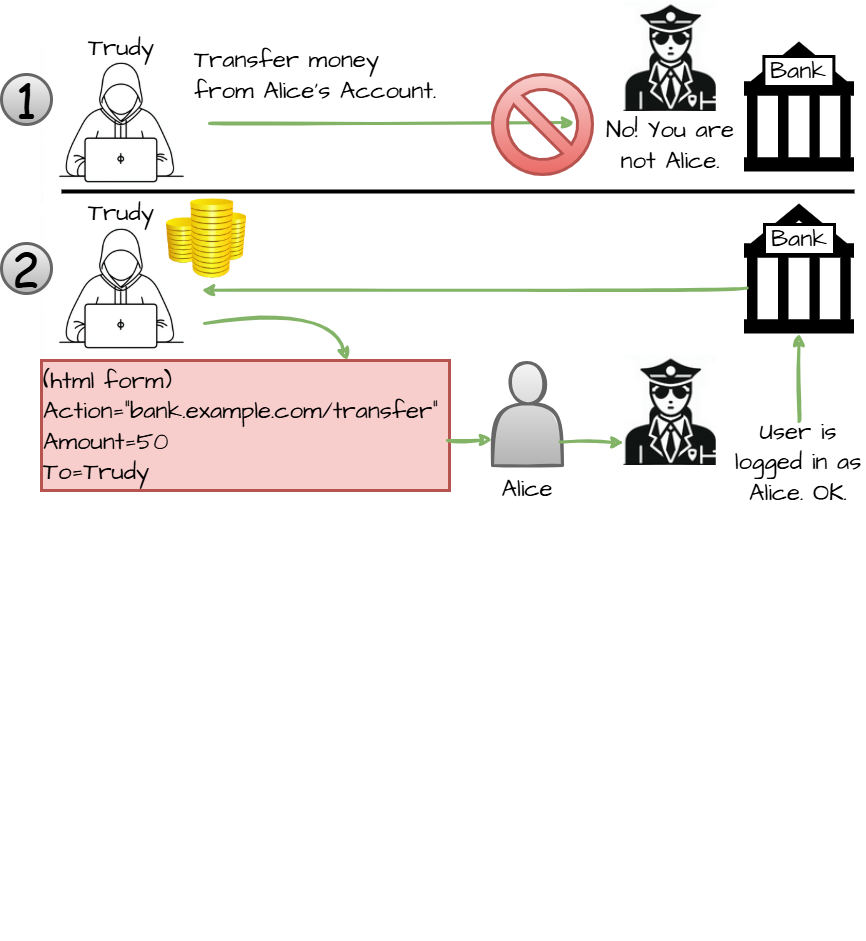
The web application does not, or cannot, sufficiently verify whether a request was intentionally provided by the user who sent the request, which could have originated from an unauthorized actor.
Alternate Terms
Session Riding
Cross Site Reference Forgery
XSRF
CSRF
Common Consequences
This table specifies different individual consequences
associated with the weakness. The Scope identifies the application security area that is
violated, while the Impact describes the negative technical impact that arises if an
adversary succeeds in exploiting this weakness. The Likelihood provides information about
how likely the specific consequence is expected to be seen relative to the other
consequences in the list. For example, there may be high likelihood that a weakness will be
exploited to achieve a certain impact, but a low likelihood that it will be exploited to
achieve a different impact.
Impact
Details
Gain Privileges or Assume Identity; Bypass Protection Mechanism; Read Application Data; Modify Application Data; DoS: Crash, Exit, or Restart
Scope: Confidentiality, Integrity, Availability, Non-Repudiation, Access Control
The consequences will vary depending on the nature of the functionality that is vulnerable to CSRF. An attacker could trick a client into making an unintentional request to the web server via a URL, image load, XMLHttpRequest, etc., which would then be treated as an authentic request from the client - effectively performing any operations as the victim, leading to an exposure of data, unintended code execution, etc. If the victim is an administrator or privileged user, the consequences may include obtaining complete control over the web application - deleting or stealing data, uninstalling the product, or using it to launch other attacks against all of the product's users. Because the attacker has the identity of the victim, the scope of CSRF is limited only by the victim's privileges.
Potential Mitigations
Phase(s)
Mitigation
Architecture and Design
Strategy: Libraries or Frameworks
Use a vetted library or framework that does not allow this weakness to occur or provides constructs that make this weakness easier to avoid [REF-1482].
For example, use anti-CSRF packages such as the OWASP CSRFGuard. [REF-330]
Another example is the ESAPI Session Management control, which includes a component for CSRF. [REF-45]
Implementation
Ensure that the application is free of cross-site scripting issues (CWE-79), because most CSRF defenses can be bypassed using attacker-controlled script.
Architecture and Design
Generate a unique nonce for each form, place the nonce into the form, and verify the nonce upon receipt of the form. Be sure that the nonce is not predictable (CWE-330). [REF-332]
Note: Note that this can be bypassed using XSS (CWE-79).
Architecture and Design
Identify especially dangerous operations. When the user performs a dangerous operation, send a separate confirmation request to ensure that the user intended to perform that operation.
Note: Note that this can be bypassed using XSS (CWE-79).
Architecture and Design
Use the "double-submitted cookie" method as described by Felten and Zeller:
When a user visits a site, the site should generate a pseudorandom value and set it as a cookie on the user's machine. The site should require every form submission to include this value as a form value and also as a cookie value. When a POST request is sent to the site, the request should only be considered valid if the form value and the cookie value are the same.
Because of the same-origin policy, an attacker cannot read or modify the value stored in the cookie. To successfully submit a form on behalf of the user, the attacker would have to correctly guess the pseudorandom value. If the pseudorandom value is cryptographically strong, this will be prohibitively difficult.
This technique requires Javascript, so it may not work for browsers that have Javascript disabled. [REF-331]
Note: Note that this can probably be bypassed using XSS (CWE-79), or when using web technologies that enable the attacker to read raw headers from HTTP requests.
Architecture and Design
Do not use the GET method for any request that triggers a state change.
Implementation
Check the HTTP Referer header to see if the request originated from an expected page. This could break legitimate functionality, because users or proxies may have disabled sending the Referer for privacy reasons.
Note: Note that this can be bypassed using XSS (CWE-79). An attacker could use XSS to generate a spoofed Referer, or to generate a malicious request from a page whose Referer would be allowed.
Composite Components
Nature
Type
ID
Name
Requires
Class - a weakness that is described in a very abstract fashion, typically independent of any specific language or technology. More specific than a Pillar Weakness, but more general than a Base Weakness. Class level weaknesses typically describe issues in terms of 1 or 2 of the following dimensions: behavior, property, and resource.
Class - a weakness that is described in a very abstract fashion, typically independent of any specific language or technology. More specific than a Pillar Weakness, but more general than a Base Weakness. Class level weaknesses typically describe issues in terms of 1 or 2 of the following dimensions: behavior, property, and resource.
Base - a weakness that is still mostly independent of a resource or technology, but with sufficient details to provide specific methods for detection and prevention. Base level weaknesses typically describe issues in terms of 2 or 3 of the following dimensions: behavior, property, technology, language, and resource.
Class - a weakness that is described in a very abstract fashion, typically independent of any specific language or technology. More specific than a Pillar Weakness, but more general than a Base Weakness. Class level weaknesses typically describe issues in terms of 1 or 2 of the following dimensions: behavior, property, and resource.
This table shows the weaknesses and high level categories that are related to this
weakness. These relationships are defined as ChildOf, ParentOf, MemberOf and give insight to
similar items that may exist at higher and lower levels of abstraction. In addition,
relationships such as PeerOf and CanAlsoBe are defined to show similar weaknesses that the user
may want to explore.
Relevant to the view "Research Concepts" (View-1000)
Nature
Type
ID
Name
ChildOf
Class - a weakness that is described in a very abstract fashion, typically independent of any specific language or technology. More specific than a Pillar Weakness, but more general than a Base Weakness. Class level weaknesses typically describe issues in terms of 1 or 2 of the following dimensions: behavior, property, and resource.
Base - a weakness that is still mostly independent of a resource or technology, but with sufficient details to provide specific methods for detection and prevention. Base level weaknesses typically describe issues in terms of 2 or 3 of the following dimensions: behavior, property, technology, language, and resource.
Improper Neutralization of Input During Web Page Generation ('Cross-site Scripting')
CanFollow
Variant - a weakness that is linked to a certain type of product, typically involving a specific language or technology. More specific than a Base weakness. Variant level weaknesses typically describe issues in terms of 3 to 5 of the following dimensions: behavior, property, technology, language, and resource.
Relevant to the view "Weaknesses for Simplified Mapping of Published Vulnerabilities" (View-1003)
Nature
Type
ID
Name
ChildOf
Class - a weakness that is described in a very abstract fashion, typically independent of any specific language or technology. More specific than a Pillar Weakness, but more general than a Base Weakness. Class level weaknesses typically describe issues in terms of 1 or 2 of the following dimensions: behavior, property, and resource.
The different Modes of Introduction provide information
about how and when this
weakness may be introduced. The Phase identifies a point in the life cycle at which
introduction
may occur, while the Note provides a typical scenario related to introduction during the
given
phase.
Phase
Note
Architecture and Design
REALIZATION: This weakness is caused during implementation of an architectural security tactic.
Applicable Platforms
This listing shows possible areas for which the given
weakness could appear. These
may be for specific named Languages, Operating Systems, Architectures, Paradigms,
Technologies,
or a class of such platforms. The platform is listed along with how frequently the given
weakness appears for that instance.
Languages
Class: Not Language-Specific
(Undetermined Prevalence)
Technologies
Class: Web Based
(Undetermined Prevalence)
Web Server
(Undetermined Prevalence)
Likelihood Of Exploit
Medium
Demonstrative Examples
Example 1
This example PHP code attempts to secure the form submission process by validating that the user submitting the form has a valid session. A CSRF attack would not be prevented by this countermeasure because the attacker forges a request through the user's web browser in which a valid session already exists.
The following HTML is intended to allow a user to update a profile.
// initiate the session in order to validate sessions
session_start();
//if the session is registered to a valid user then allow update
if (! session_is_registered("username")) {
echo "invalid session detected!";
// Redirect user to login page [...]
exit;
}
// The user session is valid, so process the request
// and update the information
update_profile();
function update_profile {
// read in the data from $POST and send an update
// to the database SendUpdateToDatabase($_SESSION['username'], $_POST['email']); [...] echo "Your profile has been successfully updated.";
}
This code may look protected since it checks for a valid session. However, CSRF attacks can be staged from virtually any tag or HTML construct, including image tags, links, embed or object tags, or other attributes that load background images.
The attacker can then host code that will silently change the username and email address of any user that visits the page while remaining logged in to the target web application. The code might be an innocent-looking web page such as:
(attack code)
Example Language: HTML
<SCRIPT> function SendAttack () {
form.email = "attacker@example.com"; // send to profile.php form.submit();
Notice how the form contains hidden fields, so when it is loaded into the browser, the user will not notice it. Because SendAttack() is defined in the body's onload attribute, it will be automatically called when the victim loads the web page.
Assuming that the user is already logged in to victim.example.com, profile.php will see that a valid user session has been established, then update the email address to the attacker's own address. At this stage, the user's identity has been compromised, and messages sent through this profile could be sent to the attacker's address.
Selected Observed
Examples
Note: this is a curated list of examples for users to understand the variety of ways in which this
weakness can be introduced. It is not a complete list of all CVEs that are related to this CWE entry.
web interface allows password changes or stopping a virtual machine via CSRF
Weakness Ordinalities
Ordinality
Description
Primary
(where the weakness exists independent of other weaknesses)
Resultant
(where the weakness is typically related to the presence of some other weaknesses)
Detection
Methods
Method
Details
Manual Analysis
This weakness can be detected using tools and techniques that require manual (human) analysis, such as penetration testing, threat modeling, and interactive tools that allow the tester to record and modify an active session.
Specifically, manual analysis can be useful for finding this weakness, and for minimizing false positives assuming an understanding of business logic. However, it might not achieve desired code coverage within limited time constraints. For black-box analysis, if credentials are not known for privileged accounts, then the most security-critical portions of the application may not receive sufficient attention.
Consider using OWASP CSRFTester to identify potential issues and aid in manual analysis.
Effectiveness: High
Note:These may be more effective than strictly automated techniques. This is especially the case with weaknesses that are related to design and business rules.
Automated Static Analysis
CSRF is currently difficult to detect reliably using automated techniques. This is because each application has its own implicit security policy that dictates which requests can be influenced by an outsider and automatically performed on behalf of a user, versus which requests require strong confidence that the user intends to make the request. For example, a keyword search of the public portion of a web site is typically expected to be encoded within a link that can be launched automatically when the user clicks on the link.
Effectiveness: Limited
Automated Static Analysis - Binary or Bytecode
According to SOAR [REF-1479], the following detection techniques may be useful:
This MemberOf Relationships table shows additional CWE Categories and Views that
reference this weakness as a member. This information is often useful in understanding where a
weakness fits within the context of external information sources.
Nature
Type
ID
Name
MemberOf
View - a subset of CWE entries that provides a way of examining CWE content. The two main view structures are Slices (flat lists) and Graphs (containing relationships between entries).
2011 Top 25 - Insecure Interaction Between Components
MemberOf
View - a subset of CWE entries that provides a way of examining CWE content. The two main view structures are Slices (flat lists) and Graphs (containing relationships between entries).
OWASP Top Ten 2013 Category A8 - Cross-Site Request Forgery (CSRF)
MemberOf
View - a subset of CWE entries that provides a way of examining CWE content. The two main view structures are Slices (flat lists) and Graphs (containing relationships between entries).
Weaknesses in the 2019 CWE Top 25 Most Dangerous Software Errors
MemberOf
View - a subset of CWE entries that provides a way of examining CWE content. The two main view structures are Slices (flat lists) and Graphs (containing relationships between entries).
OWASP Top Ten 2021 Category A01:2021 - Broken Access Control
MemberOf
View - a subset of CWE entries that provides a way of examining CWE content. The two main view structures are Slices (flat lists) and Graphs (containing relationships between entries).
Weaknesses in the 2020 CWE Top 25 Most Dangerous Software Weaknesses
MemberOf
View - a subset of CWE entries that provides a way of examining CWE content. The two main view structures are Slices (flat lists) and Graphs (containing relationships between entries).
Comprehensive Categorization: Insufficient Verification of Data Authenticity
MemberOf
View - a subset of CWE entries that provides a way of examining CWE content. The two main view structures are Slices (flat lists) and Graphs (containing relationships between entries).
Weaknesses in the 2023 CWE Top 25 Most Dangerous Software Weaknesses
MemberOf
View - a subset of CWE entries that provides a way of examining CWE content. The two main view structures are Slices (flat lists) and Graphs (containing relationships between entries).
Weaknesses in the 2024 CWE Top 25 Most Dangerous Software Weaknesses
MemberOf
View - a subset of CWE entries that provides a way of examining CWE content. The two main view structures are Slices (flat lists) and Graphs (containing relationships between entries).
OWASP Top Ten 2025 Category A01:2025 - Broken Access Control
Vulnerability Mapping Notes
Usage
ALLOWED
(this CWE ID may be used to map to real-world vulnerabilities)
Reason
Other
Rationale
This is a well-known Composite of multiple weaknesses that must all occur simultaneously, although it is attack-oriented in nature.
Comments
While attack-oriented composites are supported in CWE, they have not been a focus of research. There is a chance that future research or CWE scope clarifications will change or deprecate them. Perform root-cause analysis to determine if other weaknesses allow CSRF attacks to occur, and map to those weaknesses. For example, predictable CSRF tokens might allow bypass of CSRF protection mechanisms; if this occurs, they might be better characterized as randomness/predictability weaknesses.
Notes
Relationship
There can be a close relationship between XSS and CSRF (CWE-352). An attacker might use CSRF in order to trick the victim into submitting requests to the server in which the requests contain an XSS payload. A well-known example of this was the Samy worm on MySpace [REF-956]. The worm used XSS to insert malicious HTML sequences into a user's profile and add the attacker as a MySpace friend. MySpace friends of that victim would then execute the payload to modify their own profiles, causing the worm to propagate exponentially. Since the victims did not intentionally insert the malicious script themselves, CSRF was a root cause.
Theoretical
The CSRF topology is multi-channel:
Attacker (as outsider) to intermediary (as user). The interaction point is either an external or internal channel.
Intermediary (as user) to server (as victim). The activation point is an internal channel.
Michael Howard, David LeBlanc and John Viega. "24 Deadly Sins of Software Security". "Sin 2: Web-Server Related Vulnerabilities (XSS, XSRF, and
Response Splitting)." Page 37. McGraw-Hill. 2010.


 Description
 This table specifies different individual consequences
associated with the weakness. The Scope identifies the application security area that is
violated, while the Impact describes the negative technical impact that arises if an
adversary succeeds in exploiting this weakness. The Likelihood provides information about
how likely the specific consequence is expected to be seen relative to the other
consequences in the list. For example, there may be high likelihood that a weakness will be
exploited to achieve a certain impact, but a low likelihood that it will be exploited to
achieve a different impact.
This table specifies different individual consequences
associated with the weakness. The Scope identifies the application security area that is
violated, while the Impact describes the negative technical impact that arises if an
adversary succeeds in exploiting this weakness. The Likelihood provides information about
how likely the specific consequence is expected to be seen relative to the other
consequences in the list. For example, there may be high likelihood that a weakness will be
exploited to achieve a certain impact, but a low likelihood that it will be exploited to
achieve a different impact.