Vulnerability Mapping:ALLOWEDThis CWE ID may be used to map to real-world vulnerabilities Abstraction:
VariantVariant - a weakness that is linked to a certain type of product, typically involving a specific language or technology. More specific than a Base weakness. Variant level weaknesses typically describe issues in terms of 3 to 5 of the following dimensions: behavior, property, technology, language, and resource.
View customized information:
For users who are interested in more notional aspects of a weakness. Example: educators, technical writers, and project/program managers.For users who are concerned with the practical application and details about the nature of a weakness and how to prevent it from happening. Example: tool developers, security researchers, pen-testers, incident response analysts.For users who are mapping an issue to CWE/CAPEC IDs, i.e., finding the most appropriate CWE for a specific issue (e.g., a CVE record). Example: tool developers, security researchers.For users who wish to see all available information for the CWE/CAPEC entry.For users who want to customize what details are displayed.
×
Edit Custom Filter
Description
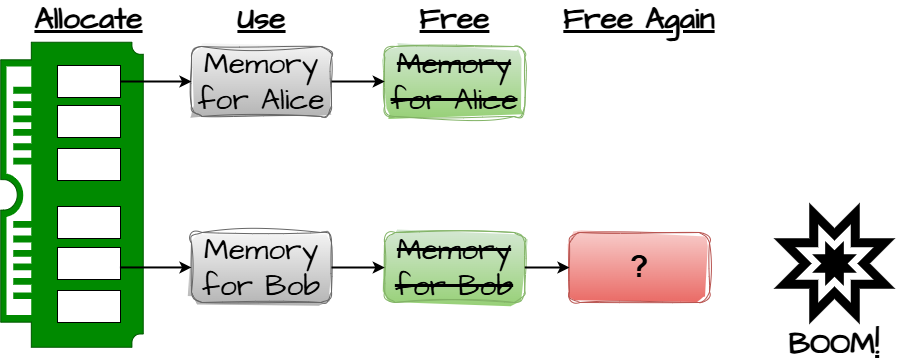
The product calls free() twice on the same memory address.
Alternate Terms
Double-free
Common Consequences
This table specifies different individual consequences
associated with the weakness. The Scope identifies the application security area that is
violated, while the Impact describes the negative technical impact that arises if an
adversary succeeds in exploiting this weakness. The Likelihood provides information about
how likely the specific consequence is expected to be seen relative to the other
consequences in the list. For example, there may be high likelihood that a weakness will be
exploited to achieve a certain impact, but a low likelihood that it will be exploited to
achieve a different impact.
Impact
Details
Modify Memory; Execute Unauthorized Code or Commands
Scope: Integrity, Confidentiality, Availability
When a program calls free() twice with the same argument, the program's memory management data structures may become corrupted, potentially leading to the reading or modification of unexpected memory addresses. This corruption can cause the program to crash or, in some circumstances, cause two later calls to malloc() to return the same pointer. If malloc() returns the same value twice and the program later gives the attacker control over the data that is written into this doubly-allocated memory, the program becomes vulnerable to a buffer overflow attack.
Doubly freeing memory may result in a write-what-where condition, allowing an attacker to execute arbitrary code.
Potential Mitigations
Phase(s)
Mitigation
Architecture and Design
Choose a language that provides automatic memory management.
Implementation
Ensure that each allocation is freed only once. After freeing a chunk, set the pointer to NULL to ensure the pointer cannot be freed again. In complicated error conditions, be sure that clean-up routines respect the state of allocation properly. If the language is object oriented, ensure that object destructors delete each chunk of memory only once.
Implementation
Use a static analysis tool to find double free instances.
Relationships
This table shows the weaknesses and high level categories that are related to this
weakness. These relationships are defined as ChildOf, ParentOf, MemberOf and give insight to
similar items that may exist at higher and lower levels of abstraction. In addition,
relationships such as PeerOf and CanAlsoBe are defined to show similar weaknesses that the user
may want to explore.
Relevant to the view "Research Concepts" (View-1000)
Nature
Type
ID
Name
ChildOf
Class - a weakness that is described in a very abstract fashion, typically independent of any specific language or technology. More specific than a Pillar Weakness, but more general than a Base Weakness. Class level weaknesses typically describe issues in terms of 1 or 2 of the following dimensions: behavior, property, and resource.
Base - a weakness that is still mostly independent of a resource or technology, but with sufficient details to provide specific methods for detection and prevention. Base level weaknesses typically describe issues in terms of 2 or 3 of the following dimensions: behavior, property, technology, language, and resource.
Base - a weakness that is still mostly independent of a resource or technology, but with sufficient details to provide specific methods for detection and prevention. Base level weaknesses typically describe issues in terms of 2 or 3 of the following dimensions: behavior, property, technology, language, and resource.
Base - a weakness that is still mostly independent of a resource or technology, but with sufficient details to provide specific methods for detection and prevention. Base level weaknesses typically describe issues in terms of 2 or 3 of the following dimensions: behavior, property, technology, language, and resource.
Variant - a weakness that is linked to a certain type of product, typically involving a specific language or technology. More specific than a Base weakness. Variant level weaknesses typically describe issues in terms of 3 to 5 of the following dimensions: behavior, property, technology, language, and resource.
Base - a weakness that is still mostly independent of a resource or technology, but with sufficient details to provide specific methods for detection and prevention. Base level weaknesses typically describe issues in terms of 2 or 3 of the following dimensions: behavior, property, technology, language, and resource.
Relevant to the view "Weaknesses for Simplified Mapping of Published Vulnerabilities" (View-1003)
Nature
Type
ID
Name
ChildOf
Class - a weakness that is described in a very abstract fashion, typically independent of any specific language or technology. More specific than a Pillar Weakness, but more general than a Base Weakness. Class level weaknesses typically describe issues in terms of 1 or 2 of the following dimensions: behavior, property, and resource.
Operation on a Resource after Expiration or Release
Relevant to the view "CISQ Quality Measures (2020)" (View-1305)
Nature
Type
ID
Name
ChildOf
Class - a weakness that is described in a very abstract fashion, typically independent of any specific language or technology. More specific than a Pillar Weakness, but more general than a Base Weakness. Class level weaknesses typically describe issues in terms of 1 or 2 of the following dimensions: behavior, property, and resource.
Operation on a Resource after Expiration or Release
Relevant to the view "CISQ Data Protection Measures" (View-1340)
Nature
Type
ID
Name
ChildOf
Class - a weakness that is described in a very abstract fashion, typically independent of any specific language or technology. More specific than a Pillar Weakness, but more general than a Base Weakness. Class level weaknesses typically describe issues in terms of 1 or 2 of the following dimensions: behavior, property, and resource.
Operation on a Resource after Expiration or Release
Modes
Of Introduction
The different Modes of Introduction provide information
about how and when this
weakness may be introduced. The Phase identifies a point in the life cycle at which
introduction
may occur, while the Note provides a typical scenario related to introduction during the
given
phase.
Phase
Note
Implementation
Applicable Platforms
This listing shows possible areas for which the given
weakness could appear. These
may be for specific named Languages, Operating Systems, Architectures, Paradigms,
Technologies,
or a class of such platforms. The platform is listed along with how frequently the given
weakness appears for that instance.
Languages
Class: Memory-Unsafe
(Often Prevalent)
C
(Undetermined Prevalence)
C++
(Undetermined Prevalence)
Likelihood Of Exploit
High
Demonstrative Examples
Example 1
The following code shows a simple example of a double free vulnerability.
(bad code)
Example Language: C
char* ptr = (char*)malloc (SIZE);
...
if (abrt) {
free(ptr);
}
...
free(ptr);
Double free vulnerabilities have two common (and sometimes overlapping) causes:
Error conditions and other exceptional circumstances
Confusion over which part of the program is responsible for freeing the memory
Although some double free vulnerabilities are not much more complicated than this example, most are spread out across hundreds of lines of code or even different files. Programmers seem particularly susceptible to freeing global variables more than once.
Example 2
While contrived, this code should be exploitable on Linux distributions that do not ship with heap-chunk check summing turned on.
Note: this is a curated list of examples for users to understand the variety of ways in which this
weakness can be introduced. It is not a complete list of all CVEs that are related to this CWE entry.
(where the weakness is typically related to the presence of some other weaknesses)
Detection
Methods
Method
Details
Fuzzing
Fuzz testing (fuzzing) is a powerful technique for generating large numbers of diverse inputs - either randomly or algorithmically - and dynamically invoking the code with those inputs. Even with random inputs, it is often capable of generating unexpected results such as crashes, memory corruption, or resource consumption. Fuzzing effectively produces repeatable test cases that clearly indicate bugs, which helps developers to diagnose the issues.
Effectiveness: High
Automated Static Analysis
Automated static analysis, commonly referred to as Static Application Security Testing (SAST), can find some instances of this weakness by analyzing source code (or binary/compiled code) without having to execute it. Typically, this is done by building a model of data flow and control flow, then searching for potentially-vulnerable patterns that connect "sources" (origins of input) with "sinks" (destinations where the data interacts with external components, a lower layer such as the OS, etc.)
Effectiveness: High
Automated Dynamic Analysis
Use tools that are integrated during
compilation to insert runtime error-checking mechanisms
related to memory safety errors, such as AddressSanitizer
(ASan) for C/C++ [REF-1518].
Effectiveness: Moderate
Note:Crafted inputs are necessary to
reach the code containing the error, such as generated
by fuzzers. Also, these tools may reduce performance,
and they only report the error condition - not the
original mistake that led to the
error.
Functional Areas
Memory Management
Affected Resources
Memory
Memberships
This MemberOf Relationships table shows additional CWE Categories and Views that
reference this weakness as a member. This information is often useful in understanding where a
weakness fits within the context of external information sources.
Nature
Type
ID
Name
MemberOf
Category - a CWE entry that contains a set of other entries that share a common characteristic.
(this CWE ID may be used to map to real-world vulnerabilities)
Reason
Acceptable-Use
Rationale
This CWE entry is at the Variant level of abstraction, which is a preferred level of abstraction for mapping to the root causes of vulnerabilities.
Comments
Carefully read both the name and description to ensure that this mapping is an appropriate fit. Do not try to 'force' a mapping to a lower-level Base/Variant simply to comply with this preferred level of abstraction.
Notes
Relationship
This is usually resultant from another weakness, such as an unhandled error or race condition between threads. It could also be primary to weaknesses such as buffer overflows.
Theoretical
It could be argued that Double Free would be most appropriately located as a child of "Use after Free", but "Use" and "Release" are considered to be distinct operations within vulnerability theory, therefore this is more accurately "Release of a Resource after Expiration or Release", which doesn't exist yet.
Taxonomy
Mappings
Mapped Taxonomy Name
Node ID
Fit
Mapped Node Name
PLOVER
DFREE - Double-Free Vulnerability
7 Pernicious Kingdoms
Double Free
CLASP
Doubly freeing memory
CERT C Secure Coding
MEM00-C
Allocate and free memory in the same module, at the same level of abstraction
CERT C Secure Coding
MEM01-C
Store a new value in pointers immediately after free()
CERT C Secure Coding
MEM30-C
CWE More Specific
Do not access freed memory
CERT C Secure Coding
MEM31-C
Free dynamically allocated memory exactly once
Software Fault Patterns
SFP12
Faulty Memory Release
References
[REF-44]
Michael Howard, David LeBlanc and John Viega. "24 Deadly Sins of Software Security". "Sin 8: C++ Catastrophes." Page 143. McGraw-Hill. 2010.
[REF-62]
Mark Dowd, John McDonald and Justin Schuh. "The Art of Software Security Assessment". Chapter 7, "Double Frees", Page 379. 1st Edition. Addison Wesley. 2006.


 Description
 This table specifies different individual consequences
associated with the weakness. The Scope identifies the application security area that is
violated, while the Impact describes the negative technical impact that arises if an
adversary succeeds in exploiting this weakness. The Likelihood provides information about
how likely the specific consequence is expected to be seen relative to the other
consequences in the list. For example, there may be high likelihood that a weakness will be
exploited to achieve a certain impact, but a low likelihood that it will be exploited to
achieve a different impact.
This table specifies different individual consequences
associated with the weakness. The Scope identifies the application security area that is
violated, while the Impact describes the negative technical impact that arises if an
adversary succeeds in exploiting this weakness. The Likelihood provides information about
how likely the specific consequence is expected to be seen relative to the other
consequences in the list. For example, there may be high likelihood that a weakness will be
exploited to achieve a certain impact, but a low likelihood that it will be exploited to
achieve a different impact.