CWE-362: Concurrent Execution using Shared Resource with Improper Synchronization ('Race Condition')
Weakness ID: 362
Vulnerability Mapping:ALLOWEDThis CWE ID could be used to map to real-world vulnerabilities in limited situations requiring careful review
(with careful review of mapping notes)
Abstraction:
ClassClass - a weakness that is described in a very abstract fashion, typically independent of any specific language or technology. More specific than a Pillar Weakness, but more general than a Base Weakness. Class level weaknesses typically describe issues in terms of 1 or 2 of the following dimensions: behavior, property, and resource.
View customized information:
For users who are interested in more notional aspects of a weakness. Example: educators, technical writers, and project/program managers.For users who are concerned with the practical application and details about the nature of a weakness and how to prevent it from happening. Example: tool developers, security researchers, pen-testers, incident response analysts.For users who are mapping an issue to CWE/CAPEC IDs, i.e., finding the most appropriate CWE for a specific issue (e.g., a CVE record). Example: tool developers, security researchers.For users who wish to see all available information for the CWE/CAPEC entry.For users who want to customize what details are displayed.
×
Edit Custom Filter
Description
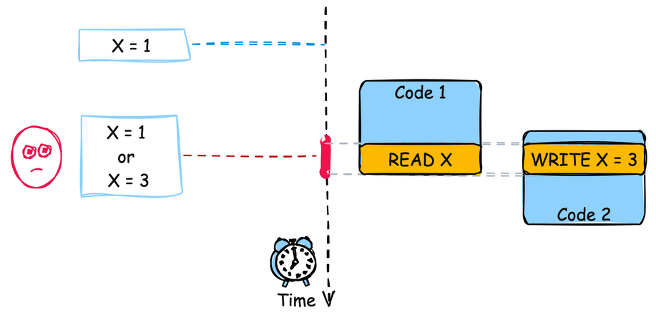
The product contains a concurrent code sequence that requires temporary, exclusive access to a shared resource, but a timing window exists in which the shared resource can be modified by another code sequence operating concurrently.
Extended Description
A race condition occurs within concurrent environments, and it is effectively a property of a code sequence. Depending on the context, a code sequence may be in the form of a function call, a small number of instructions, a series of program invocations, etc.
A race condition violates these properties, which are closely related:
Exclusivity - the code sequence is given exclusive access to the shared resource, i.e., no other code sequence can modify properties of the shared resource before the original sequence has completed execution.
Atomicity - the code sequence is behaviorally atomic, i.e., no other thread or process can concurrently execute the same sequence of instructions (or a subset) against the same resource.
A race condition exists when an "interfering code sequence" can still access the shared resource, violating exclusivity.
The interfering code sequence could be "trusted" or "untrusted." A trusted interfering code sequence occurs within the product; it cannot be modified by the attacker, and it can only be invoked indirectly. An untrusted interfering code sequence can be authored directly by the attacker, and typically it is external to the vulnerable product.
Alternate Terms
Race Condition
Common Consequences
This table specifies different individual consequences
associated with the weakness. The Scope identifies the application security area that is
violated, while the Impact describes the negative technical impact that arises if an
adversary succeeds in exploiting this weakness. The Likelihood provides information about
how likely the specific consequence is expected to be seen relative to the other
consequences in the list. For example, there may be high likelihood that a weakness will be
exploited to achieve a certain impact, but a low likelihood that it will be exploited to
achieve a different impact.
When a race condition makes it possible to bypass a resource cleanup routine or trigger multiple initialization routines, it may lead to resource exhaustion.
DoS: Crash, Exit, or Restart; DoS: Instability
Scope: Availability
When a race condition allows multiple control flows to access a resource simultaneously, it might lead the product(s) into unexpected states, possibly resulting in a crash.
Read Files or Directories; Read Application Data
Scope: Confidentiality, Integrity
When a race condition is combined with predictable resource names and loose permissions, it may be possible for an attacker to overwrite or access confidential data (CWE-59).
Execute Unauthorized Code or Commands; Gain Privileges or Assume Identity; Bypass Protection Mechanism
Scope: Access Control
This can have security implications when the expected synchronization is in security-critical code, such as recording whether a user is authenticated or modifying important state information that should not be influenced by an outsider.
Potential Mitigations
Phase(s)
Mitigation
Architecture and Design
In languages that support it, use synchronization primitives. Only wrap these around critical code to minimize the impact on performance.
Architecture and Design
Use thread-safe capabilities such as the data access abstraction in Spring.
Architecture and Design
Minimize the usage of shared resources in order to remove as much complexity as possible from the control flow and to reduce the likelihood of unexpected conditions occurring.
Additionally, this will minimize the amount of synchronization necessary and may even help to reduce the likelihood of a denial of service where an attacker may be able to repeatedly trigger a critical section (CWE-400).
Implementation
When using multithreading and operating on shared variables, only use thread-safe functions.
Implementation
Use atomic operations on shared variables. Be wary of innocent-looking constructs such as "x++". This may appear atomic at the code layer, but it is actually non-atomic at the instruction layer, since it involves a read, followed by a computation, followed by a write.
Implementation
Use a mutex if available, but be sure to avoid related weaknesses such as CWE-412.
Implementation
Avoid double-checked locking (CWE-609) and other implementation errors that arise when trying to avoid the overhead of synchronization.
Implementation
Disable interrupts or signals over critical parts of the code, but also make sure that the code does not go into a large or infinite loop.
Implementation
Use the volatile type modifier for critical variables to avoid unexpected compiler optimization or reordering. This does not necessarily solve the synchronization problem, but it can help.
Architecture and Design; Operation
Strategy: Environment Hardening
Run your code using the lowest privileges that are required to accomplish the necessary tasks [REF-76]. If possible, create isolated accounts with limited privileges that are only used for a single task. That way, a successful attack will not immediately give the attacker access to the rest of the software or its environment. For example, database applications rarely need to run as the database administrator, especially in day-to-day operations.
Relationships
This table shows the weaknesses and high level categories that are related to this
weakness. These relationships are defined as ChildOf, ParentOf, MemberOf and give insight to
similar items that may exist at higher and lower levels of abstraction. In addition,
relationships such as PeerOf and CanAlsoBe are defined to show similar weaknesses that the user
may want to explore.
Relevant to the view "Research Concepts" (View-1000)
Nature
Type
ID
Name
ChildOf
Class - a weakness that is described in a very abstract fashion, typically independent of any specific language or technology. More specific than a Pillar Weakness, but more general than a Base Weakness. Class level weaknesses typically describe issues in terms of 1 or 2 of the following dimensions: behavior, property, and resource.
Base - a weakness that is still mostly independent of a resource or technology, but with sufficient details to provide specific methods for detection and prevention. Base level weaknesses typically describe issues in terms of 2 or 3 of the following dimensions: behavior, property, technology, language, and resource.
Base - a weakness that is still mostly independent of a resource or technology, but with sufficient details to provide specific methods for detection and prevention. Base level weaknesses typically describe issues in terms of 2 or 3 of the following dimensions: behavior, property, technology, language, and resource.
Base - a weakness that is still mostly independent of a resource or technology, but with sufficient details to provide specific methods for detection and prevention. Base level weaknesses typically describe issues in terms of 2 or 3 of the following dimensions: behavior, property, technology, language, and resource.
Base - a weakness that is still mostly independent of a resource or technology, but with sufficient details to provide specific methods for detection and prevention. Base level weaknesses typically describe issues in terms of 2 or 3 of the following dimensions: behavior, property, technology, language, and resource.
Base - a weakness that is still mostly independent of a resource or technology, but with sufficient details to provide specific methods for detection and prevention. Base level weaknesses typically describe issues in terms of 2 or 3 of the following dimensions: behavior, property, technology, language, and resource.
Composite - a Compound Element that consists of two or more distinct weaknesses, in which all weaknesses must be present at the same time in order for a potential vulnerability to arise. Removing any of the weaknesses eliminates or sharply reduces the risk. One weakness, X, can be "broken down" into component weaknesses Y and Z. There can be cases in which one weakness might not be essential to a composite, but changes the nature of the composite when it becomes a vulnerability.
Base - a weakness that is still mostly independent of a resource or technology, but with sufficient details to provide specific methods for detection and prevention. Base level weaknesses typically describe issues in terms of 2 or 3 of the following dimensions: behavior, property, technology, language, and resource.
Base - a weakness that is still mostly independent of a resource or technology, but with sufficient details to provide specific methods for detection and prevention. Base level weaknesses typically describe issues in terms of 2 or 3 of the following dimensions: behavior, property, technology, language, and resource.
Class - a weakness that is described in a very abstract fashion, typically independent of any specific language or technology. More specific than a Pillar Weakness, but more general than a Base Weakness. Class level weaknesses typically describe issues in terms of 1 or 2 of the following dimensions: behavior, property, and resource.
Variant - a weakness that is linked to a certain type of product, typically involving a specific language or technology. More specific than a Base weakness. Variant level weaknesses typically describe issues in terms of 3 to 5 of the following dimensions: behavior, property, technology, language, and resource.
Base - a weakness that is still mostly independent of a resource or technology, but with sufficient details to provide specific methods for detection and prevention. Base level weaknesses typically describe issues in terms of 2 or 3 of the following dimensions: behavior, property, technology, language, and resource.
Relevant to the view "Weaknesses for Simplified Mapping of Published Vulnerabilities" (View-1003)
Nature
Type
ID
Name
MemberOf
View - a subset of CWE entries that provides a way of examining CWE content. The two main view structures are Slices (flat lists) and Graphs (containing relationships between entries).
Weaknesses for Simplified Mapping of Published Vulnerabilities
ParentOf
Base - a weakness that is still mostly independent of a resource or technology, but with sufficient details to provide specific methods for detection and prevention. Base level weaknesses typically describe issues in terms of 2 or 3 of the following dimensions: behavior, property, technology, language, and resource.
The different Modes of Introduction provide information
about how and when this
weakness may be introduced. The Phase identifies a point in the life cycle at which
introduction
may occur, while the Note provides a typical scenario related to introduction during the
given
phase.
Phase
Note
Architecture and Design
Implementation
Programmers may assume that certain code sequences execute too quickly to be affected by an interfering code sequence; when they are not, this violates atomicity. For example, the single "x++" statement may appear atomic at the code layer, but it is actually non-atomic at the instruction layer, since it involves a read (the original value of x), followed by a computation (x+1), followed by a write (save the result to x).
Applicable Platforms
This listing shows possible areas for which the given
weakness could appear. These
may be for specific named Languages, Operating Systems, Architectures, Paradigms,
Technologies,
or a class of such platforms. The platform is listed along with how frequently the given
weakness appears for that instance.
Languages
C
(Sometimes Prevalent)
C++
(Sometimes Prevalent)
Java
(Sometimes Prevalent)
Technologies
Class: Mobile
(Undetermined Prevalence)
Class: ICS/OT
(Undetermined Prevalence)
Likelihood Of Exploit
Medium
Demonstrative Examples
Example 1
This code could be used in an e-commerce application that supports transfers between accounts. It takes the total amount of the transfer, sends it to the new account, and deducts the amount from the original account.
} SendNewBalanceToDatabase($newbalance); NotifyUser("Transfer of $transfer_amount succeeded."); NotifyUser("New balance: $newbalance");
A race condition could occur between the calls to GetBalanceFromDatabase() and SendNewBalanceToDatabase().
Suppose the balance is initially 100.00. An attack could be constructed as follows:
(attack code)
Example Language: Other
In the following pseudocode, the attacker makes two simultaneous calls of the program, CALLER-1 and CALLER-2. Both callers are for the same user account. CALLER-1 (the attacker) is associated with PROGRAM-1 (the instance that handles CALLER-1). CALLER-2 is associated with PROGRAM-2. CALLER-1 makes a transfer request of 80.00. PROGRAM-1 calls GetBalanceFromDatabase and sets $balance to 100.00 PROGRAM-1 calculates $newbalance as 20.00, then calls SendNewBalanceToDatabase(). Due to high server load, the PROGRAM-1 call to SendNewBalanceToDatabase() encounters a delay. CALLER-2 makes a transfer request of 1.00. PROGRAM-2 calls GetBalanceFromDatabase() and sets $balance to 100.00. This happens because the previous PROGRAM-1 request was not processed yet. PROGRAM-2 determines the new balance as 99.00. After the initial delay, PROGRAM-1 commits its balance to the database, setting it to 20.00. PROGRAM-2 sends a request to update the database, setting the balance to 99.00
At this stage, the attacker should have a balance of 19.00 (due to 81.00 worth of transfers), but the balance is 99.00, as recorded in the database.
To prevent this weakness, the programmer has several options, including using a lock to prevent multiple simultaneous requests to the web application, or using a synchronization mechanism that includes all the code between GetBalanceFromDatabase() and SendNewBalanceToDatabase().
Example 2
The following function attempts to acquire a lock in order to perform operations on a shared resource.
(bad code)
Example Language: C
void f(pthread_mutex_t *mutex) {
pthread_mutex_lock(mutex);
/* access shared resource */
pthread_mutex_unlock(mutex);
}
However, the code does not check the value returned by pthread_mutex_lock() for errors. If pthread_mutex_lock() cannot acquire the mutex for any reason, the function may introduce a race condition into the program and result in undefined behavior.
In order to avoid data races, correctly written programs must check the result of thread synchronization functions and appropriately handle all errors, either by attempting to recover from them or reporting them to higher levels.
(good code)
Example Language: C
int f(pthread_mutex_t *mutex) {
int result;
result = pthread_mutex_lock(mutex); if (0 != result)
return result;
/* access shared resource */
return pthread_mutex_unlock(mutex);
}
Example 3
Suppose a processor's Memory Management Unit (MMU) has 5 other shadow MMUs to distribute its workload for its various cores. Each MMU has the start address and end address of "accessible" memory. Any time this accessible range changes (as per the processor's boot status), the main MMU sends an update message to all the shadow MMUs.
Suppose the interconnect fabric does not prioritize such "update" packets over other general traffic packets. This introduces a race condition. If an attacker can flood the target with enough messages so that some of those attack packets reach the target before the new access ranges gets updated, then the attacker can leverage this scenario.
Selected Observed
Examples
Note: this is a curated list of examples for users to understand the variety of ways in which this
weakness can be introduced. It is not a complete list of all CVEs that are related to this CWE entry.
Go application for cloud management creates a world-writable sudoers file that allows local attackers to inject sudo rules and escalate privileges to root by winning a race condition.
Chain: race condition (CWE-362) in anti-malware product allows deletion of files by creating a junction (CWE-1386) and using hard links during the time window in which a temporary file is created and deleted.
Chain: chipset has a race condition (CWE-362) between when an interrupt handler detects an attempt to write-enable the BIOS (in violation of the lock bit), and when the handler resets the write-enable bit back to 0, allowing attackers to issue BIOS writes during the timing window [REF-1237].
chain: time-of-check time-of-use (TOCTOU) race condition in program allows bypass of protection mechanism that was designed to prevent symlink attacks.
chain: time-of-check time-of-use (TOCTOU) race condition in program allows bypass of protection mechanism that was designed to prevent symlink attacks.
Chain: Signal handler contains too much functionality (CWE-828), introducing a race condition (CWE-362) that leads to a double free (CWE-415).
Weakness Ordinalities
Ordinality
Description
Primary
(where the weakness exists independent of other weaknesses)
Resultant
(where the weakness is typically related to the presence of some other weaknesses)
Detection
Methods
Method
Details
Black Box
Black box methods may be able to identify evidence of race conditions via methods such as multiple simultaneous connections, which may cause the software to become instable or crash. However, race conditions with very narrow timing windows would not be detectable.
White Box
Common idioms are detectable in white box analysis, such as time-of-check-time-of-use (TOCTOU) file operations (CWE-367), or double-checked locking (CWE-609).
Automated Dynamic Analysis
This weakness can be detected using dynamic tools and techniques that interact with the software using large test suites with many diverse inputs, such as fuzz testing (fuzzing), robustness testing, and fault injection. The software's operation may slow down, but it should not become unstable, crash, or generate incorrect results.
Race conditions may be detected with a stress-test by calling the software simultaneously from a large number of threads or processes, and look for evidence of any unexpected behavior.
Insert breakpoints or delays in between relevant code statements to artificially expand the race window so that it will be easier to detect.
Effectiveness: Moderate
Automated Static Analysis - Binary or Bytecode
According to SOAR [REF-1479], the following detection techniques may be useful:
This MemberOf Relationships table shows additional CWE Categories and Views that
reference this weakness as a member. This information is often useful in understanding where a
weakness fits within the context of external information sources.
Nature
Type
ID
Name
MemberOf
View - a subset of CWE entries that provides a way of examining CWE content. The two main view structures are Slices (flat lists) and Graphs (containing relationships between entries).
ICS Engineering (Construction/Deployment): Security Gaps in Commissioning
MemberOf
View - a subset of CWE entries that provides a way of examining CWE content. The two main view structures are Slices (flat lists) and Graphs (containing relationships between entries).
View - a subset of CWE entries that provides a way of examining CWE content. The two main view structures are Slices (flat lists) and Graphs (containing relationships between entries).
OWASP Top Ten 2025 Category A06:2025 - Insecure Design
Vulnerability Mapping Notes
Usage
ALLOWED-WITH-REVIEW
(this CWE ID could be used to map to real-world vulnerabilities in limited situations requiring careful review)
Reason
Abstraction
Rationale
This CWE entry is a Class and might have Base-level children that would be more appropriate
Comments
Examine children of this entry to see if there is a better fit
Notes
Research Gap
Race conditions in web applications are under-studied and probably under-reported. However, in 2008 there has been growing interest in this area.
Research Gap
Much of the focus of race condition research has been in Time-of-check Time-of-use (TOCTOU) variants (CWE-367), but many race conditions are related to synchronization problems that do not necessarily require a time-of-check.
Research Gap
From a classification/taxonomy perspective, the relationships between concurrency and program state need closer investigation and may be useful in organizing related issues.
Maintenance
The relationship between race conditions and synchronization problems (CWE-662) needs to be further developed. They are not necessarily two perspectives of the same core concept, since synchronization is only one technique for avoiding race conditions, and synchronization can be used for other purposes besides race condition prevention.
Taxonomy
Mappings
Mapped Taxonomy Name
Node ID
Fit
Mapped Node Name
PLOVER
Race Conditions
The CERT Oracle Secure Coding Standard for Java (2011)
VNA03-J
Do not assume that a group of calls to independently atomic methods is atomic


 Description
 This table specifies different individual consequences
associated with the weakness. The Scope identifies the application security area that is
violated, while the Impact describes the negative technical impact that arises if an
adversary succeeds in exploiting this weakness. The Likelihood provides information about
how likely the specific consequence is expected to be seen relative to the other
consequences in the list. For example, there may be high likelihood that a weakness will be
exploited to achieve a certain impact, but a low likelihood that it will be exploited to
achieve a different impact.
This table specifies different individual consequences
associated with the weakness. The Scope identifies the application security area that is
violated, while the Impact describes the negative technical impact that arises if an
adversary succeeds in exploiting this weakness. The Likelihood provides information about
how likely the specific consequence is expected to be seen relative to the other
consequences in the list. For example, there may be high likelihood that a weakness will be
exploited to achieve a certain impact, but a low likelihood that it will be exploited to
achieve a different impact.