Vulnerability Mapping:DISCOURAGEDThis CWE ID should not be used to map to real-world vulnerabilities Abstraction:
PillarPillar - a weakness that is the most abstract type of weakness and represents a theme for all class/base/variant weaknesses related to it. A Pillar is different from a Category as a Pillar is still technically a type of weakness that describes a mistake, while a Category represents a common characteristic used to group related things.
View customized information:
For users who are interested in more notional aspects of a weakness. Example: educators, technical writers, and project/program managers.For users who are concerned with the practical application and details about the nature of a weakness and how to prevent it from happening. Example: tool developers, security researchers, pen-testers, incident response analysts.For users who are mapping an issue to CWE/CAPEC IDs, i.e., finding the most appropriate CWE for a specific issue (e.g., a CVE record). Example: tool developers, security researchers.For users who wish to see all available information for the CWE/CAPEC entry.For users who want to customize what details are displayed.
×
Edit Custom Filter
Description
The product compares two entities in a security-relevant context, but the comparison is incorrect.
Extended Description
This Pillar covers several possibilities:
the comparison checks one factor incorrectly;
the comparison should consider multiple factors, but it does not check at least one of those factors at all;
the comparison checks the wrong factor.
Common Consequences
This table specifies different individual consequences
associated with the weakness. The Scope identifies the application security area that is
violated, while the Impact describes the negative technical impact that arises if an
adversary succeeds in exploiting this weakness. The Likelihood provides information about
how likely the specific consequence is expected to be seen relative to the other
consequences in the list. For example, there may be high likelihood that a weakness will be
exploited to achieve a certain impact, but a low likelihood that it will be exploited to
achieve a different impact.
Impact
Details
Varies by Context
Scope: Other
When the comparison is incorrect, it may lead to resultant weaknesses.
Relationships
This table shows the weaknesses and high level categories that are related to this
weakness. These relationships are defined as ChildOf, ParentOf, MemberOf and give insight to
similar items that may exist at higher and lower levels of abstraction. In addition,
relationships such as PeerOf and CanAlsoBe are defined to show similar weaknesses that the user
may want to explore.
Relevant to the view "Research Concepts" (View-1000)
Nature
Type
ID
Name
MemberOf
View - a subset of CWE entries that provides a way of examining CWE content. The two main view structures are Slices (flat lists) and Graphs (containing relationships between entries).
Base - a weakness that is still mostly independent of a resource or technology, but with sufficient details to provide specific methods for detection and prevention. Base level weaknesses typically describe issues in terms of 2 or 3 of the following dimensions: behavior, property, technology, language, and resource.
Class - a weakness that is described in a very abstract fashion, typically independent of any specific language or technology. More specific than a Pillar Weakness, but more general than a Base Weakness. Class level weaknesses typically describe issues in terms of 1 or 2 of the following dimensions: behavior, property, and resource.
Variant - a weakness that is linked to a certain type of product, typically involving a specific language or technology. More specific than a Base weakness. Variant level weaknesses typically describe issues in terms of 3 to 5 of the following dimensions: behavior, property, technology, language, and resource.
Object Model Violation: Just One of Equals and Hashcode Defined
ParentOf
Class - a weakness that is described in a very abstract fashion, typically independent of any specific language or technology. More specific than a Pillar Weakness, but more general than a Base Weakness. Class level weaknesses typically describe issues in terms of 1 or 2 of the following dimensions: behavior, property, and resource.
Base - a weakness that is still mostly independent of a resource or technology, but with sufficient details to provide specific methods for detection and prevention. Base level weaknesses typically describe issues in terms of 2 or 3 of the following dimensions: behavior, property, technology, language, and resource.
Base - a weakness that is still mostly independent of a resource or technology, but with sufficient details to provide specific methods for detection and prevention. Base level weaknesses typically describe issues in terms of 2 or 3 of the following dimensions: behavior, property, technology, language, and resource.
Class - a weakness that is described in a very abstract fashion, typically independent of any specific language or technology. More specific than a Pillar Weakness, but more general than a Base Weakness. Class level weaknesses typically describe issues in terms of 1 or 2 of the following dimensions: behavior, property, and resource.
Inadequate Detection or Handling of Adversarial Input Perturbations in Automated Recognition Mechanism
ParentOf
Variant - a weakness that is linked to a certain type of product, typically involving a specific language or technology. More specific than a Base weakness. Variant level weaknesses typically describe issues in terms of 3 to 5 of the following dimensions: behavior, property, technology, language, and resource.
Base - a weakness that is still mostly independent of a resource or technology, but with sufficient details to provide specific methods for detection and prevention. Base level weaknesses typically describe issues in terms of 2 or 3 of the following dimensions: behavior, property, technology, language, and resource.
Variant - a weakness that is linked to a certain type of product, typically involving a specific language or technology. More specific than a Base weakness. Variant level weaknesses typically describe issues in terms of 3 to 5 of the following dimensions: behavior, property, technology, language, and resource.
Relevant to the view "Weaknesses for Simplified Mapping of Published Vulnerabilities" (View-1003)
Nature
Type
ID
Name
MemberOf
View - a subset of CWE entries that provides a way of examining CWE content. The two main view structures are Slices (flat lists) and Graphs (containing relationships between entries).
Weaknesses for Simplified Mapping of Published Vulnerabilities
Modes
Of Introduction
The different Modes of Introduction provide information
about how and when this
weakness may be introduced. The Phase identifies a point in the life cycle at which
introduction
may occur, while the Note provides a typical scenario related to introduction during the
given
phase.
Phase
Note
Implementation
Applicable Platforms
This listing shows possible areas for which the given
weakness could appear. These
may be for specific named Languages, Operating Systems, Architectures, Paradigms,
Technologies,
or a class of such platforms. The platform is listed along with how frequently the given
weakness appears for that instance.
Languages
Class: Not Language-Specific
(Undetermined Prevalence)
Technologies
Class: Not Technology-Specific
(Undetermined Prevalence)
Demonstrative Examples
Example 1
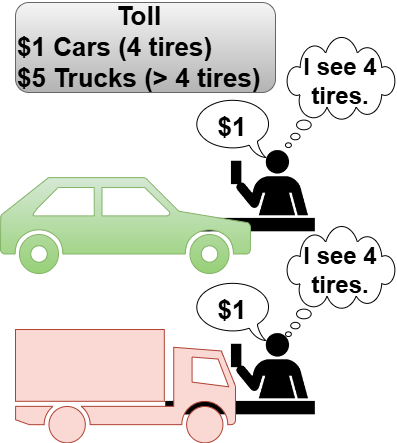
Consider an application in which Truck objects are defined to be the same if they have the same make, the same model, and were manufactured in the same year.
(bad code)
Example Language: Java
public class Truck {
private String make; private String model; private int year;
public boolean equals(Object o) {
if (o == null) return false; if (o == this) return true; if (!(o instanceof Truck)) return false;
Here, the equals() method only checks the make and model of the Truck objects, but the year of manufacture is not included.
Example 2
This example defines a fixed username and password. The AuthenticateUser() function is intended to accept a username and a password from an untrusted user, and check to ensure that it matches the username and password. If the username and password match, AuthenticateUser() is intended to indicate that authentication succeeded.
(bad code)
Example Language: C
/* Ignore CWE-259 (hard-coded password) and CWE-309 (use of password system for authentication) for this example. */
int AuthenticateUser(char *inUser, char *inPass) {
if (strncmp(username, inUser, strlen(inUser))) {
logEvent("Auth failure of username using strlen of inUser"); return(AUTH_FAIL);
} if (! strncmp(pass, inPass, strlen(inPass))) {
logEvent("Auth success of password using strlen of inUser"); return(AUTH_SUCCESS);
} else {
logEvent("Auth fail of password using sizeof"); return(AUTH_FAIL);
}
}
int main (int argc, char **argv) {
int authResult;
if (argc < 3) {
ExitError("Usage: Provide a username and password");
} authResult = AuthenticateUser(argv[1], argv[2]); if (authResult == AUTH_SUCCESS) {
DoAuthenticatedTask(argv[1]);
} else {
ExitError("Authentication failed");
}
}
In AuthenticateUser(), the strncmp() call uses the string length of an attacker-provided inPass parameter in order to determine how many characters to check in the password. So, if the attacker only provides a password of length 1, the check will only examine the first byte of the application's password before determining success.
As a result, this partial comparison leads to improper authentication (CWE-287).
Any of these passwords would still cause authentication to succeed for the "admin" user:
(attack code)
p pa pas pass
This significantly reduces the search space for an attacker, making brute force attacks more feasible.
The same problem also applies to the username, so values such as "a" and "adm" will succeed for the username.
While this demonstrative example may not seem realistic, see the Observed Examples for CVE entries that effectively reflect this same weakness.
Selected Observed
Examples
Note: this is a curated list of examples for users to understand the variety of ways in which this
weakness can be introduced. It is not a complete list of all CVEs that are related to this CWE entry.
Chain: Python-based HTTP Proxy server uses the wrong boolean operators (CWE-480) causing an incorrect comparison (CWE-697) that identifies an authN failure if all three conditions are met instead of only one, allowing bypass of the proxy authentication (CWE-1390)
Chain: Proxy uses a substring search instead of parsing the Transfer-Encoding header (CWE-697), allowing request splitting (CWE-113) and cache poisoning
Proxy performs incorrect comparison of request headers, leading to infoleak
Weakness Ordinalities
Ordinality
Description
Primary
(where the weakness exists independent of other weaknesses)
Detection
Methods
Method
Details
Automated Static Analysis
Automated static analysis, commonly referred to as Static Application Security Testing (SAST), can find some instances of this weakness by analyzing source code (or binary/compiled code) without having to execute it. Typically, this is done by building a model of data flow and control flow, then searching for potentially-vulnerable patterns that connect "sources" (origins of input) with "sinks" (destinations where the data interacts with external components, a lower layer such as the OS, etc.)
Memberships
This MemberOf Relationships table shows additional CWE Categories and Views that
reference this weakness as a member. This information is often useful in understanding where a
weakness fits within the context of external information sources.
Nature
Type
ID
Name
MemberOf
Category - a CWE entry that contains a set of other entries that share a common characteristic.
(this CWE ID should not be used to map to real-world vulnerabilities)
Reason
Abstraction
Rationale
This CWE entry is extremely high-level, a Pillar. However, sometimes this weakness is forced to be used due to the lack of in-depth weakness research. See Research Gaps.
Comments
Where feasible, consider children or descendants of this entry instead.
Notes
Research Gap
Weaknesses related to this Pillar appear to be under-studied, especially with respect to classification schemes. Input from academic and other communities could help identify and resolve gaps or organizational difficulties within CWE.
Maintenance
This entry likely has some relationships with case sensitivity (CWE-178), but case sensitivity is a factor in other types of weaknesses besides comparison. Also, in cryptography, certain attacks are possible when certain comparison operations do not take place in constant time, causing a timing-related information leak (CWE-208).


 Description
 This table specifies different individual consequences
associated with the weakness. The Scope identifies the application security area that is
violated, while the Impact describes the negative technical impact that arises if an
adversary succeeds in exploiting this weakness. The Likelihood provides information about
how likely the specific consequence is expected to be seen relative to the other
consequences in the list. For example, there may be high likelihood that a weakness will be
exploited to achieve a certain impact, but a low likelihood that it will be exploited to
achieve a different impact.
This table specifies different individual consequences
associated with the weakness. The Scope identifies the application security area that is
violated, while the Impact describes the negative technical impact that arises if an
adversary succeeds in exploiting this weakness. The Likelihood provides information about
how likely the specific consequence is expected to be seen relative to the other
consequences in the list. For example, there may be high likelihood that a weakness will be
exploited to achieve a certain impact, but a low likelihood that it will be exploited to
achieve a different impact.