Vulnerability Mapping:ALLOWEDThis CWE ID could be used to map to real-world vulnerabilities in limited situations requiring careful review
(with careful review of mapping notes)
Abstraction:
BaseBase - a weakness that is still mostly independent of a resource or technology, but with sufficient details to provide specific methods for detection and prevention. Base level weaknesses typically describe issues in terms of 2 or 3 of the following dimensions: behavior, property, technology, language, and resource.
View customized information:
For users who are interested in more notional aspects of a weakness. Example: educators, technical writers, and project/program managers.For users who are concerned with the practical application and details about the nature of a weakness and how to prevent it from happening. Example: tool developers, security researchers, pen-testers, incident response analysts.For users who are mapping an issue to CWE/CAPEC IDs, i.e., finding the most appropriate CWE for a specific issue (e.g., a CVE record). Example: tool developers, security researchers.For users who wish to see all available information for the CWE/CAPEC entry.For users who want to customize what details are displayed.
×
Edit Custom Filter
Description
The product contains hard-coded credentials, such as a password or cryptographic key.
Extended Description
There are two main variations:
Inbound: the product contains an authentication mechanism that checks the input credentials against a hard-coded set of credentials. In this variant, a default administration account is created, and a simple password is hard-coded into the product and associated with that account. This hard-coded password is the same for each installation of the product, and it usually cannot be changed or disabled by system administrators without manually modifying the program, or otherwise patching the product. It can also be difficult for the administrator to detect.
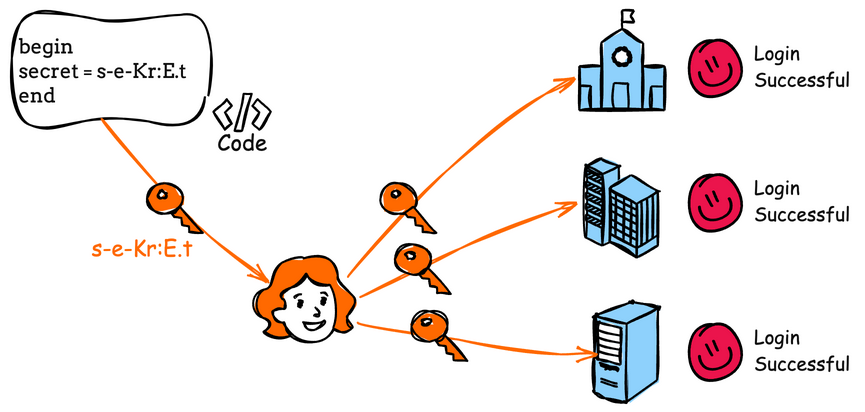
Outbound: the product connects to another system or component, and it contains hard-coded credentials for connecting to that component. This variant applies to front-end systems that authenticate with a back-end service. The back-end service may require a fixed password that can be easily discovered. The programmer may simply hard-code those back-end credentials into the front-end product.
Common Consequences
This table specifies different individual consequences
associated with the weakness. The Scope identifies the application security area that is
violated, while the Impact describes the negative technical impact that arises if an
adversary succeeds in exploiting this weakness. The Likelihood provides information about
how likely the specific consequence is expected to be seen relative to the other
consequences in the list. For example, there may be high likelihood that a weakness will be
exploited to achieve a certain impact, but a low likelihood that it will be exploited to
achieve a different impact.
Impact
Details
Bypass Protection Mechanism
Scope: Access Control
If hard-coded passwords are used, it is almost certain that malicious users will gain access to the account in question.
Any user of the product that hard-codes passwords may be able to extract the password. Client-side systems with hard-coded passwords pose even more of a threat, since the extraction of a password from a binary is usually very simple.
Read Application Data; Gain Privileges or Assume Identity; Execute Unauthorized Code or Commands; Other
Scope: Integrity, Confidentiality, Availability, Access Control, Other
This weakness can lead to the exposure of resources or functionality to unintended actors, possibly providing attackers with sensitive information or even execute arbitrary code.
If the password is ever discovered or published (a common occurrence on the Internet), then anybody with knowledge of this password can access the product. Finally, since all installations of the product will have the same password, even across different organizations, this enables massive attacks such as worms to take place.
Potential Mitigations
Phase(s)
Mitigation
Architecture and Design
For outbound authentication: store passwords, keys, and other credentials outside of the code in a strongly-protected, encrypted configuration file or database that is protected from access by all outsiders, including other local users on the same system. Properly protect the key (CWE-320). If you cannot use encryption to protect the file, then make sure that the permissions are as restrictive as possible [REF-7].
In Windows environments, the Encrypted File System (EFS) may provide some protection.
Architecture and Design
For inbound authentication: Rather than hard-code a default username and password, key, or other authentication credentials for first time logins, utilize a "first login" mode that requires the user to enter a unique strong password or key.
Architecture and Design
If the product must contain hard-coded credentials or they cannot be removed, perform access control checks and limit which entities can access the feature that requires the hard-coded credentials. For example, a feature might only be enabled through the system console instead of through a network connection.
Architecture and Design
For inbound authentication using passwords: apply strong one-way hashes to passwords and store those hashes in a configuration file or database with appropriate access control. That way, theft of the file/database still requires the attacker to try to crack the password. When handling an incoming password during authentication, take the hash of the password and compare it to the saved hash.
Use randomly assigned salts for each separate hash that is generated. This increases the amount of computation that an attacker needs to conduct a brute-force attack, possibly limiting the effectiveness of the rainbow table method.
Architecture and Design
For front-end to back-end connections: Three solutions are possible, although none are complete.
The first suggestion involves the use of generated passwords or keys that are changed automatically and must be entered at given time intervals by a system administrator. These passwords will be held in memory and only be valid for the time intervals.
Next, the passwords or keys should be limited at the back end to only performing actions valid for the front end, as opposed to having full access.
Finally, the messages sent should be tagged and checksummed with time sensitive values so as to prevent replay-style attacks.
Relationships
This table shows the weaknesses and high level categories that are related to this
weakness. These relationships are defined as ChildOf, ParentOf, MemberOf and give insight to
similar items that may exist at higher and lower levels of abstraction. In addition,
relationships such as PeerOf and CanAlsoBe are defined to show similar weaknesses that the user
may want to explore.
Relevant to the view "Research Concepts" (View-1000)
Nature
Type
ID
Name
ChildOf
Base - a weakness that is still mostly independent of a resource or technology, but with sufficient details to provide specific methods for detection and prevention. Base level weaknesses typically describe issues in terms of 2 or 3 of the following dimensions: behavior, property, technology, language, and resource.
Use of Invariant Value in Dynamically Changing Context
ChildOf
Class - a weakness that is described in a very abstract fashion, typically independent of any specific language or technology. More specific than a Pillar Weakness, but more general than a Base Weakness. Class level weaknesses typically describe issues in terms of 1 or 2 of the following dimensions: behavior, property, and resource.
Class - a weakness that is described in a very abstract fashion, typically independent of any specific language or technology. More specific than a Pillar Weakness, but more general than a Base Weakness. Class level weaknesses typically describe issues in terms of 1 or 2 of the following dimensions: behavior, property, and resource.
Variant - a weakness that is linked to a certain type of product, typically involving a specific language or technology. More specific than a Base weakness. Variant level weaknesses typically describe issues in terms of 3 to 5 of the following dimensions: behavior, property, technology, language, and resource.
Variant - a weakness that is linked to a certain type of product, typically involving a specific language or technology. More specific than a Base weakness. Variant level weaknesses typically describe issues in terms of 3 to 5 of the following dimensions: behavior, property, technology, language, and resource.
Base - a weakness that is still mostly independent of a resource or technology, but with sufficient details to provide specific methods for detection and prevention. Base level weaknesses typically describe issues in terms of 2 or 3 of the following dimensions: behavior, property, technology, language, and resource.
Relevant to the view "Weaknesses for Simplified Mapping of Published Vulnerabilities" (View-1003)
Nature
Type
ID
Name
ChildOf
Class - a weakness that is described in a very abstract fashion, typically independent of any specific language or technology. More specific than a Pillar Weakness, but more general than a Base Weakness. Class level weaknesses typically describe issues in terms of 1 or 2 of the following dimensions: behavior, property, and resource.
Relevant to the view "CISQ Quality Measures (2020)" (View-1305)
Nature
Type
ID
Name
ParentOf
Variant - a weakness that is linked to a certain type of product, typically involving a specific language or technology. More specific than a Base weakness. Variant level weaknesses typically describe issues in terms of 3 to 5 of the following dimensions: behavior, property, technology, language, and resource.
Variant - a weakness that is linked to a certain type of product, typically involving a specific language or technology. More specific than a Base weakness. Variant level weaknesses typically describe issues in terms of 3 to 5 of the following dimensions: behavior, property, technology, language, and resource.
Relevant to the view "CISQ Data Protection Measures" (View-1340)
Nature
Type
ID
Name
ParentOf
Variant - a weakness that is linked to a certain type of product, typically involving a specific language or technology. More specific than a Base weakness. Variant level weaknesses typically describe issues in terms of 3 to 5 of the following dimensions: behavior, property, technology, language, and resource.
Variant - a weakness that is linked to a certain type of product, typically involving a specific language or technology. More specific than a Base weakness. Variant level weaknesses typically describe issues in terms of 3 to 5 of the following dimensions: behavior, property, technology, language, and resource.
The different Modes of Introduction provide information
about how and when this
weakness may be introduced. The Phase identifies a point in the life cycle at which
introduction
may occur, while the Note provides a typical scenario related to introduction during the
given
phase.
Phase
Note
Architecture and Design
REALIZATION: This weakness is caused during implementation of an architectural security tactic.
Applicable Platforms
This listing shows possible areas for which the given
weakness could appear. These
may be for specific named Languages, Operating Systems, Architectures, Paradigms,
Technologies,
or a class of such platforms. The platform is listed along with how frequently the given
weakness appears for that instance.
Languages
Class: Not Language-Specific
(Undetermined Prevalence)
Technologies
Class: Mobile
(Undetermined Prevalence)
Class: ICS/OT
(Often Prevalent)
Likelihood Of Exploit
High
Demonstrative Examples
Example 1
The following code uses a hard-coded password to connect to a database:
This is an example of an external hard-coded password on the client-side of a connection. This code will run successfully, but anyone who has access to it will have access to the password. Once the program has shipped, there is no going back from the database user "scott" with a password of "tiger" unless the program is patched. A devious employee with access to this information can use it to break into the system. Even worse, if attackers have access to the bytecode for application, they can use the javap -c command to access the disassembled code, which will contain the values of the passwords used. The result of this operation might look something like the following for the example above:
Every instance of this program can be placed into diagnostic mode with the same password. Even worse is the fact that if this program is distributed as a binary-only distribution, it is very difficult to change that password or disable this "functionality."
Example 3
The following code examples attempt to verify a password using a hard-coded cryptographic key.
(bad code)
Example Language: C
int VerifyAdmin(char *password) {
if (strcmp(password,"68af404b513073584c4b6f22b6c63e6b")) {
The cryptographic key is within a hard-coded string value that is compared to the password. It is likely that an attacker will be able to read the key and compromise the system.
Example 4
The following examples show a portion of properties and configuration files for Java and ASP.NET applications. The files include username and password information but they are stored in cleartext.
This Java example shows a properties file with a cleartext username / password pair.
The following example shows a portion of a configuration file for an ASP.Net application. This configuration file includes username and password information for a connection to a database but the pair is stored in cleartext.
Username and password information should not be included in a configuration file or a properties file in cleartext as this will allow anyone who can read the file access to the resource. If possible, encrypt this information.
Example 5
In 2022, the OT:ICEFALL study examined products by 10 different Operational Technology (OT) vendors. The researchers reported 56 vulnerabilities and said that the products were "insecure by design" [REF-1283]. If exploited, these vulnerabilities often allowed adversaries to change how the products operated, ranging from denial of service to changing the code that the products executed. Since these products were often used in industries such as power, electrical, water, and others, there could even be safety implications.
Multiple vendors used hard-coded credentials in their OT products.
Selected Observed
Examples
Note: this is a curated list of examples for users to understand the variety of ways in which this
weakness can be introduced. It is not a complete list of all CVEs that are related to this CWE entry.
VoIP product uses hard coded public and private SNMP community strings that cannot be changed, which allows remote attackers to obtain sensitive information
Backup product contains hard-coded credentials that effectively serve as a back door, which allows remote attackers to access the file system
Weakness Ordinalities
Ordinality
Description
Primary
(where the weakness exists independent of other weaknesses)
Detection
Methods
Method
Details
Black Box
Credential storage in configuration files is findable using black box methods, but the use of hard-coded credentials for an incoming authentication routine typically involves an account that is not visible outside of the code.
Effectiveness: Moderate
Automated Static Analysis
Automated white box techniques have been published for detecting hard-coded credentials for incoming authentication, but there is some expert disagreement regarding their effectiveness and applicability to a broad range of methods.
Manual Static Analysis
This weakness may be detectable using manual code analysis. Unless authentication is decentralized and applied throughout the product, there can be sufficient time for the analyst to find incoming authentication routines and examine the program logic looking for usage of hard-coded credentials. Configuration files could also be analyzed.
Note:These may be more effective than strictly automated techniques. This is especially the case with weaknesses that are related to design and business rules.
Manual Dynamic Analysis
For hard-coded credentials in incoming authentication: use monitoring tools that examine the product's process as it interacts with the operating system and the network. This technique is useful in cases when source code is unavailable, if the product was not developed by you, or if you want to verify that the build phase did not introduce any new weaknesses. Examples include debuggers that directly attach to the running process; system-call tracing utilities such as truss (Solaris) and strace (Linux); system activity monitors such as FileMon, RegMon, Process Monitor, and other Sysinternals utilities (Windows); and sniffers and protocol analyzers that monitor network traffic.
Attach the monitor to the process and perform a login. Using call trees or similar artifacts from the output, examine the associated behaviors and see if any of them appear to be comparing the input to a fixed string or value.
Automated Static Analysis - Binary or Bytecode
According to SOAR [REF-1479], the following detection techniques may be useful:
This MemberOf Relationships table shows additional CWE Categories and Views that
reference this weakness as a member. This information is often useful in understanding where a
weakness fits within the context of external information sources.
Nature
Type
ID
Name
MemberOf
Category - a CWE entry that contains a set of other entries that share a common characteristic.
View - a subset of CWE entries that provides a way of examining CWE content. The two main view structures are Slices (flat lists) and Graphs (containing relationships between entries).
SEI CERT Oracle Secure Coding Standard for Java - Guidelines 49. Miscellaneous (MSC)
MemberOf
View - a subset of CWE entries that provides a way of examining CWE content. The two main view structures are Slices (flat lists) and Graphs (containing relationships between entries).
View - a subset of CWE entries that provides a way of examining CWE content. The two main view structures are Slices (flat lists) and Graphs (containing relationships between entries).
Weaknesses in the 2021 CWE Top 25 Most Dangerous Software Weaknesses
MemberOf
View - a subset of CWE entries that provides a way of examining CWE content. The two main view structures are Slices (flat lists) and Graphs (containing relationships between entries).
View - a subset of CWE entries that provides a way of examining CWE content. The two main view structures are Slices (flat lists) and Graphs (containing relationships between entries).
OWASP Top Ten 2021 Category A07:2021 - Identification and Authentication Failures
MemberOf
View - a subset of CWE entries that provides a way of examining CWE content. The two main view structures are Slices (flat lists) and Graphs (containing relationships between entries).
View - a subset of CWE entries that provides a way of examining CWE content. The two main view structures are Slices (flat lists) and Graphs (containing relationships between entries).
Weaknesses in the 2023 CWE Top 25 Most Dangerous Software Weaknesses
MemberOf
View - a subset of CWE entries that provides a way of examining CWE content. The two main view structures are Slices (flat lists) and Graphs (containing relationships between entries).


 Description
 This table specifies different individual consequences
associated with the weakness. The Scope identifies the application security area that is
violated, while the Impact describes the negative technical impact that arises if an
adversary succeeds in exploiting this weakness. The Likelihood provides information about
how likely the specific consequence is expected to be seen relative to the other
consequences in the list. For example, there may be high likelihood that a weakness will be
exploited to achieve a certain impact, but a low likelihood that it will be exploited to
achieve a different impact.
This table specifies different individual consequences
associated with the weakness. The Scope identifies the application security area that is
violated, while the Impact describes the negative technical impact that arises if an
adversary succeeds in exploiting this weakness. The Likelihood provides information about
how likely the specific consequence is expected to be seen relative to the other
consequences in the list. For example, there may be high likelihood that a weakness will be
exploited to achieve a certain impact, but a low likelihood that it will be exploited to
achieve a different impact.