Vulnerability Mapping:ALLOWEDThis CWE ID may be used to map to real-world vulnerabilities Abstraction:
BaseBase - a weakness that is still mostly independent of a resource or technology, but with sufficient details to provide specific methods for detection and prevention. Base level weaknesses typically describe issues in terms of 2 or 3 of the following dimensions: behavior, property, technology, language, and resource.
View customized information:
For users who are interested in more notional aspects of a weakness. Example: educators, technical writers, and project/program managers.For users who are concerned with the practical application and details about the nature of a weakness and how to prevent it from happening. Example: tool developers, security researchers, pen-testers, incident response analysts.For users who are mapping an issue to CWE/CAPEC IDs, i.e., finding the most appropriate CWE for a specific issue (e.g., a CVE record). Example: tool developers, security researchers.For users who wish to see all available information for the CWE/CAPEC entry.For users who want to customize what details are displayed.
×
Edit Custom Filter
Description
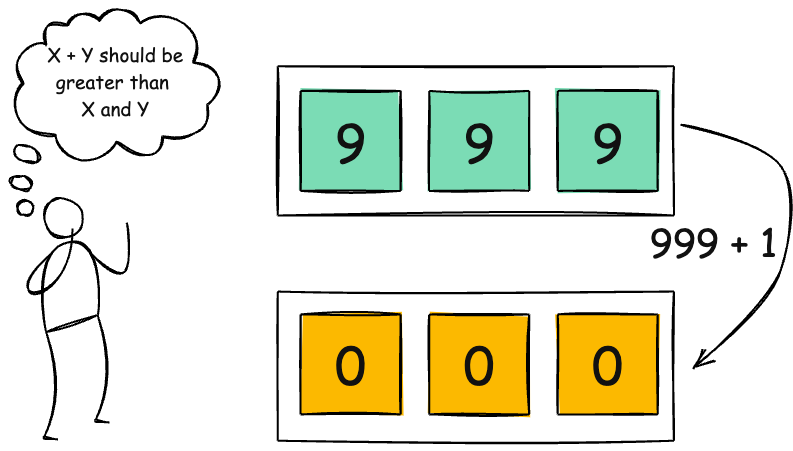
The product performs a calculation that can
produce an integer overflow or wraparound when the logic
assumes that the resulting value will always be larger than
the original value. This occurs when an integer value is
incremented to a value that is too large to store in the
associated representation. When this occurs, the value may
become a very small or negative number.
Alternate Terms
Overflow
The terms "overflow" and "wraparound" are
used interchangeably by some people, but they can have
more precise distinctions by others. See Terminology
Notes.
Wraparound
The terms "overflow" and "wraparound" are
used interchangeably by some people, but they can have
more precise distinctions by others. See Terminology
Notes.
wrap, wrap-around, wrap around
Alternate spellings of "wraparound"
Common Consequences
This table specifies different individual consequences
associated with the weakness. The Scope identifies the application security area that is
violated, while the Impact describes the negative technical impact that arises if an
adversary succeeds in exploiting this weakness. The Likelihood provides information about
how likely the specific consequence is expected to be seen relative to the other
consequences in the list. For example, there may be high likelihood that a weakness will be
exploited to achieve a certain impact, but a low likelihood that it will be exploited to
achieve a different impact.
This weakness can generally lead to undefined behavior and therefore crashes. When the calculated result is used for resource allocation, this weakness can cause too many (or too few) resources to be allocated, possibly enabling crashes if the product requests more resources than can be provided.
Modify Memory
Scope: Integrity
If the value in question is important to data (as opposed to flow), simple data corruption has occurred. Also, if the overflow/wraparound results in other conditions such as buffer overflows, further memory corruption may occur.
Execute Unauthorized Code or Commands; Bypass Protection Mechanism
Scope: Confidentiality, Availability, Access Control
This weakness can sometimes trigger buffer overflows, which can be used to execute arbitrary code. This is usually outside the scope of the product's implicit security policy.
Alter Execution Logic; DoS: Crash, Exit, or Restart; DoS: Resource Consumption (CPU)
Scope: Availability, Other
If the overflow/wraparound occurs in a loop index variable, this could cause the loop to terminate at the wrong time - too early, too late, or not at all (i.e., infinite loops). With too many iterations, some loops could consume too many resources such as memory, file handles, etc., possibly leading to a crash or other DoS.
Bypass Protection Mechanism
Scope: Access Control
If integer values are used in security-critical decisions, such as calculating quotas or allocation limits, integer overflows can be used to cause an incorrect security decision.
Potential Mitigations
Phase(s)
Mitigation
Requirements
Ensure that all protocols are strictly defined, such that all out-of-bounds behavior can be identified simply, and require strict conformance to the protocol.
Requirements
Strategy: Language Selection
Use a language that does not allow this weakness to occur or provides constructs that make this weakness easier to avoid.
If possible, choose a language or compiler that performs automatic bounds checking.
Architecture and Design
Strategy: Libraries or Frameworks
Use a vetted library or framework that does not allow this weakness to occur or provides constructs that make this weakness easier to avoid [REF-1482].
Use libraries or frameworks that make it easier to handle numbers without unexpected consequences.
Examples include safe integer handling packages such as SafeInt (C++) or IntegerLib (C or C++). [REF-106]
Implementation
Strategy: Input Validation
Perform input validation on any numeric input by ensuring that it is within the expected range. Enforce that the input meets both the minimum and maximum requirements for the expected range.
Use unsigned integers where possible. This makes it easier to perform validation for integer overflows. When signed integers are required, ensure that the range check includes minimum values as well as maximum values.
Implementation
Understand the programming language's underlying representation and how it interacts with numeric calculation (CWE-681). Pay close attention to byte size discrepancies, precision, signed/unsigned distinctions, truncation, conversion and casting between types, "not-a-number" calculations, and how the language handles numbers that are too large or too small for its underlying representation. [REF-7]
Also be careful to account for 32-bit, 64-bit, and other potential differences that may affect the numeric representation.
Architecture and Design
For any security checks that are performed on the client side, ensure that these checks are duplicated on the server side, in order to avoid CWE-602. Attackers can bypass the client-side checks by modifying values after the checks have been performed, or by changing the client to remove the client-side checks entirely. Then, these modified values would be submitted to the server.
Implementation
Strategy: Compilation or Build Hardening
Examine compiler warnings closely and eliminate problems with potential security implications, such as signed / unsigned mismatch in memory operations, or use of uninitialized variables. Even if the weakness is rarely exploitable, a single failure may lead to the compromise of the entire system.
Relationships
This table shows the weaknesses and high level categories that are related to this
weakness. These relationships are defined as ChildOf, ParentOf, MemberOf and give insight to
similar items that may exist at higher and lower levels of abstraction. In addition,
relationships such as PeerOf and CanAlsoBe are defined to show similar weaknesses that the user
may want to explore.
Relevant to the view "Research Concepts" (View-1000)
Nature
Type
ID
Name
ChildOf
Pillar - a weakness that is the most abstract type of weakness and represents a theme for all class/base/variant weaknesses related to it. A Pillar is different from a Category as a Pillar is still technically a type of weakness that describes a mistake, while a Category represents a common characteristic used to group related things.
Chain - a Compound Element that is a sequence of two or more separate weaknesses that can be closely linked together within software. One weakness, X, can directly create the conditions that are necessary to cause another weakness, Y, to enter a vulnerable condition. When this happens, CWE refers to X as "primary" to Y, and Y is "resultant" from X. Chains can involve more than two weaknesses, and in some cases, they might have a tree-like structure.
Base - a weakness that is still mostly independent of a resource or technology, but with sufficient details to provide specific methods for detection and prevention. Base level weaknesses typically describe issues in terms of 2 or 3 of the following dimensions: behavior, property, technology, language, and resource.
Base - a weakness that is still mostly independent of a resource or technology, but with sufficient details to provide specific methods for detection and prevention. Base level weaknesses typically describe issues in terms of 2 or 3 of the following dimensions: behavior, property, technology, language, and resource.
Insufficient Precision or Accuracy of a Real Number
CanPrecede
Class - a weakness that is described in a very abstract fashion, typically independent of any specific language or technology. More specific than a Pillar Weakness, but more general than a Base Weakness. Class level weaknesses typically describe issues in terms of 1 or 2 of the following dimensions: behavior, property, and resource.
Relevant to the view "Weaknesses for Simplified Mapping of Published Vulnerabilities" (View-1003)
Nature
Type
ID
Name
ChildOf
Pillar - a weakness that is the most abstract type of weakness and represents a theme for all class/base/variant weaknesses related to it. A Pillar is different from a Category as a Pillar is still technically a type of weakness that describes a mistake, while a Category represents a common characteristic used to group related things.
Relevant to the view "Seven Pernicious Kingdoms" (View-700)
Nature
Type
ID
Name
ChildOf
Class - a weakness that is described in a very abstract fashion, typically independent of any specific language or technology. More specific than a Pillar Weakness, but more general than a Base Weakness. Class level weaknesses typically describe issues in terms of 1 or 2 of the following dimensions: behavior, property, and resource.
The different Modes of Introduction provide information
about how and when this
weakness may be introduced. The Phase identifies a point in the life cycle at which
introduction
may occur, while the Note provides a typical scenario related to introduction during the
given
phase.
Phase
Note
Implementation
This weakness may become security critical when determining the offset or size in behaviors such as memory allocation, copying, and concatenation.
Applicable Platforms
This listing shows possible areas for which the given
weakness could appear. These
may be for specific named Languages, Operating Systems, Architectures, Paradigms,
Technologies,
or a class of such platforms. The platform is listed along with how frequently the given
weakness appears for that instance.
Languages
Class: Not Language-Specific
(Undetermined Prevalence)
C
(Often Prevalent)
Technologies
Class: Not Technology-Specific
(Undetermined Prevalence)
Likelihood Of Exploit
Medium
Demonstrative Examples
Example 1
The following image processing code allocates a table for images.
This code intends to allocate a table of size num_imgs, however as num_imgs grows large, the calculation determining the size of the list will eventually overflow (CWE-190). This will result in a very small list to be allocated instead. If the subsequent code operates on the list as if it were num_imgs long, it may result in many types of out-of-bounds problems (CWE-119).
Example 2
The following code excerpt from OpenSSH 3.3 demonstrates a classic case of integer overflow:
(bad code)
Example Language: C
nresp = packet_get_int(); if (nresp > 0) {
response = xmalloc(nresp*sizeof(char*)); for (i = 0; i < nresp; i++) response[i] = packet_get_string(NULL);
}
If nresp has the value 1073741824 and sizeof(char*) has its typical value of 4, then the result of the operation nresp*sizeof(char*) overflows, and the argument to xmalloc() will be 0. Most malloc() implementations will happily allocate a 0-byte buffer, causing the subsequent loop iterations to overflow the heap buffer response.
Example 3
Integer overflows can be complicated and difficult to detect. The following example is an attempt to show how an integer overflow may lead to undefined looping behavior:
(bad code)
Example Language: C
short int bytesRec = 0; char buf[SOMEBIGNUM];
while(bytesRec < MAXGET) {
bytesRec += getFromInput(buf+bytesRec);
}
In the above case, it is entirely possible that bytesRec may overflow, continuously creating a lower number than MAXGET and also overwriting the first MAXGET-1 bytes of buf.
Example 4
In this example the method determineFirstQuarterRevenue is used to determine the first quarter revenue for an accounting/business application. The method retrieves the monthly sales totals for the first three months of the year, calculates the first quarter sales totals from the monthly sales totals, calculates the first quarter revenue based on the first quarter sales, and finally saves the first quarter revenue results to the database.
// Variable for sales revenue for the quarter float quarterRevenue = 0.0f;
short JanSold = getMonthlySales(JAN); /* Get sales in January */ short FebSold = getMonthlySales(FEB); /* Get sales in February */ short MarSold = getMonthlySales(MAR); /* Get sales in March */
// Calculate quarterly total short quarterSold = JanSold + FebSold + MarSold;
// Calculate the total revenue for the quarter quarterRevenue = calculateRevenueForQuarter(quarterSold);
saveFirstQuarterRevenue(quarterRevenue);
return 0;
}
However, in this example the primitive type short int is used for both the monthly and the quarterly sales variables. In C the short int primitive type has a maximum value of 32768. This creates a potential integer overflow if the value for the three monthly sales adds up to more than the maximum value for the short int primitive type. An integer overflow can lead to data corruption, unexpected behavior, infinite loops and system crashes. To correct the situation the appropriate primitive type should be used, as in the example below, and/or provide some validation mechanism to ensure that the maximum value for the primitive type is not exceeded.
... // Calculate quarterly total long quarterSold = JanSold + FebSold + MarSold;
// Calculate the total revenue for the quarter quarterRevenue = calculateRevenueForQuarter(quarterSold);
...
}
Note that an integer overflow could also occur if the quarterSold variable has a primitive type long but the method calculateRevenueForQuarter has a parameter of type short.
Selected Observed
Examples
Note: this is a curated list of examples for users to understand the variety of ways in which this
weakness can be introduced. It is not a complete list of all CVEs that are related to this CWE entry.
Chain: Javascript engine code does not perform a length check (CWE-1284) leading to integer overflow (CWE-190) causing allocation of smaller buffer than expected (CWE-131) resulting in a heap-based buffer overflow (CWE-122)
Font rendering library does not properly
handle assigning a signed short value to an unsigned
long (CWE-195), leading to an integer wraparound
(CWE-190), causing too small of a buffer (CWE-131),
leading to an out-of-bounds write
(CWE-787).
Chain: in a web browser, an unsigned 64-bit integer is forcibly cast to a 32-bit integer (CWE-681) and potentially leading to an integer overflow (CWE-190). If an integer overflow occurs, this can cause heap memory corruption (CWE-122)
Chain: Python library does not limit the resources used to process images that specify a very large number of bands (CWE-1284), leading to excessive memory consumption (CWE-789) or an integer overflow (CWE-190).
Chain: integer overflow (CWE-190) causes a negative signed value, which later bypasses a maximum-only check (CWE-839), leading to heap-based buffer overflow (CWE-122).
Chain: integer overflow in securely-coded mail program leads to buffer overflow. In 2005, this was regarded as unrealistic to exploit, but in 2020, it was rediscovered to be easier to exploit due to evolutions of the technology.
Chain: an integer overflow (CWE-190) in the image size calculation causes an infinite loop (CWE-835) which sequentially allocates buffers without limits (CWE-1325) until the stack is full.
Weakness Ordinalities
Ordinality
Description
Primary
(where the weakness exists independent of other weaknesses)
Resultant
(where the weakness is typically related to the presence of some other weaknesses)
Detection
Methods
Method
Details
Automated Static Analysis
This weakness can often be detected using automated static analysis tools. Many modern tools use data flow analysis or constraint-based techniques to minimize the number of false positives.
Effectiveness: High
Black Box
Sometimes, evidence of this weakness can be detected using dynamic tools and techniques that interact with the product using large test suites with many diverse inputs, such as fuzz testing (fuzzing), robustness testing, and fault injection. The product's operation may slow down, but it should not become unstable, crash, or generate incorrect results.
Effectiveness: Moderate
Note:Without visibility into the code, black box methods may not be able to sufficiently distinguish this weakness from others, requiring follow-up manual methods to diagnose the underlying problem.
Manual Analysis
This weakness can be detected using tools and techniques that require manual (human) analysis, such as penetration testing, threat modeling, and interactive tools that allow the tester to record and modify an active session.
Specifically, manual static analysis is useful for evaluating the correctness of allocation calculations. This can be useful for detecting overflow conditions (CWE-190) or similar weaknesses that might have serious security impacts on the program.
Effectiveness: High
Note:These may be more effective than strictly automated techniques. This is especially the case with weaknesses that are related to design and business rules.
Automated Static Analysis - Binary or Bytecode
According to SOAR [REF-1479], the following detection techniques may be useful:
This MemberOf Relationships table shows additional CWE Categories and Views that
reference this weakness as a member. This information is often useful in understanding where a
weakness fits within the context of external information sources.
Nature
Type
ID
Name
MemberOf
Category - a CWE entry that contains a set of other entries that share a common characteristic.
CERT C++ Secure Coding Section 08 - Memory Management (MEM)
MemberOf
View - a subset of CWE entries that provides a way of examining CWE content. The two main view structures are Slices (flat lists) and Graphs (containing relationships between entries).
SEI CERT C Coding Standard - Guidelines 08. Memory Management (MEM)
MemberOf
View - a subset of CWE entries that provides a way of examining CWE content. The two main view structures are Slices (flat lists) and Graphs (containing relationships between entries).
Weaknesses in the 2019 CWE Top 25 Most Dangerous Software Errors
MemberOf
View - a subset of CWE entries that provides a way of examining CWE content. The two main view structures are Slices (flat lists) and Graphs (containing relationships between entries).
Weaknesses in the 2021 CWE Top 25 Most Dangerous Software Weaknesses
MemberOf
View - a subset of CWE entries that provides a way of examining CWE content. The two main view structures are Slices (flat lists) and Graphs (containing relationships between entries).
Weaknesses in the 2020 CWE Top 25 Most Dangerous Software Weaknesses
MemberOf
View - a subset of CWE entries that provides a way of examining CWE content. The two main view structures are Slices (flat lists) and Graphs (containing relationships between entries).
View - a subset of CWE entries that provides a way of examining CWE content. The two main view structures are Slices (flat lists) and Graphs (containing relationships between entries).
Weaknesses in the 2023 CWE Top 25 Most Dangerous Software Weaknesses
MemberOf
View - a subset of CWE entries that provides a way of examining CWE content. The two main view structures are Slices (flat lists) and Graphs (containing relationships between entries).
Weaknesses in the 2024 CWE Top 25 Most Dangerous Software Weaknesses
Vulnerability Mapping Notes
Usage
ALLOWED
(this CWE ID may be used to map to real-world vulnerabilities)
Reason
Acceptable-Use
Rationale
This CWE entry is at the Base level of abstraction, which is a preferred level of abstraction for mapping to the root causes of vulnerabilities.
Comments
Be careful of terminology problems with "overflow," "underflow," and "wraparound" - see Terminology Notes. Carefully read both the name and description to ensure that this mapping is an appropriate fit. Do not try to 'force' a mapping to a lower-level Base/Variant simply to comply with this preferred level of abstraction.
Integer Underflow (Wrap or Wraparound). Consider CWE-191 when the result is less than the minimum value that can be represented (sometimes called "underflows").
Notes
Relationship
Integer overflows can be primary to buffer overflows when they cause less memory to be allocated than expected.
Terminology
"Integer overflow" is
sometimes used to cover several types of errors, including
signedness errors, or buffer overflows that involve
manipulation of integer data types instead of
characters. Part of the confusion results from the fact
that 0xffffffff is -1 in a signed context. Other confusion
also arises because of the role that integer overflows
have in chains.
A "wraparound" is a well-defined, standard
behavior that follows specific rules for how to handle
situations when the intended numeric value is too large or
too small to be represented, as specified in standards
such as C11.
"Overflow" is sometimes conflated with
"wraparound" but typically indicates a non-standard or
undefined behavior.
The "overflow" term is sometimes used to indicate
cases where either the maximum or the minimum is exceeded,
but others might only use "overflow" to indicate exceeding
the maximum while using "underflow" for exceeding the
minimum.
Some people use "overflow" to mean any value
outside the representable range - whether greater than the
maximum, or less than the minimum - but CWE uses
"underflow" for cases in which the intended result is less
than the minimum.
See [REF-1440] for additional explanation of the
ambiguity of terminology.
Other
While there may be circumstances in
which the logic intentionally relies on wrapping - such as
with modular arithmetic in timers or counters - it can
have security consequences if the wrap is unexpected.
This is especially the case if the integer overflow can be
triggered using user-supplied inputs.
Taxonomy
Mappings
Mapped Taxonomy Name
Node ID
Fit
Mapped Node Name
PLOVER
Integer overflow (wrap or wraparound)
7 Pernicious Kingdoms
Integer Overflow
CLASP
Integer overflow
CERT C Secure Coding
INT18-C
CWE More Abstract
Evaluate integer expressions in a larger size before comparing or assigning to that size
CERT C Secure Coding
INT30-C
CWE More Abstract
Ensure that unsigned integer operations do not wrap
CERT C Secure Coding
INT32-C
Imprecise
Ensure that operations on signed integers do not result in overflow
CERT C Secure Coding
INT35-C
Evaluate integer expressions in a larger size before comparing or assigning to that size
CERT C Secure Coding
MEM07-C
CWE More Abstract
Ensure that the arguments to calloc(), when multiplied, do not wrap
Mark Dowd, John McDonald and Justin Schuh. "The Art of Software Security Assessment". Chapter 6, "Signed Integer Boundaries", Page 220. 1st Edition. Addison Wesley. 2006.


 Description
 This table specifies different individual consequences
associated with the weakness. The Scope identifies the application security area that is
violated, while the Impact describes the negative technical impact that arises if an
adversary succeeds in exploiting this weakness. The Likelihood provides information about
how likely the specific consequence is expected to be seen relative to the other
consequences in the list. For example, there may be high likelihood that a weakness will be
exploited to achieve a certain impact, but a low likelihood that it will be exploited to
achieve a different impact.
This table specifies different individual consequences
associated with the weakness. The Scope identifies the application security area that is
violated, while the Impact describes the negative technical impact that arises if an
adversary succeeds in exploiting this weakness. The Likelihood provides information about
how likely the specific consequence is expected to be seen relative to the other
consequences in the list. For example, there may be high likelihood that a weakness will be
exploited to achieve a certain impact, but a low likelihood that it will be exploited to
achieve a different impact.