Vulnerability Mapping:DISCOURAGEDThis CWE ID should not be used to map to real-world vulnerabilities Abstraction:
ClassClass - a weakness that is described in a very abstract fashion, typically independent of any specific language or technology. More specific than a Pillar Weakness, but more general than a Base Weakness. Class level weaknesses typically describe issues in terms of 1 or 2 of the following dimensions: behavior, property, and resource.
View customized information:
For users who are interested in more notional aspects of a weakness. Example: educators, technical writers, and project/program managers.For users who are concerned with the practical application and details about the nature of a weakness and how to prevent it from happening. Example: tool developers, security researchers, pen-testers, incident response analysts.For users who are mapping an issue to CWE/CAPEC IDs, i.e., finding the most appropriate CWE for a specific issue (e.g., a CVE record). Example: tool developers, security researchers.For users who wish to see all available information for the CWE/CAPEC entry.For users who want to customize what details are displayed.
×
Edit Custom Filter
Description
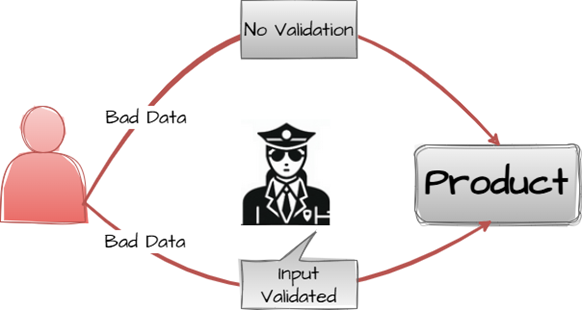
The product receives input or data, but it does
not validate or incorrectly validates that the input has the
properties that are required to process the data safely and
correctly.
Extended Description
Input validation is a frequently-used technique
for checking potentially dangerous inputs in order to
ensure that the inputs are safe for processing within the
code, or when communicating with other components.
Input can consist of:
raw data - strings, numbers, parameters, file contents, etc.
metadata - information about the raw data, such as headers or size
Data can be simple or structured. Structured data
can be composed of many nested layers, composed of
combinations of metadata and raw data, with other simple or
structured data.
Many properties of raw data or metadata may need
to be validated upon entry into the code, such
as:
specified quantities such as size, length, frequency, price, rate, number of operations, time, etc.
implied or derived quantities, such as the actual size of a file instead of a specified size
indexes, offsets, or positions into more complex data structures
symbolic keys or other elements into hash tables, associative arrays, etc.
well-formedness, i.e. syntactic correctness - compliance with expected syntax
lexical token correctness - compliance with rules for what is treated as a token
specified or derived type - the actual type of the input (or what the input appears to be)
consistency - between individual data elements, between raw data and metadata, between references, etc.
conformance to domain-specific rules, e.g. business logic
equivalence - ensuring that equivalent inputs are treated the same
authenticity, ownership, or other attestations about the input, e.g. a cryptographic signature to prove the source of the data
Implied or derived properties of data must often
be calculated or inferred by the code itself. Errors in
deriving properties may be considered a contributing factor
to improper input validation.
Common Consequences
This table specifies different individual consequences
associated with the weakness. The Scope identifies the application security area that is
violated, while the Impact describes the negative technical impact that arises if an
adversary succeeds in exploiting this weakness. The Likelihood provides information about
how likely the specific consequence is expected to be seen relative to the other
consequences in the list. For example, there may be high likelihood that a weakness will be
exploited to achieve a certain impact, but a low likelihood that it will be exploited to
achieve a different impact.
An attacker could provide unexpected values and cause a program crash or arbitrary control of resource allocation, leading to excessive consumption of resources such as memory and CPU.
Read Memory; Read Files or Directories
Scope: Confidentiality
An attacker could read confidential data if they are able to control resource references.
Modify Memory; Execute Unauthorized Code or Commands
Scope: Integrity, Confidentiality, Availability
An attacker could use malicious input to modify data or possibly alter control flow in unexpected ways, including arbitrary command execution.
Potential Mitigations
Phase(s)
Mitigation
Architecture and Design
Strategy: Attack Surface Reduction
Consider using language-theoretic security (LangSec) techniques that characterize inputs using a formal language and build "recognizers" for that language. This effectively requires parsing to be a distinct layer that effectively enforces a boundary between raw input and internal data representations, instead of allowing parser code to be scattered throughout the program, where it could be subject to errors or inconsistencies that create weaknesses. [REF-1109] [REF-1110] [REF-1111]
Architecture and Design
Strategy: Libraries or Frameworks
Use an input validation framework such as Struts or the OWASP ESAPI Validation API. Note that using a framework does not automatically address all input validation problems; be mindful of weaknesses that could arise from misusing the framework itself (CWE-1173).
Architecture and Design; Implementation
Strategy: Attack Surface Reduction
Understand all the potential areas where untrusted inputs can enter the product, including but not limited to: parameters or arguments, cookies, anything read from the network, environment variables, reverse DNS lookups, query results, request headers, URL components, e-mail, files, filenames, databases, and any external systems that provide data to the application. Remember that such inputs may be obtained indirectly through API calls.
Implementation
Strategy: Input Validation
Assume all input is malicious. Use an "accept known good" input validation strategy, i.e., use a list of acceptable inputs that strictly conform to specifications. Reject any input that does not strictly conform to specifications, or transform it into something that does.
When performing input validation, consider all potentially relevant properties, including length, type of input, the full range of acceptable values, missing or extra inputs, syntax, consistency across related fields, and conformance to business rules. As an example of business rule logic, "boat" may be syntactically valid because it only contains alphanumeric characters, but it is not valid if the input is only expected to contain colors such as "red" or "blue."
Do not rely exclusively on looking for malicious or malformed inputs. This is likely to miss at least one undesirable input, especially if the code's environment changes. This can give attackers enough room to bypass the intended validation. However, denylists can be useful for detecting potential attacks or determining which inputs are so malformed that they should be rejected outright.
Effectiveness: High
Architecture and Design
For any security checks that are performed on the client side, ensure that these checks are duplicated on the server side, in order to avoid CWE-602. Attackers can bypass the client-side checks by modifying values after the checks have been performed, or by changing the client to remove the client-side checks entirely. Then, these modified values would be submitted to the server.
Even though client-side checks provide minimal benefits with respect to server-side security, they are still useful. First, they can support intrusion detection. If the server receives input that should have been rejected by the client, then it may be an indication of an attack. Second, client-side error-checking can provide helpful feedback to the user about the expectations for valid input. Third, there may be a reduction in server-side processing time for accidental input errors, although this is typically a small savings.
Implementation
When your application combines data from multiple sources, perform the validation after the sources have been combined. The individual data elements may pass the validation step but violate the intended restrictions after they have been combined.
Implementation
Be especially careful to validate all input when invoking code that crosses language boundaries, such as from an interpreted language to native code. This could create an unexpected interaction between the language boundaries. Ensure that you are not violating any of the expectations of the language with which you are interfacing. For example, even though Java may not be susceptible to buffer overflows, providing a large argument in a call to native code might trigger an overflow.
Implementation
Directly convert your input type into the expected data type, such as using a conversion function that translates a string into a number. After converting to the expected data type, ensure that the input's values fall within the expected range of allowable values and that multi-field consistencies are maintained.
Implementation
Inputs should be decoded and canonicalized to the application's current internal representation before being validated (CWE-180, CWE-181). Make sure that your application does not inadvertently decode the same input twice (CWE-174). Such errors could be used to bypass allowlist schemes by introducing dangerous inputs after they have been checked. Use libraries such as the OWASP ESAPI Canonicalization control.
Consider performing repeated canonicalization until your input does not change any more. This will avoid double-decoding and similar scenarios, but it might inadvertently modify inputs that are allowed to contain properly-encoded dangerous content.
Implementation
When exchanging data between components, ensure that both components are using the same character encoding. Ensure that the proper encoding is applied at each interface. Explicitly set the encoding you are using whenever the protocol allows you to do so.
Relationships
This table shows the weaknesses and high level categories that are related to this
weakness. These relationships are defined as ChildOf, ParentOf, MemberOf and give insight to
similar items that may exist at higher and lower levels of abstraction. In addition,
relationships such as PeerOf and CanAlsoBe are defined to show similar weaknesses that the user
may want to explore.
Relevant to the view "Research Concepts" (View-1000)
Nature
Type
ID
Name
ChildOf
Pillar - a weakness that is the most abstract type of weakness and represents a theme for all class/base/variant weaknesses related to it. A Pillar is different from a Category as a Pillar is still technically a type of weakness that describes a mistake, while a Category represents a common characteristic used to group related things.
Base - a weakness that is still mostly independent of a resource or technology, but with sufficient details to provide specific methods for detection and prevention. Base level weaknesses typically describe issues in terms of 2 or 3 of the following dimensions: behavior, property, technology, language, and resource.
Variant - a weakness that is linked to a certain type of product, typically involving a specific language or technology. More specific than a Base weakness. Variant level weaknesses typically describe issues in terms of 3 to 5 of the following dimensions: behavior, property, technology, language, and resource.
Base - a weakness that is still mostly independent of a resource or technology, but with sufficient details to provide specific methods for detection and prevention. Base level weaknesses typically describe issues in terms of 2 or 3 of the following dimensions: behavior, property, technology, language, and resource.
Base - a weakness that is still mostly independent of a resource or technology, but with sufficient details to provide specific methods for detection and prevention. Base level weaknesses typically describe issues in terms of 2 or 3 of the following dimensions: behavior, property, technology, language, and resource.
Improper Validation of Specified Quantity in Input
ParentOf
Base - a weakness that is still mostly independent of a resource or technology, but with sufficient details to provide specific methods for detection and prevention. Base level weaknesses typically describe issues in terms of 2 or 3 of the following dimensions: behavior, property, technology, language, and resource.
Improper Validation of Specified Index, Position, or Offset in Input
ParentOf
Base - a weakness that is still mostly independent of a resource or technology, but with sufficient details to provide specific methods for detection and prevention. Base level weaknesses typically describe issues in terms of 2 or 3 of the following dimensions: behavior, property, technology, language, and resource.
Improper Validation of Syntactic Correctness of Input
ParentOf
Base - a weakness that is still mostly independent of a resource or technology, but with sufficient details to provide specific methods for detection and prevention. Base level weaknesses typically describe issues in terms of 2 or 3 of the following dimensions: behavior, property, technology, language, and resource.
Base - a weakness that is still mostly independent of a resource or technology, but with sufficient details to provide specific methods for detection and prevention. Base level weaknesses typically describe issues in terms of 2 or 3 of the following dimensions: behavior, property, technology, language, and resource.
Base - a weakness that is still mostly independent of a resource or technology, but with sufficient details to provide specific methods for detection and prevention. Base level weaknesses typically describe issues in terms of 2 or 3 of the following dimensions: behavior, property, technology, language, and resource.
Improper Validation of Unsafe Equivalence in Input
PeerOf
Class - a weakness that is described in a very abstract fashion, typically independent of any specific language or technology. More specific than a Pillar Weakness, but more general than a Base Weakness. Class level weaknesses typically describe issues in terms of 1 or 2 of the following dimensions: behavior, property, and resource.
Base - a weakness that is still mostly independent of a resource or technology, but with sufficient details to provide specific methods for detection and prevention. Base level weaknesses typically describe issues in terms of 2 or 3 of the following dimensions: behavior, property, technology, language, and resource.
Improper Limitation of a Pathname to a Restricted Directory ('Path Traversal')
CanPrecede
Base - a weakness that is still mostly independent of a resource or technology, but with sufficient details to provide specific methods for detection and prevention. Base level weaknesses typically describe issues in terms of 2 or 3 of the following dimensions: behavior, property, technology, language, and resource.
Class - a weakness that is described in a very abstract fashion, typically independent of any specific language or technology. More specific than a Pillar Weakness, but more general than a Base Weakness. Class level weaknesses typically describe issues in terms of 1 or 2 of the following dimensions: behavior, property, and resource.
Improper Neutralization of Special Elements in Output Used by a Downstream Component ('Injection')
CanPrecede
Class - a weakness that is described in a very abstract fashion, typically independent of any specific language or technology. More specific than a Pillar Weakness, but more general than a Base Weakness. Class level weaknesses typically describe issues in terms of 1 or 2 of the following dimensions: behavior, property, and resource.
Improper Restriction of Operations within the Bounds of a Memory Buffer
CanPrecede
Base - a weakness that is still mostly independent of a resource or technology, but with sufficient details to provide specific methods for detection and prevention. Base level weaknesses typically describe issues in terms of 2 or 3 of the following dimensions: behavior, property, technology, language, and resource.
Allocation of Resources Without Limits or Throttling
Relevant to the view "Weaknesses for Simplified Mapping of Published Vulnerabilities" (View-1003)
Nature
Type
ID
Name
MemberOf
View - a subset of CWE entries that provides a way of examining CWE content. The two main view structures are Slices (flat lists) and Graphs (containing relationships between entries).
Weaknesses for Simplified Mapping of Published Vulnerabilities
ParentOf
Variant - a weakness that is linked to a certain type of product, typically involving a specific language or technology. More specific than a Base weakness. Variant level weaknesses typically describe issues in terms of 3 to 5 of the following dimensions: behavior, property, technology, language, and resource.
Base - a weakness that is still mostly independent of a resource or technology, but with sufficient details to provide specific methods for detection and prevention. Base level weaknesses typically describe issues in terms of 2 or 3 of the following dimensions: behavior, property, technology, language, and resource.
Relevant to the view "Seven Pernicious Kingdoms" (View-700)
Nature
Type
ID
Name
ParentOf
Base - a weakness that is still mostly independent of a resource or technology, but with sufficient details to provide specific methods for detection and prevention. Base level weaknesses typically describe issues in terms of 2 or 3 of the following dimensions: behavior, property, technology, language, and resource.
External Control of System or Configuration Setting
ParentOf
Base - a weakness that is still mostly independent of a resource or technology, but with sufficient details to provide specific methods for detection and prevention. Base level weaknesses typically describe issues in terms of 2 or 3 of the following dimensions: behavior, property, technology, language, and resource.
Variant - a weakness that is linked to a certain type of product, typically involving a specific language or technology. More specific than a Base weakness. Variant level weaknesses typically describe issues in terms of 3 to 5 of the following dimensions: behavior, property, technology, language, and resource.
Variant - a weakness that is linked to a certain type of product, typically involving a specific language or technology. More specific than a Base weakness. Variant level weaknesses typically describe issues in terms of 3 to 5 of the following dimensions: behavior, property, technology, language, and resource.
Variant - a weakness that is linked to a certain type of product, typically involving a specific language or technology. More specific than a Base weakness. Variant level weaknesses typically describe issues in terms of 3 to 5 of the following dimensions: behavior, property, technology, language, and resource.
Struts: Form Bean Does Not Extend Validation Class
ParentOf
Variant - a weakness that is linked to a certain type of product, typically involving a specific language or technology. More specific than a Base weakness. Variant level weaknesses typically describe issues in terms of 3 to 5 of the following dimensions: behavior, property, technology, language, and resource.
Variant - a weakness that is linked to a certain type of product, typically involving a specific language or technology. More specific than a Base weakness. Variant level weaknesses typically describe issues in terms of 3 to 5 of the following dimensions: behavior, property, technology, language, and resource.
Variant - a weakness that is linked to a certain type of product, typically involving a specific language or technology. More specific than a Base weakness. Variant level weaknesses typically describe issues in terms of 3 to 5 of the following dimensions: behavior, property, technology, language, and resource.
Variant - a weakness that is linked to a certain type of product, typically involving a specific language or technology. More specific than a Base weakness. Variant level weaknesses typically describe issues in terms of 3 to 5 of the following dimensions: behavior, property, technology, language, and resource.
Variant - a weakness that is linked to a certain type of product, typically involving a specific language or technology. More specific than a Base weakness. Variant level weaknesses typically describe issues in terms of 3 to 5 of the following dimensions: behavior, property, technology, language, and resource.
Variant - a weakness that is linked to a certain type of product, typically involving a specific language or technology. More specific than a Base weakness. Variant level weaknesses typically describe issues in terms of 3 to 5 of the following dimensions: behavior, property, technology, language, and resource.
Variant - a weakness that is linked to a certain type of product, typically involving a specific language or technology. More specific than a Base weakness. Variant level weaknesses typically describe issues in terms of 3 to 5 of the following dimensions: behavior, property, technology, language, and resource.
Base - a weakness that is still mostly independent of a resource or technology, but with sufficient details to provide specific methods for detection and prevention. Base level weaknesses typically describe issues in terms of 2 or 3 of the following dimensions: behavior, property, technology, language, and resource.
Variant - a weakness that is linked to a certain type of product, typically involving a specific language or technology. More specific than a Base weakness. Variant level weaknesses typically describe issues in terms of 3 to 5 of the following dimensions: behavior, property, technology, language, and resource.
Improper Neutralization of CRLF Sequences in HTTP Headers ('HTTP Request/Response Splitting')
ParentOf
Class - a weakness that is described in a very abstract fashion, typically independent of any specific language or technology. More specific than a Pillar Weakness, but more general than a Base Weakness. Class level weaknesses typically describe issues in terms of 1 or 2 of the following dimensions: behavior, property, and resource.
Base - a weakness that is still mostly independent of a resource or technology, but with sufficient details to provide specific methods for detection and prevention. Base level weaknesses typically describe issues in terms of 2 or 3 of the following dimensions: behavior, property, technology, language, and resource.
Class - a weakness that is described in a very abstract fashion, typically independent of any specific language or technology. More specific than a Pillar Weakness, but more general than a Base Weakness. Class level weaknesses typically describe issues in terms of 1 or 2 of the following dimensions: behavior, property, and resource.
Improper Restriction of Operations within the Bounds of a Memory Buffer
ParentOf
Base - a weakness that is still mostly independent of a resource or technology, but with sufficient details to provide specific methods for detection and prevention. Base level weaknesses typically describe issues in terms of 2 or 3 of the following dimensions: behavior, property, technology, language, and resource.
Buffer Copy without Checking Size of Input ('Classic Buffer Overflow')
ParentOf
Base - a weakness that is still mostly independent of a resource or technology, but with sufficient details to provide specific methods for detection and prevention. Base level weaknesses typically describe issues in terms of 2 or 3 of the following dimensions: behavior, property, technology, language, and resource.
Base - a weakness that is still mostly independent of a resource or technology, but with sufficient details to provide specific methods for detection and prevention. Base level weaknesses typically describe issues in terms of 2 or 3 of the following dimensions: behavior, property, technology, language, and resource.
Base - a weakness that is still mostly independent of a resource or technology, but with sufficient details to provide specific methods for detection and prevention. Base level weaknesses typically describe issues in terms of 2 or 3 of the following dimensions: behavior, property, technology, language, and resource.
Base - a weakness that is still mostly independent of a resource or technology, but with sufficient details to provide specific methods for detection and prevention. Base level weaknesses typically describe issues in terms of 2 or 3 of the following dimensions: behavior, property, technology, language, and resource.
Base - a weakness that is still mostly independent of a resource or technology, but with sufficient details to provide specific methods for detection and prevention. Base level weaknesses typically describe issues in terms of 2 or 3 of the following dimensions: behavior, property, technology, language, and resource.
Use of Externally-Controlled Input to Select Classes or Code ('Unsafe Reflection')
ParentOf
Variant - a weakness that is linked to a certain type of product, typically involving a specific language or technology. More specific than a Base weakness. Variant level weaknesses typically describe issues in terms of 3 to 5 of the following dimensions: behavior, property, technology, language, and resource.
Use of Path Manipulation Function without Maximum-sized Buffer
Modes
Of Introduction
The different Modes of Introduction provide information
about how and when this
weakness may be introduced. The Phase identifies a point in the life cycle at which
introduction
may occur, while the Note provides a typical scenario related to introduction during the
given
phase.
Phase
Note
Architecture and Design
Implementation
REALIZATION: This weakness is caused during implementation of an architectural security tactic.
If a programmer believes that an attacker cannot modify certain inputs, then the programmer might not perform any input validation at all. For example, in web applications, many programmers believe that cookies and hidden form fields can not be modified from a web browser (CWE-472), although they can be altered using a proxy or a custom program. In a client-server architecture, the programmer might assume that client-side security checks cannot be bypassed, even when a custom client could be written that skips those checks (CWE-602).
Applicable Platforms
This listing shows possible areas for which the given
weakness could appear. These
may be for specific named Languages, Operating Systems, Architectures, Paradigms,
Technologies,
or a class of such platforms. The platform is listed along with how frequently the given
weakness appears for that instance.
Languages
Class: Not Language-Specific
(Often Prevalent)
Technologies
AI/ML
(Often Prevalent)
Likelihood Of Exploit
High
Demonstrative Examples
Example 1
This example demonstrates a shopping interaction in which the user is free to specify the quantity of items to be purchased and a total is calculated.
(bad code)
Example Language: Java
... public static final double price = 20.00; int quantity = currentUser.getAttribute("quantity"); double total = price * quantity; chargeUser(total); ...
The user has no control over the price variable, however the code does not prevent a negative value from being specified for quantity. If an attacker were to provide a negative value, then the user would have their account credited instead of debited.
Example 2
This example asks the user for a height and width of an m X n game board with a maximum dimension of 100 squares.
int m,n, error; board_square_t *board; printf("Please specify the board height: \n"); error = scanf("%d", &m); if ( EOF == error ){
die("No integer passed: Die evil hacker!\n");
} printf("Please specify the board width: \n"); error = scanf("%d", &n); if ( EOF == error ){
die("No integer passed: Die evil hacker!\n");
} if ( m > MAX_DIM || n > MAX_DIM ) {
die("Value too large: Die evil hacker!\n");
} board = (board_square_t*) malloc( m * n * sizeof(board_square_t)); ...
While this code checks to make sure the user cannot specify large, positive integers and consume too much memory, it does not check for negative values supplied by the user. As a result, an attacker can perform a resource consumption (CWE-400) attack against this program by specifying two, large negative values that will not overflow, resulting in a very large memory allocation (CWE-789) and possibly a system crash. Alternatively, an attacker can provide very large negative values which will cause an integer overflow (CWE-190) and unexpected behavior will follow depending on how the values are treated in the remainder of the program.
Example 3
The following example shows a PHP application in which the programmer attempts to display a user's birthday and homepage.
The programmer intended for $birthday to be in a date format and $homepage to be a valid URL. However, since the values are derived from an HTTP request, if an attacker can trick a victim into clicking a crafted URL with <script> tags providing the values for birthday and / or homepage, then the script will run on the client's browser when the web server echoes the content. Notice that even if the programmer were to defend the $birthday variable by restricting input to integers and dashes, it would still be possible for an attacker to provide a string of the form:
(attack code)
2009-01-09--
If this data were used in a SQL statement, it would treat the remainder of the statement as a comment. The comment could disable other security-related logic in the statement. In this case, encoding combined with input validation would be a more useful protection mechanism.
Furthermore, an XSS (CWE-79) attack or SQL injection (CWE-89) are just a few of the potential consequences when input validation is not used. Depending on the context of the code, CRLF Injection (CWE-93), Argument Injection (CWE-88), or Command Injection (CWE-77) may also be possible.
Example 4
The following example takes a user-supplied value to allocate an array of objects and then operates on the array.
(bad code)
Example Language: Java
private void buildList ( int untrustedListSize ){
if ( 0 > untrustedListSize ){
die("Negative value supplied for list size, die evil hacker!");
} Widget[] list = new Widget [ untrustedListSize ]; list[0] = new Widget();
}
This example attempts to build a list from a user-specified value, and even checks to ensure a non-negative value is supplied. If, however, a 0 value is provided, the code will build an array of size 0 and then try to store a new Widget in the first location, causing an exception to be thrown.
Example 5
This Android application has registered to handle a URL when sent an intent:
(bad code)
Example Language: Java
... IntentFilter filter = new IntentFilter("com.example.URLHandler.openURL"); MyReceiver receiver = new MyReceiver(); registerReceiver(receiver, filter); ...
public class UrlHandlerReceiver extends BroadcastReceiver {
@Override public void onReceive(Context context, Intent intent) {
String URL = intent.getStringExtra("URLToOpen"); int length = URL.length();
... }
}
}
The application assumes the URL will always be included in the intent. When the URL is not present, the call to getStringExtra() will return null, thus causing a null pointer exception when length() is called.
Selected Observed
Examples
Note: this is a curated list of examples for users to understand the variety of ways in which this
weakness can be introduced. It is not a complete list of all CVEs that are related to this CWE entry.
Large language model (LLM) management tool does not
validate the format of a digest value (CWE-1287) from a
private, untrusted model registry, enabling relative
path traversal (CWE-23), a.k.a. Probllama
Chain: a learning management tool debugger uses external input to locate previous session logs (CWE-73) and does not properly validate the given path (CWE-20), allowing for filesystem path traversal using "../" sequences (CWE-24)
Chain: backslash followed by a newline can bypass a validation step (CWE-20), leading to eval injection (CWE-95), as exploited in the wild per CISA KEV.
crash via multiple "." characters in file extension
Weakness Ordinalities
Ordinality
Description
Primary
(where the weakness exists independent of other weaknesses)
Detection
Methods
Method
Details
Automated Static Analysis
Some instances of improper input validation can be detected using automated static analysis.
A static analysis tool might allow the user to specify which application-specific methods or functions perform input validation; the tool might also have built-in knowledge of validation frameworks such as Struts. The tool may then suppress or de-prioritize any associated warnings. This allows the analyst to focus on areas of the software in which input validation does not appear to be present.
Except in the cases described in the previous paragraph, automated static analysis might not be able to recognize when proper input validation is being performed, leading to false positives - i.e., warnings that do not have any security consequences or require any code changes.
Manual Static Analysis
When custom input validation is required, such as when enforcing business rules, manual analysis is necessary to ensure that the validation is properly implemented.
Fuzzing
Fuzzing techniques can be useful for detecting input validation errors. When unexpected inputs are provided to the software, the software should not crash or otherwise become unstable, and it should generate application-controlled error messages. If exceptions or interpreter-generated error messages occur, this indicates that the input was not detected and handled within the application logic itself.
Automated Static Analysis - Binary or Bytecode
According to SOAR [REF-1479], the following detection techniques may be useful:
This MemberOf Relationships table shows additional CWE Categories and Views that
reference this weakness as a member. This information is often useful in understanding where a
weakness fits within the context of external information sources.
Nature
Type
ID
Name
MemberOf
View - a subset of CWE entries that provides a way of examining CWE content. The two main view structures are Slices (flat lists) and Graphs (containing relationships between entries).
SEI CERT C Coding Standard - Guidelines 09. Input Output (FIO)
MemberOf
View - a subset of CWE entries that provides a way of examining CWE content. The two main view structures are Slices (flat lists) and Graphs (containing relationships between entries).
Weaknesses in the 2019 CWE Top 25 Most Dangerous Software Errors
MemberOf
View - a subset of CWE entries that provides a way of examining CWE content. The two main view structures are Slices (flat lists) and Graphs (containing relationships between entries).
View - a subset of CWE entries that provides a way of examining CWE content. The two main view structures are Slices (flat lists) and Graphs (containing relationships between entries).
ICS Operations (& Maintenance): Emerging Energy Technologies
MemberOf
View - a subset of CWE entries that provides a way of examining CWE content. The two main view structures are Slices (flat lists) and Graphs (containing relationships between entries).
View - a subset of CWE entries that provides a way of examining CWE content. The two main view structures are Slices (flat lists) and Graphs (containing relationships between entries).
Weaknesses in the 2023 CWE Top 25 Most Dangerous Software Weaknesses
MemberOf
View - a subset of CWE entries that provides a way of examining CWE content. The two main view structures are Slices (flat lists) and Graphs (containing relationships between entries).
Weaknesses in the 2024 CWE Top 25 Most Dangerous Software Weaknesses
MemberOf
View - a subset of CWE entries that provides a way of examining CWE content. The two main view structures are Slices (flat lists) and Graphs (containing relationships between entries).
CWE-20 is commonly misused in low-information vulnerability reports when lower-level CWEs could be used instead, or when more details about the vulnerability are available [REF-1287]. It is not useful for trend analysis. It is also a level-1 Class (i.e., a child of a Pillar). Finally, CWE-20 is often misused when the root cause issue is related to how input is incorrectly transformed, instead of "validated" to be correct as-is.
Comments
Within CWE, the "input validation" term focuses on the act of checking whether an input is already safe, which is different from other techniques that ensure safe processing of input. Carefully perform root-cause analysis to be sure that the issue is not due to techniques that attempt to transform potentially-dangerous input into something safe, such as filtering (CWE-790) - which attempts to remove dangerous inputs - or encoding/escaping (CWE-116), which attempts to ensure that the input is not misinterpreted when it is included in output to another component.
If the issue is truly due to imroper input validation, consider using lower-level children.
CWE-116 and CWE-20 have a close association because, depending on the nature of the structured message, proper input validation can indirectly prevent special characters from changing the meaning of a structured message. For example, by validating that a numeric ID field should only contain the 0-9 characters, the programmer effectively prevents injection attacks.
Multiple techniques exist to transform potentially dangerous input into something safe, which is different than "validation," which is a technique to check if an input is already safe. CWE users need to be cautious during root cause analysis to ensure that an issue is truly an input-validation problem.
Terminology
The "input validation" term is extremely common, but it is used in many different ways. In some cases its usage can obscure the real underlying weakness or otherwise hide chaining and composite relationships.
Some people use "input validation" as a general term that covers many different neutralization techniques for ensuring that input is appropriate, such as filtering, i.e., attempting to remove dangerous inputs (related to CWE-790); encoding/escaping, i.e., attempting to ensure that the input is not misinterpreted when it is included in output to another component (related to CWE-116); or canonicalization, which often indirectly removes otherwise-dangerous inputs. Others use the term in a narrower context to simply mean "checking if an input conforms to expectations without changing it." CWE uses this narrow interpretation.
Note that "input validation" has very different
meanings to different people, or within different
classification schemes. Caution must be used when
referencing this CWE entry or mapping to it. For example,
some weaknesses might involve inadvertently giving control
to an attacker over an input when they should not be able
to provide an input at all, but sometimes this is referred
to as input validation.
Finally, it is important to emphasize that the
distinctions between input validation and output escaping
are often blurred. Developers must be careful to
understand the difference, including how input validation
is not always sufficient to prevent vulnerabilities,
especially when less stringent data types must be
supported, such as free-form text. Consider a SQL injection
scenario in which a person's last name is inserted into a
query. The name "O'Reilly" would likely pass the validation
step since it is a common last name in the English
language. However, this valid name cannot be directly
inserted into the database because it contains the "'"
apostrophe character, which would need to be escaped or
otherwise transformed. In this case, removing the
apostrophe might reduce the risk of SQL injection, but it
would produce incorrect behavior because the wrong name
would be recorded.
Maintenance
As of 2020, this entry is used more often than preferred, and it is a source of frequent confusion. It is being actively modified for CWE 4.1 and subsequent versions.
Maintenance
Concepts such as validation, data transformation, and neutralization are being refined, so relationships between CWE-20 and other entries such as CWE-707 may change in future versions, along with an update to the Vulnerability Theory document.
Maintenance
Input validation - whether missing or incorrect - is such an essential and widespread part of secure development that it is implicit in many different weaknesses. Traditionally, problems such as buffer overflows and XSS have been classified as input validation problems by many security professionals. However, input validation is not necessarily the only protection mechanism available for avoiding such problems, and in some cases it is not even sufficient. The CWE team has begun capturing these subtleties in chains within the Research Concepts view (CWE-1000), but more work is needed.
Taxonomy
Mappings
Mapped Taxonomy Name
Node ID
Fit
Mapped Node Name
7 Pernicious Kingdoms
Input validation and representation
OWASP Top Ten 2004
A1
CWE More Specific
Unvalidated Input
CERT C Secure Coding
ERR07-C
Prefer functions that support error checking over equivalent functions that don't


 Description
 This table specifies different individual consequences
associated with the weakness. The Scope identifies the application security area that is
violated, while the Impact describes the negative technical impact that arises if an
adversary succeeds in exploiting this weakness. The Likelihood provides information about
how likely the specific consequence is expected to be seen relative to the other
consequences in the list. For example, there may be high likelihood that a weakness will be
exploited to achieve a certain impact, but a low likelihood that it will be exploited to
achieve a different impact.
This table specifies different individual consequences
associated with the weakness. The Scope identifies the application security area that is
violated, while the Impact describes the negative technical impact that arises if an
adversary succeeds in exploiting this weakness. The Likelihood provides information about
how likely the specific consequence is expected to be seen relative to the other
consequences in the list. For example, there may be high likelihood that a weakness will be
exploited to achieve a certain impact, but a low likelihood that it will be exploited to
achieve a different impact.