CWE-119: Improper Restriction of Operations within the Bounds of a Memory Buffer
Weakness ID: 119
Vulnerability Mapping:DISCOURAGEDThis CWE ID should not be used to map to real-world vulnerabilities Abstraction:
ClassClass - a weakness that is described in a very abstract fashion, typically independent of any specific language or technology. More specific than a Pillar Weakness, but more general than a Base Weakness. Class level weaknesses typically describe issues in terms of 1 or 2 of the following dimensions: behavior, property, and resource.
View customized information:
For users who are interested in more notional aspects of a weakness. Example: educators, technical writers, and project/program managers.For users who are concerned with the practical application and details about the nature of a weakness and how to prevent it from happening. Example: tool developers, security researchers, pen-testers, incident response analysts.For users who are mapping an issue to CWE/CAPEC IDs, i.e., finding the most appropriate CWE for a specific issue (e.g., a CVE record). Example: tool developers, security researchers.For users who wish to see all available information for the CWE/CAPEC entry.For users who want to customize what details are displayed.
×
Edit Custom Filter
Description
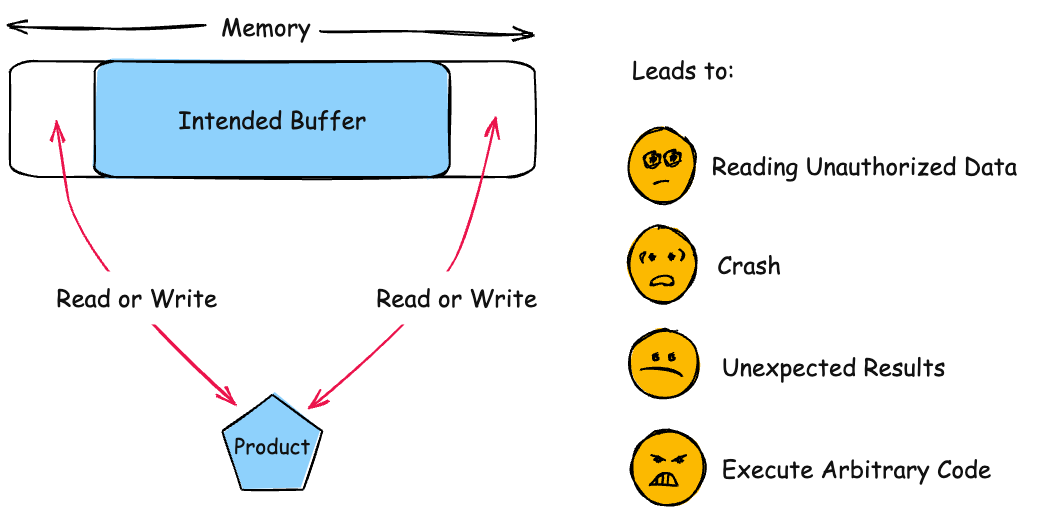
The product performs operations on a memory buffer, but it reads from or writes to a memory location outside the buffer's intended boundary. This may result in read or write operations on unexpected memory locations that could be linked to other variables, data structures, or internal program data.
Alternate Terms
Buffer Overflow
This term has many different meanings to different audiences. From a CWE mapping perspective, this term should be avoided where possible. Some researchers, developers, and tools intend for it to mean "write past the end of a buffer," whereas others use the same term to mean "any read or write outside the boundaries of a buffer, whether before the beginning of the buffer or after the end of the buffer." Others could mean "any action after the end of a buffer, whether it is a read or write." Since the term is commonly used for exploitation and for vulnerabilities, it further confuses things.
buffer overrun
Some prominent vendors and researchers use the term "buffer overrun," but most people use "buffer overflow." See the alternate term for "buffer overflow" for context.
memory safety
Generally used for techniques that avoid weaknesses related to memory access, such as those identified by CWE-119 and its descendants. However, the term is not formal, and there is likely disagreement between practitioners as to which weaknesses are implicitly covered by the "memory safety" term.
Common Consequences
This table specifies different individual consequences
associated with the weakness. The Scope identifies the application security area that is
violated, while the Impact describes the negative technical impact that arises if an
adversary succeeds in exploiting this weakness. The Likelihood provides information about
how likely the specific consequence is expected to be seen relative to the other
consequences in the list. For example, there may be high likelihood that a weakness will be
exploited to achieve a certain impact, but a low likelihood that it will be exploited to
achieve a different impact.
Impact
Details
Execute Unauthorized Code or Commands; Modify Memory
Scope: Integrity, Confidentiality, Availability
If the memory accessible by the attacker can be effectively controlled, it may be possible to execute arbitrary code, as with a standard buffer overflow. If the attacker can overwrite a pointer's worth of memory (usually 32 or 64 bits), they can alter the intended control flow by redirecting a function pointer to their own malicious code. Even when the attacker can only modify a single byte arbitrary code execution can be possible. Sometimes this is because the same problem can be exploited repeatedly to the same effect. Other times it is because the attacker can overwrite security-critical application-specific data -- such as a flag indicating whether the user is an administrator.
Out of bounds memory access will very likely result in the corruption of relevant memory, and perhaps instructions, possibly leading to a crash. Other attacks leading to lack of availability are possible, including putting the program into an infinite loop.
Read Memory
Scope: Confidentiality
In the case of an out-of-bounds read, the attacker may have access to sensitive information. If the sensitive information contains system details, such as the current buffer's position in memory, this knowledge can be used to craft further attacks, possibly with more severe consequences.
Potential Mitigations
Phase(s)
Mitigation
Requirements
Strategy: Language Selection
Use a language that does not allow this weakness to occur or provides constructs that make this weakness easier to avoid.
For example, many languages that perform their own memory management, such as Java and Perl, are not subject to buffer overflows. Other languages, such as Ada and C#, typically provide overflow protection, but the protection can be disabled by the programmer.
Be wary that a language's interface to native code may still be subject to overflows, even if the language itself is theoretically safe.
Architecture and Design
Strategy: Libraries or Frameworks
Use a vetted library or framework that does not allow this weakness to occur or provides constructs that make this weakness easier to avoid.
Examples include the Safe C String Library (SafeStr) by Messier and Viega [REF-57], and the Strsafe.h library from Microsoft [REF-56]. These libraries provide safer versions of overflow-prone string-handling functions.
Note: This is not a complete solution, since many buffer overflows are not related to strings.
Operation; Build and Compilation
Strategy: Environment Hardening
Use automatic buffer overflow detection mechanisms that are offered by certain compilers or compiler extensions. Examples include: the Microsoft Visual Studio /GS flag, Fedora/Red Hat FORTIFY_SOURCE GCC flag, StackGuard, and ProPolice, which provide various mechanisms including canary-based detection and range/index checking.
D3-SFCV (Stack Frame Canary Validation) from D3FEND [REF-1334] discusses canary-based detection in detail.
Effectiveness: Defense in Depth
Note:
This is not necessarily a complete solution, since these mechanisms only detect certain types of overflows. In addition, the result is still a denial of service, since the typical response is to exit the application.
Implementation
Consider adhering to the following rules when allocating and managing an application's memory:
Double check that the buffer is as large as specified.
When using functions that accept a number of bytes to copy, such as strncpy(), be aware that if the destination buffer size is equal to the source buffer size, it may not NULL-terminate the string.
Check buffer boundaries if accessing the buffer in a loop and make sure there is no danger of writing past the allocated space.
If necessary, truncate all input strings to a reasonable length before passing them to the copy and concatenation functions.
Operation; Build and Compilation
Strategy: Environment Hardening
Run or compile the software using features or extensions that randomly arrange the positions of a program's executable and libraries in memory. Because this makes the addresses unpredictable, it can prevent an attacker from reliably jumping to exploitable code.
Examples include Address Space Layout Randomization (ASLR) [REF-58] [REF-60] and Position-Independent Executables (PIE) [REF-64]. Imported modules may be similarly realigned if their default memory addresses conflict with other modules, in a process known as "rebasing" (for Windows) and "prelinking" (for Linux) [REF-1332] using randomly generated addresses. ASLR for libraries cannot be used in conjunction with prelink since it would require relocating the libraries at run-time, defeating the whole purpose of prelinking.
For more information on these techniques see D3-SAOR (Segment Address Offset Randomization) from D3FEND [REF-1335].
Effectiveness: Defense in Depth
Note: These techniques do not provide a complete solution. For instance, exploits frequently use a bug that discloses memory addresses in order to maximize reliability of code execution [REF-1337]. It has also been shown that a side-channel attack can bypass ASLR [REF-1333].
Operation
Strategy: Environment Hardening
Use a CPU and operating system that offers Data Execution Protection (using hardware NX or XD bits) or the equivalent techniques that simulate this feature in software, such as PaX [REF-60] [REF-61]. These techniques ensure that any instruction executed is exclusively at a memory address that is part of the code segment.
For more information on these techniques see D3-PSEP (Process Segment Execution Prevention) from D3FEND [REF-1336].
Effectiveness: Defense in Depth
Note: This is not a complete solution, since buffer overflows could be used to overwrite nearby variables to modify the software's state in dangerous ways. In addition, it cannot be used in cases in which self-modifying code is required. Finally, an attack could still cause a denial of service, since the typical response is to exit the application.
Implementation
Replace unbounded copy functions with analogous functions that support length arguments, such as strcpy with strncpy. Create these if they are not available.
Effectiveness: Moderate
Note: This approach is still susceptible to calculation errors, including issues such as off-by-one errors (CWE-193) and incorrectly calculating buffer lengths (CWE-131).
Relationships
This table shows the weaknesses and high level categories that are related to this
weakness. These relationships are defined as ChildOf, ParentOf, MemberOf and give insight to
similar items that may exist at higher and lower levels of abstraction. In addition,
relationships such as PeerOf and CanAlsoBe are defined to show similar weaknesses that the user
may want to explore.
Relevant to the view "Research Concepts" (View-1000)
Nature
Type
ID
Name
ChildOf
Class - a weakness that is described in a very abstract fashion, typically independent of any specific language or technology. More specific than a Pillar Weakness, but more general than a Base Weakness. Class level weaknesses typically describe issues in terms of 1 or 2 of the following dimensions: behavior, property, and resource.
Incorrect Access of Indexable Resource ('Range Error')
ParentOf
Base - a weakness that is still mostly independent of a resource or technology, but with sufficient details to provide specific methods for detection and prevention. Base level weaknesses typically describe issues in terms of 2 or 3 of the following dimensions: behavior, property, technology, language, and resource.
Base - a weakness that is still mostly independent of a resource or technology, but with sufficient details to provide specific methods for detection and prevention. Base level weaknesses typically describe issues in terms of 2 or 3 of the following dimensions: behavior, property, technology, language, and resource.
Base - a weakness that is still mostly independent of a resource or technology, but with sufficient details to provide specific methods for detection and prevention. Base level weaknesses typically describe issues in terms of 2 or 3 of the following dimensions: behavior, property, technology, language, and resource.
Base - a weakness that is still mostly independent of a resource or technology, but with sufficient details to provide specific methods for detection and prevention. Base level weaknesses typically describe issues in terms of 2 or 3 of the following dimensions: behavior, property, technology, language, and resource.
Base - a weakness that is still mostly independent of a resource or technology, but with sufficient details to provide specific methods for detection and prevention. Base level weaknesses typically describe issues in terms of 2 or 3 of the following dimensions: behavior, property, technology, language, and resource.
Base - a weakness that is still mostly independent of a resource or technology, but with sufficient details to provide specific methods for detection and prevention. Base level weaknesses typically describe issues in terms of 2 or 3 of the following dimensions: behavior, property, technology, language, and resource.
Base - a weakness that is still mostly independent of a resource or technology, but with sufficient details to provide specific methods for detection and prevention. Base level weaknesses typically describe issues in terms of 2 or 3 of the following dimensions: behavior, property, technology, language, and resource.
Base - a weakness that is still mostly independent of a resource or technology, but with sufficient details to provide specific methods for detection and prevention. Base level weaknesses typically describe issues in terms of 2 or 3 of the following dimensions: behavior, property, technology, language, and resource.
Base - a weakness that is still mostly independent of a resource or technology, but with sufficient details to provide specific methods for detection and prevention. Base level weaknesses typically describe issues in terms of 2 or 3 of the following dimensions: behavior, property, technology, language, and resource.
Base - a weakness that is still mostly independent of a resource or technology, but with sufficient details to provide specific methods for detection and prevention. Base level weaknesses typically describe issues in terms of 2 or 3 of the following dimensions: behavior, property, technology, language, and resource.
Class - a weakness that is described in a very abstract fashion, typically independent of any specific language or technology. More specific than a Pillar Weakness, but more general than a Base Weakness. Class level weaknesses typically describe issues in terms of 1 or 2 of the following dimensions: behavior, property, and resource.
Base - a weakness that is still mostly independent of a resource or technology, but with sufficient details to provide specific methods for detection and prevention. Base level weaknesses typically describe issues in terms of 2 or 3 of the following dimensions: behavior, property, technology, language, and resource.
Variant - a weakness that is linked to a certain type of product, typically involving a specific language or technology. More specific than a Base weakness. Variant level weaknesses typically describe issues in terms of 3 to 5 of the following dimensions: behavior, property, technology, language, and resource.
Base - a weakness that is still mostly independent of a resource or technology, but with sufficient details to provide specific methods for detection and prevention. Base level weaknesses typically describe issues in terms of 2 or 3 of the following dimensions: behavior, property, technology, language, and resource.
Base - a weakness that is still mostly independent of a resource or technology, but with sufficient details to provide specific methods for detection and prevention. Base level weaknesses typically describe issues in terms of 2 or 3 of the following dimensions: behavior, property, technology, language, and resource.
Base - a weakness that is still mostly independent of a resource or technology, but with sufficient details to provide specific methods for detection and prevention. Base level weaknesses typically describe issues in terms of 2 or 3 of the following dimensions: behavior, property, technology, language, and resource.
Variant - a weakness that is linked to a certain type of product, typically involving a specific language or technology. More specific than a Base weakness. Variant level weaknesses typically describe issues in terms of 3 to 5 of the following dimensions: behavior, property, technology, language, and resource.
Base - a weakness that is still mostly independent of a resource or technology, but with sufficient details to provide specific methods for detection and prevention. Base level weaknesses typically describe issues in terms of 2 or 3 of the following dimensions: behavior, property, technology, language, and resource.
Base - a weakness that is still mostly independent of a resource or technology, but with sufficient details to provide specific methods for detection and prevention. Base level weaknesses typically describe issues in terms of 2 or 3 of the following dimensions: behavior, property, technology, language, and resource.
Access of Resource Using Incompatible Type ('Type Confusion')
CanFollow
Base - a weakness that is still mostly independent of a resource or technology, but with sufficient details to provide specific methods for detection and prevention. Base level weaknesses typically describe issues in terms of 2 or 3 of the following dimensions: behavior, property, technology, language, and resource.
Improper Access Control Applied to Mirrored or Aliased Memory Regions
CanFollow
Base - a weakness that is still mostly independent of a resource or technology, but with sufficient details to provide specific methods for detection and prevention. Base level weaknesses typically describe issues in terms of 2 or 3 of the following dimensions: behavior, property, technology, language, and resource.
Improper Handling of Overlap Between Protected Memory Ranges
CanFollow
Base - a weakness that is still mostly independent of a resource or technology, but with sufficient details to provide specific methods for detection and prevention. Base level weaknesses typically describe issues in terms of 2 or 3 of the following dimensions: behavior, property, technology, language, and resource.
Insufficient Precision or Accuracy of a Real Number
Relevant to the view "Weaknesses for Simplified Mapping of Published Vulnerabilities" (View-1003)
Nature
Type
ID
Name
MemberOf
View - a subset of CWE entries that provides a way of examining CWE content. The two main view structures are Slices (flat lists) and Graphs (containing relationships between entries).
Weaknesses for Simplified Mapping of Published Vulnerabilities
ParentOf
Base - a weakness that is still mostly independent of a resource or technology, but with sufficient details to provide specific methods for detection and prevention. Base level weaknesses typically describe issues in terms of 2 or 3 of the following dimensions: behavior, property, technology, language, and resource.
Buffer Copy without Checking Size of Input ('Classic Buffer Overflow')
ParentOf
Base - a weakness that is still mostly independent of a resource or technology, but with sufficient details to provide specific methods for detection and prevention. Base level weaknesses typically describe issues in terms of 2 or 3 of the following dimensions: behavior, property, technology, language, and resource.
Base - a weakness that is still mostly independent of a resource or technology, but with sufficient details to provide specific methods for detection and prevention. Base level weaknesses typically describe issues in terms of 2 or 3 of the following dimensions: behavior, property, technology, language, and resource.
Base - a weakness that is still mostly independent of a resource or technology, but with sufficient details to provide specific methods for detection and prevention. Base level weaknesses typically describe issues in terms of 2 or 3 of the following dimensions: behavior, property, technology, language, and resource.
Relevant to the view "CISQ Quality Measures (2020)" (View-1305)
Nature
Type
ID
Name
ParentOf
Base - a weakness that is still mostly independent of a resource or technology, but with sufficient details to provide specific methods for detection and prevention. Base level weaknesses typically describe issues in terms of 2 or 3 of the following dimensions: behavior, property, technology, language, and resource.
Base - a weakness that is still mostly independent of a resource or technology, but with sufficient details to provide specific methods for detection and prevention. Base level weaknesses typically describe issues in terms of 2 or 3 of the following dimensions: behavior, property, technology, language, and resource.
Improper Handling of Length Parameter Inconsistency
ParentOf
Base - a weakness that is still mostly independent of a resource or technology, but with sufficient details to provide specific methods for detection and prevention. Base level weaknesses typically describe issues in terms of 2 or 3 of the following dimensions: behavior, property, technology, language, and resource.
Base - a weakness that is still mostly independent of a resource or technology, but with sufficient details to provide specific methods for detection and prevention. Base level weaknesses typically describe issues in terms of 2 or 3 of the following dimensions: behavior, property, technology, language, and resource.
Base - a weakness that is still mostly independent of a resource or technology, but with sufficient details to provide specific methods for detection and prevention. Base level weaknesses typically describe issues in terms of 2 or 3 of the following dimensions: behavior, property, technology, language, and resource.
Base - a weakness that is still mostly independent of a resource or technology, but with sufficient details to provide specific methods for detection and prevention. Base level weaknesses typically describe issues in terms of 2 or 3 of the following dimensions: behavior, property, technology, language, and resource.
Base - a weakness that is still mostly independent of a resource or technology, but with sufficient details to provide specific methods for detection and prevention. Base level weaknesses typically describe issues in terms of 2 or 3 of the following dimensions: behavior, property, technology, language, and resource.
Base - a weakness that is still mostly independent of a resource or technology, but with sufficient details to provide specific methods for detection and prevention. Base level weaknesses typically describe issues in terms of 2 or 3 of the following dimensions: behavior, property, technology, language, and resource.
Base - a weakness that is still mostly independent of a resource or technology, but with sufficient details to provide specific methods for detection and prevention. Base level weaknesses typically describe issues in terms of 2 or 3 of the following dimensions: behavior, property, technology, language, and resource.
Base - a weakness that is still mostly independent of a resource or technology, but with sufficient details to provide specific methods for detection and prevention. Base level weaknesses typically describe issues in terms of 2 or 3 of the following dimensions: behavior, property, technology, language, and resource.
Relevant to the view "CISQ Data Protection Measures" (View-1340)
Nature
Type
ID
Name
ParentOf
Base - a weakness that is still mostly independent of a resource or technology, but with sufficient details to provide specific methods for detection and prevention. Base level weaknesses typically describe issues in terms of 2 or 3 of the following dimensions: behavior, property, technology, language, and resource.
Base - a weakness that is still mostly independent of a resource or technology, but with sufficient details to provide specific methods for detection and prevention. Base level weaknesses typically describe issues in terms of 2 or 3 of the following dimensions: behavior, property, technology, language, and resource.
Base - a weakness that is still mostly independent of a resource or technology, but with sufficient details to provide specific methods for detection and prevention. Base level weaknesses typically describe issues in terms of 2 or 3 of the following dimensions: behavior, property, technology, language, and resource.
Improper Handling of Length Parameter Inconsistency
ParentOf
Base - a weakness that is still mostly independent of a resource or technology, but with sufficient details to provide specific methods for detection and prevention. Base level weaknesses typically describe issues in terms of 2 or 3 of the following dimensions: behavior, property, technology, language, and resource.
Base - a weakness that is still mostly independent of a resource or technology, but with sufficient details to provide specific methods for detection and prevention. Base level weaknesses typically describe issues in terms of 2 or 3 of the following dimensions: behavior, property, technology, language, and resource.
Base - a weakness that is still mostly independent of a resource or technology, but with sufficient details to provide specific methods for detection and prevention. Base level weaknesses typically describe issues in terms of 2 or 3 of the following dimensions: behavior, property, technology, language, and resource.
Base - a weakness that is still mostly independent of a resource or technology, but with sufficient details to provide specific methods for detection and prevention. Base level weaknesses typically describe issues in terms of 2 or 3 of the following dimensions: behavior, property, technology, language, and resource.
Base - a weakness that is still mostly independent of a resource or technology, but with sufficient details to provide specific methods for detection and prevention. Base level weaknesses typically describe issues in terms of 2 or 3 of the following dimensions: behavior, property, technology, language, and resource.
Base - a weakness that is still mostly independent of a resource or technology, but with sufficient details to provide specific methods for detection and prevention. Base level weaknesses typically describe issues in terms of 2 or 3 of the following dimensions: behavior, property, technology, language, and resource.
Base - a weakness that is still mostly independent of a resource or technology, but with sufficient details to provide specific methods for detection and prevention. Base level weaknesses typically describe issues in terms of 2 or 3 of the following dimensions: behavior, property, technology, language, and resource.
Base - a weakness that is still mostly independent of a resource or technology, but with sufficient details to provide specific methods for detection and prevention. Base level weaknesses typically describe issues in terms of 2 or 3 of the following dimensions: behavior, property, technology, language, and resource.
Relevant to the view "Seven Pernicious Kingdoms" (View-700)
Nature
Type
ID
Name
ChildOf
Class - a weakness that is described in a very abstract fashion, typically independent of any specific language or technology. More specific than a Pillar Weakness, but more general than a Base Weakness. Class level weaknesses typically describe issues in terms of 1 or 2 of the following dimensions: behavior, property, and resource.
Certain languages allow direct addressing of memory locations and do not automatically ensure that these locations are valid for the memory buffer that is being referenced.
Modes
Of Introduction
The different Modes of Introduction provide information
about how and when this
weakness may be introduced. The Phase identifies a point in the life cycle at which
introduction
may occur, while the Note provides a typical scenario related to introduction during the
given
phase.
Phase
Note
Implementation
Applicable Platforms
This listing shows possible areas for which the given
weakness could appear. These
may be for specific named Languages, Operating Systems, Architectures, Paradigms,
Technologies,
or a class of such platforms. The platform is listed along with how frequently the given
weakness appears for that instance.
Languages
Class: Memory-Unsafe
(Often Prevalent)
C
(Often Prevalent)
C++
(Often Prevalent)
Class: Assembly
(Undetermined Prevalence)
Technologies
Class: Not Technology-Specific
(Undetermined Prevalence)
Likelihood Of Exploit
High
Demonstrative Examples
Example 1
This example takes an IP address from a user, verifies that it is well formed and then looks up the hostname and copies it into a buffer.
This function allocates a buffer of 64 bytes to store the hostname, however there is no guarantee that the hostname will not be larger than 64 bytes. If an attacker specifies an address which resolves to a very large hostname, then the function may overwrite sensitive data or even relinquish control flow to the attacker.
Note that this example also contains an unchecked return value (CWE-252) that can lead to a NULL pointer dereference (CWE-476).
Example 2
This example applies an encoding procedure to an input string and stores it into a buffer.
(bad code)
Example Language: C
char * copy_input(char *user_supplied_string){
int i, dst_index; char *dst_buf = (char*)malloc(4*sizeof(char) * MAX_SIZE); if ( MAX_SIZE <= strlen(user_supplied_string) ){
die("user string too long, die evil hacker!");
} dst_index = 0; for ( i = 0; i < strlen(user_supplied_string); i++ ){
The programmer attempts to encode the ampersand character in the user-controlled string, however the length of the string is validated before the encoding procedure is applied. Furthermore, the programmer assumes encoding expansion will only expand a given character by a factor of 4, while the encoding of the ampersand expands by 5. As a result, when the encoding procedure expands the string it is possible to overflow the destination buffer if the attacker provides a string of many ampersands.
Example 3
The following example asks a user for an offset into an array to select an item.
(bad code)
Example Language: C
int main (int argc, char **argv) {
char *items[] = {"boat", "car", "truck", "train"}; int index = GetUntrustedOffset(); printf("You selected %s\n", items[index-1]);
}
The programmer allows the user to specify which element in the list to select, however an attacker can provide an out-of-bounds offset, resulting in a buffer over-read (CWE-126).
Example 4
In the following code, the method retrieves a value from an array at a specific array index location that is given as an input parameter to the method
(bad code)
Example Language: C
int getValueFromArray(int *array, int len, int index) {
int value;
// check that the array index is less than the maximum
// length of the array if (index < len) {
// get the value at the specified index of the array value = array[index];
} // if array index is invalid then output error message // and return value indicating error else {
printf("Value is: %d\n", array[index]); value = -1;
}
return value;
}
However, this method only verifies that the given array index is less than the maximum length of the array but does not check for the minimum value (CWE-839). This will allow a negative value to be accepted as the input array index, which will result in reading data before the beginning of the buffer (CWE-127) and may allow access to sensitive memory. The input array index should be checked to verify that is within the maximum and minimum range required for the array (CWE-129). In this example the if statement should be modified to include a minimum range check, as shown below.
(good code)
Example Language: C
...
// check that the array index is within the correct
// range of values for the array if (index >= 0 && index < len) {
...
Example 5
Windows provides the _mbs family of functions to perform various operations on multibyte strings. When these functions are passed a malformed multibyte string, such as a string containing a valid leading byte followed by a single null byte, they can read or write past the end of the string buffer causing a buffer overflow. The following functions all pose a risk of buffer overflow: _mbsinc _mbsdec _mbsncat _mbsncpy _mbsnextc _mbsnset _mbsrev _mbsset _mbsstr _mbstok _mbccpy _mbslen
Selected Observed
Examples
Note: this is a curated list of examples for users to understand the variety of ways in which this
weakness can be introduced. It is not a complete list of all CVEs that are related to this CWE entry.
Chain: build process for JavaScript runtime environment can have inconsistent sizes for off_t (CWE-1102), allowing out-of-bounds access / segmentation fault (CWE-119)
Chain: machine-learning product can have a heap-based
buffer overflow (CWE-122) when some integer-oriented bounds are
calculated by using ceiling() and floor() on floating point values
(CWE-1339)
Chain: integer overflow in securely-coded mail program leads to buffer overflow. In 2005, this was regarded as unrealistic to exploit, but in 2020, it was rediscovered to be easier to exploit due to evolutions of the technology.
chain: unchecked message size metadata allows integer overflow (CWE-190) leading to buffer overflow (CWE-119).
Weakness Ordinalities
Ordinality
Description
Primary
(where the weakness exists independent of other weaknesses)
Resultant
(where the weakness is typically related to the presence of some other weaknesses)
Detection
Methods
Method
Details
Automated Static Analysis
This weakness can often be detected using automated static analysis tools. Many modern tools use data flow analysis or constraint-based techniques to minimize the number of false positives.
Automated static analysis generally does not account for environmental considerations when reporting out-of-bounds memory operations. This can make it difficult for users to determine which warnings should be investigated first. For example, an analysis tool might report buffer overflows that originate from command line arguments in a program that is not expected to run with setuid or other special privileges.
Effectiveness: High
Note:Detection techniques for buffer-related errors are more mature than for most other weakness types.
Automated Dynamic Analysis
This weakness can be detected using dynamic tools and techniques that interact with the software using large test suites with many diverse inputs, such as fuzz testing (fuzzing), robustness testing, and fault injection. The software's operation may slow down, but it should not become unstable, crash, or generate incorrect results.
Automated Dynamic Analysis
Use tools that are integrated during
compilation to insert runtime error-checking mechanisms
related to memory safety errors, such as AddressSanitizer
(ASan) for C/C++ [REF-1518].
Effectiveness: Moderate
Note:Crafted inputs are necessary to
reach the code containing the error, such as generated
by fuzzers. Also, these tools may reduce performance,
and they only report the error condition - not the
original mistake that led to the
error.
Automated Static Analysis - Binary or Bytecode
According to SOAR [REF-1479], the following detection techniques may be useful:
This MemberOf Relationships table shows additional CWE Categories and Views that
reference this weakness as a member. This information is often useful in understanding where a
weakness fits within the context of external information sources.
Nature
Type
ID
Name
MemberOf
View - a subset of CWE entries that provides a way of examining CWE content. The two main view structures are Slices (flat lists) and Graphs (containing relationships between entries).
SEI CERT C Coding Standard - Guidelines 07. Characters and Strings (STR)
MemberOf
View - a subset of CWE entries that provides a way of examining CWE content. The two main view structures are Slices (flat lists) and Graphs (containing relationships between entries).
View - a subset of CWE entries that provides a way of examining CWE content. The two main view structures are Slices (flat lists) and Graphs (containing relationships between entries).
Weaknesses in the 2021 CWE Top 25 Most Dangerous Software Weaknesses
MemberOf
View - a subset of CWE entries that provides a way of examining CWE content. The two main view structures are Slices (flat lists) and Graphs (containing relationships between entries).
View - a subset of CWE entries that provides a way of examining CWE content. The two main view structures are Slices (flat lists) and Graphs (containing relationships between entries).
Weaknesses in the 2020 CWE Top 25 Most Dangerous Software Weaknesses
MemberOf
View - a subset of CWE entries that provides a way of examining CWE content. The two main view structures are Slices (flat lists) and Graphs (containing relationships between entries).
View - a subset of CWE entries that provides a way of examining CWE content. The two main view structures are Slices (flat lists) and Graphs (containing relationships between entries).
Weaknesses in the 2023 CWE Top 25 Most Dangerous Software Weaknesses
MemberOf
View - a subset of CWE entries that provides a way of examining CWE content. The two main view structures are Slices (flat lists) and Graphs (containing relationships between entries).
CWE-119 is commonly misused in low-information vulnerability reports when lower-level CWEs could be used instead, or when more details about the vulnerability are available.
Comments
Look at CWE-119's children and its descendants, which should generally be a better fit. Since this issue is resultant from other weaknesses, conduct root cause analysis to determine the error(s) that led to operations outside of intended buffer boundaries.
It is possible in any programming languages without memory management support to attempt an operation outside of the bounds of a memory buffer, but the consequences will vary widely depending on the language, platform, and chip architecture.
Taxonomy
Mappings
Mapped Taxonomy Name
Node ID
Fit
Mapped Node Name
OWASP Top Ten 2004
A5
Exact
Buffer Overflows
CERT C Secure Coding
ARR00-C
Understand how arrays work
CERT C Secure Coding
ARR30-C
CWE More Abstract
Do not form or use out-of-bounds pointers or array subscripts
CERT C Secure Coding
ARR38-C
CWE More Abstract
Guarantee that library functions do not form invalid pointers
CERT C Secure Coding
ENV01-C
Do not make assumptions about the size of an environment variable
CERT C Secure Coding
EXP39-C
Imprecise
Do not access a variable through a pointer of an incompatible type
CERT C Secure Coding
FIO37-C
Do not assume character data has been read
CERT C Secure Coding
STR31-C
CWE More Abstract
Guarantee that storage for strings has sufficient space for character data and the null terminator
CERT C Secure Coding
STR32-C
CWE More Abstract
Do not pass a non-null-terminated character sequence to a library function that expects a string
Mark Dowd, John McDonald and Justin Schuh. "The Art of Software Security Assessment". Chapter 5, "Memory Corruption", Page 167. 1st Edition. Addison Wesley. 2006.


 Description
 This table specifies different individual consequences
associated with the weakness. The Scope identifies the application security area that is
violated, while the Impact describes the negative technical impact that arises if an
adversary succeeds in exploiting this weakness. The Likelihood provides information about
how likely the specific consequence is expected to be seen relative to the other
consequences in the list. For example, there may be high likelihood that a weakness will be
exploited to achieve a certain impact, but a low likelihood that it will be exploited to
achieve a different impact.
This table specifies different individual consequences
associated with the weakness. The Scope identifies the application security area that is
violated, while the Impact describes the negative technical impact that arises if an
adversary succeeds in exploiting this weakness. The Likelihood provides information about
how likely the specific consequence is expected to be seen relative to the other
consequences in the list. For example, there may be high likelihood that a weakness will be
exploited to achieve a certain impact, but a low likelihood that it will be exploited to
achieve a different impact.