Vulnerability Mapping:ALLOWEDThis CWE ID may be used to map to real-world vulnerabilities Abstraction:
BaseBase - a weakness that is still mostly independent of a resource or technology, but with sufficient details to provide specific methods for detection and prevention. Base level weaknesses typically describe issues in terms of 2 or 3 of the following dimensions: behavior, property, technology, language, and resource.
View customized information:
For users who are interested in more notional aspects of a weakness. Example: educators, technical writers, and project/program managers.For users who are concerned with the practical application and details about the nature of a weakness and how to prevent it from happening. Example: tool developers, security researchers, pen-testers, incident response analysts.For users who are mapping an issue to CWE/CAPEC IDs, i.e., finding the most appropriate CWE for a specific issue (e.g., a CVE record). Example: tool developers, security researchers.For users who wish to see all available information for the CWE/CAPEC entry.For users who want to customize what details are displayed.
×
Edit Custom Filter
Description
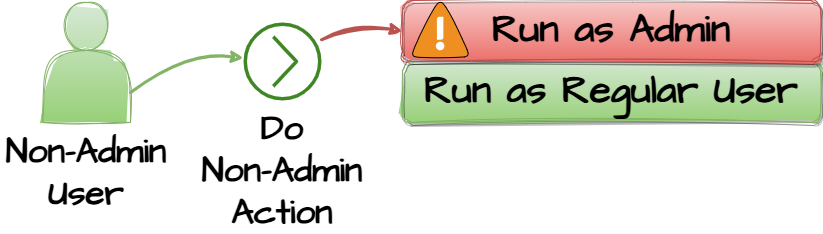
The product performs an operation at a privilege level that is higher than the minimum level required, which creates new weaknesses or amplifies the consequences of other weaknesses.
Alternate Terms
Excessive Agency
a term used by OWASP in its 2025 LLM Top Ten [REF-1524] that includes "excessive functionality" and "excessive permissions". This term might apply to multiple weaknesses.
Common Consequences
This table specifies different individual consequences
associated with the weakness. The Scope identifies the application security area that is
violated, while the Impact describes the negative technical impact that arises if an
adversary succeeds in exploiting this weakness. The Likelihood provides information about
how likely the specific consequence is expected to be seen relative to the other
consequences in the list. For example, there may be high likelihood that a weakness will be
exploited to achieve a certain impact, but a low likelihood that it will be exploited to
achieve a different impact.
Impact
Details
Gain Privileges or Assume Identity; Execute Unauthorized Code or Commands; Read Application Data; DoS: Crash, Exit, or Restart
Scope: Confidentiality, Integrity, Availability, Access Control
An attacker will be able to gain access to any resources that are allowed by the extra privileges. Common results include executing code, disabling services, and reading restricted data. New weaknesses can be exposed because running with extra privileges, such as root or Administrator, can disable the normal security checks being performed by the operating system or surrounding environment. Other pre-existing weaknesses can turn into security vulnerabilities if they occur while operating at raised privileges.
Potential Mitigations
Phase(s)
Mitigation
Architecture and Design; Operation
Strategy: Environment Hardening
Run your code using the lowest privileges that are required to accomplish the necessary tasks [REF-76]. If possible, create isolated accounts with limited privileges that are only used for a single task. That way, a successful attack will not immediately give the attacker access to the rest of the software or its environment. For example, database applications rarely need to run as the database administrator, especially in day-to-day operations.
Architecture and Design
Strategy: Separation of Privilege
Identify the functionality that requires additional privileges, such as access to privileged operating system resources. Wrap and centralize this functionality if possible, and isolate the privileged code as much as possible from other code [REF-76]. Raise privileges as late as possible, and drop them as soon as possible to avoid CWE-271. Avoid weaknesses such as CWE-288 and CWE-420 by protecting all possible communication channels that could interact with the privileged code, such as a secondary socket that is only intended to be accessed by administrators.
Architecture and Design
Strategy: Attack Surface Reduction
Identify the functionality that requires additional privileges, such as access to privileged operating system resources. Wrap and centralize this functionality if possible, and isolate the privileged code as much as possible from other code [REF-76]. Raise privileges as late as possible, and drop them as soon as possible to avoid CWE-271. Avoid weaknesses such as CWE-288 and CWE-420 by protecting all possible communication channels that could interact with the privileged code, such as a secondary socket that is only intended to be accessed by administrators.
Implementation
Perform extensive input validation for any privileged code that must be exposed to the user and reject anything that does not fit your strict requirements.
Implementation
When dropping privileges, ensure that they have been dropped successfully to avoid CWE-273. As protection mechanisms in the environment get stronger, privilege-dropping calls may fail even if it seems like they would always succeed.
Implementation
If circumstances force you to run with extra privileges, then determine the minimum access level necessary. First identify the different permissions that the software and its users will need to perform their actions, such as file read and write permissions, network socket permissions, and so forth. Then explicitly allow those actions while denying all else [REF-76]. Perform extensive input validation and canonicalization to minimize the chances of introducing a separate vulnerability. This mitigation is much more prone to error than dropping the privileges in the first place.
Operation; System Configuration
Strategy: Environment Hardening
Ensure that the software runs properly under the United States Government Configuration Baseline (USGCB) [REF-199] or an equivalent hardening configuration guide, which many organizations use to limit the attack surface and potential risk of deployed software.
Relationships
This table shows the weaknesses and high level categories that are related to this
weakness. These relationships are defined as ChildOf, ParentOf, MemberOf and give insight to
similar items that may exist at higher and lower levels of abstraction. In addition,
relationships such as PeerOf and CanAlsoBe are defined to show similar weaknesses that the user
may want to explore.
Relevant to the view "Research Concepts" (View-1000)
Nature
Type
ID
Name
ChildOf
Class - a weakness that is described in a very abstract fashion, typically independent of any specific language or technology. More specific than a Pillar Weakness, but more general than a Base Weakness. Class level weaknesses typically describe issues in terms of 1 or 2 of the following dimensions: behavior, property, and resource.
Class - a weakness that is described in a very abstract fashion, typically independent of any specific language or technology. More specific than a Pillar Weakness, but more general than a Base Weakness. Class level weaknesses typically describe issues in terms of 1 or 2 of the following dimensions: behavior, property, and resource.
The different Modes of Introduction provide information
about how and when this
weakness may be introduced. The Phase identifies a point in the life cycle at which
introduction
may occur, while the Note provides a typical scenario related to introduction during the
given
phase.
Phase
Note
Implementation
REALIZATION: This weakness is caused during implementation of an architectural security tactic.
Installation
Architecture and Design
When designing AI/ML agents ("agentic AI"), designers might use components that have more privileges than the user intends.
Architecture and Design
If an application has this design problem, then it can be easier for the developer to make implementation-related errors such as CWE-271 (Privilege Dropping / Lowering Errors). In addition, the consequences of Privilege Chaining (CWE-268) can become more severe.
Operation
Applicable Platforms
This listing shows possible areas for which the given
weakness could appear. These
may be for specific named Languages, Operating Systems, Architectures, Paradigms,
Technologies,
or a class of such platforms. The platform is listed along with how frequently the given
weakness appears for that instance.
Languages
Class: Not Language-Specific
(Undetermined Prevalence)
Technologies
AI/ML
(Often Prevalent)
Class: Mobile
(Undetermined Prevalence)
Likelihood Of Exploit
Medium
Demonstrative Examples
Example 1
This code temporarily raises the program's privileges to allow creation of a new user folder.
print('Unable to create new user directory for user:' + username) return False
return True
While the program only raises its privilege level to create the folder and immediately lowers it again, if the call to os.mkdir() throws an exception, the call to lowerPrivileges() will not occur. As a result, the program is indefinitely operating in a raised privilege state, possibly allowing further exploitation to occur.
Example 2
The following code calls chroot() to restrict the application to a subset of the filesystem below APP_HOME in order to prevent an attacker from using the program to gain unauthorized access to files located elsewhere. The code then opens a file specified by the user and processes the contents of the file.
(bad code)
Example Language: C
chroot(APP_HOME); chdir("/"); FILE* data = fopen(argv[1], "r+"); ...
Constraining the process inside the application's home directory before opening any files is a valuable security measure. However, the absence of a call to setuid() with some non-zero value means the application is continuing to operate with unnecessary root privileges. Any successful exploit carried out by an attacker against the application can now result in a privilege escalation attack because any malicious operations will be performed with the privileges of the superuser. If the application drops to the privilege level of a non-root user, the potential for damage is substantially reduced.
Example 3
This application intends to use a user's location to determine the timezone the user is in:
This is unnecessary use of the location API, as this information is already available using the Android Time API. Always be sure there is not another way to obtain needed information before resorting to using the location API.
Example 4
This code uses location to determine the user's current US State location.
First the application must declare that it requires the ACCESS_FINE_LOCATION permission in the application's manifest.xml:
During execution, a call to getLastLocation() will return a location based on the application's location permissions. In this case the application has permission for the most accurate location possible:
While the application needs this information, it does not need to use the ACCESS_FINE_LOCATION permission, as the ACCESS_COARSE_LOCATION permission will be sufficient to identify which US state the user is in.
Selected Observed
Examples
Note: this is a curated list of examples for users to understand the variety of ways in which this
weakness can be introduced. It is not a complete list of all CVEs that are related to this CWE entry.
FTP client program on a certain OS runs with setuid privileges and has a buffer overflow. Most clients do not need extra privileges, so an overflow is not a vulnerability for those clients.
Composite: application running with high privileges (CWE-250) allows user to specify a restricted file to process, which generates a parsing error that leaks the contents of the file (CWE-209).
mail program runs as root but does not drop its privileges before attempting to access a file. Attacker can use a symlink from their home directory to a directory only readable by root, then determine whether the file exists based on the response.
Product launches Help functionality while running with raised privileges, allowing command execution using Windows message to access "open file" dialog.
Weakness Ordinalities
Ordinality
Description
Primary
(where the weakness exists independent of other weaknesses)
Detection
Methods
Method
Details
Manual Analysis
This weakness can be detected using tools and techniques that require manual (human) analysis, such as penetration testing, threat modeling, and interactive tools that allow the tester to record and modify an active session.
Note:These may be more effective than strictly automated techniques. This is especially the case with weaknesses that are related to design and business rules.
Black Box
Use monitoring tools that examine the software's process as it interacts with the operating system and the network. This technique is useful in cases when source code is unavailable, if the software was not developed by you, or if you want to verify that the build phase did not introduce any new weaknesses. Examples include debuggers that directly attach to the running process; system-call tracing utilities such as truss (Solaris) and strace (Linux); system activity monitors such as FileMon, RegMon, Process Monitor, and other Sysinternals utilities (Windows); and sniffers and protocol analyzers that monitor network traffic.
Attach the monitor to the process and perform a login. Look for library functions and system calls that indicate when privileges are being raised or dropped. Look for accesses of resources that are restricted to normal users.
Note:Note that this technique is only useful for privilege issues related to system resources. It is not likely to detect application-level business rules that are related to privileges, such as if a blog system allows a user to delete a blog entry without first checking that the user has administrator privileges.
Automated Static Analysis - Binary or Bytecode
According to SOAR [REF-1479], the following detection techniques may be useful:
Highly cost effective:
Compare binary / bytecode to application permission manifest
This MemberOf Relationships table shows additional CWE Categories and Views that
reference this weakness as a member. This information is often useful in understanding where a
weakness fits within the context of external information sources.
Nature
Type
ID
Name
MemberOf
Category - a CWE entry that contains a set of other entries that share a common characteristic.
View - a subset of CWE entries that provides a way of examining CWE content. The two main view structures are Slices (flat lists) and Graphs (containing relationships between entries).
General Software Weaknesses that Appear in Products that Use or Support AI/ML Technology
Vulnerability Mapping Notes
Usage
ALLOWED
(this CWE ID may be used to map to real-world vulnerabilities)
Reason
Acceptable-Use
Rationale
This CWE entry is at the Base level of abstraction, which is a preferred level of abstraction for mapping to the root causes of vulnerabilities.
Comments
Carefully read both the name and description to ensure that this mapping is an appropriate fit. Do not try to 'force' a mapping to a lower-level Base/Variant simply to comply with this preferred level of abstraction.
Notes
Relationship
There is a close association with CWE-653 (Insufficient Separation of Privileges). CWE-653 is about providing separate components for each privilege; CWE-250 is about ensuring that each component has the least amount of privileges possible.
Other
Privilege management functions can behave in some less-than-obvious ways, and they have different quirks on different platforms. These inconsistencies are particularly pronounced if you are transitioning from one non-root user to another.
Other
Signal handlers and spawned processes run at the privilege of the owning process, so if a process is running as root when a signal fires or a sub-process is executed, the signal handler or sub-process will operate with root privileges.
Maintenance
CWE-271, CWE-272, and CWE-250 are all closely related and possibly overlapping. CWE-271 is probably better suited as a category. Both CWE-272 and CWE-250 are in active use by the community. The "least privilege" phrase has multiple interpretations.
Taxonomy
Mappings
Mapped Taxonomy Name
Node ID
Fit
Mapped Node Name
7 Pernicious Kingdoms
Often Misused: Privilege Management
The CERT Oracle Secure Coding Standard for Java (2011)
SER09-J
Minimize privileges before deserializing from a privilege context
Michael Howard, David LeBlanc and John Viega. "24 Deadly Sins of Software Security". "Sin 16: Executing Code With Too Much Privilege." Page 243. McGraw-Hill. 2010.
[REF-62]
Mark Dowd, John McDonald and Justin Schuh. "The Art of Software Security Assessment". Chapter 9, "Privilege Vulnerabilities", Page 477. 1st Edition. Addison Wesley. 2006.


 Description
 This table specifies different individual consequences
associated with the weakness. The Scope identifies the application security area that is
violated, while the Impact describes the negative technical impact that arises if an
adversary succeeds in exploiting this weakness. The Likelihood provides information about
how likely the specific consequence is expected to be seen relative to the other
consequences in the list. For example, there may be high likelihood that a weakness will be
exploited to achieve a certain impact, but a low likelihood that it will be exploited to
achieve a different impact.
This table specifies different individual consequences
associated with the weakness. The Scope identifies the application security area that is
violated, while the Impact describes the negative technical impact that arises if an
adversary succeeds in exploiting this weakness. The Likelihood provides information about
how likely the specific consequence is expected to be seen relative to the other
consequences in the list. For example, there may be high likelihood that a weakness will be
exploited to achieve a certain impact, but a low likelihood that it will be exploited to
achieve a different impact.