CWE entries in this view (graph) are fully or partially eliminated by following the guidance presented in the Secure Coding Guide for Python, as published by OpenSSF in 2026.
Audience
Stakeholder
Description
Software Developers
By following this coding guide, Python developers will be able to fully or partially prevent the weaknesses that are identified in this view. In addition, developers can use a CWE coverage graph to determine which weaknesses are not directly addressed by the guide, which will help identify and resolve remaining gaps in training, tool acquisition, or other approaches for reducing weaknesses.
Product Customers
If a software developer claims to be following this coding guide, then customers can search for the weaknesses in this view in order to formulate independent evidence of that claim.
Educators
Educators can use this view in multiple ways. For example, if there is a focus on teaching weaknesses, the educator could link them to this relevant Secure Coding Guide.
Relationships
The following graph shows the tree-like relationships between
weaknesses that exist at different levels of abstraction. At the highest level, categories
and pillars exist to group weaknesses. Categories (which are not technically weaknesses) are
special CWE entries used to group weaknesses that share a common characteristic. Pillars are
weaknesses that are described in the most abstract fashion. Below these top-level entries
are weaknesses are varying levels of abstraction. Classes are still very abstract, typically
independent of any specific language or technology. Base level weaknesses are used to
present a more specific type of weakness. A variant is a weakness that is described at a
very low level of detail, typically limited to a specific language or technology. A chain is
a set of weaknesses that must be reachable consecutively in order to produce an exploitable
vulnerability. While a composite is a set of weaknesses that must all be present
simultaneously in order to produce an exploitable vulnerability.
1449(Weaknesses Addressed by the OpenSSF Secure Coding Guide for Python (2026)) >
1451(OpenSSF Secure Coding Guide for Python (2026) - 01 Introduction)
Weaknesses in this category are related to the rules and recommendations in section "01 Introduction" of the OpenSSF Secure Coding Guide for Python.
Base - a weakness that is still mostly independent of a resource or technology, but with sufficient details to provide specific methods for detection and prevention. Base level weaknesses typically describe issues in terms of 2 or 3 of the following dimensions: behavior, property, technology, language, and resource.
External Control of Assumed-Immutable Web Parameter
- (472)
1449(Weaknesses Addressed by the OpenSSF Secure Coding Guide for Python (2026)) >
1451(OpenSSF Secure Coding Guide for Python (2026) - 01 Introduction) >
472(External Control of Assumed-Immutable Web Parameter)
The web application does not sufficiently verify inputs that are assumed to be immutable but are actually externally controllable, such as hidden form fields.
Assumed-Immutable Parameter Tampering
Class - a weakness that is described in a very abstract fashion, typically independent of any specific language or technology. More specific than a Pillar Weakness, but more general than a Base Weakness. Class level weaknesses typically describe issues in terms of 1 or 2 of the following dimensions: behavior, property, and resource.
Trust Boundary Violation
- (501)
1449(Weaknesses Addressed by the OpenSSF Secure Coding Guide for Python (2026)) >
1451(OpenSSF Secure Coding Guide for Python (2026) - 01 Introduction) >
501(Trust Boundary Violation)
The product mixes trusted and untrusted data in the same data structure or structured message.
Base - a weakness that is still mostly independent of a resource or technology, but with sufficient details to provide specific methods for detection and prevention. Base level weaknesses typically describe issues in terms of 2 or 3 of the following dimensions: behavior, property, technology, language, and resource.
Operator Precedence Logic Error
- (783)
1449(Weaknesses Addressed by the OpenSSF Secure Coding Guide for Python (2026)) >
1451(OpenSSF Secure Coding Guide for Python (2026) - 01 Introduction) >
783(Operator Precedence Logic Error)
The product uses an expression in which operator precedence causes incorrect logic to be used.
Base - a weakness that is still mostly independent of a resource or technology, but with sufficient details to provide specific methods for detection and prevention. Base level weaknesses typically describe issues in terms of 2 or 3 of the following dimensions: behavior, property, technology, language, and resource.
Use of Hard-coded Credentials
- (798)
1449(Weaknesses Addressed by the OpenSSF Secure Coding Guide for Python (2026)) >
1451(OpenSSF Secure Coding Guide for Python (2026) - 01 Introduction) >
798(Use of Hard-coded Credentials)
The product contains hard-coded credentials, such as a password or cryptographic key.
1449(Weaknesses Addressed by the OpenSSF Secure Coding Guide for Python (2026)) >
1452(OpenSSF Secure Coding Guide for Python (2026) - 02 Encoding and Strings)
Weaknesses in this category are related to the rules and recommendations in section "02 Encoding and Strings" of the OpenSSF Secure Coding Guide for Python.
Variant - a weakness that is linked to a certain type of product, typically involving a specific language or technology. More specific than a Base weakness. Variant level weaknesses typically describe issues in terms of 3 to 5 of the following dimensions: behavior, property, technology, language, and resource.
Improper Handling of Mixed Encoding
- (175)
1449(Weaknesses Addressed by the OpenSSF Secure Coding Guide for Python (2026)) >
1452(OpenSSF Secure Coding Guide for Python (2026) - 02 Encoding and Strings) >
175(Improper Handling of Mixed Encoding)
The product does not properly handle when the same input uses several different (mixed) encodings.
Variant - a weakness that is linked to a certain type of product, typically involving a specific language or technology. More specific than a Base weakness. Variant level weaknesses typically describe issues in terms of 3 to 5 of the following dimensions: behavior, property, technology, language, and resource.
Improper Handling of Unicode Encoding
- (176)
1449(Weaknesses Addressed by the OpenSSF Secure Coding Guide for Python (2026)) >
1452(OpenSSF Secure Coding Guide for Python (2026) - 02 Encoding and Strings) >
176(Improper Handling of Unicode Encoding)
The product does not properly handle when an input contains Unicode encoding.
Variant - a weakness that is linked to a certain type of product, typically involving a specific language or technology. More specific than a Base weakness. Variant level weaknesses typically describe issues in terms of 3 to 5 of the following dimensions: behavior, property, technology, language, and resource.
Incorrect Behavior Order: Validate Before Canonicalize
- (180)
1449(Weaknesses Addressed by the OpenSSF Secure Coding Guide for Python (2026)) >
1452(OpenSSF Secure Coding Guide for Python (2026) - 02 Encoding and Strings) >
180(Incorrect Behavior Order: Validate Before Canonicalize)
The product validates input before it is canonicalized.
1449(Weaknesses Addressed by the OpenSSF Secure Coding Guide for Python (2026)) >
1453(OpenSSF Secure Coding Guide for Python (2026) - 03 Numbers)
Weaknesses in this category are related to the rules and recommendations in section "03 Numbers" of the OpenSSF Secure Coding Guide for Python.
Base - a weakness that is still mostly independent of a resource or technology, but with sufficient details to provide specific methods for detection and prevention. Base level weaknesses typically describe issues in terms of 2 or 3 of the following dimensions: behavior, property, technology, language, and resource.
Incorrect Bitwise Shift of Integer
- (1335)
1449(Weaknesses Addressed by the OpenSSF Secure Coding Guide for Python (2026)) >
1453(OpenSSF Secure Coding Guide for Python (2026) - 03 Numbers) >
1335(Incorrect Bitwise Shift of Integer)
An integer value is specified to be shifted by a negative amount or an amount greater than or equal to the number of bits contained in the value.
Base - a weakness that is still mostly independent of a resource or technology, but with sufficient details to provide specific methods for detection and prevention. Base level weaknesses typically describe issues in terms of 2 or 3 of the following dimensions: behavior, property, technology, language, and resource.
Insufficient Precision or Accuracy of a Real Number
- (1339)
1449(Weaknesses Addressed by the OpenSSF Secure Coding Guide for Python (2026)) >
1453(OpenSSF Secure Coding Guide for Python (2026) - 03 Numbers) >
1339(Insufficient Precision or Accuracy of a Real Number)
The product processes a real number with an implementation in which the number's representation does not preserve required accuracy and precision in its fractional part, causing an incorrect result.
Base - a weakness that is still mostly independent of a resource or technology, but with sufficient details to provide specific methods for detection and prevention. Base level weaknesses typically describe issues in terms of 2 or 3 of the following dimensions: behavior, property, technology, language, and resource.
Integer Overflow or Wraparound
- (190)
1449(Weaknesses Addressed by the OpenSSF Secure Coding Guide for Python (2026)) >
1453(OpenSSF Secure Coding Guide for Python (2026) - 03 Numbers) >
190(Integer Overflow or Wraparound)
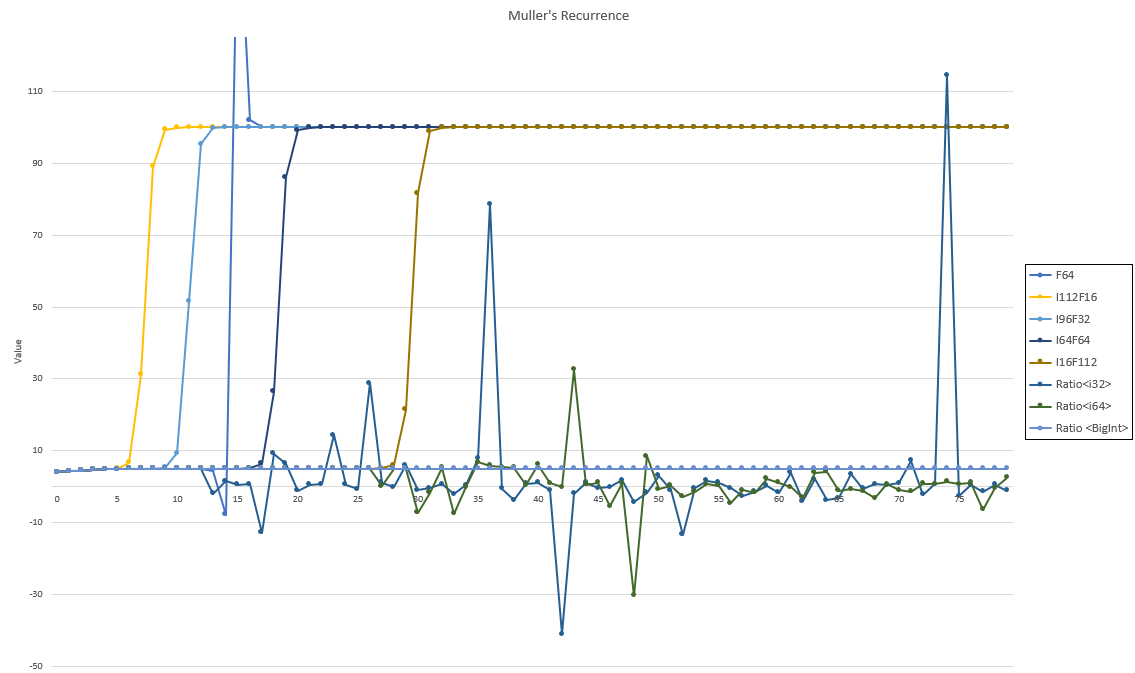
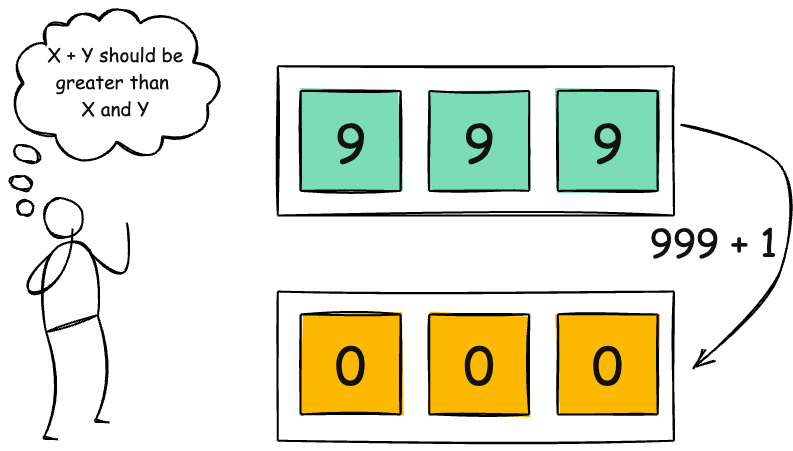
The product performs a calculation that can
produce an integer overflow or wraparound when the logic
assumes that the resulting value will always be larger than
the original value. This occurs when an integer value is
incremented to a value that is too large to store in the
associated representation. When this occurs, the value may
become a very small or negative number.
OverflowWraparoundwrap, wrap-around, wrap aroundYear 2038 problem, Y2K38, Y2038, Epochalypse
Base - a weakness that is still mostly independent of a resource or technology, but with sufficient details to provide specific methods for detection and prevention. Base level weaknesses typically describe issues in terms of 2 or 3 of the following dimensions: behavior, property, technology, language, and resource.
Integer Underflow (Wrap or Wraparound)
- (191)
1449(Weaknesses Addressed by the OpenSSF Secure Coding Guide for Python (2026)) >
1453(OpenSSF Secure Coding Guide for Python (2026) - 03 Numbers) >
191(Integer Underflow (Wrap or Wraparound))
The product subtracts one value from another, such that the result is less than the minimum allowable integer value, which produces a value that is not equal to the correct result.
Integer underflow
Base - a weakness that is still mostly independent of a resource or technology, but with sufficient details to provide specific methods for detection and prevention. Base level weaknesses typically describe issues in terms of 2 or 3 of the following dimensions: behavior, property, technology, language, and resource.
Numeric Truncation Error
- (197)
1449(Weaknesses Addressed by the OpenSSF Secure Coding Guide for Python (2026)) >
1453(OpenSSF Secure Coding Guide for Python (2026) - 03 Numbers) >
197(Numeric Truncation Error)
Truncation errors occur when a primitive is cast to a primitive of a smaller size and data is lost in the conversion.
Base - a weakness that is still mostly independent of a resource or technology, but with sufficient details to provide specific methods for detection and prevention. Base level weaknesses typically describe issues in terms of 2 or 3 of the following dimensions: behavior, property, technology, language, and resource.
Incorrect Conversion between Numeric Types
- (681)
1449(Weaknesses Addressed by the OpenSSF Secure Coding Guide for Python (2026)) >
1453(OpenSSF Secure Coding Guide for Python (2026) - 03 Numbers) >
681(Incorrect Conversion between Numeric Types)
When converting from one data type to another, such as long to integer, data can be omitted or translated in a way that produces unexpected values. If the resulting values are used in a sensitive context, then dangerous behaviors may occur.
1449(Weaknesses Addressed by the OpenSSF Secure Coding Guide for Python (2026)) >
1454(OpenSSF Secure Coding Guide for Python (2026) - 04 Neutralization)
Weaknesses in this category are related to the rules and recommendations in section "04 Neutralization" of the OpenSSF Secure Coding Guide for Python.
Base - a weakness that is still mostly independent of a resource or technology, but with sufficient details to provide specific methods for detection and prevention. Base level weaknesses typically describe issues in terms of 2 or 3 of the following dimensions: behavior, property, technology, language, and resource.
Use of Externally-Controlled Format String
- (134)
1449(Weaknesses Addressed by the OpenSSF Secure Coding Guide for Python (2026)) >
1454(OpenSSF Secure Coding Guide for Python (2026) - 04 Neutralization) >
134(Use of Externally-Controlled Format String)
The product uses a function that accepts a format string as an argument, but the format string originates from an external source.
Base - a weakness that is still mostly independent of a resource or technology, but with sufficient details to provide specific methods for detection and prevention. Base level weaknesses typically describe issues in terms of 2 or 3 of the following dimensions: behavior, property, technology, language, and resource.
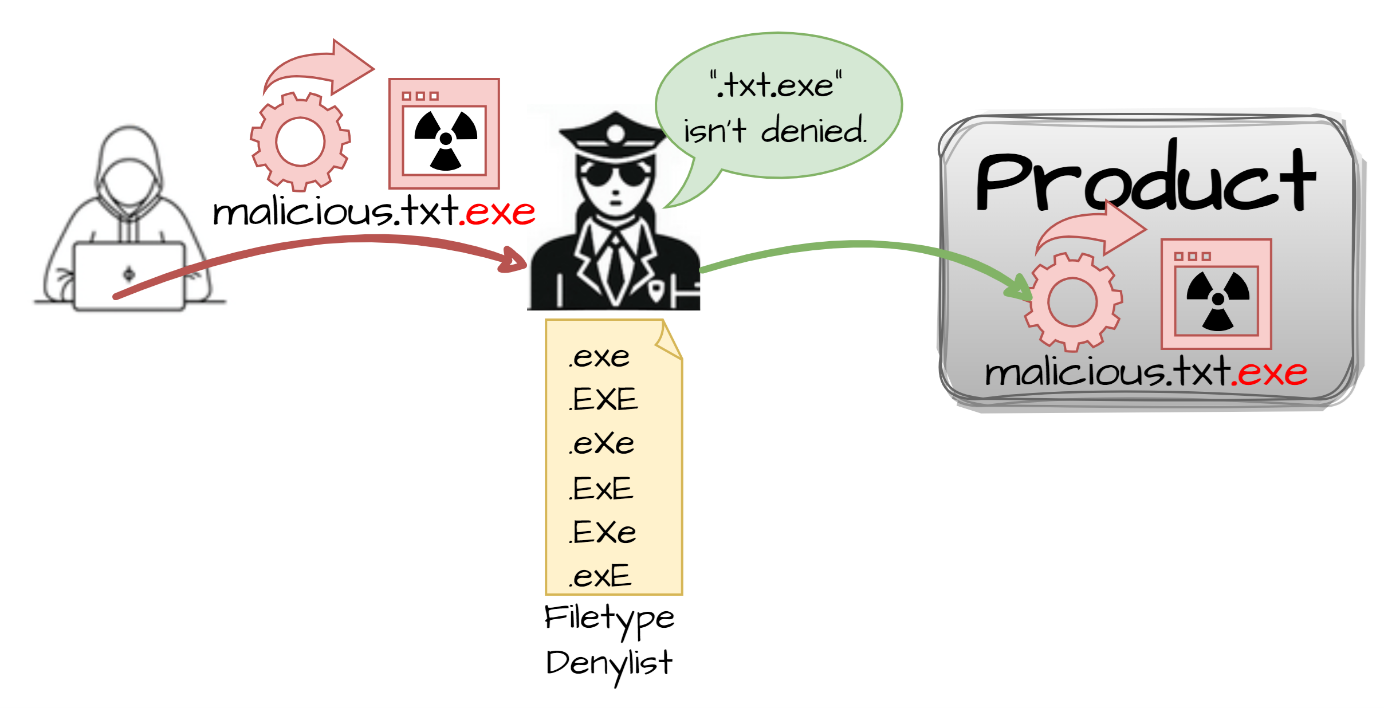
Incomplete List of Disallowed Inputs
- (184)
1449(Weaknesses Addressed by the OpenSSF Secure Coding Guide for Python (2026)) >
1454(OpenSSF Secure Coding Guide for Python (2026) - 04 Neutralization) >
184(Incomplete List of Disallowed Inputs)
The product implements a protection mechanism that relies on a list of inputs (or properties of inputs) that are not allowed by policy or otherwise require other action to neutralize before additional processing takes place, but the list is incomplete.
Denylist / Deny ListBlocklist / Block ListBlacklist / Black List
Base - a weakness that is still mostly independent of a resource or technology, but with sufficient details to provide specific methods for detection and prevention. Base level weaknesses typically describe issues in terms of 2 or 3 of the following dimensions: behavior, property, technology, language, and resource.
Improper Handling of Highly Compressed Data (Data Amplification)
- (409)
1449(Weaknesses Addressed by the OpenSSF Secure Coding Guide for Python (2026)) >
1454(OpenSSF Secure Coding Guide for Python (2026) - 04 Neutralization) >
409(Improper Handling of Highly Compressed Data (Data Amplification))
The product does not handle or incorrectly
handles a compressed input with a very high compression ratio
that produces a large output.
Base - a weakness that is still mostly independent of a resource or technology, but with sufficient details to provide specific methods for detection and prevention. Base level weaknesses typically describe issues in terms of 2 or 3 of the following dimensions: behavior, property, technology, language, and resource.
Untrusted Search Path
- (426)
1449(Weaknesses Addressed by the OpenSSF Secure Coding Guide for Python (2026)) >
1454(OpenSSF Secure Coding Guide for Python (2026) - 04 Neutralization) >
426(Untrusted Search Path)
The product searches for critical resources using an externally-supplied search path that can point to resources that are not under the product's direct control.
Untrusted Path
Base - a weakness that is still mostly independent of a resource or technology, but with sufficient details to provide specific methods for detection and prevention. Base level weaknesses typically describe issues in terms of 2 or 3 of the following dimensions: behavior, property, technology, language, and resource.
Deserialization of Untrusted Data
- (502)
1449(Weaknesses Addressed by the OpenSSF Secure Coding Guide for Python (2026)) >
1454(OpenSSF Secure Coding Guide for Python (2026) - 04 Neutralization) >
502(Deserialization of Untrusted Data)
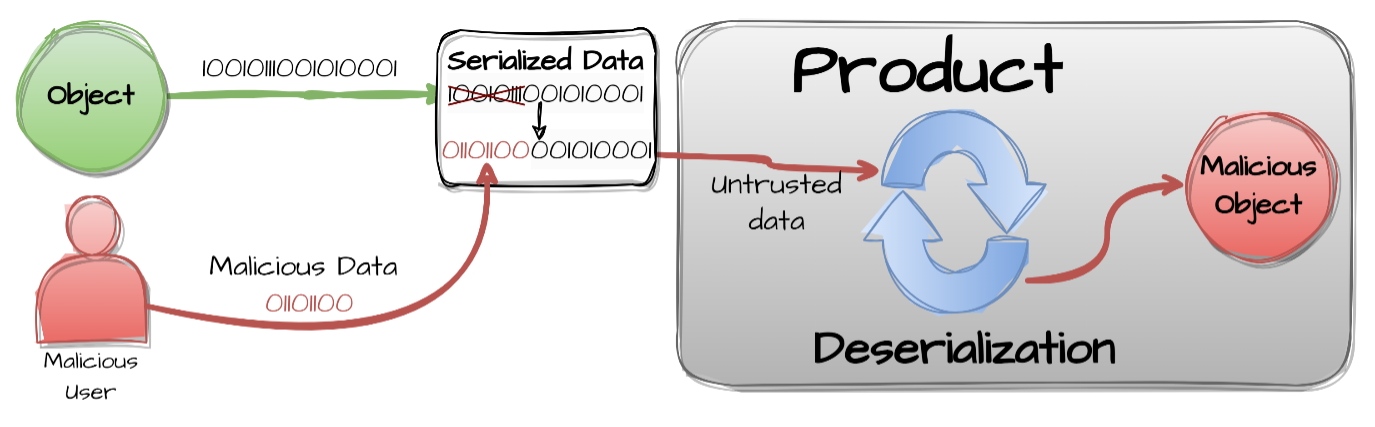
The product deserializes untrusted data without sufficiently ensuring that the resulting data will be valid.
Marshaling/Marshalling, Unmarshaling/UnmarshallingPickling, UnpicklingPHP Object Injection
Base - a weakness that is still mostly independent of a resource or technology, but with sufficient details to provide specific methods for detection and prevention. Base level weaknesses typically describe issues in terms of 2 or 3 of the following dimensions: behavior, property, technology, language, and resource.
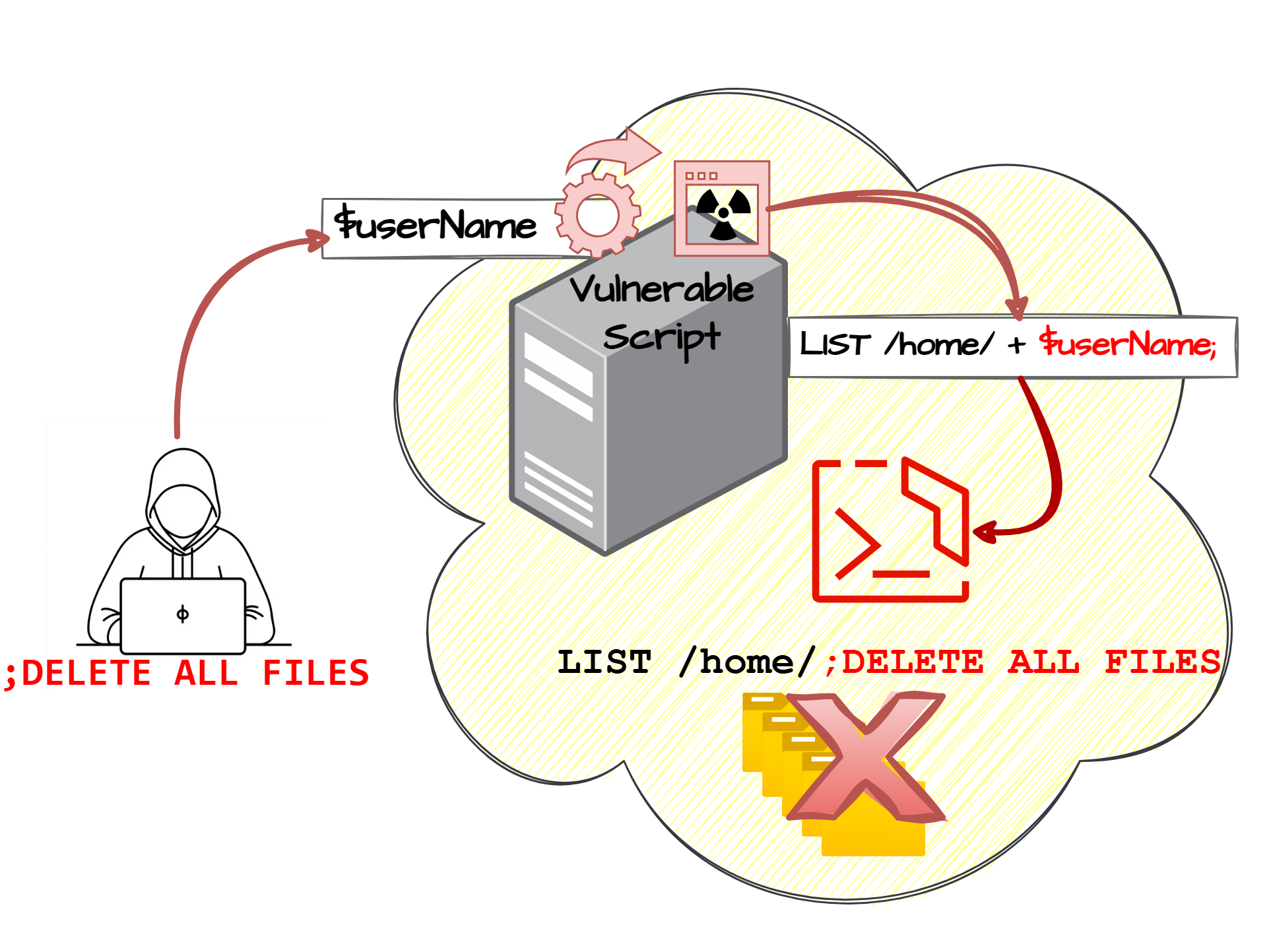
Improper Neutralization of Special Elements used in an OS Command
- (78)
1449(Weaknesses Addressed by the OpenSSF Secure Coding Guide for Python (2026)) >
1454(OpenSSF Secure Coding Guide for Python (2026) - 04 Neutralization) >
78(Improper Neutralization of Special Elements used in an OS Command)
The product constructs all or part of an OS command using externally-influenced input from an upstream component, but it does not neutralize or incorrectly neutralizes special elements that could modify the intended OS command before it is sent to a downstream component.
Shell injectionShell metacharactersOS Command Injection
Base - a weakness that is still mostly independent of a resource or technology, but with sufficient details to provide specific methods for detection and prevention. Base level weaknesses typically describe issues in terms of 2 or 3 of the following dimensions: behavior, property, technology, language, and resource.
Access of Resource Using Incompatible Type
- (843)
1449(Weaknesses Addressed by the OpenSSF Secure Coding Guide for Python (2026)) >
1454(OpenSSF Secure Coding Guide for Python (2026) - 04 Neutralization) >
843(Access of Resource Using Incompatible Type)
The product allocates or initializes a resource such as a pointer, object, or variable using one type, but it later accesses that resource using a type that is incompatible with the original type.
Type ConfusionObject Type Confusion
Base - a weakness that is still mostly independent of a resource or technology, but with sufficient details to provide specific methods for detection and prevention. Base level weaknesses typically describe issues in terms of 2 or 3 of the following dimensions: behavior, property, technology, language, and resource.
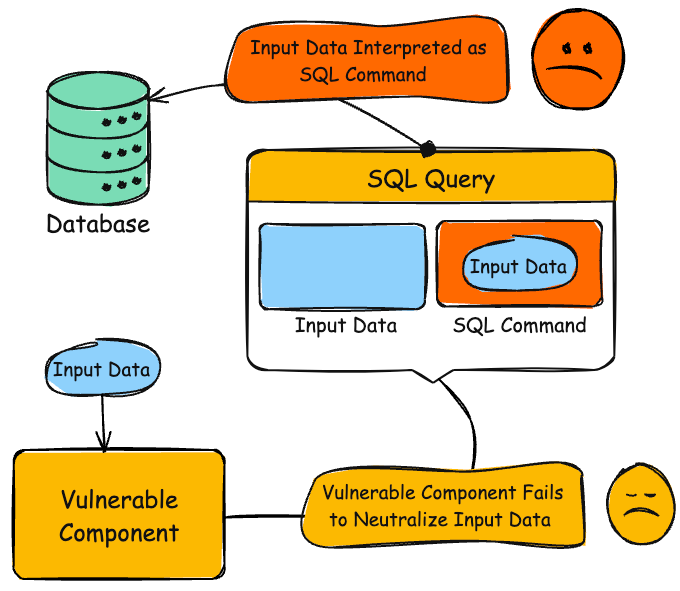
Improper Neutralization of Special Elements used in an SQL Command
- (89)
1449(Weaknesses Addressed by the OpenSSF Secure Coding Guide for Python (2026)) >
1454(OpenSSF Secure Coding Guide for Python (2026) - 04 Neutralization) >
89(Improper Neutralization of Special Elements used in an SQL Command)
The product constructs all or part of an SQL command using externally-influenced input from an upstream component, but it does not neutralize or incorrectly neutralizes special elements that could modify the intended SQL command when it is sent to a downstream component. Without sufficient removal or quoting of SQL syntax in user-controllable inputs, the generated SQL query can cause those inputs to be interpreted as SQL instead of ordinary user data.
SQL InjectionSQLi
1449(Weaknesses Addressed by the OpenSSF Secure Coding Guide for Python (2026)) >
1455(OpenSSF Secure Coding Guide for Python (2026) - 05 Exception Handling)
Weaknesses in this category are related to the rules and recommendations in section "05 Exception Handling" of the OpenSSF Secure Coding Guide for Python.
Base - a weakness that is still mostly independent of a resource or technology, but with sufficient details to provide specific methods for detection and prevention. Base level weaknesses typically describe issues in terms of 2 or 3 of the following dimensions: behavior, property, technology, language, and resource.
Declaration of Catch for Generic Exception
- (396)
1449(Weaknesses Addressed by the OpenSSF Secure Coding Guide for Python (2026)) >
1455(OpenSSF Secure Coding Guide for Python (2026) - 05 Exception Handling) >
396(Declaration of Catch for Generic Exception)
Catching overly broad exceptions promotes complex error handling code that is more likely to contain security vulnerabilities.
Base - a weakness that is still mostly independent of a resource or technology, but with sufficient details to provide specific methods for detection and prevention. Base level weaknesses typically describe issues in terms of 2 or 3 of the following dimensions: behavior, property, technology, language, and resource.
Declaration of Throws for Generic Exception
- (397)
1449(Weaknesses Addressed by the OpenSSF Secure Coding Guide for Python (2026)) >
1455(OpenSSF Secure Coding Guide for Python (2026) - 05 Exception Handling) >
397(Declaration of Throws for Generic Exception)
The product throws or raises an overly broad exception that can hide important details and produce inappropriate responses to certain conditions.
Base - a weakness that is still mostly independent of a resource or technology, but with sufficient details to provide specific methods for detection and prevention. Base level weaknesses typically describe issues in terms of 2 or 3 of the following dimensions: behavior, property, technology, language, and resource.
Improper Cleanup on Thrown Exception
- (460)
1449(Weaknesses Addressed by the OpenSSF Secure Coding Guide for Python (2026)) >
1455(OpenSSF Secure Coding Guide for Python (2026) - 05 Exception Handling) >
460(Improper Cleanup on Thrown Exception)
The product does not clean up its state or incorrectly cleans up its state when an exception is thrown.
Base - a weakness that is still mostly independent of a resource or technology, but with sufficient details to provide specific methods for detection and prevention. Base level weaknesses typically describe issues in terms of 2 or 3 of the following dimensions: behavior, property, technology, language, and resource.
Return Inside Finally Block
- (584)
1449(Weaknesses Addressed by the OpenSSF Secure Coding Guide for Python (2026)) >
1455(OpenSSF Secure Coding Guide for Python (2026) - 05 Exception Handling) >
584(Return Inside Finally Block)
The code has a return statement inside a finally block.
Class - a weakness that is described in a very abstract fashion, typically independent of any specific language or technology. More specific than a Pillar Weakness, but more general than a Base Weakness. Class level weaknesses typically describe issues in terms of 1 or 2 of the following dimensions: behavior, property, and resource.
Improper Check for Unusual or Exceptional Conditions
- (754)
1449(Weaknesses Addressed by the OpenSSF Secure Coding Guide for Python (2026)) >
1455(OpenSSF Secure Coding Guide for Python (2026) - 05 Exception Handling) >
754(Improper Check for Unusual or Exceptional Conditions)
The product does not check or incorrectly checks for unusual or exceptional conditions that are not expected to occur frequently during day to day operation of the product.
Class - a weakness that is described in a very abstract fashion, typically independent of any specific language or technology. More specific than a Pillar Weakness, but more general than a Base Weakness. Class level weaknesses typically describe issues in terms of 1 or 2 of the following dimensions: behavior, property, and resource.
Improper Handling of Exceptional Conditions
- (755)
1449(Weaknesses Addressed by the OpenSSF Secure Coding Guide for Python (2026)) >
1455(OpenSSF Secure Coding Guide for Python (2026) - 05 Exception Handling) >
755(Improper Handling of Exceptional Conditions)
The product does not handle or incorrectly handles an exceptional condition.
1449(Weaknesses Addressed by the OpenSSF Secure Coding Guide for Python (2026)) >
1456(OpenSSF Secure Coding Guide for Python (2026) - 06 Logging)
Weaknesses in this category are related to the rules and recommendations in section "06 Logging" of the OpenSSF Secure Coding Guide for Python.
Base - a weakness that is still mostly independent of a resource or technology, but with sufficient details to provide specific methods for detection and prevention. Base level weaknesses typically describe issues in terms of 2 or 3 of the following dimensions: behavior, property, technology, language, and resource.
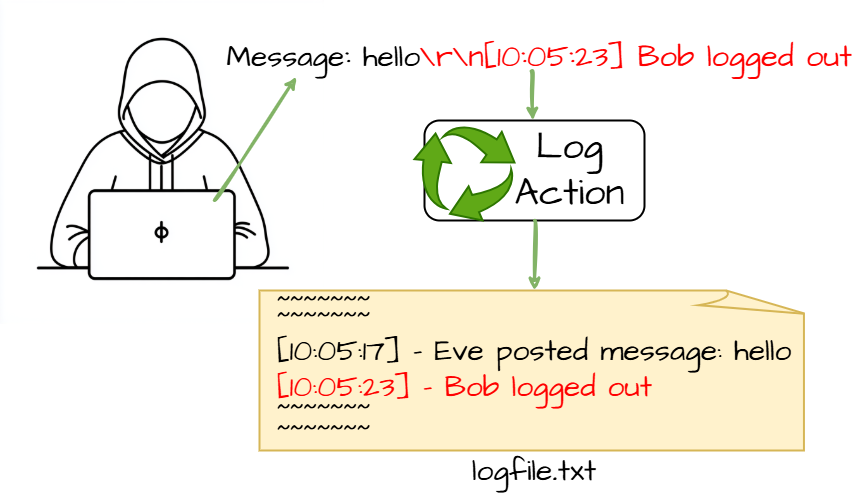
Improper Output Neutralization for Logs
- (117)
1449(Weaknesses Addressed by the OpenSSF Secure Coding Guide for Python (2026)) >
1456(OpenSSF Secure Coding Guide for Python (2026) - 06 Logging) >
117(Improper Output Neutralization for Logs)
The product constructs a log message from external input, but it does not neutralize or incorrectly neutralizes special elements when the message is written to a log file.
Log forging
Base - a weakness that is still mostly independent of a resource or technology, but with sufficient details to provide specific methods for detection and prevention. Base level weaknesses typically describe issues in terms of 2 or 3 of the following dimensions: behavior, property, technology, language, and resource.
Generation of Error Message Containing Sensitive Information
- (209)
1449(Weaknesses Addressed by the OpenSSF Secure Coding Guide for Python (2026)) >
1456(OpenSSF Secure Coding Guide for Python (2026) - 06 Logging) >
209(Generation of Error Message Containing Sensitive Information)
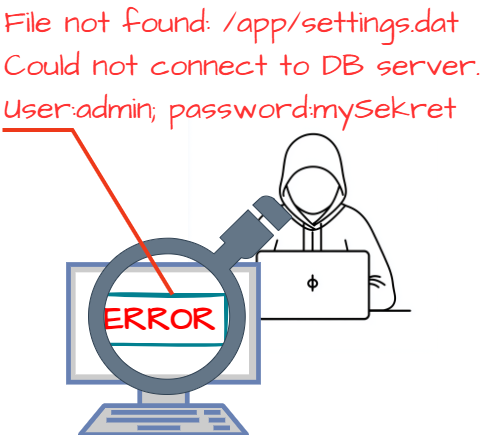
The product generates an error message that includes sensitive information about its environment, users, or associated data.
Base - a weakness that is still mostly independent of a resource or technology, but with sufficient details to provide specific methods for detection and prevention. Base level weaknesses typically describe issues in terms of 2 or 3 of the following dimensions: behavior, property, technology, language, and resource.
Active Debug Code
- (489)
1449(Weaknesses Addressed by the OpenSSF Secure Coding Guide for Python (2026)) >
1456(OpenSSF Secure Coding Guide for Python (2026) - 06 Logging) >
489(Active Debug Code)
The product is released with debugging code still enabled or active.
Leftover debug code
Base - a weakness that is still mostly independent of a resource or technology, but with sufficient details to provide specific methods for detection and prevention. Base level weaknesses typically describe issues in terms of 2 or 3 of the following dimensions: behavior, property, technology, language, and resource.
Insertion of Sensitive Information into Log File
- (532)
1449(Weaknesses Addressed by the OpenSSF Secure Coding Guide for Python (2026)) >
1456(OpenSSF Secure Coding Guide for Python (2026) - 06 Logging) >
532(Insertion of Sensitive Information into Log File)
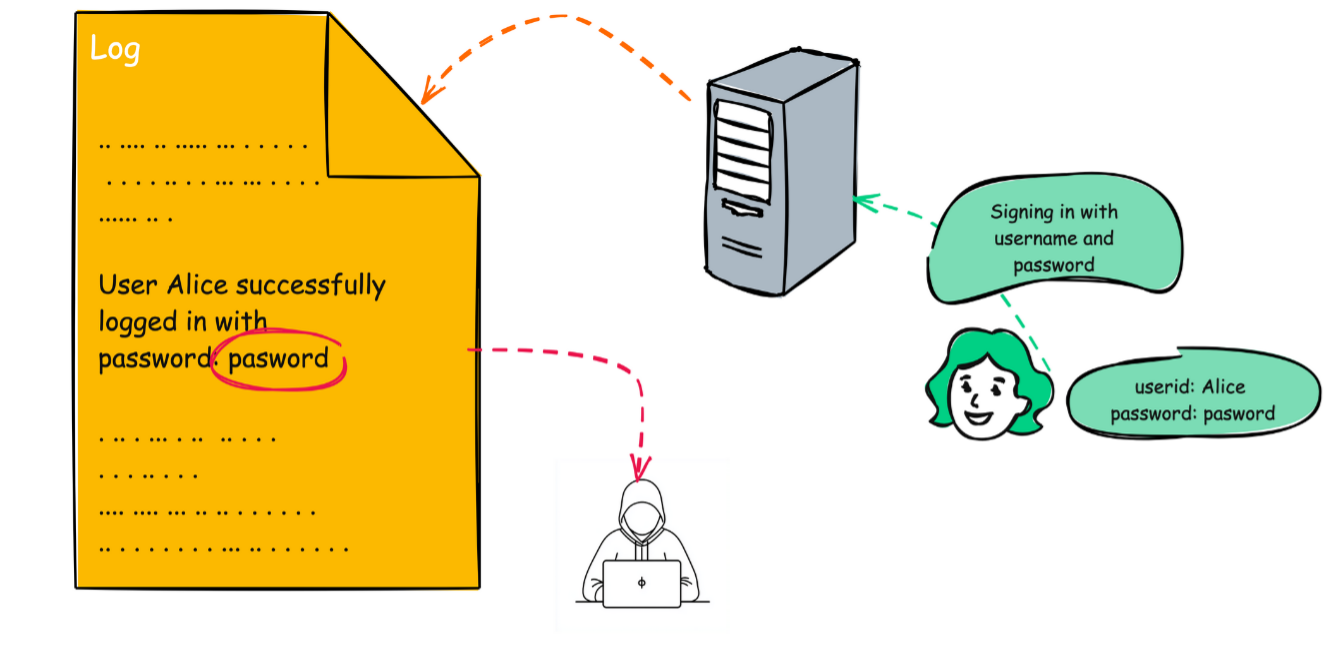
The product writes sensitive information to a log file.
Base - a weakness that is still mostly independent of a resource or technology, but with sufficient details to provide specific methods for detection and prevention. Base level weaknesses typically describe issues in terms of 2 or 3 of the following dimensions: behavior, property, technology, language, and resource.
Insufficient Logging
- (778)
1449(Weaknesses Addressed by the OpenSSF Secure Coding Guide for Python (2026)) >
1456(OpenSSF Secure Coding Guide for Python (2026) - 06 Logging) >
778(Insufficient Logging)
When a security-critical event occurs, the product either does not record the event or omits important details about the event when logging it.
1449(Weaknesses Addressed by the OpenSSF Secure Coding Guide for Python (2026)) >
1457(OpenSSF Secure Coding Guide for Python (2026) - 07 Concurrency)
Weaknesses in this category are related to the rules and recommendations in section "07 Concurrency" of the OpenSSF Secure Coding Guide for Python.
Class - a weakness that is described in a very abstract fashion, typically independent of any specific language or technology. More specific than a Pillar Weakness, but more general than a Base Weakness. Class level weaknesses typically describe issues in terms of 1 or 2 of the following dimensions: behavior, property, and resource.
Concurrent Execution using Shared Resource with Improper Synchronization
- (362)
1449(Weaknesses Addressed by the OpenSSF Secure Coding Guide for Python (2026)) >
1457(OpenSSF Secure Coding Guide for Python (2026) - 07 Concurrency) >
362(Concurrent Execution using Shared Resource with Improper Synchronization)
The product contains a concurrent code sequence that requires temporary, exclusive access to a shared resource, but a timing window exists in which the shared resource can be modified by another code sequence operating concurrently.
Race Condition
Base - a weakness that is still mostly independent of a resource or technology, but with sufficient details to provide specific methods for detection and prevention. Base level weaknesses typically describe issues in terms of 2 or 3 of the following dimensions: behavior, property, technology, language, and resource.
Missing Report of Error Condition
- (392)
1449(Weaknesses Addressed by the OpenSSF Secure Coding Guide for Python (2026)) >
1457(OpenSSF Secure Coding Guide for Python (2026) - 07 Concurrency) >
392(Missing Report of Error Condition)
The product encounters an error but does not provide a status code or return value to indicate that an error has occurred.
Class - a weakness that is described in a very abstract fashion, typically independent of any specific language or technology. More specific than a Pillar Weakness, but more general than a Base Weakness. Class level weaknesses typically describe issues in terms of 1 or 2 of the following dimensions: behavior, property, and resource.
Uncontrolled Resource Consumption
- (400)
1449(Weaknesses Addressed by the OpenSSF Secure Coding Guide for Python (2026)) >
1457(OpenSSF Secure Coding Guide for Python (2026) - 07 Concurrency) >
400(Uncontrolled Resource Consumption)
The product does not properly control the allocation and maintenance of a limited resource.
Resource Exhaustion
Class - a weakness that is described in a very abstract fashion, typically independent of any specific language or technology. More specific than a Pillar Weakness, but more general than a Base Weakness. Class level weaknesses typically describe issues in terms of 1 or 2 of the following dimensions: behavior, property, and resource.
Insufficient Resource Pool
- (410)
1449(Weaknesses Addressed by the OpenSSF Secure Coding Guide for Python (2026)) >
1457(OpenSSF Secure Coding Guide for Python (2026) - 07 Concurrency) >
410(Insufficient Resource Pool)
The product's resource pool is not large enough to handle peak demand.
Class - a weakness that is described in a very abstract fashion, typically independent of any specific language or technology. More specific than a Pillar Weakness, but more general than a Base Weakness. Class level weaknesses typically describe issues in terms of 1 or 2 of the following dimensions: behavior, property, and resource.
Improper Initialization
- (665)
1449(Weaknesses Addressed by the OpenSSF Secure Coding Guide for Python (2026)) >
1457(OpenSSF Secure Coding Guide for Python (2026) - 07 Concurrency) >
665(Improper Initialization)
The product does not initialize or incorrectly initializes a resource.
Base - a weakness that is still mostly independent of a resource or technology, but with sufficient details to provide specific methods for detection and prevention. Base level weaknesses typically describe issues in terms of 2 or 3 of the following dimensions: behavior, property, technology, language, and resource.
Deadlock
- (833)
1449(Weaknesses Addressed by the OpenSSF Secure Coding Guide for Python (2026)) >
1457(OpenSSF Secure Coding Guide for Python (2026) - 07 Concurrency) >
833(Deadlock)
The product contains multiple threads or executable segments that are waiting for each other to release a necessary lock, resulting in deadlock.
1449(Weaknesses Addressed by the OpenSSF Secure Coding Guide for Python (2026)) >
1458(OpenSSF Secure Coding Guide for Python (2026) - 08 Coding Standards)
Weaknesses in this category are related to the rules and recommendations in section "08 Coding Standards" of the OpenSSF Secure Coding Guide for Python.
Base - a weakness that is still mostly independent of a resource or technology, but with sufficient details to provide specific methods for detection and prevention. Base level weaknesses typically describe issues in terms of 2 or 3 of the following dimensions: behavior, property, technology, language, and resource.
Loop Condition Value Update within the Loop
- (1095)
1449(Weaknesses Addressed by the OpenSSF Secure Coding Guide for Python (2026)) >
1458(OpenSSF Secure Coding Guide for Python (2026) - 08 Coding Standards) >
1095(Loop Condition Value Update within the Loop)
The product uses a loop with a control flow condition based on
a value that is updated within the body of the loop.
Base - a weakness that is still mostly independent of a resource or technology, but with sufficient details to provide specific methods for detection and prevention. Base level weaknesses typically describe issues in terms of 2 or 3 of the following dimensions: behavior, property, technology, language, and resource.
Use of Same Variable for Multiple Purposes
- (1109)
1449(Weaknesses Addressed by the OpenSSF Secure Coding Guide for Python (2026)) >
1458(OpenSSF Secure Coding Guide for Python (2026) - 08 Coding Standards) >
1109(Use of Same Variable for Multiple Purposes)
The code contains a callable, block, or other code element in
which the same variable is used to control more than one unique task or store
more than one instance of data.
Base - a weakness that is still mostly independent of a resource or technology, but with sufficient details to provide specific methods for detection and prevention. Base level weaknesses typically describe issues in terms of 2 or 3 of the following dimensions: behavior, property, technology, language, and resource.
Unchecked Return Value
- (252)
1449(Weaknesses Addressed by the OpenSSF Secure Coding Guide for Python (2026)) >
1458(OpenSSF Secure Coding Guide for Python (2026) - 08 Coding Standards) >
252(Unchecked Return Value)
The product does not check the return value from a method or function.
Class - a weakness that is described in a very abstract fashion, typically independent of any specific language or technology. More specific than a Pillar Weakness, but more general than a Base Weakness. Class level weaknesses typically describe issues in terms of 1 or 2 of the following dimensions: behavior, property, and resource.
Improper Resource Shutdown or Release
- (404)
1449(Weaknesses Addressed by the OpenSSF Secure Coding Guide for Python (2026)) >
1458(OpenSSF Secure Coding Guide for Python (2026) - 08 Coding Standards) >
404(Improper Resource Shutdown or Release)
The product does not release or incorrectly releases a resource before it is made available for re-use.
Base - a weakness that is still mostly independent of a resource or technology, but with sufficient details to provide specific methods for detection and prevention. Base level weaknesses typically describe issues in terms of 2 or 3 of the following dimensions: behavior, property, technology, language, and resource.
Incomplete Cleanup
- (459)
1449(Weaknesses Addressed by the OpenSSF Secure Coding Guide for Python (2026)) >
1458(OpenSSF Secure Coding Guide for Python (2026) - 08 Coding Standards) >
459(Incomplete Cleanup)
The product does not properly "clean up" and remove temporary or supporting resources after they have been used.
Insufficient Cleanup
Base - a weakness that is still mostly independent of a resource or technology, but with sufficient details to provide specific methods for detection and prevention. Base level weaknesses typically describe issues in terms of 2 or 3 of the following dimensions: behavior, property, technology, language, and resource.
NULL Pointer Dereference
- (476)
1449(Weaknesses Addressed by the OpenSSF Secure Coding Guide for Python (2026)) >
1458(OpenSSF Secure Coding Guide for Python (2026) - 08 Coding Standards) >
476(NULL Pointer Dereference)
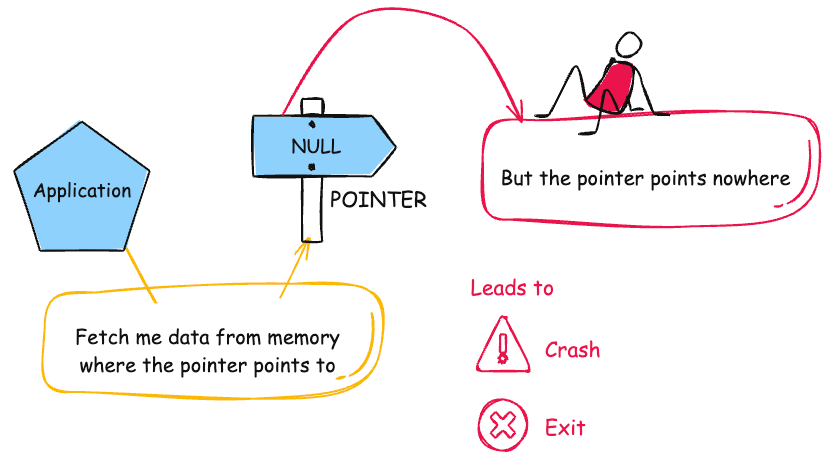
The product dereferences a pointer that it expects to be valid but is NULL.
NPDnull derefNPEnil pointer dereference
Variant - a weakness that is linked to a certain type of product, typically involving a specific language or technology. More specific than a Base weakness. Variant level weaknesses typically describe issues in terms of 3 to 5 of the following dimensions: behavior, property, technology, language, and resource.
Comparison of Object References Instead of Object Contents
- (595)
1449(Weaknesses Addressed by the OpenSSF Secure Coding Guide for Python (2026)) >
1458(OpenSSF Secure Coding Guide for Python (2026) - 08 Coding Standards) >
595(Comparison of Object References Instead of Object Contents)
The product compares object references instead of the contents of the objects themselves, preventing it from detecting equivalent objects.
Base - a weakness that is still mostly independent of a resource or technology, but with sufficient details to provide specific methods for detection and prevention. Base level weaknesses typically describe issues in terms of 2 or 3 of the following dimensions: behavior, property, technology, language, and resource.
Reachable Assertion
- (617)
1449(Weaknesses Addressed by the OpenSSF Secure Coding Guide for Python (2026)) >
1458(OpenSSF Secure Coding Guide for Python (2026) - 08 Coding Standards) >
617(Reachable Assertion)
The product contains an assert() or similar statement that can be triggered by an attacker, which leads to an application exit or other behavior that is more severe than necessary.
assertion failure
Pillar - a weakness that is the most abstract type of weakness and represents a theme for all class/base/variant weaknesses related to it. A Pillar is different from a Category as a Pillar is still technically a type of weakness that describes a mistake, while a Category represents a common characteristic used to group related things.
Improper Check or Handling of Exceptional Conditions
- (703)
1449(Weaknesses Addressed by the OpenSSF Secure Coding Guide for Python (2026)) >
1458(OpenSSF Secure Coding Guide for Python (2026) - 08 Coding Standards) >
703(Improper Check or Handling of Exceptional Conditions)
The product does not properly anticipate or handle exceptional conditions that rarely occur during normal operation of the product.
1449(Weaknesses Addressed by the OpenSSF Secure Coding Guide for Python (2026)) >
1459(OpenSSF Secure Coding Guide for Python (2026) - 09 Cryptography)
Weaknesses in this category are related to the rules and recommendations in section "09 Cryptography" of the OpenSSF Secure Coding Guide for Python.
Class - a weakness that is described in a very abstract fashion, typically independent of any specific language or technology. More specific than a Pillar Weakness, but more general than a Base Weakness. Class level weaknesses typically describe issues in terms of 1 or 2 of the following dimensions: behavior, property, and resource.
Use of Insufficiently Random Values
- (330)
1449(Weaknesses Addressed by the OpenSSF Secure Coding Guide for Python (2026)) >
1459(OpenSSF Secure Coding Guide for Python (2026) - 09 Cryptography) >
330(Use of Insufficiently Random Values)
The product uses insufficiently random numbers or values in a security context that depends on unpredictable numbers.
(this CWE ID must not be used to map to real-world vulnerabilities)
Reason
View
Rationale
This entry is a View. Views are not weaknesses and therefore inappropriate to describe the root causes of vulnerabilities.
Comments
Use this View or other Views to search and navigate for the appropriate weakness.
Notes
Relationship
The relationships in this view were determined based on specific statements within the rules from the guide. Not all rules have direct relationships to individual weaknesses, although they likely have chaining relationships in specific circumstances.
CWE-843: Access of Resource Using Incompatible Type
Weakness ID: 843
Vulnerability Mapping:ALLOWEDThis CWE ID may be used to map to real-world vulnerabilities Abstraction:
BaseBase - a weakness that is still mostly independent of a resource or technology, but with sufficient details to provide specific methods for detection and prevention. Base level weaknesses typically describe issues in terms of 2 or 3 of the following dimensions: behavior, property, technology, language, and resource.
View customized information:
Shows the description and diagram, platforms, mitigations, consequences, relationships, memberships, and content history.For users who are interested in more notional aspects of a weakness. Example: educators, technical writers, and project/program managers.For users who are concerned with the practical application and details about the nature of a weakness and how to prevent it from happening. Example: tool developers, security researchers, pen-testers, incident response analysts.For users who are mapping an issue to CWE/CAPEC IDs, i.e., finding the most appropriate CWE for a specific issue (e.g., a CVE record). Example: tool developers, security researchers.For users who wish to see all available information for the CWE/CAPEC entry.For users who want to customize what details are displayed.
×
Edit Custom Filter
More information is available — Please edit the custom filter or select a different filter.
Description
The product allocates or initializes a resource such as a pointer, object, or variable using one type, but it later accesses that resource using a type that is incompatible with the original type.
Alternate Terms
Type Confusion
Roles: Common-Name
Object Type Confusion
Roles: Common-Name
Common Consequences
This table specifies different individual consequences
associated with the weakness. The Scope identifies the application security area that is
violated, while the Impact describes the negative technical impact that arises if an
adversary succeeds in exploiting this weakness. The Likelihood provides information about
how likely the specific consequence is expected to be seen relative to the other
consequences in the list. For example, there may be high likelihood that a weakness will be
exploited to achieve a certain impact, but a low likelihood that it will be exploited to
achieve a different impact.
Impact
Details
Varies by Context
Scope: Other
When the product accesses the resource using an incompatible type, this could trigger logical errors because the resource does not have expected properties.
Read Memory; Modify Memory; Execute Unauthorized Code or Commands; DoS: Crash, Exit, or Restart
Scope: Availability, Integrity, Confidentiality
If a memory buffer is accessed using an incompatible type, and the allocated buffer is smaller than the type that the code is attempting to access, then an attacker could read or write memory outside the bounds of the buffer, leading to a crash or possibly code execution.
Relationships
This table shows the weaknesses and high level categories that are related to this
weakness. These relationships are defined as ChildOf, ParentOf, MemberOf and give insight to
similar items that may exist at higher and lower levels of abstraction. In addition,
relationships such as PeerOf, Overlaps, and CanAlsoBe are defined to show similar weaknesses that the user
may want to explore.
Relevant to the view "Complete Weakness Hierarchy" (View-1000)
Nature
Type
ID
Name
ChildOf
Class - a weakness that is described in a very abstract fashion, typically independent of any specific language or technology. More specific than a Pillar Weakness, but more general than a Base Weakness. Class level weaknesses typically describe issues in terms of 1 or 2 of the following dimensions: behavior, property, and resource.
Base - a weakness that is still mostly independent of a resource or technology, but with sufficient details to provide specific methods for detection and prevention. Base level weaknesses typically describe issues in terms of 2 or 3 of the following dimensions: behavior, property, technology, language, and resource.
Class - a weakness that is described in a very abstract fashion, typically independent of any specific language or technology. More specific than a Pillar Weakness, but more general than a Base Weakness. Class level weaknesses typically describe issues in terms of 1 or 2 of the following dimensions: behavior, property, and resource.
Relevant to the view "Weaknesses for Simplified Mapping of Published Vulnerabilities" (View-1003)
Nature
Type
ID
Name
ChildOf
Class - a weakness that is described in a very abstract fashion, typically independent of any specific language or technology. More specific than a Pillar Weakness, but more general than a Base Weakness. Class level weaknesses typically describe issues in terms of 1 or 2 of the following dimensions: behavior, property, and resource.
The different Modes of Introduction provide information
about how and when this
weakness may be introduced. The Phase identifies a point in the life cycle at which
introduction
may occur, while the Note provides a typical scenario related to introduction during the
given
phase.
Phase(s)
Note
Implementation
This weakness is not unique to C and C++. While it is frequently associated with unions when parsing data with many different embedded object types in C, it can be present in any application that can interpret the same variable or memory location in multiple ways. For example, errors in PHP applications can be triggered by providing array parameters when scalars are expected, or vice versa. Languages such as Perl, which perform automatic conversion of a variable of one type when it is accessed as if it were another type, can also contain these issues.
Applicable Platforms
This listing shows possible areas for which the given
weakness could appear. These
may be for specific named Languages, Operating Systems, Architectures, Paradigms,
Technologies,
or a class of such platforms. The platform is listed along with how frequently the given
weakness appears for that instance.
Type
Applicable Platforms
Notes
Languages
C
(Undetermined Prevalence)
C++
(Undetermined Prevalence)
Python
(Undetermined Prevalence)
Demonstrative Examples
Example 1
The following code uses a union to support the representation of different types of messages. It formats messages differently, depending on their type.
buf.msgType = NAME_TYPE; buf.name = defaultMessage; printf("Pointer of buf.name is %p\n", buf.name); /* This particular value for nameID is used to make the code architecture-independent. If coming from untrusted input, it could be any value. */
buf.nameID = (int)(defaultMessage + 1); printf("Pointer of buf.name is now %p\n", buf.name); if (buf.msgType == NAME_TYPE) {
printf("Message: %s\n", buf.name);
} else {
printf("Message: Use ID %d\n", buf.nameID);
}
}
The code intends to process the message as a NAME_TYPE, and sets the default message to "Hello World." However, since both buf.name and buf.nameID are part of the same union, they can act as aliases for the same memory location, depending on memory layout after compilation.
As a result, modification of buf.nameID - an int - can effectively modify the pointer that is stored in buf.name - a string.
Execution of the program might generate output such as:
Pointer of name is 10830
Pointer of name is now 10831
Message: ello World
Notice how the pointer for buf.name was changed, even though buf.name was not explicitly modified.
In this case, the first "H" character of the message is omitted. However, if an attacker is able to fully control the value of buf.nameID, then buf.name could contain an arbitrary pointer, leading to out-of-bounds reads or writes.
Example 2
The following PHP code accepts a value, adds 5, and prints the sum.
(bad code)
Example Language: PHP
$value = $_GET['value']; $sum = $value + 5; echo "value parameter is '$value'<p>"; echo "SUM is $sum";
When called with the following query string:
value=123
the program calculates the sum and prints out:
SUM is 128
However, the attacker could supply a query string such as:
value[]=123
The "[]" array syntax causes $value to be treated as an array type, which then generates a fatal error when calculating $sum:
Fatal error: Unsupported operand types in program.php on line 2
Example 3
The following Perl code is intended to look up the privileges for user ID's between 0 and 3, by rreading an element of the $UserPrivilegeArray reference. It is expected that only userID 3 is an admin (since this is listed in the third element of the array).
(bad code)
Example Language: Perl
my $UserPrivilegeArray = ["user", "user", "admin", "user"];
In this case, the programmer intended to use "$UserPrivilegeArray->{$userID}" to access the proper position in the array. But because the subscript was omitted, the "user" string was compared to the scalar representation of the $UserPrivilegeArray reference, which might be of the form "ARRAY(0x229e8)" or similar.
Since the logic also "fails open" (CWE-636), the result of this bug is that all users are assigned administrator privileges.
While this is a forced example, it demonstrates how type confusion can have security consequences, even in memory-safe languages.
Selected Observed
Examples
Note: this is a curated list of examples for users to understand the variety of ways in which this
weakness can be introduced. It is not a complete list of all CVEs that are related to this CWE entry.
Improperly-parsed file containing records of different types leads to code execution when a memory location is interpreted as a different object than intended.
Weakness Ordinalities
Ordinality
Description
Primary
(where the weakness exists independent of other weaknesses)
Resultant
(where the weakness is typically related to the presence of some other weaknesses)
Detection
Methods
Method
Details
Automated Static Analysis
Automated static analysis, commonly referred to as Static Application Security Testing (SAST), can find some instances of this weakness by analyzing source code (or binary/compiled code) without having to execute it. Typically, this is done by building a model of data flow and control flow, then searching for potentially-vulnerable patterns that connect "sources" (origins of input) with "sinks" (destinations where the data interacts with external components, a lower layer such as the OS, etc.)
Effectiveness: High
Memberships
This MemberOf Relationships table shows additional CWE Categories and Views that
reference this weakness as a member. This information is often useful in understanding where a
weakness fits within the context of external information sources.
Nature
Type
ID
Name
MemberOf
Grouping - a CWE entry that contains a set of other entries that share a common characteristic.
OpenSSF Secure Coding Guide for Python (2026) - 04 Neutralization
Vulnerability Mapping Notes
Usage
ALLOWED
(this CWE ID may be used to map to real-world vulnerabilities)
Reason
Acceptable-Use
Rationale
This CWE entry is at the Base level of abstraction, which is a preferred level of abstraction for mapping to the root causes of vulnerabilities.
Comments
Carefully read both the name and description to ensure that this mapping is an appropriate fit. Do not try to 'force' a mapping to a lower-level Base/Variant simply to comply with this preferred level of abstraction.
Notes
Applicable Platform
This weakness is possible in any type-unsafe programming language.
Research Gap
Type confusion weaknesses have received some attention by applied researchers and major software vendors for C and C++ code. Some publicly-reported vulnerabilities probably have type confusion as a root-cause weakness, but these may be described as "memory corruption" instead.
For other languages, there are very few public reports of type confusion weaknesses. These are probably under-studied. Since many programs rely directly or indirectly on loose typing, a potential "type confusion" behavior might be intentional, possibly requiring more manual analysis.
Taxonomy
Mappings
Mapped Taxonomy Name
Node ID
Fit
Mapped Node Name
CERT C Secure Coding
EXP39-C
Exact
Do not access a variable through a pointer of an incompatible type
Mark Dowd, John McDonald and Justin Schuh. "The Art of Software Security Assessment". Chapter 7, "Type Confusion", Page 319. 1st Edition. Addison Wesley. 2006.
Vulnerability Mapping:ALLOWEDThis CWE ID may be used to map to real-world vulnerabilities Abstraction:
BaseBase - a weakness that is still mostly independent of a resource or technology, but with sufficient details to provide specific methods for detection and prevention. Base level weaknesses typically describe issues in terms of 2 or 3 of the following dimensions: behavior, property, technology, language, and resource.
View customized information:
Shows the description and diagram, platforms, mitigations, consequences, relationships, memberships, and content history.For users who are interested in more notional aspects of a weakness. Example: educators, technical writers, and project/program managers.For users who are concerned with the practical application and details about the nature of a weakness and how to prevent it from happening. Example: tool developers, security researchers, pen-testers, incident response analysts.For users who are mapping an issue to CWE/CAPEC IDs, i.e., finding the most appropriate CWE for a specific issue (e.g., a CVE record). Example: tool developers, security researchers.For users who wish to see all available information for the CWE/CAPEC entry.For users who want to customize what details are displayed.
×
Edit Custom Filter
More information is available — Please edit the custom filter or select a different filter.
Description
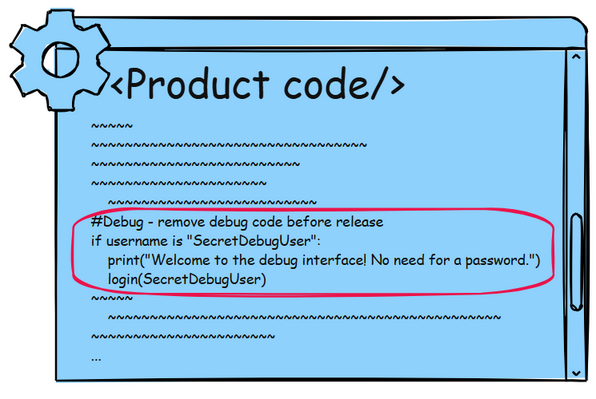
The product is released with debugging code still enabled or active.
Alternate Terms
Leftover debug code
This term originates from Seven Pernicious Kingdoms
Common Consequences
This table specifies different individual consequences
associated with the weakness. The Scope identifies the application security area that is
violated, while the Impact describes the negative technical impact that arises if an
adversary succeeds in exploiting this weakness. The Likelihood provides information about
how likely the specific consequence is expected to be seen relative to the other
consequences in the list. For example, there may be high likelihood that a weakness will be
exploited to achieve a certain impact, but a low likelihood that it will be exploited to
achieve a different impact.
Impact
Details
Bypass Protection Mechanism; Read Application Data; Gain Privileges or Assume Identity; Varies by Context
Scope: Confidentiality, Integrity, Availability, Access Control, Other
Active debug code can create unintended entry points or expose sensitive information. The severity of the exposed debug code will depend on the particular instance. At the least, it will give an attacker sensitive information about the settings and mechanics of web applications on the server. At worst, as is often the case, the debug code will allow an attacker complete control over the web application and server, as well as confidential information that is accessed by either of these.
Potential Mitigations
Phase(s)
Mitigation
Build and Compilation; Distribution
Remove debug code before deploying the application.
Relationships
This table shows the weaknesses and high level categories that are related to this
weakness. These relationships are defined as ChildOf, ParentOf, MemberOf and give insight to
similar items that may exist at higher and lower levels of abstraction. In addition,
relationships such as PeerOf, Overlaps, and CanAlsoBe are defined to show similar weaknesses that the user
may want to explore.
Relevant to the view "Complete Weakness Hierarchy" (View-1000)
Nature
Type
ID
Name
ChildOf
Pillar - a weakness that is the most abstract type of weakness and represents a theme for all class/base/variant weaknesses related to it. A Pillar is different from a Category as a Pillar is still technically a type of weakness that describes a mistake, while a Category represents a common characteristic used to group related things.
Variant - a weakness that is linked to a certain type of product, typically involving a specific language or technology. More specific than a Base weakness. Variant level weaknesses typically describe issues in terms of 3 to 5 of the following dimensions: behavior, property, technology, language, and resource.
Base - a weakness that is still mostly independent of a resource or technology, but with sufficient details to provide specific methods for detection and prevention. Base level weaknesses typically describe issues in terms of 2 or 3 of the following dimensions: behavior, property, technology, language, and resource.
The different Modes of Introduction provide information
about how and when this
weakness may be introduced. The Phase identifies a point in the life cycle at which
introduction
may occur, while the Note provides a typical scenario related to introduction during the
given
phase.
Phase(s)
Note
Implementation
In web-based applications, debug code is used to test and modify web application properties, configuration information, and functions. If a debug application is left on a production server, this oversight during the "software process" allows attackers access to debug functionality.
Implementation
A common development practice is to add "back door" code specifically designed for debugging or testing purposes that is not intended to be shipped or deployed with the product. These back door entry points create security risks because they are not considered during design or testing and fall outside of the expected operating conditions of the product.
Build and Compilation
Operation
Applicable Platforms
This listing shows possible areas for which the given
weakness could appear. These
may be for specific named Languages, Operating Systems, Architectures, Paradigms,
Technologies,
or a class of such platforms. The platform is listed along with how frequently the given
weakness appears for that instance.
Type
Applicable Platforms
Notes
Languages
Class: Not Language-Specific
(Undetermined Prevalence)
Python
(Undetermined Prevalence)
Technologies
Class: Not Technology-Specific
(Undetermined Prevalence)
Class: ICS/OT
(Undetermined Prevalence)
Demonstrative Examples
Example 1
Debug code can be used to bypass authentication. For example, suppose an application has a login script that receives a username and a password. Assume also that a third, optional, parameter, called "debug", is interpreted by the script as requesting a switch to debug mode, and that when this parameter is given the username and password are not checked. In such a case, it is very simple to bypass the authentication process if the special behavior of the application regarding the debug parameter is known. In a case where the form is:
Which will grant the attacker access to the site, bypassing the authentication process.
Selected Observed
Examples
Note: this is a curated list of examples for users to understand the variety of ways in which this
weakness can be introduced. It is not a complete list of all CVEs that are related to this CWE entry.
Mesh Wi-Fi router has active debug code, allowing attackers to modify device settings
Weakness Ordinalities
Ordinality
Description
Indirect
(where the weakness is a quality issue that might indirectly make it easier to introduce security-relevant weaknesses or make them more difficult to detect)
Primary
(where the weakness exists independent of other weaknesses)
Detection
Methods
Method
Details
Automated Static Analysis
Automated static analysis, commonly referred to as Static Application Security Testing (SAST), can find some instances of this weakness by analyzing source code (or binary/compiled code) without having to execute it. Typically, this is done by building a model of data flow and control flow, then searching for potentially-vulnerable patterns that connect "sources" (origins of input) with "sinks" (destinations where the data interacts with external components, a lower layer such as the OS, etc.)
Effectiveness: High
Memberships
This MemberOf Relationships table shows additional CWE Categories and Views that
reference this weakness as a member. This information is often useful in understanding where a
weakness fits within the context of external information sources.
Nature
Type
ID
Name
MemberOf
Grouping - a CWE entry that contains a set of other entries that share a common characteristic.
OpenSSF Secure Coding Guide for Python (2026) - 06 Logging
Vulnerability Mapping Notes
Usage
ALLOWED
(this CWE ID may be used to map to real-world vulnerabilities)
Reason
Acceptable-Use
Rationale
This CWE entry is at the Base level of abstraction, which is a preferred level of abstraction for mapping to the root causes of vulnerabilities.
Comments
Carefully read both the name and description to ensure that this mapping is an appropriate fit. Do not try to 'force' a mapping to a lower-level Base/Variant simply to comply with this preferred level of abstraction.
Notes
Other
In J2EE a main method may be a good indicator that debug code has been left in the application, although there may not be any direct security impact.
Katrina Tsipenyuk, Brian Chess and Gary McGraw. "Seven Pernicious Kingdoms: A Taxonomy of Software Security Errors". NIST Workshop on Software Security Assurance Tools Techniques and Metrics. NIST. 2005-11-07.
<https://cwe.mitre.org/documents/sources/SevenPerniciousKingdoms.pdf>.
CWE-595: Comparison of Object References Instead of Object Contents
Weakness ID: 595
Vulnerability Mapping:ALLOWEDThis CWE ID may be used to map to real-world vulnerabilities Abstraction:
VariantVariant - a weakness that is linked to a certain type of product, typically involving a specific language or technology. More specific than a Base weakness. Variant level weaknesses typically describe issues in terms of 3 to 5 of the following dimensions: behavior, property, technology, language, and resource.
View customized information:
Shows the description and diagram, platforms, mitigations, consequences, relationships, memberships, and content history.For users who are interested in more notional aspects of a weakness. Example: educators, technical writers, and project/program managers.For users who are concerned with the practical application and details about the nature of a weakness and how to prevent it from happening. Example: tool developers, security researchers, pen-testers, incident response analysts.For users who are mapping an issue to CWE/CAPEC IDs, i.e., finding the most appropriate CWE for a specific issue (e.g., a CVE record). Example: tool developers, security researchers.For users who wish to see all available information for the CWE/CAPEC entry.For users who want to customize what details are displayed.
×
Edit Custom Filter
More information is available — Please edit the custom filter or select a different filter.
Description
The product compares object references instead of the contents of the objects themselves, preventing it from detecting equivalent objects.
Extended Description
For example, in Java, comparing objects using == usually produces deceptive results, since the == operator compares object references rather than values; often, this means that using == for strings is actually comparing the strings' references, not their values.
Common Consequences
This table specifies different individual consequences
associated with the weakness. The Scope identifies the application security area that is
violated, while the Impact describes the negative technical impact that arises if an
adversary succeeds in exploiting this weakness. The Likelihood provides information about
how likely the specific consequence is expected to be seen relative to the other
consequences in the list. For example, there may be high likelihood that a weakness will be
exploited to achieve a certain impact, but a low likelihood that it will be exploited to
achieve a different impact.
Impact
Details
Varies by Context
Scope: Other
This weakness can lead to erroneous results that can cause unexpected application behaviors.
Potential Mitigations
Phase(s)
Mitigation
Implementation
In Java, use the equals() method to compare objects instead of the == operator. If using ==, it is important for performance reasons that your objects are created by a static factory, not by a constructor.
Relationships
This table shows the weaknesses and high level categories that are related to this
weakness. These relationships are defined as ChildOf, ParentOf, MemberOf and give insight to
similar items that may exist at higher and lower levels of abstraction. In addition,
relationships such as PeerOf, Overlaps, and CanAlsoBe are defined to show similar weaknesses that the user
may want to explore.
Relevant to the view "Complete Weakness Hierarchy" (View-1000)
Nature
Type
ID
Name
ChildOf
Class - a weakness that is described in a very abstract fashion, typically independent of any specific language or technology. More specific than a Pillar Weakness, but more general than a Base Weakness. Class level weaknesses typically describe issues in terms of 1 or 2 of the following dimensions: behavior, property, and resource.
Variant - a weakness that is linked to a certain type of product, typically involving a specific language or technology. More specific than a Base weakness. Variant level weaknesses typically describe issues in terms of 3 to 5 of the following dimensions: behavior, property, technology, language, and resource.
Relevant to the view "CISQ Quality Measures (2020)" (View-1305)
Nature
Type
ID
Name
ParentOf
Variant - a weakness that is linked to a certain type of product, typically involving a specific language or technology. More specific than a Base weakness. Variant level weaknesses typically describe issues in terms of 3 to 5 of the following dimensions: behavior, property, technology, language, and resource.
Base - a weakness that is still mostly independent of a resource or technology, but with sufficient details to provide specific methods for detection and prevention. Base level weaknesses typically describe issues in terms of 2 or 3 of the following dimensions: behavior, property, technology, language, and resource.
Persistent Storable Data Element without Associated Comparison Control Element
Modes
Of Introduction
The different Modes of Introduction provide information
about how and when this
weakness may be introduced. The Phase identifies a point in the life cycle at which
introduction
may occur, while the Note provides a typical scenario related to introduction during the
given
phase.
Phase(s)
Note
Implementation
Applicable Platforms
This listing shows possible areas for which the given
weakness could appear. These
may be for specific named Languages, Operating Systems, Architectures, Paradigms,
Technologies,
or a class of such platforms. The platform is listed along with how frequently the given
weakness appears for that instance.
Type
Applicable Platforms
Notes
Languages
Class: Not Language-Specific
(Undetermined Prevalence)
Java
(Undetermined Prevalence)
JavaScript
(Undetermined Prevalence)
PHP
(Undetermined Prevalence)
Python
(Undetermined Prevalence)
Demonstrative Examples
Example 1
In the example below, two Java String objects are declared and initialized with the same string values. An if statement is used to determine if the strings are equivalent.
(bad code)
Example Language: Java
String str1 = new String("Hello"); String str2 = new String("Hello"); if (str1 == str2) {
System.out.println("str1 == str2");
}
However, the if statement will not be executed as the strings are compared using the "==" operator. For Java objects, such as String objects, the "==" operator compares object references, not object values. While the two String objects above contain the same string values, they refer to different object references, so the System.out.println statement will not be executed. To compare object values, the previous code could be modified to use the equals method:
(good code)
Example Language: Java
if (str1.equals(str2)) {
System.out.println("str1 equals str2");
}
Example 2
In the following Java example, two BankAccount objects are compared in the isSameAccount method using the == operator.
(bad code)
Example Language: Java
public boolean isSameAccount(BankAccount accountA, BankAccount accountB) {
return accountA == accountB;
}
Using the == operator to compare objects may produce incorrect or deceptive results by comparing object references rather than values. The equals() method should be used to ensure correct results or objects should contain a member variable that uniquely identifies the object.
The following example shows the use of the equals() method to compare the BankAccount objects and the next example uses a class get method to retrieve the bank account number that uniquely identifies the BankAccount object to compare the objects.
(good code)
Example Language: Java
public boolean isSameAccount(BankAccount accountA, BankAccount accountB) {
return accountA.equals(accountB);
}
Weakness Ordinalities
Ordinality
Description
Primary
(where the weakness exists independent of other weaknesses)
Detection
Methods
Method
Details
Automated Static Analysis
Automated static analysis, commonly referred to as Static Application Security Testing (SAST), can find some instances of this weakness by analyzing source code (or binary/compiled code) without having to execute it. Typically, this is done by building a model of data flow and control flow, then searching for potentially-vulnerable patterns that connect "sources" (origins of input) with "sinks" (destinations where the data interacts with external components, a lower layer such as the OS, etc.)
Effectiveness: High
Memberships
This MemberOf Relationships table shows additional CWE Categories and Views that
reference this weakness as a member. This information is often useful in understanding where a
weakness fits within the context of external information sources.
Nature
Type
ID
Name
MemberOf
Grouping - a CWE entry that contains a set of other entries that share a common characteristic.
The CERT Oracle Secure Coding Standard for Java (2011) Chapter 4 - Expressions (EXP)
MemberOf
View - a subset of CWE entries that provides a way of examining CWE content. The two main view structures are Slices (flat lists) and Graphs (containing relationships between entries).
(this CWE ID may be used to map to real-world vulnerabilities)
Reason
Acceptable-Use
Rationale
This CWE entry is at the Variant level of abstraction, which is a preferred level of abstraction for mapping to the root causes of vulnerabilities.
Comments
Carefully read both the name and description to ensure that this mapping is an appropriate fit. Do not try to 'force' a mapping to a lower-level Base/Variant simply to comply with this preferred level of abstraction.
Taxonomy
Mappings
Mapped Taxonomy Name
Node ID
Fit
Mapped Node Name
The CERT Oracle Secure Coding Standard for Java (2011)
EXP02-J
Use the two-argument Arrays.equals() method to compare the contents of arrays
The CERT Oracle Secure Coding Standard for Java (2011)
EXP02-J
Use the two-argument Arrays.equals() method to compare the contents of arrays
The CERT Oracle Secure Coding Standard for Java (2011)
EXP03-J
Do not use the equality operators when comparing values of boxed primitives
OpenSSF Secure Coding Guide for Python
pyscg-0033
Implement Comparisons by Value Rather Than Reference
CWE-362: Concurrent Execution using Shared Resource with Improper Synchronization
Weakness ID: 362
Vulnerability Mapping:ALLOWEDThis CWE ID could be used to map to real-world vulnerabilities in limited situations requiring careful review
(with careful review of mapping notes)
Abstraction:
ClassClass - a weakness that is described in a very abstract fashion, typically independent of any specific language or technology. More specific than a Pillar Weakness, but more general than a Base Weakness. Class level weaknesses typically describe issues in terms of 1 or 2 of the following dimensions: behavior, property, and resource.
View customized information:
Shows the description and diagram, platforms, mitigations, consequences, relationships, memberships, and content history.For users who are interested in more notional aspects of a weakness. Example: educators, technical writers, and project/program managers.For users who are concerned with the practical application and details about the nature of a weakness and how to prevent it from happening. Example: tool developers, security researchers, pen-testers, incident response analysts.For users who are mapping an issue to CWE/CAPEC IDs, i.e., finding the most appropriate CWE for a specific issue (e.g., a CVE record). Example: tool developers, security researchers.For users who wish to see all available information for the CWE/CAPEC entry.For users who want to customize what details are displayed.
×
Edit Custom Filter
More information is available — Please edit the custom filter or select a different filter.
Description
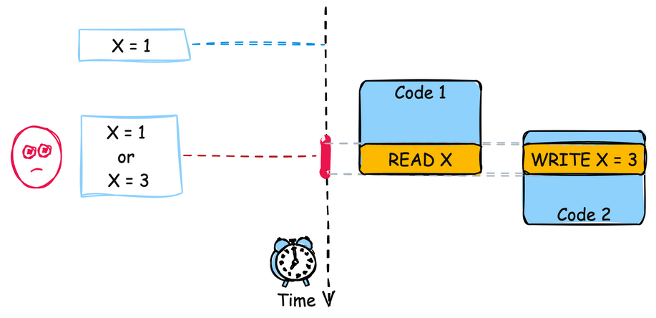
The product contains a concurrent code sequence that requires temporary, exclusive access to a shared resource, but a timing window exists in which the shared resource can be modified by another code sequence operating concurrently.
Technical Nuance
A race condition violates these properties, which are closely related:
Exclusivity: the code sequence is given exclusive access to the shared resource, i.e., no other code sequence can modify properties of the shared resource before the original sequence has completed execution.
Atomicity: the code sequence is behaviorally atomic, i.e., no other thread or process can concurrently execute the same sequence of instructions (or a subset) against the same resource.
A race condition exists when an "interfering code sequence" can still access the shared resource, violating exclusivity.
The interfering code sequence could be "trusted" or "untrusted." A trusted interfering code sequence occurs within the product; it cannot be modified by the attacker, and it can only be invoked indirectly. An untrusted interfering code sequence can be authored directly by the attacker, and typically it is external to the vulnerable product.
Alternate Terms
Race Condition
Roles: Common-Name
Common Consequences
This table specifies different individual consequences
associated with the weakness. The Scope identifies the application security area that is
violated, while the Impact describes the negative technical impact that arises if an
adversary succeeds in exploiting this weakness. The Likelihood provides information about
how likely the specific consequence is expected to be seen relative to the other
consequences in the list. For example, there may be high likelihood that a weakness will be
exploited to achieve a certain impact, but a low likelihood that it will be exploited to
achieve a different impact.
When a race condition makes it possible to bypass a resource cleanup routine or trigger multiple initialization routines, it may lead to resource exhaustion.
DoS: Crash, Exit, or Restart; DoS: Instability
Scope: Availability
When a race condition allows multiple control flows to access a resource simultaneously, it might lead the product(s) into unexpected states, possibly resulting in a crash.
Read Files or Directories; Read Application Data
Scope: Confidentiality, Integrity
When a race condition is combined with predictable resource names and loose permissions, it may be possible for an attacker to overwrite or access confidential data (CWE-59).
Execute Unauthorized Code or Commands; Gain Privileges or Assume Identity; Bypass Protection Mechanism
Scope: Access Control
This can have security implications when the expected synchronization is in security-critical code, such as recording whether a user is authenticated or modifying important state information that should not be influenced by an outsider.
Potential Mitigations
Phase(s)
Mitigation
Architecture and Design
In languages that support it, use synchronization primitives. Only wrap these around critical code to minimize the impact on performance.
Architecture and Design
Use thread-safe capabilities such as the data access abstraction in Spring.
Architecture and Design
Minimize the usage of shared resources in order to remove as much complexity as possible from the control flow and to reduce the likelihood of unexpected conditions occurring.
Additionally, this will minimize the amount of synchronization necessary and may even help to reduce the likelihood of a denial of service where an attacker may be able to repeatedly trigger a critical section (CWE-400).
Implementation
When using multithreading and operating on shared variables, only use thread-safe functions.
Implementation
Use atomic operations on shared variables. Be wary of innocent-looking constructs such as "x++". This may appear atomic at the code layer, but it is actually non-atomic at the instruction layer, since it involves a read, followed by a computation, followed by a write.
Implementation
Use a mutex if available, but be sure to avoid related weaknesses such as CWE-412.
Implementation
Avoid double-checked locking (CWE-609) and other implementation errors that arise when trying to avoid the overhead of synchronization.
Implementation
Disable interrupts or signals over critical parts of the code, but also make sure that the code does not go into a large or infinite loop.
Implementation
Use the volatile type modifier for critical variables to avoid unexpected compiler optimization or reordering. This does not necessarily solve the synchronization problem, but it can help.
Architecture and Design; Operation
Strategy: Environment Hardening
Run your code using the lowest privileges that are required to accomplish the necessary tasks [REF-76]. If possible, create isolated accounts with limited privileges that are only used for a single task. That way, a successful attack will not immediately give the attacker access to the rest of the software or its environment. For example, database applications rarely need to run as the database administrator, especially in day-to-day operations.
Relationships
This table shows the weaknesses and high level categories that are related to this
weakness. These relationships are defined as ChildOf, ParentOf, MemberOf and give insight to
similar items that may exist at higher and lower levels of abstraction. In addition,
relationships such as PeerOf, Overlaps, and CanAlsoBe are defined to show similar weaknesses that the user
may want to explore.
Relevant to the view "Complete Weakness Hierarchy" (View-1000)
Nature
Type
ID
Name
ChildOf
Class - a weakness that is described in a very abstract fashion, typically independent of any specific language or technology. More specific than a Pillar Weakness, but more general than a Base Weakness. Class level weaknesses typically describe issues in terms of 1 or 2 of the following dimensions: behavior, property, and resource.
Base - a weakness that is still mostly independent of a resource or technology, but with sufficient details to provide specific methods for detection and prevention. Base level weaknesses typically describe issues in terms of 2 or 3 of the following dimensions: behavior, property, technology, language, and resource.
Base - a weakness that is still mostly independent of a resource or technology, but with sufficient details to provide specific methods for detection and prevention. Base level weaknesses typically describe issues in terms of 2 or 3 of the following dimensions: behavior, property, technology, language, and resource.
Base - a weakness that is still mostly independent of a resource or technology, but with sufficient details to provide specific methods for detection and prevention. Base level weaknesses typically describe issues in terms of 2 or 3 of the following dimensions: behavior, property, technology, language, and resource.
Base - a weakness that is still mostly independent of a resource or technology, but with sufficient details to provide specific methods for detection and prevention. Base level weaknesses typically describe issues in terms of 2 or 3 of the following dimensions: behavior, property, technology, language, and resource.
Base - a weakness that is still mostly independent of a resource or technology, but with sufficient details to provide specific methods for detection and prevention. Base level weaknesses typically describe issues in terms of 2 or 3 of the following dimensions: behavior, property, technology, language, and resource.
Composite - a Compound Element that consists of two or more distinct weaknesses, in which all weaknesses must be present at the same time in order for a potential vulnerability to arise. Removing any of the weaknesses eliminates or sharply reduces the risk. One weakness, X, can be "broken down" into component weaknesses Y and Z. There can be cases in which one weakness might not be essential to a composite, but changes the nature of the composite when it becomes a vulnerability.
Base - a weakness that is still mostly independent of a resource or technology, but with sufficient details to provide specific methods for detection and prevention. Base level weaknesses typically describe issues in terms of 2 or 3 of the following dimensions: behavior, property, technology, language, and resource.
Base - a weakness that is still mostly independent of a resource or technology, but with sufficient details to provide specific methods for detection and prevention. Base level weaknesses typically describe issues in terms of 2 or 3 of the following dimensions: behavior, property, technology, language, and resource.
Class - a weakness that is described in a very abstract fashion, typically independent of any specific language or technology. More specific than a Pillar Weakness, but more general than a Base Weakness. Class level weaknesses typically describe issues in terms of 1 or 2 of the following dimensions: behavior, property, and resource.
Variant - a weakness that is linked to a certain type of product, typically involving a specific language or technology. More specific than a Base weakness. Variant level weaknesses typically describe issues in terms of 3 to 5 of the following dimensions: behavior, property, technology, language, and resource.
Base - a weakness that is still mostly independent of a resource or technology, but with sufficient details to provide specific methods for detection and prevention. Base level weaknesses typically describe issues in terms of 2 or 3 of the following dimensions: behavior, property, technology, language, and resource.
Relevant to the view "Weaknesses for Simplified Mapping of Published Vulnerabilities" (View-1003)
Nature
Type
ID
Name
MemberOf
View - a subset of CWE entries that provides a way of examining CWE content. The two main view structures are Slices (flat lists) and Graphs (containing relationships between entries).
Weaknesses for Simplified Mapping of Published Vulnerabilities
ParentOf
Base - a weakness that is still mostly independent of a resource or technology, but with sufficient details to provide specific methods for detection and prevention. Base level weaknesses typically describe issues in terms of 2 or 3 of the following dimensions: behavior, property, technology, language, and resource.
A race condition occurs within concurrent environments, and it is effectively a property of a code sequence. Depending on the context, a code sequence may be in the form of a function call, a small number of instructions, a series of program invocations, etc.
Modes
Of Introduction
The different Modes of Introduction provide information
about how and when this
weakness may be introduced. The Phase identifies a point in the life cycle at which
introduction
may occur, while the Note provides a typical scenario related to introduction during the
given
phase.
Phase(s)
Note
Architecture and Design
Implementation
Programmers may assume that certain code sequences execute too quickly to be affected by an interfering code sequence; when they are not, this violates atomicity. For example, the single "x++" statement may appear atomic at the code layer, but it is actually non-atomic at the instruction layer, since it involves a read (the original value of x), followed by a computation (x+1), followed by a write (save the result to x).
Applicable Platforms
This listing shows possible areas for which the given
weakness could appear. These
may be for specific named Languages, Operating Systems, Architectures, Paradigms,
Technologies,
or a class of such platforms. The platform is listed along with how frequently the given
weakness appears for that instance.
Type
Applicable Platforms
Notes
Languages
C
(Sometimes Prevalent)
C++
(Sometimes Prevalent)
Java
(Sometimes Prevalent)
Python
(Undetermined Prevalence)
Technologies
Class: Mobile
(Undetermined Prevalence)
Class: ICS/OT
(Undetermined Prevalence)
Likelihood Of Exploit
Medium
Demonstrative Examples
Example 1
This code could be used in an e-commerce application that supports transfers between accounts. It takes the total amount of the transfer, sends it to the new account, and deducts the amount from the original account.
} SendNewBalanceToDatabase($newbalance); NotifyUser("Transfer of $transfer_amount succeeded."); NotifyUser("New balance: $newbalance");
A race condition could occur between the calls to GetBalanceFromDatabase() and SendNewBalanceToDatabase().
Suppose the balance is initially 100.00. An attack could be constructed as follows:
(attack code)
Example Language: Pseudocode
In the following pseudocode, the attacker makes two simultaneous calls of the program, CALLER-1 and CALLER-2. Both callers are for the same user account. CALLER-1 (the attacker) is associated with PROGRAM-1 (the instance that handles CALLER-1). CALLER-2 is associated with PROGRAM-2. CALLER-1 makes a transfer request of 80.00. PROGRAM-1 calls GetBalanceFromDatabase and sets $balance to 100.00 PROGRAM-1 calculates $newbalance as 20.00, then calls SendNewBalanceToDatabase(). Due to high server load, the PROGRAM-1 call to SendNewBalanceToDatabase() encounters a delay. CALLER-2 makes a transfer request of 1.00. PROGRAM-2 calls GetBalanceFromDatabase() and sets $balance to 100.00. This happens because the previous PROGRAM-1 request was not processed yet. PROGRAM-2 determines the new balance as 99.00. After the initial delay, PROGRAM-1 commits its balance to the database, setting it to 20.00. PROGRAM-2 sends a request to update the database, setting the balance to 99.00
At this stage, the attacker should have a balance of 19.00 (due to 81.00 worth of transfers), but the balance is 99.00, as recorded in the database.
To prevent this weakness, the programmer has several options, including using a lock to prevent multiple simultaneous requests to the web application, or using a synchronization mechanism that includes all the code between GetBalanceFromDatabase() and SendNewBalanceToDatabase().
Example 2
The following function attempts to acquire a lock in order to perform operations on a shared resource.
(bad code)
Example Language: C
void f(pthread_mutex_t *mutex) {
pthread_mutex_lock(mutex);
/* access shared resource */
pthread_mutex_unlock(mutex);
}
However, the code does not check the value returned by pthread_mutex_lock() for errors. If pthread_mutex_lock() cannot acquire the mutex for any reason, the function may introduce a race condition into the program and result in undefined behavior.
In order to avoid data races, correctly written programs must check the result of thread synchronization functions and appropriately handle all errors, either by attempting to recover from them or reporting them to higher levels.
(good code)
Example Language: C
int f(pthread_mutex_t *mutex) {
int result;
result = pthread_mutex_lock(mutex); if (0 != result)
return result;
/* access shared resource */
return pthread_mutex_unlock(mutex);
}
Example 3
Suppose a processor's Memory Management Unit (MMU) has 5 other shadow MMUs to distribute its workload for its various cores. Each MMU has the start address and end address of "accessible" memory. Any time this accessible range changes (as per the processor's boot status), the main MMU sends an update message to all the shadow MMUs.
Suppose the interconnect fabric does not prioritize such "update" packets over other general traffic packets. This introduces a race condition. If an attacker can flood the target with enough messages so that some of those attack packets reach the target before the new access ranges gets updated, then the attacker can leverage this scenario.
Selected Observed
Examples
Note: this is a curated list of examples for users to understand the variety of ways in which this
weakness can be introduced. It is not a complete list of all CVEs that are related to this CWE entry.
Go application for cloud management creates a world-writable sudoers file that allows local attackers to inject sudo rules and escalate privileges to root by winning a race condition.
Chain: race condition (CWE-362) in anti-malware product allows deletion of files by creating a junction (CWE-1386) and using hard links during the time window in which a temporary file is created and deleted.
Chain: chipset has a race condition (CWE-362) between when an interrupt handler detects an attempt to write-enable the BIOS (in violation of the lock bit), and when the handler resets the write-enable bit back to 0, allowing attackers to issue BIOS writes during the timing window [REF-1237].
Chain: time-of-check time-of-use (TOCTOU) race condition in program allows bypass of protection mechanism that was designed to prevent symlink attacks.
Chain: time-of-check time-of-use (TOCTOU) race condition in program allows bypass of protection mechanism that was designed to prevent symlink attacks.
Composite: race condition (CWE-362) allows attacker to modify an object while it is still being initialized, causing software to access uninitialized memory (CWE-908).
Chain: Signal handler contains too much functionality (CWE-828), introducing a race condition (CWE-362) that leads to a double free (CWE-415).
Weakness Ordinalities
Ordinality
Description
Primary
(where the weakness exists independent of other weaknesses)
Resultant
(where the weakness is typically related to the presence of some other weaknesses)
Detection
Methods
Method
Details
Black Box
Black box methods may be able to identify evidence of race conditions via methods such as multiple simultaneous connections, which may cause the software to become instable or crash. However, race conditions with very narrow timing windows would not be detectable.
White Box
Common idioms are detectable in white box analysis, such as time-of-check-time-of-use (TOCTOU) file operations (CWE-367), or double-checked locking (CWE-609).
Automated Dynamic Analysis
This weakness can be detected using dynamic tools and techniques that interact with the software using large test suites with many diverse inputs, such as fuzz testing (fuzzing), robustness testing, and fault injection. The software's operation may slow down, but it should not become unstable, crash, or generate incorrect results.
Race conditions may be detected with a stress-test by calling the software simultaneously from a large number of threads or processes, and look for evidence of any unexpected behavior.
Insert breakpoints or delays in between relevant code statements to artificially expand the race window so that it will be easier to detect.
Effectiveness: Moderate
Automated Static Analysis - Binary or Bytecode
According to SOAR [REF-1479], the following detection techniques may be useful:
This MemberOf Relationships table shows additional CWE Categories and Views that
reference this weakness as a member. This information is often useful in understanding where a
weakness fits within the context of external information sources.
Nature
Type
ID
Name
MemberOf
View - a subset of CWE entries that provides a way of examining CWE content. The two main view structures are Slices (flat lists) and Graphs (containing relationships between entries).
ICS Engineering (Construction/Deployment): Security Gaps in Commissioning
MemberOf
View - a subset of CWE entries that provides a way of examining CWE content. The two main view structures are Slices (flat lists) and Graphs (containing relationships between entries).
View - a subset of CWE entries that provides a way of examining CWE content. The two main view structures are Slices (flat lists) and Graphs (containing relationships between entries).
OpenSSF Secure Coding Guide for Python (2026) - 07 Concurrency
Vulnerability Mapping Notes
Usage
ALLOWED-WITH-REVIEW
(this CWE ID could be used to map to real-world vulnerabilities in limited situations requiring careful review)
Reason
Abstraction
Rationale
This CWE entry is a Class and might have Base-level children that would be more appropriate
Comments
Examine children of this entry to see if there is a better fit
Notes
Research Gap
Race conditions in web applications are under-studied and probably under-reported. However, in 2008 there has been growing interest in this area.
Research Gap
Much of the focus of race condition research has been in Time-of-check Time-of-use (TOCTOU) variants (CWE-367), but many race conditions are related to synchronization problems that do not necessarily require a time-of-check.
Research Gap
From a classification/taxonomy perspective, the relationships between concurrency and program state need closer investigation and may be useful in organizing related issues.
Maintenance
The relationship between race conditions and synchronization problems (CWE-662) needs to be further developed. They are not necessarily two perspectives of the same core concept, since synchronization is only one technique for avoiding race conditions, and synchronization can be used for other purposes besides race condition prevention.
Taxonomy
Mappings
Mapped Taxonomy Name
Node ID
Fit
Mapped Node Name
PLOVER
Race Conditions
The CERT Oracle Secure Coding Standard for Java (2011)
VNA03-J
Do not assume that a group of calls to independently atomic methods is atomic
Vulnerability Mapping:ALLOWEDThis CWE ID may be used to map to real-world vulnerabilities Abstraction:
BaseBase - a weakness that is still mostly independent of a resource or technology, but with sufficient details to provide specific methods for detection and prevention. Base level weaknesses typically describe issues in terms of 2 or 3 of the following dimensions: behavior, property, technology, language, and resource.
View customized information:
Shows the description and diagram, platforms, mitigations, consequences, relationships, memberships, and content history.For users who are interested in more notional aspects of a weakness. Example: educators, technical writers, and project/program managers.For users who are concerned with the practical application and details about the nature of a weakness and how to prevent it from happening. Example: tool developers, security researchers, pen-testers, incident response analysts.For users who are mapping an issue to CWE/CAPEC IDs, i.e., finding the most appropriate CWE for a specific issue (e.g., a CVE record). Example: tool developers, security researchers.For users who wish to see all available information for the CWE/CAPEC entry.For users who want to customize what details are displayed.
×
Edit Custom Filter
More information is available — Please edit the custom filter or select a different filter.
Description
The product contains multiple threads or executable segments that are waiting for each other to release a necessary lock, resulting in deadlock.
Common Consequences
This table specifies different individual consequences
associated with the weakness. The Scope identifies the application security area that is
violated, while the Impact describes the negative technical impact that arises if an
adversary succeeds in exploiting this weakness. The Likelihood provides information about
how likely the specific consequence is expected to be seen relative to the other
consequences in the list. For example, there may be high likelihood that a weakness will be
exploited to achieve a certain impact, but a low likelihood that it will be exploited to
achieve a different impact.
Each thread of execution will "hang" and prevent tasks from completing. In some cases, CPU consumption may occur if a lock check occurs in a tight loop.
Relationships
This table shows the weaknesses and high level categories that are related to this
weakness. These relationships are defined as ChildOf, ParentOf, MemberOf and give insight to
similar items that may exist at higher and lower levels of abstraction. In addition,
relationships such as PeerOf, Overlaps, and CanAlsoBe are defined to show similar weaknesses that the user
may want to explore.
Relevant to the view "Complete Weakness Hierarchy" (View-1000)
Nature
Type
ID
Name
ChildOf
Class - a weakness that is described in a very abstract fashion, typically independent of any specific language or technology. More specific than a Pillar Weakness, but more general than a Base Weakness. Class level weaknesses typically describe issues in terms of 1 or 2 of the following dimensions: behavior, property, and resource.
Relevant to the view "CISQ Quality Measures (2020)" (View-1305)
Nature
Type
ID
Name
ChildOf
Class - a weakness that is described in a very abstract fashion, typically independent of any specific language or technology. More specific than a Pillar Weakness, but more general than a Base Weakness. Class level weaknesses typically describe issues in terms of 1 or 2 of the following dimensions: behavior, property, and resource.
The different Modes of Introduction provide information
about how and when this
weakness may be introduced. The Phase identifies a point in the life cycle at which
introduction
may occur, while the Note provides a typical scenario related to introduction during the
given
phase.
Phase(s)
Note
Implementation
Applicable Platforms
This listing shows possible areas for which the given
weakness could appear. These
may be for specific named Languages, Operating Systems, Architectures, Paradigms,
Technologies,
or a class of such platforms. The platform is listed along with how frequently the given
weakness appears for that instance.
Type
Applicable Platforms
Notes
Languages
Class: Not Language-Specific
(Undetermined Prevalence)
Python
(Undetermined Prevalence)
Technologies
Class: Not Technology-Specific
(Undetermined Prevalence)
Selected Observed
Examples
Note: this is a curated list of examples for users to understand the variety of ways in which this
weakness can be introduced. It is not a complete list of all CVEs that are related to this CWE entry.
Chain: array index error (CWE-129) leads to deadlock (CWE-833)
Weakness Ordinalities
Ordinality
Description
Resultant
(where the weakness is typically related to the presence of some other weaknesses)
Detection
Methods
Method
Details
Automated Static Analysis
Automated static analysis, commonly referred to as Static Application Security Testing (SAST), can find some instances of this weakness by analyzing source code (or binary/compiled code) without having to execute it. Typically, this is done by building a model of data flow and control flow, then searching for potentially-vulnerable patterns that connect "sources" (origins of input) with "sinks" (destinations where the data interacts with external components, a lower layer such as the OS, etc.)
Effectiveness: High
Memberships
This MemberOf Relationships table shows additional CWE Categories and Views that
reference this weakness as a member. This information is often useful in understanding where a
weakness fits within the context of external information sources.
Nature
Type
ID
Name
MemberOf
Grouping - a CWE entry that contains a set of other entries that share a common characteristic.
OpenSSF Secure Coding Guide for Python (2026) - 07 Concurrency
Vulnerability Mapping Notes
Usage
ALLOWED
(this CWE ID may be used to map to real-world vulnerabilities)
Reason
Acceptable-Use
Rationale
This CWE entry is at the Base level of abstraction, which is a preferred level of abstraction for mapping to the root causes of vulnerabilities.
Comments
Carefully read both the name and description to ensure that this mapping is an appropriate fit. Do not try to 'force' a mapping to a lower-level Base/Variant simply to comply with this preferred level of abstraction.
Taxonomy
Mappings
Mapped Taxonomy Name
Node ID
Fit
Mapped Node Name
The CERT Oracle Secure Coding Standard for Java (2011)
LCK08-J
Ensure actively held locks are released on exceptional conditions
Mark Dowd, John McDonald and Justin Schuh. "The Art of Software Security Assessment". Chapter 13, "Synchronization Problems", section "Starvation and Deadlocks", Page 760. 1st Edition. Addison Wesley. 2006.
[REF-783]
Robert C. Seacord. "Secure Coding in C and C++". Chapter 7, "Concurrency", section "Mutual Exclusion and Deadlock", Page 248. Addison Wesley. 2006.
CWE-396: Declaration of Catch for Generic Exception
Weakness ID: 396
Vulnerability Mapping:ALLOWEDThis CWE ID may be used to map to real-world vulnerabilities Abstraction:
BaseBase - a weakness that is still mostly independent of a resource or technology, but with sufficient details to provide specific methods for detection and prevention. Base level weaknesses typically describe issues in terms of 2 or 3 of the following dimensions: behavior, property, technology, language, and resource.
View customized information:
Shows the description and diagram, platforms, mitigations, consequences, relationships, memberships, and content history.For users who are interested in more notional aspects of a weakness. Example: educators, technical writers, and project/program managers.For users who are concerned with the practical application and details about the nature of a weakness and how to prevent it from happening. Example: tool developers, security researchers, pen-testers, incident response analysts.For users who are mapping an issue to CWE/CAPEC IDs, i.e., finding the most appropriate CWE for a specific issue (e.g., a CVE record). Example: tool developers, security researchers.For users who wish to see all available information for the CWE/CAPEC entry.For users who want to customize what details are displayed.
×
Edit Custom Filter
More information is available — Please edit the custom filter or select a different filter.
Description
Catching overly broad exceptions promotes complex error handling code that is more likely to contain security vulnerabilities.
Common Consequences
This table specifies different individual consequences
associated with the weakness. The Scope identifies the application security area that is
violated, while the Impact describes the negative technical impact that arises if an
adversary succeeds in exploiting this weakness. The Likelihood provides information about
how likely the specific consequence is expected to be seen relative to the other
consequences in the list. For example, there may be high likelihood that a weakness will be
exploited to achieve a certain impact, but a low likelihood that it will be exploited to
achieve a different impact.
Impact
Details
Hide Activities
Scope: Non-Repudiation, Other
Multiple catch blocks can get ugly and
repetitive, but "condensing" catch blocks by catching a
high-level class like Exception can obscure exceptions
that deserve special treatment or that should not be
caught at this point in the program. Catching an overly
broad exception essentially defeats the purpose of a
language's typed exceptions, and can become
particularly dangerous if the program grows and begins
to throw new types of exceptions. The new exception
types will not receive any attention. A generic
exception can hide details about unexpected adversary
activities by making it difficult to properly
troubleshoot error conditions during execution.
Relationships
This table shows the weaknesses and high level categories that are related to this
weakness. These relationships are defined as ChildOf, ParentOf, MemberOf and give insight to
similar items that may exist at higher and lower levels of abstraction. In addition,
relationships such as PeerOf, Overlaps, and CanAlsoBe are defined to show similar weaknesses that the user
may want to explore.
Relevant to the view "Complete Weakness Hierarchy" (View-1000)
Nature
Type
ID
Name
ChildOf
Class - a weakness that is described in a very abstract fashion, typically independent of any specific language or technology. More specific than a Pillar Weakness, but more general than a Base Weakness. Class level weaknesses typically describe issues in terms of 1 or 2 of the following dimensions: behavior, property, and resource.
Class - a weakness that is described in a very abstract fashion, typically independent of any specific language or technology. More specific than a Pillar Weakness, but more general than a Base Weakness. Class level weaknesses typically describe issues in terms of 1 or 2 of the following dimensions: behavior, property, and resource.
Class - a weakness that is described in a very abstract fashion, typically independent of any specific language or technology. More specific than a Pillar Weakness, but more general than a Base Weakness. Class level weaknesses typically describe issues in terms of 1 or 2 of the following dimensions: behavior, property, and resource.
The different Modes of Introduction provide information
about how and when this
weakness may be introduced. The Phase identifies a point in the life cycle at which
introduction
may occur, while the Note provides a typical scenario related to introduction during the
given
phase.
Phase(s)
Note
Implementation
Applicable Platforms
This listing shows possible areas for which the given
weakness could appear. These
may be for specific named Languages, Operating Systems, Architectures, Paradigms,
Technologies,
or a class of such platforms. The platform is listed along with how frequently the given
weakness appears for that instance.
Type
Applicable Platforms
Notes
Languages
C++
(Undetermined Prevalence)
Java
(Undetermined Prevalence)
C#
(Undetermined Prevalence)
Python
(Undetermined Prevalence)
Demonstrative Examples
Example 1
The following code excerpt handles three types of exceptions in an identical fashion.
(good code)
Example Language: Java
try {
doExchange();
} catch (IOException e) {
logger.error("doExchange failed", e);
} catch (InvocationTargetException e) {
logger.error("doExchange failed", e);
} catch (SQLException e) {
logger.error("doExchange failed", e);
}
At first blush, it may seem preferable to deal with these exceptions in a single catch block, as follows:
(bad code)
Example Language: Java
try {
doExchange();
} catch (Exception e) {
logger.error("doExchange failed", e);
}
However, if doExchange() is modified to throw a new type of exception that should be handled in some different kind of way, the broad catch block will prevent the compiler from pointing out the situation. Further, the new catch block will now also handle exceptions derived from RuntimeException such as ClassCastException, and NullPointerException, which is not the programmer's intent.
Weakness Ordinalities
Ordinality
Description
Primary
(where the weakness exists independent of other weaknesses)
Detection
Methods
Method
Details
Automated Static Analysis
Automated static analysis, commonly referred to as Static Application Security Testing (SAST), can find some instances of this weakness by analyzing source code (or binary/compiled code) without having to execute it. Typically, this is done by building a model of data flow and control flow, then searching for potentially-vulnerable patterns that connect "sources" (origins of input) with "sinks" (destinations where the data interacts with external components, a lower layer such as the OS, etc.)
Effectiveness: High
Memberships
This MemberOf Relationships table shows additional CWE Categories and Views that
reference this weakness as a member. This information is often useful in understanding where a
weakness fits within the context of external information sources.
Nature
Type
ID
Name
MemberOf
Grouping - a CWE entry that contains a set of other entries that share a common characteristic.
(this CWE ID may be used to map to real-world vulnerabilities)
Reason
Acceptable-Use
Rationale
This CWE entry is at the Base level of abstraction, which is a preferred level of abstraction for mapping to the root causes of vulnerabilities.
Comments
Carefully read both the name and description to ensure that this mapping is an appropriate fit. Do not try to 'force' a mapping to a lower-level Base/Variant simply to comply with this preferred level of abstraction.
Taxonomy
Mappings
Mapped Taxonomy Name
Node ID
Fit
Mapped Node Name
7 Pernicious Kingdoms
Overly-Broad Catch Block
Software Fault Patterns
SFP5
Ambiguous Exception Type
OMG ASCSM
ASCSM-CWE-396
OMG ASCRM
ASCRM-CWE-396
OpenSSF Secure Coding Guide for Python
pyscg-0016
Propagate Exceptions and Preserve Context
References
[REF-6]
Katrina Tsipenyuk, Brian Chess and Gary McGraw. "Seven Pernicious Kingdoms: A Taxonomy of Software Security Errors". NIST Workshop on Software Security Assurance Tools Techniques and Metrics. NIST. 2005-11-07.
<https://cwe.mitre.org/documents/sources/SevenPerniciousKingdoms.pdf>.
[REF-44]
Michael Howard, David LeBlanc and John Viega. "24 Deadly Sins of Software Security". "Sin 9: Catching Exceptions." Page 157. McGraw-Hill. 2010.
CWE-397: Declaration of Throws for Generic Exception
Weakness ID: 397
Vulnerability Mapping:ALLOWEDThis CWE ID may be used to map to real-world vulnerabilities Abstraction:
BaseBase - a weakness that is still mostly independent of a resource or technology, but with sufficient details to provide specific methods for detection and prevention. Base level weaknesses typically describe issues in terms of 2 or 3 of the following dimensions: behavior, property, technology, language, and resource.
View customized information:
Shows the description and diagram, platforms, mitigations, consequences, relationships, memberships, and content history.For users who are interested in more notional aspects of a weakness. Example: educators, technical writers, and project/program managers.For users who are concerned with the practical application and details about the nature of a weakness and how to prevent it from happening. Example: tool developers, security researchers, pen-testers, incident response analysts.For users who are mapping an issue to CWE/CAPEC IDs, i.e., finding the most appropriate CWE for a specific issue (e.g., a CVE record). Example: tool developers, security researchers.For users who wish to see all available information for the CWE/CAPEC entry.For users who want to customize what details are displayed.
×
Edit Custom Filter
More information is available — Please edit the custom filter or select a different filter.
Description
The product throws or raises an overly broad exception that can hide important details and produce inappropriate responses to certain conditions.
Common Consequences
This table specifies different individual consequences
associated with the weakness. The Scope identifies the application security area that is
violated, while the Impact describes the negative technical impact that arises if an
adversary succeeds in exploiting this weakness. The Likelihood provides information about
how likely the specific consequence is expected to be seen relative to the other
consequences in the list. For example, there may be high likelihood that a weakness will be
exploited to achieve a certain impact, but a low likelihood that it will be exploited to
achieve a different impact.
Impact
Details
Hide Activities; Alter Execution Logic
Scope: Non-Repudiation, Other
Declaring a method to throw Exception or Throwable promotes generic error handling procedures that make it difficult for callers to perform proper error handling and error recovery. For example, Java's exception mechanism makes it easy for callers to anticipate what can go wrong and write code to handle each specific exceptional circumstance. Throwing a generic exception can hide details about unexpected adversary activities by making it difficult to properly troubleshoot error conditions during execution.
Relationships
This table shows the weaknesses and high level categories that are related to this
weakness. These relationships are defined as ChildOf, ParentOf, MemberOf and give insight to
similar items that may exist at higher and lower levels of abstraction. In addition,
relationships such as PeerOf, Overlaps, and CanAlsoBe are defined to show similar weaknesses that the user
may want to explore.
Relevant to the view "Complete Weakness Hierarchy" (View-1000)
Nature
Type
ID
Name
ChildOf
Class - a weakness that is described in a very abstract fashion, typically independent of any specific language or technology. More specific than a Pillar Weakness, but more general than a Base Weakness. Class level weaknesses typically describe issues in terms of 1 or 2 of the following dimensions: behavior, property, and resource.
Pillar - a weakness that is the most abstract type of weakness and represents a theme for all class/base/variant weaknesses related to it. A Pillar is different from a Category as a Pillar is still technically a type of weakness that describes a mistake, while a Category represents a common characteristic used to group related things.
Improper Check or Handling of Exceptional Conditions
ChildOf
Class - a weakness that is described in a very abstract fashion, typically independent of any specific language or technology. More specific than a Pillar Weakness, but more general than a Base Weakness. Class level weaknesses typically describe issues in terms of 1 or 2 of the following dimensions: behavior, property, and resource.
The different Modes of Introduction provide information
about how and when this
weakness may be introduced. The Phase identifies a point in the life cycle at which
introduction
may occur, while the Note provides a typical scenario related to introduction during the
given
phase.
Phase(s)
Note
Implementation
Applicable Platforms
This listing shows possible areas for which the given
weakness could appear. These
may be for specific named Languages, Operating Systems, Architectures, Paradigms,
Technologies,
or a class of such platforms. The platform is listed along with how frequently the given
weakness appears for that instance.
Type
Applicable Platforms
Notes
Languages
C++
(Undetermined Prevalence)
C#
(Undetermined Prevalence)
Java
(Undetermined Prevalence)
Python
(Undetermined Prevalence)
Demonstrative Examples
Example 1
The following method throws three types of exceptions.
(good code)
Example Language: Java
public void doExchange() throws IOException, InvocationTargetException, SQLException {
...
}
While it might seem tidier to write
(bad code)
Example Language: Java
public void doExchange() throws Exception {
...
}
doing so hampers the caller's ability to understand and handle the exceptions that occur. Further, if a later revision of doExchange() introduces a new type of exception that should be treated differently than previous exceptions, there is no easy way to enforce this requirement.
Example 2
Early versions of C++ (C++98, C++03, C++11) included a feature known as Dynamic Exception Specification. This allowed functions to declare what type of exceptions it may throw. It is possible to declare a general class of exception to cover any derived exceptions that may be thrown.
(bad code)
Example Language: C++
int myfunction() throw(std::exception) {
if (0) throw out_of_range(); throw length_error();
}
In the example above, the code declares that myfunction() can throw an exception of type "std::exception" thus hiding details about the possible derived exceptions that could potentially be thrown.
Weakness Ordinalities
Ordinality
Description
Primary
(where the weakness exists independent of other weaknesses)
Detection
Methods
Method
Details
Automated Static Analysis
Automated static analysis, commonly referred to as Static Application Security Testing (SAST), can find some instances of this weakness by analyzing source code (or binary/compiled code) without having to execute it. Typically, this is done by building a model of data flow and control flow, then searching for potentially-vulnerable patterns that connect "sources" (origins of input) with "sinks" (destinations where the data interacts with external components, a lower layer such as the OS, etc.)
Effectiveness: High
Memberships
This MemberOf Relationships table shows additional CWE Categories and Views that
reference this weakness as a member. This information is often useful in understanding where a
weakness fits within the context of external information sources.
Nature
Type
ID
Name
MemberOf
Grouping - a CWE entry that contains a set of other entries that share a common characteristic.
(this CWE ID may be used to map to real-world vulnerabilities)
Reason
Acceptable-Use
Rationale
This CWE entry is at the Base level of abstraction, which is a preferred level of abstraction for mapping to the root causes of vulnerabilities.
Comments
Carefully read both the name and description to ensure that this mapping is an appropriate fit. Do not try to 'force' a mapping to a lower-level Base/Variant simply to comply with this preferred level of abstraction.
Notes
Applicable Platform
For C++, this weakness only applies to C++98, C++03, and C++11. It relies on a feature known as Dynamic Exception Specification, which was part of early versions of C++ but was deprecated in C++11. It has been removed for C++17 and later.
Taxonomy
Mappings
Mapped Taxonomy Name
Node ID
Fit
Mapped Node Name
7 Pernicious Kingdoms
Overly-Broad Throws Declaration
The CERT Oracle Secure Coding Standard for Java (2011)
ERR07-J
Do not throw RuntimeException, Exception, or Throwable
Software Fault Patterns
SFP5
Ambiguous Exception Type
OMG ASCSM
ASCSM-CWE-397
OMG ASCRM
ASCRM-CWE-397
OpenSSF Secure Coding Guide for Python
pyscg-0014
Use Specific Exception Types
References
[REF-6]
Katrina Tsipenyuk, Brian Chess and Gary McGraw. "Seven Pernicious Kingdoms: A Taxonomy of Software Security Errors". NIST Workshop on Software Security Assurance Tools Techniques and Metrics. NIST. 2005-11-07.
<https://cwe.mitre.org/documents/sources/SevenPerniciousKingdoms.pdf>.
Vulnerability Mapping:ALLOWEDThis CWE ID may be used to map to real-world vulnerabilities Abstraction:
BaseBase - a weakness that is still mostly independent of a resource or technology, but with sufficient details to provide specific methods for detection and prevention. Base level weaknesses typically describe issues in terms of 2 or 3 of the following dimensions: behavior, property, technology, language, and resource.
View customized information:
Shows the description and diagram, platforms, mitigations, consequences, relationships, memberships, and content history.For users who are interested in more notional aspects of a weakness. Example: educators, technical writers, and project/program managers.For users who are concerned with the practical application and details about the nature of a weakness and how to prevent it from happening. Example: tool developers, security researchers, pen-testers, incident response analysts.For users who are mapping an issue to CWE/CAPEC IDs, i.e., finding the most appropriate CWE for a specific issue (e.g., a CVE record). Example: tool developers, security researchers.For users who wish to see all available information for the CWE/CAPEC entry.For users who want to customize what details are displayed.
×
Edit Custom Filter
More information is available — Please edit the custom filter or select a different filter.
Description
The product deserializes untrusted data without sufficiently ensuring that the resulting data will be valid.
Marshaling and unmarshaling are effectively synonyms for serialization and deserialization, respectively.
Pickling, Unpickling
In Python, the "pickle" functionality is used to perform serialization and deserialization.
PHP Object Injection
Some PHP application researchers use this term when attacking unsafe use of the unserialize() function; but it is also used for CWE-915.
Common Consequences
This table specifies different individual consequences
associated with the weakness. The Scope identifies the application security area that is
violated, while the Impact describes the negative technical impact that arises if an
adversary succeeds in exploiting this weakness. The Likelihood provides information about
how likely the specific consequence is expected to be seen relative to the other
consequences in the list. For example, there may be high likelihood that a weakness will be
exploited to achieve a certain impact, but a low likelihood that it will be exploited to
achieve a different impact.
Impact
Details
Modify Application Data; Unexpected State
Scope: Integrity
Attackers can modify unexpected objects or data that was assumed to be safe from modification. Deserialized data or code could be modified without using the provided accessor functions, or unexpected functions could be invoked.
DoS: Resource Consumption (CPU)
Scope: Availability
If a function is making an assumption on when to terminate, based on a sentry in a string, it could easily never terminate.
Varies by Context
Scope: Other
The consequences can vary widely, because it depends on which objects or methods are being deserialized, and how they are used. Making an assumption that the code in the deserialized object is valid is dangerous and can enable exploitation. One example is attackers using gadget chains to perform unauthorized actions, such as generating a shell.
Potential Mitigations
Phase(s)
Mitigation
Architecture and Design; Implementation
If available, use the signing/sealing features of the programming language to assure that deserialized data has not been tainted. For example, a hash-based message authentication code (HMAC) could be used to ensure that data has not been modified.
Implementation
When deserializing data, populate a new object rather than just deserializing. The result is that the data flows through safe input validation and that the functions are safe.
Implementation
Explicitly define a final object() to prevent deserialization.
Architecture and Design; Implementation
Make fields transient to protect them from deserialization.
An attempt to serialize and then deserialize a class containing transient fields will result in NULLs where the transient data should be. This is an excellent way to prevent time, environment-based, or sensitive variables from being carried over and used improperly.
Implementation
Avoid having unnecessary types or gadgets (a sequence of instances and method invocations that can self-execute during the deserialization process, often found in libraries) available that can be leveraged for malicious ends. This limits the potential for unintended or unauthorized types and gadgets to be leveraged by the attacker. Add only acceptable classes to an allowlist. Note: new gadgets are constantly being discovered, so this alone is not a sufficient mitigation.
Architecture and Design; Implementation
Employ cryptography of the data or code for protection. However, it's important to note that it would still be client-side security. This is risky because if the client is compromised then the security implemented on the client (the cryptography) can be bypassed.
Operation
Strategy: Firewall
Use an application firewall that can detect attacks against this weakness. It can be beneficial in cases in which the code cannot be fixed (because it is controlled by a third party), as an emergency prevention measure while more comprehensive software assurance measures are applied, or to provide defense in depth [REF-1481].
Effectiveness: Moderate
Note: An application firewall might not cover all possible input vectors. In addition, attack techniques might be available to bypass the protection mechanism, such as using malformed inputs that can still be processed by the component that receives those inputs. Depending on functionality, an application firewall might inadvertently reject or modify legitimate requests. Finally, some manual effort may be required for customization.
Relationships
This table shows the weaknesses and high level categories that are related to this
weakness. These relationships are defined as ChildOf, ParentOf, MemberOf and give insight to
similar items that may exist at higher and lower levels of abstraction. In addition,
relationships such as PeerOf, Overlaps, and CanAlsoBe are defined to show similar weaknesses that the user
may want to explore.
Relevant to the view "Complete Weakness Hierarchy" (View-1000)
Nature
Type
ID
Name
ChildOf
Class - a weakness that is described in a very abstract fashion, typically independent of any specific language or technology. More specific than a Pillar Weakness, but more general than a Base Weakness. Class level weaknesses typically describe issues in terms of 1 or 2 of the following dimensions: behavior, property, and resource.
Improper Control of Dynamically-Managed Code Resources
PeerOf
Base - a weakness that is still mostly independent of a resource or technology, but with sufficient details to provide specific methods for detection and prevention. Base level weaknesses typically describe issues in terms of 2 or 3 of the following dimensions: behavior, property, technology, language, and resource.
Relevant to the view "Weaknesses for Simplified Mapping of Published Vulnerabilities" (View-1003)
Nature
Type
ID
Name
ChildOf
Class - a weakness that is described in a very abstract fashion, typically independent of any specific language or technology. More specific than a Pillar Weakness, but more general than a Base Weakness. Class level weaknesses typically describe issues in terms of 1 or 2 of the following dimensions: behavior, property, and resource.
Serialization and deserialization refer to the process of taking program-internal object-related data, packaging it in a way that allows the data to be externally stored or transferred ("serialization"), then extracting the serialized data to reconstruct the original object ("deserialization").
Modes
Of Introduction
The different Modes of Introduction provide information
about how and when this
weakness may be introduced. The Phase identifies a point in the life cycle at which
introduction
may occur, while the Note provides a typical scenario related to introduction during the
given
phase.
Phase(s)
Note
Architecture and Design
OMISSION: This weakness is caused by missing a security tactic during the architecture and design phase.
Implementation
Applicable Platforms
This listing shows possible areas for which the given
weakness could appear. These
may be for specific named Languages, Operating Systems, Architectures, Paradigms,
Technologies,
or a class of such platforms. The platform is listed along with how frequently the given
weakness appears for that instance.
Type
Applicable Platforms
Notes
Languages
Java
(Undetermined Prevalence)
Ruby
(Undetermined Prevalence)
PHP
(Undetermined Prevalence)
Python
(Undetermined Prevalence)
JavaScript
(Undetermined Prevalence)
Python
(Undetermined Prevalence)
Technologies
Class: Not Technology-Specific
(Undetermined Prevalence)
Class: ICS/OT
(Often Prevalent)
AI/ML
(Often Prevalent)
Likelihood Of Exploit
Medium
Demonstrative Examples
Example 1
This code snippet deserializes an object from a file and uses it as a UI button:
(bad code)
Example Language: Java
try {
File file = new File("object.obj"); ObjectInputStream in = new ObjectInputStream(new FileInputStream(file)); javax.swing.JButton button = (javax.swing.JButton) in.readObject(); in.close();
}
This code does not attempt to verify the source or contents of the file before deserializing it. An attacker may be able to replace the intended file with a file that contains arbitrary malicious code which will be executed when the button is pressed.
To mitigate this, explicitly define final readObject() to prevent deserialization. An example of this is:
(good code)
Example Language: Java
private final void readObject(ObjectInputStream in) throws java.io.IOException { throw new java.io.IOException("Cannot be deserialized"); }
Example 2
In Python, the Pickle library handles the serialization and deserialization processes. In this example derived from [REF-467], the code receives and parses data, and afterwards tries to authenticate a user based on validating a token.
(bad code)
Example Language: Python
try {
class ExampleProtocol(protocol.Protocol): def dataReceived(self, data):
# Code that would be here would parse the incoming data # After receiving headers, call confirmAuth() to authenticate
def confirmAuth(self, headers): try: token = cPickle.loads(base64.b64decode(headers['AuthToken'])) if not check_hmac(token['signature'], token['data'], getSecretKey()): raise AuthFail self.secure_data = token['data'] except: raise AuthFail
}
Unfortunately, the code does not verify that the incoming data is legitimate. An attacker can construct a illegitimate, serialized object "AuthToken" that instantiates one of Python's subprocesses to execute arbitrary commands. For instance,the attacker could construct a pickle that leverages Python's subprocess module, which spawns new processes and includes a number of arguments for various uses. Since Pickle allows objects to define the process for how they should be unpickled, the attacker can direct the unpickle process to call Popen in the subprocess module and execute /bin/sh.
Selected Observed
Examples
Note: this is a curated list of examples for users to understand the variety of ways in which this
weakness can be introduced. It is not a complete list of all CVEs that are related to this CWE entry.
PHP-based content management system written in PHP uses unserialize function on untrusted input to generate arbitrary objects, possibly allowing code execution.
Web browser allows execution of native methods via a crafted string to a JavaScript function that deserializes the string.
Weakness Ordinalities
Ordinality
Description
Primary
(where the weakness exists independent of other weaknesses)
Resultant
(where the weakness is typically related to the presence of some other weaknesses)
Detection
Methods
Method
Details
Automated Static Analysis
Automated static analysis, commonly referred to as Static Application Security Testing (SAST), can find some instances of this weakness by analyzing source code (or binary/compiled code) without having to execute it. Typically, this is done by building a model of data flow and control flow, then searching for potentially-vulnerable patterns that connect "sources" (origins of input) with "sinks" (destinations where the data interacts with external components, a lower layer such as the OS, etc.)
Effectiveness: High
Memberships
This MemberOf Relationships table shows additional CWE Categories and Views that
reference this weakness as a member. This information is often useful in understanding where a
weakness fits within the context of external information sources.
Nature
Type
ID
Name
MemberOf
Grouping - a CWE entry that contains a set of other entries that share a common characteristic.
The CERT Oracle Secure Coding Standard for Java (2011) Chapter 15 - Serialization (SER)
MemberOf
View - a subset of CWE entries that provides a way of examining CWE content. The two main view structures are Slices (flat lists) and Graphs (containing relationships between entries).
SEI CERT Oracle Secure Coding Standard for Java - Guidelines 14. Serialization (SER)
MemberOf
View - a subset of CWE entries that provides a way of examining CWE content. The two main view structures are Slices (flat lists) and Graphs (containing relationships between entries).
View - a subset of CWE entries that provides a way of examining CWE content. The two main view structures are Slices (flat lists) and Graphs (containing relationships between entries).
Weaknesses in the 2021 CWE Top 25 Most Dangerous Software Weaknesses
MemberOf
View - a subset of CWE entries that provides a way of examining CWE content. The two main view structures are Slices (flat lists) and Graphs (containing relationships between entries).
View - a subset of CWE entries that provides a way of examining CWE content. The two main view structures are Slices (flat lists) and Graphs (containing relationships between entries).
OWASP Top Ten 2021 Category A08:2021 - Software and Data Integrity Failures
MemberOf
View - a subset of CWE entries that provides a way of examining CWE content. The two main view structures are Slices (flat lists) and Graphs (containing relationships between entries).
View - a subset of CWE entries that provides a way of examining CWE content. The two main view structures are Slices (flat lists) and Graphs (containing relationships between entries).
Weaknesses in the 2023 CWE Top 25 Most Dangerous Software Weaknesses
MemberOf
View - a subset of CWE entries that provides a way of examining CWE content. The two main view structures are Slices (flat lists) and Graphs (containing relationships between entries).
Weaknesses in the 2024 CWE Top 25 Most Dangerous Software Weaknesses
MemberOf
View - a subset of CWE entries that provides a way of examining CWE content. The two main view structures are Slices (flat lists) and Graphs (containing relationships between entries).
OpenSSF Secure Coding Guide for Python (2026) - 04 Neutralization
Vulnerability Mapping Notes
Usage
ALLOWED
(this CWE ID may be used to map to real-world vulnerabilities)
Reason
Acceptable-Use
Rationale
This CWE entry is at the Base level of abstraction, which is a preferred level of abstraction for mapping to the root causes of vulnerabilities.
Comments
Carefully read both the name and description to ensure that this mapping is an appropriate fit. Do not try to 'force' a mapping to a lower-level Base/Variant simply to comply with this preferred level of abstraction.
Notes
Maintenance
The relationships between CWE-502 and CWE-915 need further exploration. CWE-915 is more narrowly scoped to object modification, and is not necessarily used for deserialization.
Taxonomy
Mappings
Mapped Taxonomy Name
Node ID
Fit
Mapped Node Name
CLASP
Deserialization of untrusted data
The CERT Oracle Secure Coding Standard for Java (2011)
SER01-J
Do not deviate from the proper signatures of serialization methods
The CERT Oracle Secure Coding Standard for Java (2011)
SER03-J
Do not serialize unencrypted, sensitive data
The CERT Oracle Secure Coding Standard for Java (2011)
SER06-J
Make defensive copies of private mutable components during deserialization
The CERT Oracle Secure Coding Standard for Java (2011)
SER08-J
Do not use the default serialized form for implementation defined invariants
CWE-472: External Control of Assumed-Immutable Web Parameter
Weakness ID: 472
Vulnerability Mapping:ALLOWEDThis CWE ID may be used to map to real-world vulnerabilities Abstraction:
BaseBase - a weakness that is still mostly independent of a resource or technology, but with sufficient details to provide specific methods for detection and prevention. Base level weaknesses typically describe issues in terms of 2 or 3 of the following dimensions: behavior, property, technology, language, and resource.
View customized information:
Shows the description and diagram, platforms, mitigations, consequences, relationships, memberships, and content history.For users who are interested in more notional aspects of a weakness. Example: educators, technical writers, and project/program managers.For users who are concerned with the practical application and details about the nature of a weakness and how to prevent it from happening. Example: tool developers, security researchers, pen-testers, incident response analysts.For users who are mapping an issue to CWE/CAPEC IDs, i.e., finding the most appropriate CWE for a specific issue (e.g., a CVE record). Example: tool developers, security researchers.For users who wish to see all available information for the CWE/CAPEC entry.For users who want to customize what details are displayed.
×
Edit Custom Filter
More information is available — Please edit the custom filter or select a different filter.
Description
The web application does not sufficiently verify inputs that are assumed to be immutable but are actually externally controllable, such as hidden form fields.
Extended Description
For example, custom cookies commonly store session data or persistent data across sessions. This kind of session data is normally involved in security related decisions on the server side, such as user authentication and access control. Thus, the cookies might contain sensitive data such as user credentials and privileges. This is a dangerous practice, as it can often lead to improper reliance on the value of the client-provided cookie by the server side application.
Alternate Terms
Assumed-Immutable Parameter Tampering
Common Consequences
This table specifies different individual consequences
associated with the weakness. The Scope identifies the application security area that is
violated, while the Impact describes the negative technical impact that arises if an
adversary succeeds in exploiting this weakness. The Likelihood provides information about
how likely the specific consequence is expected to be seen relative to the other
consequences in the list. For example, there may be high likelihood that a weakness will be
exploited to achieve a certain impact, but a low likelihood that it will be exploited to
achieve a different impact.
Impact
Details
Modify Application Data
Scope: Integrity
Without appropriate protection mechanisms, the client can easily tamper with cookies and similar web data. Reliance on the cookies without detailed validation can lead to problems such as SQL injection. If you use cookie values for security related decisions on the server side, manipulating the cookies might lead to violations of security policies such as authentication bypassing, user impersonation and privilege escalation. In addition, storing sensitive data in the cookie without appropriate protection can also lead to disclosure of sensitive user data, especially data stored in persistent cookies.
Bypass Protection Mechanism
Scope: Integrity
If cookie values are used for security related decisions on the server side, manipulating the cookies might lead to violations of security policies such as authentication bypassing, user impersonation, and privilege escalation.
Read Application Data
Scope: Confidentiality
Storing sensitive data in the cookie without appropriate protection can also lead to disclosure of sensitive user data, especially data stored in persistent cookies.
Potential Mitigations
Phase(s)
Mitigation
Implementation
Strategy: Input Validation
Assume all input is malicious. Use an "accept known good" input validation strategy, i.e., use a list of acceptable inputs that strictly conform to specifications. Reject any input that does not strictly conform to specifications, or transform it into something that does.
When performing input validation, consider all potentially relevant properties, including length, type of input, the full range of acceptable values, missing or extra inputs, syntax, consistency across related fields, and conformance to business rules. As an example of business rule logic, "boat" may be syntactically valid because it only contains alphanumeric characters, but it is not valid if the input is only expected to contain colors such as "red" or "blue."
Do not rely exclusively on looking for malicious or malformed inputs. This is likely to miss at least one undesirable input, especially if the code's environment changes. This can give attackers enough room to bypass the intended validation. However, denylists can be useful for detecting potential attacks or determining which inputs are so malformed that they should be rejected outright.
Implementation
Strategy: Input Validation
Inputs should be decoded and canonicalized to the application's current internal representation before being validated (CWE-180). Make sure that the application does not decode the same input twice (CWE-174). Such errors could be used to bypass allowlist validation schemes by introducing dangerous inputs after they have been checked.
Relationships
This table shows the weaknesses and high level categories that are related to this
weakness. These relationships are defined as ChildOf, ParentOf, MemberOf and give insight to
similar items that may exist at higher and lower levels of abstraction. In addition,
relationships such as PeerOf, Overlaps, and CanAlsoBe are defined to show similar weaknesses that the user
may want to explore.
Relevant to the view "Complete Weakness Hierarchy" (View-1000)
Nature
Type
ID
Name
ChildOf
Base - a weakness that is still mostly independent of a resource or technology, but with sufficient details to provide specific methods for detection and prevention. Base level weaknesses typically describe issues in terms of 2 or 3 of the following dimensions: behavior, property, technology, language, and resource.
Class - a weakness that is described in a very abstract fashion, typically independent of any specific language or technology. More specific than a Pillar Weakness, but more general than a Base Weakness. Class level weaknesses typically describe issues in terms of 1 or 2 of the following dimensions: behavior, property, and resource.
Class - a weakness that is described in a very abstract fashion, typically independent of any specific language or technology. More specific than a Pillar Weakness, but more general than a Base Weakness. Class level weaknesses typically describe issues in terms of 1 or 2 of the following dimensions: behavior, property, and resource.
The different Modes of Introduction provide information
about how and when this
weakness may be introduced. The Phase identifies a point in the life cycle at which
introduction
may occur, while the Note provides a typical scenario related to introduction during the
given
phase.
Phase(s)
Note
Implementation
Web application developers often mistakenly assume that data cannot be modified when it has been passed in hidden fields, cookies, or headers.
Implementation
OMISSION: This weakness is caused by missing a security tactic during the architecture and design phase.
Applicable Platforms
This listing shows possible areas for which the given
weakness could appear. These
may be for specific named Languages, Operating Systems, Architectures, Paradigms,
Technologies,
or a class of such platforms. The platform is listed along with how frequently the given
weakness appears for that instance.
Type
Applicable Platforms
Notes
Languages
Class: Not Language-Specific
(Undetermined Prevalence)
Python
(Undetermined Prevalence)
Technologies
Class: Web Based
(Undetermined Prevalence)
Web Server
(Undetermined Prevalence)
Demonstrative Examples
Example 1
In this example, a web application uses the value of a hidden form field (accountID) without having done any input validation because it was assumed to be immutable.
(bad code)
Example Language: Java
String accountID = request.getParameter("accountID"); User user = getUserFromID(Long.parseLong(accountID));
Example 2
Hidden fields should not be trusted as secure parameters.
An attacker can intercept and alter hidden fields in a post to the server as easily as user input fields. An attacker can simply parse the HTML for the substring:
(bad code)
Example Language: HTML
<input type="hidden"
or even just "hidden". Hidden field values displayed later in the session, such as on the following page, can open a site up to cross-site scripting attacks.
Selected Observed
Examples
Note: this is a curated list of examples for users to understand the variety of ways in which this
weakness can be introduced. It is not a complete list of all CVEs that are related to this CWE entry.
Modification of message number parameter allows attackers to read other people's messages.
Weakness Ordinalities
Ordinality
Description
Primary
(where the weakness exists independent of other weaknesses)
Resultant
(where the weakness is typically related to the presence of some other weaknesses)
Detection
Methods
Method
Details
Automated Static Analysis
Automated static analysis, commonly referred to as Static Application Security Testing (SAST), can find some instances of this weakness by analyzing source code (or binary/compiled code) without having to execute it. Typically, this is done by building a model of data flow and control flow, then searching for potentially-vulnerable patterns that connect "sources" (origins of input) with "sinks" (destinations where the data interacts with external components, a lower layer such as the OS, etc.)
Effectiveness: High
Memberships
This MemberOf Relationships table shows additional CWE Categories and Views that
reference this weakness as a member. This information is often useful in understanding where a
weakness fits within the context of external information sources.
Nature
Type
ID
Name
MemberOf
Grouping - a CWE entry that contains a set of other entries that share a common characteristic.
OpenSSF Secure Coding Guide for Python (2026) - 01 Introduction
Vulnerability Mapping Notes
Usage
ALLOWED
(this CWE ID may be used to map to real-world vulnerabilities)
Reason
Acceptable-Use
Rationale
This CWE entry is at the Base level of abstraction, which is a preferred level of abstraction for mapping to the root causes of vulnerabilities.
Comments
Carefully read both the name and description to ensure that this mapping is an appropriate fit. Do not try to 'force' a mapping to a lower-level Base/Variant simply to comply with this preferred level of abstraction.
Notes
Relationship
This is a primary weakness for many other weaknesses and functional consequences, including XSS, SQL injection, path disclosure, and file inclusion.
Michael Howard, David LeBlanc and John Viega. "24 Deadly Sins of Software Security". "Sin 4: Use of Magic URLs, Predictable Cookies, and Hidden Form
Fields." Page 75. McGraw-Hill. 2010.
[REF-62]
Mark Dowd, John McDonald and Justin Schuh. "The Art of Software Security Assessment". Chapter 17, "Embedding State in HTML and URLs", Page 1032. 1st Edition. Addison Wesley. 2006.
CWE-209: Generation of Error Message Containing Sensitive Information
Weakness ID: 209
Vulnerability Mapping:ALLOWEDThis CWE ID may be used to map to real-world vulnerabilities Abstraction:
BaseBase - a weakness that is still mostly independent of a resource or technology, but with sufficient details to provide specific methods for detection and prevention. Base level weaknesses typically describe issues in terms of 2 or 3 of the following dimensions: behavior, property, technology, language, and resource.
View customized information:
Shows the description and diagram, platforms, mitigations, consequences, relationships, memberships, and content history.For users who are interested in more notional aspects of a weakness. Example: educators, technical writers, and project/program managers.For users who are concerned with the practical application and details about the nature of a weakness and how to prevent it from happening. Example: tool developers, security researchers, pen-testers, incident response analysts.For users who are mapping an issue to CWE/CAPEC IDs, i.e., finding the most appropriate CWE for a specific issue (e.g., a CVE record). Example: tool developers, security researchers.For users who wish to see all available information for the CWE/CAPEC entry.For users who want to customize what details are displayed.
×
Edit Custom Filter
More information is available — Please edit the custom filter or select a different filter.
Description
The product generates an error message that includes sensitive information about its environment, users, or associated data.
Dimensions
The Dimensions table provides information about the
different dimensions associated with this weakness. The Type identifies the dimension type,
while the Value provides the specific value for that dimension.
Type
Value
Behavior-Type
Generation
Resource-Type
Error Message
Info-Type
Information
Info-Property
Sensitive
Common Consequences
This table specifies different individual consequences
associated with the weakness. The Scope identifies the application security area that is
violated, while the Impact describes the negative technical impact that arises if an
adversary succeeds in exploiting this weakness. The Likelihood provides information about
how likely the specific consequence is expected to be seen relative to the other
consequences in the list. For example, there may be high likelihood that a weakness will be
exploited to achieve a certain impact, but a low likelihood that it will be exploited to
achieve a different impact.
Impact
Details
Read Application Data
Scope: Confidentiality
Often this will either reveal sensitive information which may be used to launch another, more focused attack or disclose private information stored in the server. For example, an attempt to exploit a path traversal weakness (CWE-22) might yield the full pathname of the installed application. In turn, this could be used to select the proper number of ".." sequences to navigate to the targeted file. An attack using SQL injection (CWE-89) might not initially succeed, but an error message could reveal the malformed query, which would expose query logic and possibly even passwords or other sensitive information used within the query.
Potential Mitigations
Phase(s)
Mitigation
Implementation
Ensure that error messages only contain minimal details that are useful to the intended audience and no one else. The messages need to strike the balance between being too cryptic (which can confuse users) or being too detailed (which may reveal more than intended). The messages should not reveal the methods that were used to determine the error. Attackers can use detailed information to refine or optimize their original attack, thereby increasing their chances of success.
If errors must be captured in some detail, record them in log messages, but consider what could occur if the log messages can be viewed by attackers. Highly sensitive information such as passwords should never be saved to log files.
Avoid inconsistent messaging that might accidentally tip off an attacker about internal state, such as whether a user account exists or not.
Implementation
Handle exceptions internally and do not display errors containing potentially sensitive information to a user.
Implementation
Strategy: Attack Surface Reduction
Use naming conventions and strong types to make it easier to spot when sensitive data is being used. When creating structures, objects, or other complex entities, separate the sensitive and non-sensitive data as much as possible.
Effectiveness: Defense in Depth
Note: This makes it easier to spot places in the code where data is being used that is unencrypted.
Implementation; Build and Compilation
Strategy: Compilation or Build Hardening
Debugging information should not make its way into a production release.
Implementation; Build and Compilation
Strategy: Environment Hardening
Debugging information should not make its way into a production release.
System Configuration
Where available, configure the environment to use less verbose error messages. For example, in PHP, disable the display_errors setting during configuration, or at runtime using the error_reporting() function.
System Configuration
Create default error pages or messages that do not leak any information.
Relationships
This table shows the weaknesses and high level categories that are related to this
weakness. These relationships are defined as ChildOf, ParentOf, MemberOf and give insight to
similar items that may exist at higher and lower levels of abstraction. In addition,
relationships such as PeerOf, Overlaps, and CanAlsoBe are defined to show similar weaknesses that the user
may want to explore.
Relevant to the view "Complete Weakness Hierarchy" (View-1000)
Nature
Type
ID
Name
ChildOf
Class - a weakness that is described in a very abstract fashion, typically independent of any specific language or technology. More specific than a Pillar Weakness, but more general than a Base Weakness. Class level weaknesses typically describe issues in terms of 1 or 2 of the following dimensions: behavior, property, and resource.
Exposure of Sensitive Information to an Unauthorized Actor
ChildOf
Class - a weakness that is described in a very abstract fashion, typically independent of any specific language or technology. More specific than a Pillar Weakness, but more general than a Base Weakness. Class level weaknesses typically describe issues in terms of 1 or 2 of the following dimensions: behavior, property, and resource.
Base - a weakness that is still mostly independent of a resource or technology, but with sufficient details to provide specific methods for detection and prevention. Base level weaknesses typically describe issues in terms of 2 or 3 of the following dimensions: behavior, property, technology, language, and resource.
Self-generated Error Message Containing Sensitive Information
ParentOf
Base - a weakness that is still mostly independent of a resource or technology, but with sufficient details to provide specific methods for detection and prevention. Base level weaknesses typically describe issues in terms of 2 or 3 of the following dimensions: behavior, property, technology, language, and resource.
Externally-Generated Error Message Containing Sensitive Information
ParentOf
Variant - a weakness that is linked to a certain type of product, typically involving a specific language or technology. More specific than a Base weakness. Variant level weaknesses typically describe issues in terms of 3 to 5 of the following dimensions: behavior, property, technology, language, and resource.
Server-generated Error Message Containing Sensitive Information
PeerOf
Base - a weakness that is still mostly independent of a resource or technology, but with sufficient details to provide specific methods for detection and prevention. Base level weaknesses typically describe issues in terms of 2 or 3 of the following dimensions: behavior, property, technology, language, and resource.
Variant - a weakness that is linked to a certain type of product, typically involving a specific language or technology. More specific than a Base weakness. Variant level weaknesses typically describe issues in terms of 3 to 5 of the following dimensions: behavior, property, technology, language, and resource.
Base - a weakness that is still mostly independent of a resource or technology, but with sufficient details to provide specific methods for detection and prevention. Base level weaknesses typically describe issues in terms of 2 or 3 of the following dimensions: behavior, property, technology, language, and resource.
Relevant to the view "Weaknesses for Simplified Mapping of Published Vulnerabilities" (View-1003)
Nature
Type
ID
Name
ChildOf
Class - a weakness that is described in a very abstract fashion, typically independent of any specific language or technology. More specific than a Pillar Weakness, but more general than a Base Weakness. Class level weaknesses typically describe issues in terms of 1 or 2 of the following dimensions: behavior, property, and resource.
The different Modes of Introduction provide information
about how and when this
weakness may be introduced. The Phase identifies a point in the life cycle at which
introduction
may occur, while the Note provides a typical scenario related to introduction during the
given
phase.
Phase(s)
Note
Architecture and Design
Implementation
REALIZATION: This weakness is caused during implementation of an architectural security tactic.
System Configuration
Operation
Applicable Platforms
This listing shows possible areas for which the given
weakness could appear. These
may be for specific named Languages, Operating Systems, Architectures, Paradigms,
Technologies,
or a class of such platforms. The platform is listed along with how frequently the given
weakness appears for that instance.
Type
Applicable Platforms
Notes
Languages
Class: Not Language-Specific
(Undetermined Prevalence)
Go
(Undetermined Prevalence)
PHP
(Often Prevalent)
Java
(Often Prevalent)
Python
(Undetermined Prevalence)
Technologies
Class: Not Technology-Specific
(Undetermined Prevalence)
Likelihood Of Exploit
High
Demonstrative Examples
Example 1
In the following example, sensitive information might be printed depending on the exception that occurs.
(bad code)
Example Language: Java
try {
/.../
} catch (Exception e) {
System.out.println(e);
}
If an exception related to SQL is handled by the catch, then the output might contain sensitive information such as SQL query structure or private information. If this output is redirected to a web user, this may represent a security problem.
Example 2
This code tries to open a database connection, and prints any exceptions that occur.
(bad code)
Example Language: PHP
try {
openDbConnection();
} //print exception message that includes exception message and configuration file location catch (Exception $e) {
If an exception occurs, the printed message exposes the location of the configuration file the script is using. An attacker can use this information to target the configuration file (perhaps exploiting a Path Traversal weakness). If the file can be read, the attacker could gain credentials for accessing the database. The attacker may also be able to replace the file with a malicious one, causing the application to use an arbitrary database.
Example 3
The following code generates an error message that leaks the full pathname of the configuration file.
# avoid CWE-22, CWE-78, others. ExitError("Bad hacker!") if ($uname !~ /^\w+$/); $file = "$ConfigDir/$uname.txt"; if (! (-e $file)) {
ExitError("Error: $file does not exist");
} ...
If this code is running on a server, such as a web application, then the person making the request should not know what the full pathname of the configuration directory is. By submitting a username that does not produce a $file that exists, an attacker could get this pathname. It could then be used to exploit path traversal or symbolic link following problems that may exist elsewhere in the application.
Example 4
In the example below, the method getUserBankAccount retrieves a bank account object from a database using the supplied username and account number to query the database. If an SQLException is raised when querying the database, an error message is created and output to a log file.
(bad code)
Example Language: Java
public BankAccount getUserBankAccount(String username, String accountNumber) {
query = "SELECT * FROM accounts WHERE owner = " + username + " AND accountID = " + accountNumber; DatabaseManager dbManager = new DatabaseManager(); Connection conn = dbManager.getConnection(); Statement stmt = conn.createStatement(); ResultSet queryResult = stmt.executeQuery(query); userAccount = (BankAccount)queryResult.getObject(accountNumber);
}
} catch (SQLException ex) {
String logMessage = "Unable to retrieve account information from database,\nquery: " + query; Logger.getLogger(BankManager.class.getName()).log(Level.SEVERE, logMessage, ex);
} return userAccount;
}
The error message that is created includes information about the database query that may contain sensitive information about the database or query logic. In this case, the error message will expose the table name and column names used in the database. This data could be used to simplify other attacks, such as SQL injection (CWE-89) to directly access the database.
Selected Observed
Examples
Note: this is a curated list of examples for users to understand the variety of ways in which this
weakness can be introduced. It is not a complete list of all CVEs that are related to this CWE entry.
Composite: application running with high privileges (CWE-250) allows user to specify a restricted file to process, which generates a parsing error that leaks the contents of the file (CWE-209).
(where the weakness exists independent of other weaknesses)
Resultant
(where the weakness is typically related to the presence of some other weaknesses)
Detection
Methods
Method
Details
Manual Analysis
This weakness generally requires domain-specific interpretation using manual analysis. However, the number of potential error conditions may be too large to cover completely within limited time constraints.
Effectiveness: High
Automated Analysis
Automated methods may be able to detect certain idioms automatically, such as exposed stack traces or pathnames, but violation of business rules or privacy requirements is not typically feasible.
Effectiveness: Moderate
Automated Dynamic Analysis
This weakness can be detected using dynamic tools and techniques that interact with the software using large test suites with many diverse inputs, such as fuzz testing (fuzzing), robustness testing, and fault injection. The software's operation may slow down, but it should not become unstable, crash, or generate incorrect results.
Error conditions may be triggered with a stress-test by calling the software simultaneously from a large number of threads or processes, and look for evidence of any unexpected behavior.
Effectiveness: Moderate
Manual Dynamic Analysis
Identify error conditions that are not likely to occur during normal usage and trigger them. For example, run the program under low memory conditions, run with insufficient privileges or permissions, interrupt a transaction before it is completed, or disable connectivity to basic network services such as DNS. Monitor the software for any unexpected behavior. If you trigger an unhandled exception or similar error that was discovered and handled by the application's environment, it may still indicate unexpected conditions that were not handled by the application itself.
Automated Static Analysis
Automated static analysis, commonly referred to as Static Application Security Testing (SAST), can find some instances of this weakness by analyzing source code (or binary/compiled code) without having to execute it. Typically, this is done by building a model of data flow and control flow, then searching for potentially-vulnerable patterns that connect "sources" (origins of input) with "sinks" (destinations where the data interacts with external components, a lower layer such as the OS, etc.)
Memberships
This MemberOf Relationships table shows additional CWE Categories and Views that
reference this weakness as a member. This information is often useful in understanding where a
weakness fits within the context of external information sources.
Nature
Type
ID
Name
MemberOf
Grouping - a CWE entry that contains a set of other entries that share a common characteristic.
CERT C++ Secure Coding Section 12 - Exceptions and Error Handling (ERR)
MemberOf
View - a subset of CWE entries that provides a way of examining CWE content. The two main view structures are Slices (flat lists) and Graphs (containing relationships between entries).
OpenSSF Secure Coding Guide for Python (2026) - 06 Logging
MemberOf
View - a subset of CWE entries that provides a way of examining CWE content. The two main view structures are Slices (flat lists) and Graphs (containing relationships between entries).
Weaknesses Addressed by the OWASP Golang Secure Coding Practices Guide
Vulnerability Mapping Notes
Usage
ALLOWED
(this CWE ID may be used to map to real-world vulnerabilities)
Reason
Acceptable-Use
Rationale
This CWE entry is at the Base level of abstraction, which is a preferred level of abstraction for mapping to the root causes of vulnerabilities.
Comments
Carefully read both the name and description to ensure that this mapping is an appropriate fit. Do not try to 'force' a mapping to a lower-level Base/Variant simply to comply with this preferred level of abstraction.
Notes
Other
The sensitive information may be valuable information on its own (such as a password), or it may be useful for launching other, more serious attacks.
The error message may be created in different ways:
self-generated: the source code explicitly constructs the error message and delivers it
externally-generated: the external environment, such as a language interpreter, handles the error and constructs its own message, whose contents are not under direct control by the programmer
Taxonomy
Mappings
Mapped Taxonomy Name
Node ID
Fit
Mapped Node Name
CLASP
Accidental leaking of sensitive information through error messages
OWASP Top Ten 2007
A6
CWE More Specific
Information Leakage and Improper Error Handling
OWASP Top Ten 2004
A7
CWE More Specific
Improper Error Handling
OWASP Top Ten 2004
A10
CWE More Specific
Insecure Configuration Management
The CERT Oracle Secure Coding Standard for Java (2011)
ERR01-J
Do not allow exceptions to expose sensitive information
Software Fault Patterns
SFP23
Exposed Data
OpenSSF Secure Coding Guide for Python
pyscg-0050
Sanitize Error Output to Prevent Information Disclosure
Brian Chess and Jacob West. "Secure Programming with Static Analysis". Section 9.2, Page 326. Addison-Wesley. 2007.
[REF-176]
Michael Howard and David LeBlanc. "Writing Secure Code". Chapter 16, "General Good Practices." Page 415. 1st Edition. Microsoft Press. 2001-11-13.
[REF-44]
Michael Howard, David LeBlanc and John Viega. "24 Deadly Sins of Software Security". "Sin 11: Failure to Handle Errors Correctly." Page 183. McGraw-Hill. 2010.
[REF-44]
Michael Howard, David LeBlanc and John Viega. "24 Deadly Sins of Software Security". "Sin 12: Information Leakage." Page 191. McGraw-Hill. 2010.
Mark Dowd, John McDonald and Justin Schuh. "The Art of Software Security Assessment". Chapter 3, "Overly Verbose Error Messages", Page 75. 1st Edition. Addison Wesley. 2006.
CWE-754: Improper Check for Unusual or Exceptional Conditions
Weakness ID: 754
Vulnerability Mapping:ALLOWEDThis CWE ID could be used to map to real-world vulnerabilities in limited situations requiring careful review
(with careful review of mapping notes)
Abstraction:
ClassClass - a weakness that is described in a very abstract fashion, typically independent of any specific language or technology. More specific than a Pillar Weakness, but more general than a Base Weakness. Class level weaknesses typically describe issues in terms of 1 or 2 of the following dimensions: behavior, property, and resource.
View customized information:
Shows the description and diagram, platforms, mitigations, consequences, relationships, memberships, and content history.For users who are interested in more notional aspects of a weakness. Example: educators, technical writers, and project/program managers.For users who are concerned with the practical application and details about the nature of a weakness and how to prevent it from happening. Example: tool developers, security researchers, pen-testers, incident response analysts.For users who are mapping an issue to CWE/CAPEC IDs, i.e., finding the most appropriate CWE for a specific issue (e.g., a CVE record). Example: tool developers, security researchers.For users who wish to see all available information for the CWE/CAPEC entry.For users who want to customize what details are displayed.
×
Edit Custom Filter
More information is available — Please edit the custom filter or select a different filter.
Description
The product does not check or incorrectly checks for unusual or exceptional conditions that are not expected to occur frequently during day to day operation of the product.
Common Consequences
This table specifies different individual consequences
associated with the weakness. The Scope identifies the application security area that is
violated, while the Impact describes the negative technical impact that arises if an
adversary succeeds in exploiting this weakness. The Likelihood provides information about
how likely the specific consequence is expected to be seen relative to the other
consequences in the list. For example, there may be high likelihood that a weakness will be
exploited to achieve a certain impact, but a low likelihood that it will be exploited to
achieve a different impact.
Impact
Details
DoS: Crash, Exit, or Restart; Unexpected State
Scope: Integrity, Availability
This could lead to instability, incorrect behavior, or a vulnerability. Any data that was produced as a result of a function call could be in a bad state upon return. If the return value is not checked, then this bad data may be used in operations, possibly leading to a crash or other unintended behaviors.
Potential Mitigations
Phase(s)
Mitigation
Requirements
Strategy: Language Selection
Use a language that does not allow this weakness to occur or provides constructs that make this weakness easier to avoid.
Choose languages with features such as exception handling that force the programmer to anticipate unusual conditions that may generate exceptions. Custom exceptions may need to be developed to handle unusual business-logic conditions. Be careful not to pass sensitive exceptions back to the user (CWE-209, CWE-248).
Implementation
Check the results of all functions that return a value and verify that the value is expected.
Effectiveness: High
Note: Checking the return value of the function will typically be sufficient, however beware of race conditions (CWE-362) in a concurrent environment.
Implementation
If using exception handling, catch and throw specific exceptions instead of overly-general exceptions (CWE-396, CWE-397). Catch and handle exceptions as locally as possible so that exceptions do not propagate too far up the call stack (CWE-705). Avoid unchecked or uncaught exceptions where feasible (CWE-248).
Effectiveness: High
Note: Using specific exceptions, and ensuring that exceptions are checked, helps programmers to anticipate and appropriately handle many unusual events that could occur.
Implementation
Ensure that error messages only contain minimal details that are useful to the intended audience and no one else. The messages need to strike the balance between being too cryptic (which can confuse users) or being too detailed (which may reveal more than intended). The messages should not reveal the methods that were used to determine the error. Attackers can use detailed information to refine or optimize their original attack, thereby increasing their chances of success.
If errors must be captured in some detail, record them in log messages, but consider what could occur if the log messages can be viewed by attackers. Highly sensitive information such as passwords should never be saved to log files.
Avoid inconsistent messaging that might accidentally tip off an attacker about internal state, such as whether a user account exists or not.
Exposing additional information to a potential attacker in the context of an exceptional condition can help the attacker determine what attack vectors are most likely to succeed beyond DoS.
Implementation
Strategy: Input Validation
Assume all input is malicious. Use an "accept known good" input validation strategy, i.e., use a list of acceptable inputs that strictly conform to specifications. Reject any input that does not strictly conform to specifications, or transform it into something that does.
When performing input validation, consider all potentially relevant properties, including length, type of input, the full range of acceptable values, missing or extra inputs, syntax, consistency across related fields, and conformance to business rules. As an example of business rule logic, "boat" may be syntactically valid because it only contains alphanumeric characters, but it is not valid if the input is only expected to contain colors such as "red" or "blue."
Do not rely exclusively on looking for malicious or malformed inputs. This is likely to miss at least one undesirable input, especially if the code's environment changes. This can give attackers enough room to bypass the intended validation. However, denylists can be useful for detecting potential attacks or determining which inputs are so malformed that they should be rejected outright.
Note: Performing extensive input validation does not help with handling unusual conditions, but it will minimize their occurrences and will make it more difficult for attackers to trigger them.
Architecture and Design; Implementation
If the program must fail, ensure that it fails gracefully (fails closed). There may be a temptation to simply let the program fail poorly in cases such as low memory conditions, but an attacker may be able to assert control before the software has fully exited. Alternately, an uncontrolled failure could cause cascading problems with other downstream components; for example, the program could send a signal to a downstream process so the process immediately knows that a problem has occurred and has a better chance of recovery.
Architecture and Design
Use system limits, which should help to prevent resource exhaustion. However, the product should still handle low resource conditions since they may still occur.
Relationships
This table shows the weaknesses and high level categories that are related to this
weakness. These relationships are defined as ChildOf, ParentOf, MemberOf and give insight to
similar items that may exist at higher and lower levels of abstraction. In addition,
relationships such as PeerOf, Overlaps, and CanAlsoBe are defined to show similar weaknesses that the user
may want to explore.
Relevant to the view "Complete Weakness Hierarchy" (View-1000)
Nature
Type
ID
Name
ChildOf
Pillar - a weakness that is the most abstract type of weakness and represents a theme for all class/base/variant weaknesses related to it. A Pillar is different from a Category as a Pillar is still technically a type of weakness that describes a mistake, while a Category represents a common characteristic used to group related things.
Improper Check or Handling of Exceptional Conditions
ParentOf
Base - a weakness that is still mostly independent of a resource or technology, but with sufficient details to provide specific methods for detection and prevention. Base level weaknesses typically describe issues in terms of 2 or 3 of the following dimensions: behavior, property, technology, language, and resource.
Base - a weakness that is still mostly independent of a resource or technology, but with sufficient details to provide specific methods for detection and prevention. Base level weaknesses typically describe issues in terms of 2 or 3 of the following dimensions: behavior, property, technology, language, and resource.
Base - a weakness that is still mostly independent of a resource or technology, but with sufficient details to provide specific methods for detection and prevention. Base level weaknesses typically describe issues in terms of 2 or 3 of the following dimensions: behavior, property, technology, language, and resource.
Base - a weakness that is still mostly independent of a resource or technology, but with sufficient details to provide specific methods for detection and prevention. Base level weaknesses typically describe issues in terms of 2 or 3 of the following dimensions: behavior, property, technology, language, and resource.
Base - a weakness that is still mostly independent of a resource or technology, but with sufficient details to provide specific methods for detection and prevention. Base level weaknesses typically describe issues in terms of 2 or 3 of the following dimensions: behavior, property, technology, language, and resource.
Base - a weakness that is still mostly independent of a resource or technology, but with sufficient details to provide specific methods for detection and prevention. Base level weaknesses typically describe issues in terms of 2 or 3 of the following dimensions: behavior, property, technology, language, and resource.
Variant - a weakness that is linked to a certain type of product, typically involving a specific language or technology. More specific than a Base weakness. Variant level weaknesses typically describe issues in terms of 3 to 5 of the following dimensions: behavior, property, technology, language, and resource.
Relevant to the view "Weaknesses for Simplified Mapping of Published Vulnerabilities" (View-1003)
Nature
Type
ID
Name
MemberOf
View - a subset of CWE entries that provides a way of examining CWE content. The two main view structures are Slices (flat lists) and Graphs (containing relationships between entries).
Weaknesses for Simplified Mapping of Published Vulnerabilities
ParentOf
Base - a weakness that is still mostly independent of a resource or technology, but with sufficient details to provide specific methods for detection and prevention. Base level weaknesses typically describe issues in terms of 2 or 3 of the following dimensions: behavior, property, technology, language, and resource.
Base - a weakness that is still mostly independent of a resource or technology, but with sufficient details to provide specific methods for detection and prevention. Base level weaknesses typically describe issues in terms of 2 or 3 of the following dimensions: behavior, property, technology, language, and resource.
Base - a weakness that is still mostly independent of a resource or technology, but with sufficient details to provide specific methods for detection and prevention. Base level weaknesses typically describe issues in terms of 2 or 3 of the following dimensions: behavior, property, technology, language, and resource.
Many functions will return some value about the success of their actions. This will alert the program whether or not to handle any errors caused by that function.
Modes
Of Introduction
The different Modes of Introduction provide information
about how and when this
weakness may be introduced. The Phase identifies a point in the life cycle at which
introduction
may occur, while the Note provides a typical scenario related to introduction during the
given
phase.
Phase(s)
Note
Implementation
The programmer may assume that certain events or conditions will never occur or do not need to be worried about, such as low memory conditions, lack of access to resources due to restrictive permissions, or misbehaving clients or components. Attackers may intentionally trigger these unusual conditions, thus violating the programmer's assumptions.
Implementation
REALIZATION: This weakness is caused during implementation of an architectural security tactic.
Applicable Platforms
This listing shows possible areas for which the given
weakness could appear. These
may be for specific named Languages, Operating Systems, Architectures, Paradigms,
Technologies,
or a class of such platforms. The platform is listed along with how frequently the given
weakness appears for that instance.
Type
Applicable Platforms
Notes
Languages
Class: Not Language-Specific
(Undetermined Prevalence)
Python
(Undetermined Prevalence)
Technologies
Class: Not Technology-Specific
(Undetermined Prevalence)
The programmer expects that when fgets() returns, buf will contain a null-terminated string of length 9 or less. But if an I/O error occurs, fgets() will not null-terminate buf. Furthermore, if the end of the file is reached before any characters are read, fgets() returns without writing anything to buf. In both of these situations, fgets() signals that something unusual has happened by returning NULL, but in this code, the warning will not be noticed. The lack of a null terminator in buf can result in a buffer overflow in the subsequent call to strcpy().
Example 2
The following code does not check to see if memory allocation succeeded before attempting to use the pointer returned by malloc().
The traditional defense of this coding error is: "If my program runs out of memory, it will fail. It doesn't matter whether I handle the error or simply allow the program to die with a segmentation fault when it tries to dereference the null pointer." This argument ignores three important considerations:
Depending upon the type and size of the application, it may be possible to free memory that is being used elsewhere so that execution can continue.
It is impossible for the program to perform a graceful exit if required. If the program is performing an atomic operation, it can leave the system in an inconsistent state.
The programmer has lost the opportunity to record diagnostic information. Did the call to malloc() fail because req_size was too large or because there were too many requests being handled at the same time? Or was it caused by a memory leak that has built up over time? Without handling the error, there is no way to know.
Example 3
The following examples read a file into a byte array.
(bad code)
Example Language: C#
char[] byteArray = new char[1024]; for (IEnumerator i=users.GetEnumerator(); i.MoveNext() ;i.Current()) {
String userName = (String) i.Current(); String pFileName = PFILE_ROOT + "/" + userName; StreamReader sr = new StreamReader(pFileName); sr.Read(byteArray,0,1024);//the file is always 1k bytes sr.Close(); processPFile(userName, byteArray);
}
(bad code)
Example Language: Java
FileInputStream fis; byte[] byteArray = new byte[1024]; for (Iterator i=users.iterator(); i.hasNext();) {
String userName = (String) i.next(); String pFileName = PFILE_ROOT + "/" + userName; FileInputStream fis = new FileInputStream(pFileName); fis.read(byteArray); // the file is always 1k bytes fis.close(); processPFile(userName, byteArray);
The code loops through a set of users, reading a private data file for each user. The programmer assumes that the files are always 1 kilobyte in size and therefore ignores the return value from Read(). If an attacker can create a smaller file, the program will recycle the remainder of the data from the previous user and treat it as though it belongs to the attacker.
Example 4
The following code does not check to see if the string returned by getParameter() is null before calling the member function compareTo(), potentially causing a NULL dereference.
(bad code)
Example Language: Java
String itemName = request.getParameter(ITEM_NAME); if (itemName.compareTo(IMPORTANT_ITEM) == 0) {
...
} ...
The following code does not check to see if the string returned by the Item property is null before calling the member function Equals(), potentially causing a NULL dereference.
(bad code)
Example Language: Java
String itemName = request.Item(ITEM_NAME); if (itemName.Equals(IMPORTANT_ITEM)) {
...
} ...
The traditional defense of this coding error is: "I know the requested value will always exist because.... If it does not exist, the program cannot perform the desired behavior so it doesn't matter whether I handle the error or simply allow the program to die dereferencing a null value." But attackers are skilled at finding unexpected paths through programs, particularly when exceptions are involved.
Example 5
The following code shows a system property that is set to null and later dereferenced by a programmer who mistakenly assumes it will always be defined.
(bad code)
Example Language: Java
System.clearProperty("os.name"); ... String os = System.getProperty("os.name"); if (os.equalsIgnoreCase("Windows 95")) System.out.println("Not supported");
The traditional defense of this coding error is: "I know the requested value will always exist because.... If it does not exist, the program cannot perform the desired behavior so it doesn't matter whether I handle the error or simply allow the program to die dereferencing a null value." But attackers are skilled at finding unexpected paths through programs, particularly when exceptions are involved.
Example 6
The following VB.NET code does not check to make sure that it has read 50 bytes from myfile.txt. This can cause DoDangerousOperation() to operate on an unexpected value.
(bad code)
Example Language: C#
Dim MyFile As New FileStream("myfile.txt", FileMode.Open, FileAccess.Read, FileShare.Read) Dim MyArray(50) As Byte MyFile.Read(MyArray, 0, 50) DoDangerousOperation(MyArray(20))
In .NET, it is not uncommon for programmers to misunderstand Read() and related methods that are part of many System.IO classes. The stream and reader classes do not consider it to be unusual or exceptional if only a small amount of data becomes available. These classes simply add the small amount of data to the return buffer, and set the return value to the number of bytes or characters read. There is no guarantee that the amount of data returned is equal to the amount of data requested.
Example 7
This example takes an IP address from a user, verifies that it is well formed and then looks up the hostname and copies it into a buffer.
If an attacker provides an address that appears to be well-formed, but the address does not resolve to a hostname, then the call to gethostbyaddr() will return NULL. Since the code does not check the return value from gethostbyaddr (CWE-252), a NULL pointer dereference
(CWE-476) would then occur in the call to strcpy().
Note that this code is also vulnerable to a buffer overflow (CWE-119).
Example 8
In the following C/C++ example the method outputStringToFile opens a file in the local filesystem and outputs a string to the file. The input parameters output and filename contain the string to output to the file and the name of the file respectively.
(bad code)
Example Language: C++
int outputStringToFile(char *output, char *filename) {
However, this code does not check the return values of the methods openFileToWrite, writeToFile, closeFile to verify that the file was properly opened and closed and that the string was successfully written to the file. The return values for these methods should be checked to determine if the method was successful and allow for detection of errors or unexpected conditions as in the following example.
(good code)
Example Language: C++
int outputStringToFile(char *output, char *filename) {
int isOutput = SUCCESS;
int isOpen = openFileToWrite(filename); if (isOpen == FAIL) {
printf("Unable to open file %s", filename); isOutput = FAIL;
} else {
int isWrite = writeToFile(output); if (isWrite == FAIL) {
printf("Unable to write to file %s", filename); isOutput = FAIL;
}
int isClose = closeFile(filename); if (isClose == FAIL)
isOutput = FAIL;
} return isOutput;
}
Example 9
In the following Java example the method readFromFile uses a FileReader object to read the contents of a file. The FileReader object is created using the File object readFile, the readFile object is initialized using the setInputFile method. The setInputFile method should be called before calling the readFromFile method.
(bad code)
Example Language: Java
private File readFile = null;
public void setInputFile(String inputFile) {
// create readFile File object from string containing name of file
}
public void readFromFile() {
try {
reader = new FileReader(readFile);
// read input file
} catch (FileNotFoundException ex) {...}
}
However, the readFromFile method does not check to see if the readFile object is null, i.e. has not been initialized, before creating the FileReader object and reading from the input file. The readFromFile method should verify whether the readFile object is null and output an error message and raise an exception if the readFile object is null, as in the following code.
(good code)
Example Language: Java
private File readFile = null;
public void setInputFile(String inputFile) {
// create readFile File object from string containing name of file
}
public void readFromFile() {
try {
if (readFile == null) {
System.err.println("Input file has not been set, call setInputFile method before calling openInputFile"); throw NullPointerException;
Note: this is a curated list of examples for users to understand the variety of ways in which this
weakness can be introduced. It is not a complete list of all CVEs that are related to this CWE entry.
Program does not check return value when invoking functions to drop privileges, which could leave users with higher privileges than expected by forcing those functions to fail.
Program does not check return value when invoking functions to drop privileges, which could leave users with higher privileges than expected by forcing those functions to fail.
Weakness Ordinalities
Ordinality
Description
Primary
(where the weakness exists independent of other weaknesses)
Resultant
(where the weakness is typically related to the presence of some other weaknesses)
Detection
Methods
Method
Details
Automated Static Analysis
Automated static analysis may be useful for detecting unusual conditions involving system resources or common programming idioms, but not for violations of business rules.
Effectiveness: Moderate
Manual Dynamic Analysis
Identify error conditions that are not likely to occur during normal usage and trigger them. For example, run the program under low memory conditions, run with insufficient privileges or permissions, interrupt a transaction before it is completed, or disable connectivity to basic network services such as DNS. Monitor the software for any unexpected behavior. If you trigger an unhandled exception or similar error that was discovered and handled by the application's environment, it may still indicate unexpected conditions that were not handled by the application itself.
Memberships
This MemberOf Relationships table shows additional CWE Categories and Views that
reference this weakness as a member. This information is often useful in understanding where a
weakness fits within the context of external information sources.
Nature
Type
ID
Name
MemberOf
Grouping - a CWE entry that contains a set of other entries that share a common characteristic.
View - a subset of CWE entries that provides a way of examining CWE content. The two main view structures are Slices (flat lists) and Graphs (containing relationships between entries).
Weaknesses Addressed by the Top 20 Secure PLC Coding Practices
Vulnerability Mapping Notes
Usage
ALLOWED-WITH-REVIEW
(this CWE ID could be used to map to real-world vulnerabilities in limited situations requiring careful review)
Reasons
Abstraction,
Frequent Misinterpretation
Rationale
This CWE entry is a Class and might have Base-level children that would be more appropriate
Comments
Important: This entry is not exclusively about the use of exceptions and exception handling, which are just one type of mechanism for both checking and handling unusual or unexpected conditions. Examine children of this entry to see if there is a better fit.
Notes
Relationship
Sometimes, when a return value can be used to indicate an error, an unchecked return value is a code-layer instance of a missing application-layer check for exceptional conditions. However, return values are not always needed to communicate exceptional conditions. For example, expiration of resources, values passed by reference, asynchronously modified data, sockets, etc. may indicate exceptional conditions without the use of a return value.
Taxonomy
Mappings
Mapped Taxonomy Name
Node ID
Fit
Mapped Node Name
SEI CERT Perl Coding Standard
EXP31-PL
CWE More Abstract
Do not suppress or ignore exceptions
ISA/IEC 62443
Part 4-2
Req CR 3.5
ISA/IEC 62443
Part 4-2
Req CR 3.7
OpenSSF Secure Coding Guide for Python
pyscg-0018
Validate Numeric Data Beyond Type Checking
PLC Top 20
4
Use PLC flags as integrity checks
PLC Top 20
7
Validate and alert for paired inputs / outputs
PLC Top 20
11
Instrument for plausibility checks
PLC Top 20
12
Validate inputs based on physical plausibility
PLC Top 20
16
Summarize PLC cycle times and trend them on the HMI
PLC Top 20
20
Trap false negatives and false positives for critical alerts
References
[REF-62]
Mark Dowd, John McDonald and Justin Schuh. "The Art of Software Security Assessment". Chapter 7, "Program Building Blocks" Page 341. 1st Edition. Addison Wesley. 2006.
[REF-62]
Mark Dowd, John McDonald and Justin Schuh. "The Art of Software Security Assessment". Chapter 1, "Exceptional Conditions," Page 22. 1st Edition. Addison Wesley. 2006.
[REF-44]
Michael Howard, David LeBlanc and John Viega. "24 Deadly Sins of Software Security". "Sin 11: Failure to Handle Errors Correctly." Page 183. McGraw-Hill. 2010.
CWE-703: Improper Check or Handling of Exceptional Conditions
Weakness ID: 703
Vulnerability Mapping:DISCOURAGEDThis CWE ID should not be used to map to real-world vulnerabilities Abstraction:
PillarPillar - a weakness that is the most abstract type of weakness and represents a theme for all class/base/variant weaknesses related to it. A Pillar is different from a Category as a Pillar is still technically a type of weakness that describes a mistake, while a Category represents a common characteristic used to group related things.
View customized information:
Shows the description and diagram, platforms, mitigations, consequences, relationships, memberships, and content history.For users who are interested in more notional aspects of a weakness. Example: educators, technical writers, and project/program managers.For users who are concerned with the practical application and details about the nature of a weakness and how to prevent it from happening. Example: tool developers, security researchers, pen-testers, incident response analysts.For users who are mapping an issue to CWE/CAPEC IDs, i.e., finding the most appropriate CWE for a specific issue (e.g., a CVE record). Example: tool developers, security researchers.For users who wish to see all available information for the CWE/CAPEC entry.For users who want to customize what details are displayed.
×
Edit Custom Filter
More information is available — Please edit the custom filter or select a different filter.
Description
The product does not properly anticipate or handle exceptional conditions that rarely occur during normal operation of the product.
Dimensions
The Dimensions table provides information about the
different dimensions associated with this weakness. The Type identifies the dimension type,
while the Value provides the specific value for that dimension.
Type
Value
Behavior-Property
Improper
Behavior-Type
Check
Behavior-Type
Handling
Other
Exceptional Conditions
Common Consequences
This table specifies different individual consequences
associated with the weakness. The Scope identifies the application security area that is
violated, while the Impact describes the negative technical impact that arises if an
adversary succeeds in exploiting this weakness. The Likelihood provides information about
how likely the specific consequence is expected to be seen relative to the other
consequences in the list. For example, there may be high likelihood that a weakness will be
exploited to achieve a certain impact, but a low likelihood that it will be exploited to
achieve a different impact.
Impact
Details
Read Application Data; DoS: Crash, Exit, or Restart; Unexpected State
Scope: Confidentiality, Availability, Integrity
Relationships
This table shows the weaknesses and high level categories that are related to this
weakness. These relationships are defined as ChildOf, ParentOf, MemberOf and give insight to
similar items that may exist at higher and lower levels of abstraction. In addition,
relationships such as PeerOf, Overlaps, and CanAlsoBe are defined to show similar weaknesses that the user
may want to explore.
Relevant to the view "Complete Weakness Hierarchy" (View-1000)
Nature
Type
ID
Name
MemberOf
View - a subset of CWE entries that provides a way of examining CWE content. The two main view structures are Slices (flat lists) and Graphs (containing relationships between entries).
Class - a weakness that is described in a very abstract fashion, typically independent of any specific language or technology. More specific than a Pillar Weakness, but more general than a Base Weakness. Class level weaknesses typically describe issues in terms of 1 or 2 of the following dimensions: behavior, property, and resource.
Improper Handling of Syntactically Invalid Structure
ParentOf
Base - a weakness that is still mostly independent of a resource or technology, but with sufficient details to provide specific methods for detection and prevention. Base level weaknesses typically describe issues in terms of 2 or 3 of the following dimensions: behavior, property, technology, language, and resource.
Base - a weakness that is still mostly independent of a resource or technology, but with sufficient details to provide specific methods for detection and prevention. Base level weaknesses typically describe issues in terms of 2 or 3 of the following dimensions: behavior, property, technology, language, and resource.
Class - a weakness that is described in a very abstract fashion, typically independent of any specific language or technology. More specific than a Pillar Weakness, but more general than a Base Weakness. Class level weaknesses typically describe issues in terms of 1 or 2 of the following dimensions: behavior, property, and resource.
Improper Check for Unusual or Exceptional Conditions
ParentOf
Class - a weakness that is described in a very abstract fashion, typically independent of any specific language or technology. More specific than a Pillar Weakness, but more general than a Base Weakness. Class level weaknesses typically describe issues in terms of 1 or 2 of the following dimensions: behavior, property, and resource.
Class - a weakness that is described in a very abstract fashion, typically independent of any specific language or technology. More specific than a Pillar Weakness, but more general than a Base Weakness. Class level weaknesses typically describe issues in terms of 1 or 2 of the following dimensions: behavior, property, and resource.
Relevant to the view "CISQ Quality Measures (2020)" (View-1305)
Nature
Type
ID
Name
ParentOf
Base - a weakness that is still mostly independent of a resource or technology, but with sufficient details to provide specific methods for detection and prevention. Base level weaknesses typically describe issues in terms of 2 or 3 of the following dimensions: behavior, property, technology, language, and resource.
Base - a weakness that is still mostly independent of a resource or technology, but with sufficient details to provide specific methods for detection and prevention. Base level weaknesses typically describe issues in terms of 2 or 3 of the following dimensions: behavior, property, technology, language, and resource.
Relevant to the view "CISQ Data Protection Measures" (View-1340)
Nature
Type
ID
Name
ParentOf
Base - a weakness that is still mostly independent of a resource or technology, but with sufficient details to provide specific methods for detection and prevention. Base level weaknesses typically describe issues in terms of 2 or 3 of the following dimensions: behavior, property, technology, language, and resource.
Base - a weakness that is still mostly independent of a resource or technology, but with sufficient details to provide specific methods for detection and prevention. Base level weaknesses typically describe issues in terms of 2 or 3 of the following dimensions: behavior, property, technology, language, and resource.
The different Modes of Introduction provide information
about how and when this
weakness may be introduced. The Phase identifies a point in the life cycle at which
introduction
may occur, while the Note provides a typical scenario related to introduction during the
given
phase.
Phase(s)
Note
Architecture and Design
Implementation
REALIZATION: This weakness is caused during implementation of an architectural security tactic.
Operation
Applicable Platforms
This listing shows possible areas for which the given
weakness could appear. These
may be for specific named Languages, Operating Systems, Architectures, Paradigms,
Technologies,
or a class of such platforms. The platform is listed along with how frequently the given
weakness appears for that instance.
Type
Applicable Platforms
Notes
Languages
Class: Not Language-Specific
(Undetermined Prevalence)
Python
(Undetermined Prevalence)
Technologies
Class: Not Technology-Specific
(Undetermined Prevalence)
The programmer expects that when fgets() returns, buf will contain a null-terminated string of length 9 or less. But if an I/O error occurs, fgets() will not null-terminate buf. Furthermore, if the end of the file is reached before any characters are read, fgets() returns without writing anything to buf. In both of these situations, fgets() signals that something unusual has happened by returning NULL, but in this code, the warning will not be noticed. The lack of a null terminator in buf can result in a buffer overflow in the subsequent call to strcpy().
Example 2
The following method throws three types of exceptions.
(good code)
Example Language: Java
public void doExchange() throws IOException, InvocationTargetException, SQLException {
...
}
While it might seem tidier to write
(bad code)
Example Language: Java
public void doExchange() throws Exception {
...
}
doing so hampers the caller's ability to understand and handle the exceptions that occur. Further, if a later revision of doExchange() introduces a new type of exception that should be treated differently than previous exceptions, there is no easy way to enforce this requirement.
Selected Observed
Examples
Note: this is a curated list of examples for users to understand the variety of ways in which this
weakness can be introduced. It is not a complete list of all CVEs that are related to this CWE entry.
Chain: JavaScript-based cryptocurrency library can fall back to the insecure Math.random() function instead of reporting a failure (CWE-392), thus reducing the entropy (CWE-332) and leading to generation of non-unique cryptographic keys for Bitcoin wallets (CWE-1391)
Chain: an operating system does not properly process malformed Open Shortest Path First (OSPF) Type/Length/Value Identifiers (TLV) (CWE-703), which can cause the process to enter an infinite loop (CWE-835)
Weakness Ordinalities
Ordinality
Description
Primary
(where the weakness exists independent of other weaknesses)
Resultant
(where the weakness is typically related to the presence of some other weaknesses)
Detection
Methods
Method
Details
Dynamic Analysis with Manual Results Interpretation
According to SOAR [REF-1479], the following detection techniques may be useful:
Highly cost effective:
Fault Injection - source code
Fault Injection - binary
Cost effective for partial coverage:
Forced Path Execution
Effectiveness: High
Manual Static Analysis - Source Code
According to SOAR [REF-1479], the following detection techniques may be useful:
Highly cost effective:
Manual Source Code Review (not inspections)
Cost effective for partial coverage:
Focused Manual Spotcheck - Focused manual analysis of source
Effectiveness: High
Automated Static Analysis - Source Code
According to SOAR [REF-1479], the following detection techniques may be useful:
Cost effective for partial coverage:
Source code Weakness Analyzer
Context-configured Source Code Weakness Analyzer
Effectiveness: SOAR Partial
Architecture or Design Review
According to SOAR [REF-1479], the following detection techniques may be useful:
This MemberOf Relationships table shows additional CWE Categories and Views that
reference this weakness as a member. This information is often useful in understanding where a
weakness fits within the context of external information sources.
Nature
Type
ID
Name
MemberOf
Grouping - a CWE entry that contains a set of other entries that share a common characteristic.
View - a subset of CWE entries that provides a way of examining CWE content. The two main view structures are Slices (flat lists) and Graphs (containing relationships between entries).
(this CWE ID should not be used to map to real-world vulnerabilities)
Reason
Abstraction
Rationale
This CWE entry is extremely high-level, a Pillar.
Comments
Consider children or descendants of this entry instead.
Notes
Relationship
This is a high-level class that might have some overlap with other classes. It could be argued that even "normal" weaknesses such as buffer overflows involve unusual or exceptional conditions. In that sense, this might be an inherent aspect of most other weaknesses within CWE, similar to API Abuse (CWE-227) and Indicator of Poor Code Quality (CWE-398). However, this entry is currently intended to unify disparate concepts that do not have other places within the Research Concepts view (CWE-1000).
Taxonomy
Mappings
Mapped Taxonomy Name
Node ID
Fit
Mapped Node Name
The CERT Oracle Secure Coding Standard for Java (2011)
Note: this date reflects when the entry was first published. Draft versions of this entry were provided to members of the CWE community and modified between Draft 9 and 1.0.
Vulnerability Mapping:ALLOWEDThis CWE ID may be used to map to real-world vulnerabilities Abstraction:
BaseBase - a weakness that is still mostly independent of a resource or technology, but with sufficient details to provide specific methods for detection and prevention. Base level weaknesses typically describe issues in terms of 2 or 3 of the following dimensions: behavior, property, technology, language, and resource.
View customized information:
Shows the description and diagram, platforms, mitigations, consequences, relationships, memberships, and content history.For users who are interested in more notional aspects of a weakness. Example: educators, technical writers, and project/program managers.For users who are concerned with the practical application and details about the nature of a weakness and how to prevent it from happening. Example: tool developers, security researchers, pen-testers, incident response analysts.For users who are mapping an issue to CWE/CAPEC IDs, i.e., finding the most appropriate CWE for a specific issue (e.g., a CVE record). Example: tool developers, security researchers.For users who wish to see all available information for the CWE/CAPEC entry.For users who want to customize what details are displayed.
×
Edit Custom Filter
More information is available — Please edit the custom filter or select a different filter.
Description
The product does not clean up its state or incorrectly cleans up its state when an exception is thrown.
Common Consequences
This table specifies different individual consequences
associated with the weakness. The Scope identifies the application security area that is
violated, while the Impact describes the negative technical impact that arises if an
adversary succeeds in exploiting this weakness. The Likelihood provides information about
how likely the specific consequence is expected to be seen relative to the other
consequences in the list. For example, there may be high likelihood that a weakness will be
exploited to achieve a certain impact, but a low likelihood that it will be exploited to
achieve a different impact.
Impact
Details
Unexpected State; Varies by Context
Scope: Other
Exceptions can disturb the flow of the code and prevent the necessary cleanup from happening. This could lead to unexpected state or control flow.
Potential Mitigations
Phase(s)
Mitigation
Implementation
If one breaks from a loop or function by throwing an exception, make sure that cleanup happens or that you should exit the program. Use throwing exceptions sparsely.
Relationships
This table shows the weaknesses and high level categories that are related to this
weakness. These relationships are defined as ChildOf, ParentOf, MemberOf and give insight to
similar items that may exist at higher and lower levels of abstraction. In addition,
relationships such as PeerOf, Overlaps, and CanAlsoBe are defined to show similar weaknesses that the user
may want to explore.
Relevant to the view "Complete Weakness Hierarchy" (View-1000)
Nature
Type
ID
Name
ChildOf
Base - a weakness that is still mostly independent of a resource or technology, but with sufficient details to provide specific methods for detection and prevention. Base level weaknesses typically describe issues in terms of 2 or 3 of the following dimensions: behavior, property, technology, language, and resource.
Class - a weakness that is described in a very abstract fashion, typically independent of any specific language or technology. More specific than a Pillar Weakness, but more general than a Base Weakness. Class level weaknesses typically describe issues in terms of 1 or 2 of the following dimensions: behavior, property, and resource.
The different Modes of Introduction provide information
about how and when this
weakness may be introduced. The Phase identifies a point in the life cycle at which
introduction
may occur, while the Note provides a typical scenario related to introduction during the
given
phase.
Phase(s)
Note
Implementation
Often, when functions or loops become complicated, some level of resource cleanup is needed throughout execution.
Implementation
REALIZATION: This weakness is caused during implementation of an architectural security tactic.
Applicable Platforms
This listing shows possible areas for which the given
weakness could appear. These
may be for specific named Languages, Operating Systems, Architectures, Paradigms,
Technologies,
or a class of such platforms. The platform is listed along with how frequently the given
weakness appears for that instance.
threadLock=true; //do some stuff to truthvalue threadLock=false;
}
} catch (Exception e){
System.err.println("You did something bad"); if (something) return truthvalue;
} return truthvalue;
}
}
In this case, a thread might be left locked accidentally.
Weakness Ordinalities
Ordinality
Description
Primary
(where the weakness exists independent of other weaknesses)
Detection
Methods
Method
Details
Automated Static Analysis
Automated static analysis, commonly referred to as Static Application Security Testing (SAST), can find some instances of this weakness by analyzing source code (or binary/compiled code) without having to execute it. Typically, this is done by building a model of data flow and control flow, then searching for potentially-vulnerable patterns that connect "sources" (origins of input) with "sinks" (destinations where the data interacts with external components, a lower layer such as the OS, etc.)
Effectiveness: High
Memberships
This MemberOf Relationships table shows additional CWE Categories and Views that
reference this weakness as a member. This information is often useful in understanding where a
weakness fits within the context of external information sources.
Nature
Type
ID
Name
MemberOf
Grouping - a CWE entry that contains a set of other entries that share a common characteristic.
(this CWE ID may be used to map to real-world vulnerabilities)
Reason
Acceptable-Use
Rationale
This CWE entry is at the Base level of abstraction, which is a preferred level of abstraction for mapping to the root causes of vulnerabilities.
Comments
Carefully read both the name and description to ensure that this mapping is an appropriate fit. Do not try to 'force' a mapping to a lower-level Base/Variant simply to comply with this preferred level of abstraction.
Taxonomy
Mappings
Mapped Taxonomy Name
Node ID
Fit
Mapped Node Name
CLASP
Improper cleanup on thrown exception
The CERT Oracle Secure Coding Standard for Java (2011)
ERR03-J
Restore prior object state on method failure
The CERT Oracle Secure Coding Standard for Java (2011)
ERR05-J
Do not let checked exceptions escape from a finally block
CWE-755: Improper Handling of Exceptional Conditions
Weakness ID: 755
Vulnerability Mapping:DISCOURAGEDThis CWE ID should not be used to map to real-world vulnerabilities Abstraction:
ClassClass - a weakness that is described in a very abstract fashion, typically independent of any specific language or technology. More specific than a Pillar Weakness, but more general than a Base Weakness. Class level weaknesses typically describe issues in terms of 1 or 2 of the following dimensions: behavior, property, and resource.
View customized information:
Shows the description and diagram, platforms, mitigations, consequences, relationships, memberships, and content history.For users who are interested in more notional aspects of a weakness. Example: educators, technical writers, and project/program managers.For users who are concerned with the practical application and details about the nature of a weakness and how to prevent it from happening. Example: tool developers, security researchers, pen-testers, incident response analysts.For users who are mapping an issue to CWE/CAPEC IDs, i.e., finding the most appropriate CWE for a specific issue (e.g., a CVE record). Example: tool developers, security researchers.For users who wish to see all available information for the CWE/CAPEC entry.For users who want to customize what details are displayed.
×
Edit Custom Filter
More information is available — Please edit the custom filter or select a different filter.
Description
The product does not handle or incorrectly handles an exceptional condition.
Common Consequences
This table specifies different individual consequences
associated with the weakness. The Scope identifies the application security area that is
violated, while the Impact describes the negative technical impact that arises if an
adversary succeeds in exploiting this weakness. The Likelihood provides information about
how likely the specific consequence is expected to be seen relative to the other
consequences in the list. For example, there may be high likelihood that a weakness will be
exploited to achieve a certain impact, but a low likelihood that it will be exploited to
achieve a different impact.
Impact
Details
Other
Scope: Other
Relationships
This table shows the weaknesses and high level categories that are related to this
weakness. These relationships are defined as ChildOf, ParentOf, MemberOf and give insight to
similar items that may exist at higher and lower levels of abstraction. In addition,
relationships such as PeerOf, Overlaps, and CanAlsoBe are defined to show similar weaknesses that the user
may want to explore.
Relevant to the view "Complete Weakness Hierarchy" (View-1000)
Nature
Type
ID
Name
ChildOf
Pillar - a weakness that is the most abstract type of weakness and represents a theme for all class/base/variant weaknesses related to it. A Pillar is different from a Category as a Pillar is still technically a type of weakness that describes a mistake, while a Category represents a common characteristic used to group related things.
Improper Check or Handling of Exceptional Conditions
ParentOf
Base - a weakness that is still mostly independent of a resource or technology, but with sufficient details to provide specific methods for detection and prevention. Base level weaknesses typically describe issues in terms of 2 or 3 of the following dimensions: behavior, property, technology, language, and resource.
Generation of Error Message Containing Sensitive Information
ParentOf
Base - a weakness that is still mostly independent of a resource or technology, but with sufficient details to provide specific methods for detection and prevention. Base level weaknesses typically describe issues in terms of 2 or 3 of the following dimensions: behavior, property, technology, language, and resource.
Base - a weakness that is still mostly independent of a resource or technology, but with sufficient details to provide specific methods for detection and prevention. Base level weaknesses typically describe issues in terms of 2 or 3 of the following dimensions: behavior, property, technology, language, and resource.
Base - a weakness that is still mostly independent of a resource or technology, but with sufficient details to provide specific methods for detection and prevention. Base level weaknesses typically describe issues in terms of 2 or 3 of the following dimensions: behavior, property, technology, language, and resource.
Improper Handling of Insufficient Permissions or Privileges
ParentOf
Variant - a weakness that is linked to a certain type of product, typically involving a specific language or technology. More specific than a Base weakness. Variant level weaknesses typically describe issues in terms of 3 to 5 of the following dimensions: behavior, property, technology, language, and resource.
Base - a weakness that is still mostly independent of a resource or technology, but with sufficient details to provide specific methods for detection and prevention. Base level weaknesses typically describe issues in terms of 2 or 3 of the following dimensions: behavior, property, technology, language, and resource.
Base - a weakness that is still mostly independent of a resource or technology, but with sufficient details to provide specific methods for detection and prevention. Base level weaknesses typically describe issues in terms of 2 or 3 of the following dimensions: behavior, property, technology, language, and resource.
Variant - a weakness that is linked to a certain type of product, typically involving a specific language or technology. More specific than a Base weakness. Variant level weaknesses typically describe issues in terms of 3 to 5 of the following dimensions: behavior, property, technology, language, and resource.
Use of NullPointerException Catch to Detect NULL Pointer Dereference
ParentOf
Base - a weakness that is still mostly independent of a resource or technology, but with sufficient details to provide specific methods for detection and prevention. Base level weaknesses typically describe issues in terms of 2 or 3 of the following dimensions: behavior, property, technology, language, and resource.
Base - a weakness that is still mostly independent of a resource or technology, but with sufficient details to provide specific methods for detection and prevention. Base level weaknesses typically describe issues in terms of 2 or 3 of the following dimensions: behavior, property, technology, language, and resource.
Base - a weakness that is still mostly independent of a resource or technology, but with sufficient details to provide specific methods for detection and prevention. Base level weaknesses typically describe issues in terms of 2 or 3 of the following dimensions: behavior, property, technology, language, and resource.
Class - a weakness that is described in a very abstract fashion, typically independent of any specific language or technology. More specific than a Pillar Weakness, but more general than a Base Weakness. Class level weaknesses typically describe issues in terms of 1 or 2 of the following dimensions: behavior, property, and resource.
Base - a weakness that is still mostly independent of a resource or technology, but with sufficient details to provide specific methods for detection and prevention. Base level weaknesses typically describe issues in terms of 2 or 3 of the following dimensions: behavior, property, technology, language, and resource.
Relevant to the view "Weaknesses for Simplified Mapping of Published Vulnerabilities" (View-1003)
Nature
Type
ID
Name
MemberOf
View - a subset of CWE entries that provides a way of examining CWE content. The two main view structures are Slices (flat lists) and Graphs (containing relationships between entries).
The different Modes of Introduction provide information
about how and when this
weakness may be introduced. The Phase identifies a point in the life cycle at which
introduction
may occur, while the Note provides a typical scenario related to introduction during the
given
phase.
Phase(s)
Note
Implementation
REALIZATION: This weakness is caused during implementation of an architectural security tactic.
Applicable Platforms
This listing shows possible areas for which the given
weakness could appear. These
may be for specific named Languages, Operating Systems, Architectures, Paradigms,
Technologies,
or a class of such platforms. The platform is listed along with how frequently the given
weakness appears for that instance.
Type
Applicable Platforms
Notes
Languages
Class: Not Language-Specific
(Undetermined Prevalence)
Python
(Undetermined Prevalence)
Likelihood Of Exploit
Medium
Demonstrative Examples
Example 1
The following example attempts to resolve a hostname.
A DNS lookup failure will cause the Servlet to throw an exception.
Example 2
The following example attempts to allocate memory for a character. After the call to malloc, an if statement is used to check whether the malloc function failed.
(bad code)
Example Language: C
foo=malloc(sizeof(char)); //the next line checks to see if malloc failed if (foo==NULL) {
//We do nothing so we just ignore the error.
}
The conditional successfully detects a NULL return value from malloc indicating a failure, however it does not do anything to handle the problem. Unhandled errors may have unexpected results and may cause the program to crash or terminate.
Instead, the if block should contain statements that either attempt to fix the problem or notify the user that an error has occurred and continue processing or perform some cleanup and gracefully terminate the program. The following example notifies the user that the malloc function did not allocate the required memory resources and returns an error code.
(good code)
Example Language: C
foo=malloc(sizeof(char)); //the next line checks to see if malloc failed if (foo==NULL) {
printf("Malloc failed to allocate memory resources"); return -1;
}
Example 3
The following code mistakenly catches a NullPointerException.
(bad code)
Example Language: Java
try {
mysteryMethod();
} catch (NullPointerException npe) {
}
Selected Observed
Examples
Note: this is a curated list of examples for users to understand the variety of ways in which this
weakness can be introduced. It is not a complete list of all CVEs that are related to this CWE entry.
Chain: JavaScript-based cryptocurrency library can fall back to the insecure Math.random() function instead of reporting a failure (CWE-392), thus reducing the entropy (CWE-332) and leading to generation of non-unique cryptographic keys for Bitcoin wallets (CWE-1391)
virtual interrupt controller in a virtualization product allows crash of host by writing a certain invalid value to a register, which triggers a fatal error instead of returning an error code
Chain: OS kernel does not properly handle a failure of a function call (CWE-755), leading to an unlock of a resource that was not locked (CWE-832), with resultant crash.
Weakness Ordinalities
Ordinality
Description
Primary
(where the weakness exists independent of other weaknesses)
Resultant
(where the weakness is typically related to the presence of some other weaknesses)
Detection
Methods
Method
Details
Automated Static Analysis
Automated static analysis, commonly referred to as Static Application Security Testing (SAST), can find some instances of this weakness by analyzing source code (or binary/compiled code) without having to execute it. Typically, this is done by building a model of data flow and control flow, then searching for potentially-vulnerable patterns that connect "sources" (origins of input) with "sinks" (destinations where the data interacts with external components, a lower layer such as the OS, etc.)
Memberships
This MemberOf Relationships table shows additional CWE Categories and Views that
reference this weakness as a member. This information is often useful in understanding where a
weakness fits within the context of external information sources.
Nature
Type
ID
Name
MemberOf
Grouping - a CWE entry that contains a set of other entries that share a common characteristic.
CWE-409: Improper Handling of Highly Compressed Data (Data Amplification)
Weakness ID: 409
Vulnerability Mapping:ALLOWEDThis CWE ID may be used to map to real-world vulnerabilities Abstraction:
BaseBase - a weakness that is still mostly independent of a resource or technology, but with sufficient details to provide specific methods for detection and prevention. Base level weaknesses typically describe issues in terms of 2 or 3 of the following dimensions: behavior, property, technology, language, and resource.
View customized information:
Shows the description and diagram, platforms, mitigations, consequences, relationships, memberships, and content history.For users who are interested in more notional aspects of a weakness. Example: educators, technical writers, and project/program managers.For users who are concerned with the practical application and details about the nature of a weakness and how to prevent it from happening. Example: tool developers, security researchers, pen-testers, incident response analysts.For users who are mapping an issue to CWE/CAPEC IDs, i.e., finding the most appropriate CWE for a specific issue (e.g., a CVE record). Example: tool developers, security researchers.For users who wish to see all available information for the CWE/CAPEC entry.For users who want to customize what details are displayed.
×
Edit Custom Filter
More information is available — Please edit the custom filter or select a different filter.
Description
The product does not handle or incorrectly
handles a compressed input with a very high compression ratio
that produces a large output.
Common Consequences
This table specifies different individual consequences
associated with the weakness. The Scope identifies the application security area that is
violated, while the Impact describes the negative technical impact that arises if an
adversary succeeds in exploiting this weakness. The Likelihood provides information about
how likely the specific consequence is expected to be seen relative to the other
consequences in the list. For example, there may be high likelihood that a weakness will be
exploited to achieve a certain impact, but a low likelihood that it will be exploited to
achieve a different impact.
System resources, CPU and memory, can be quickly consumed. This can lead to poor system performance or system crash.
Relationships
This table shows the weaknesses and high level categories that are related to this
weakness. These relationships are defined as ChildOf, ParentOf, MemberOf and give insight to
similar items that may exist at higher and lower levels of abstraction. In addition,
relationships such as PeerOf, Overlaps, and CanAlsoBe are defined to show similar weaknesses that the user
may want to explore.
Relevant to the view "Complete Weakness Hierarchy" (View-1000)
Nature
Type
ID
Name
ChildOf
Class - a weakness that is described in a very abstract fashion, typically independent of any specific language or technology. More specific than a Pillar Weakness, but more general than a Base Weakness. Class level weaknesses typically describe issues in terms of 1 or 2 of the following dimensions: behavior, property, and resource.
The different Modes of Introduction provide information
about how and when this
weakness may be introduced. The Phase identifies a point in the life cycle at which
introduction
may occur, while the Note provides a typical scenario related to introduction during the
given
phase.
Phase(s)
Note
Architecture and Design
Implementation
Applicable Platforms
This listing shows possible areas for which the given
weakness could appear. These
may be for specific named Languages, Operating Systems, Architectures, Paradigms,
Technologies,
or a class of such platforms. The platform is listed along with how frequently the given
weakness appears for that instance.
Type
Applicable Platforms
Notes
Languages
Class: Not Language-Specific
(Undetermined Prevalence)
Python
(Undetermined Prevalence)
Technologies
Class: Not Technology-Specific
(Undetermined Prevalence)
Demonstrative Examples
Example 1
An example of data amplification is a "decompression
bomb" (aka "zip bomb"), a small ZIP file that can
produce a large amount of data when it is decompressed
[REF-1542].
Example 2
The DTD and the very brief XML below illustrate what is meant by an XML bomb. The ZERO entity contains one character, the letter A. The choice of entity name ZERO is being used to indicate length equivalent to that exponent on two, that is, the length of ZERO is 2^0. Similarly, ONE refers to ZERO twice, therefore the XML parser will expand ONE to a length of 2, or 2^1. Ultimately, we reach entity THIRTYTWO, which will expand to 2^32 characters in length, or 4 GB, probably consuming far more data than expected.
(attack code)
Example Language: XML
<?xml version="1.0"?> <!DOCTYPE MaliciousDTD [ <!ENTITY ZERO "A"> <!ENTITY ONE "&ZERO;&ZERO;"> <!ENTITY TWO "&ONE;&ONE;"> ... <!ENTITY THIRTYTWO "&THIRTYONE;&THIRTYONE;"> ]> <data>&THIRTYTWO;</data>
Selected Observed
Examples
Note: this is a curated list of examples for users to understand the variety of ways in which this
weakness can be introduced. It is not a complete list of all CVEs that are related to this CWE entry.
(where the weakness exists independent of other weaknesses)
Memberships
This MemberOf Relationships table shows additional CWE Categories and Views that
reference this weakness as a member. This information is often useful in understanding where a
weakness fits within the context of external information sources.
Nature
Type
ID
Name
MemberOf
Grouping - a CWE entry that contains a set of other entries that share a common characteristic.
The CERT Oracle Secure Coding Standard for Java (2011) Chapter 2 - Input Validation and Data Sanitization (IDS)
MemberOf
View - a subset of CWE entries that provides a way of examining CWE content. The two main view structures are Slices (flat lists) and Graphs (containing relationships between entries).
OpenSSF Secure Coding Guide for Python (2026) - 04 Neutralization
Vulnerability Mapping Notes
Usage
ALLOWED
(this CWE ID may be used to map to real-world vulnerabilities)
Reason
Acceptable-Use
Rationale
This CWE entry is at the Base level of abstraction, which is a preferred level of abstraction for mapping to the root causes of vulnerabilities.
Comments
Carefully read both the name and description to ensure that this mapping is an appropriate fit. Do not try to 'force' a mapping to a lower-level Base/Variant simply to comply with this preferred level of abstraction.
Taxonomy
Mappings
Mapped Taxonomy Name
Node ID
Fit
Mapped Node Name
PLOVER
Data Amplification
The CERT Oracle Secure Coding Standard for Java (2011)
Vulnerability Mapping:ALLOWEDThis CWE ID may be used to map to real-world vulnerabilities Abstraction:
VariantVariant - a weakness that is linked to a certain type of product, typically involving a specific language or technology. More specific than a Base weakness. Variant level weaknesses typically describe issues in terms of 3 to 5 of the following dimensions: behavior, property, technology, language, and resource.
View customized information:
Shows the description and diagram, platforms, mitigations, consequences, relationships, memberships, and content history.For users who are interested in more notional aspects of a weakness. Example: educators, technical writers, and project/program managers.For users who are concerned with the practical application and details about the nature of a weakness and how to prevent it from happening. Example: tool developers, security researchers, pen-testers, incident response analysts.For users who are mapping an issue to CWE/CAPEC IDs, i.e., finding the most appropriate CWE for a specific issue (e.g., a CVE record). Example: tool developers, security researchers.For users who wish to see all available information for the CWE/CAPEC entry.For users who want to customize what details are displayed.
×
Edit Custom Filter
More information is available — Please edit the custom filter or select a different filter.
Description
The product does not properly handle when the same input uses several different (mixed) encodings.
Common Consequences
This table specifies different individual consequences
associated with the weakness. The Scope identifies the application security area that is
violated, while the Impact describes the negative technical impact that arises if an
adversary succeeds in exploiting this weakness. The Likelihood provides information about
how likely the specific consequence is expected to be seen relative to the other
consequences in the list. For example, there may be high likelihood that a weakness will be
exploited to achieve a certain impact, but a low likelihood that it will be exploited to
achieve a different impact.
Impact
Details
Unexpected State
Scope: Integrity
Potential Mitigations
Phase(s)
Mitigation
Architecture and Design
Strategy: Input Validation
Avoid making decisions based on names of resources (e.g. files) if those resources can have alternate names.
Implementation
Strategy: Input Validation
Assume all input is malicious. Use an "accept known good" input validation strategy, i.e., use a list of acceptable inputs that strictly conform to specifications. Reject any input that does not strictly conform to specifications, or transform it into something that does.
When performing input validation, consider all potentially relevant properties, including length, type of input, the full range of acceptable values, missing or extra inputs, syntax, consistency across related fields, and conformance to business rules. As an example of business rule logic, "boat" may be syntactically valid because it only contains alphanumeric characters, but it is not valid if the input is only expected to contain colors such as "red" or "blue."
Do not rely exclusively on looking for malicious or malformed inputs. This is likely to miss at least one undesirable input, especially if the code's environment changes. This can give attackers enough room to bypass the intended validation. However, denylists can be useful for detecting potential attacks or determining which inputs are so malformed that they should be rejected outright.
Implementation
Strategy: Output Encoding
Use and specify an output encoding that can be handled by the downstream component that is reading the output. Common encodings include ISO-8859-1, UTF-7, and UTF-8. When an encoding is not specified, a downstream component may choose a different encoding, either by assuming a default encoding or automatically inferring which encoding is being used, which can be erroneous. When the encodings are inconsistent, the downstream component might treat some character or byte sequences as special, even if they are not special in the original encoding. Attackers might then be able to exploit this discrepancy and conduct injection attacks; they even might be able to bypass protection mechanisms that assume the original encoding is also being used by the downstream component.
Implementation
Strategy: Input Validation
Inputs should be decoded and canonicalized to the application's current internal representation before being validated (CWE-180). Make sure that the application does not decode the same input twice (CWE-174). Such errors could be used to bypass allowlist validation schemes by introducing dangerous inputs after they have been checked.
Relationships
This table shows the weaknesses and high level categories that are related to this
weakness. These relationships are defined as ChildOf, ParentOf, MemberOf and give insight to
similar items that may exist at higher and lower levels of abstraction. In addition,
relationships such as PeerOf, Overlaps, and CanAlsoBe are defined to show similar weaknesses that the user
may want to explore.
Relevant to the view "Complete Weakness Hierarchy" (View-1000)
Nature
Type
ID
Name
ChildOf
Class - a weakness that is described in a very abstract fashion, typically independent of any specific language or technology. More specific than a Pillar Weakness, but more general than a Base Weakness. Class level weaknesses typically describe issues in terms of 1 or 2 of the following dimensions: behavior, property, and resource.
The different Modes of Introduction provide information
about how and when this
weakness may be introduced. The Phase identifies a point in the life cycle at which
introduction
may occur, while the Note provides a typical scenario related to introduction during the
given
phase.
Phase(s)
Note
Implementation
Applicable Platforms
This listing shows possible areas for which the given
weakness could appear. These
may be for specific named Languages, Operating Systems, Architectures, Paradigms,
Technologies,
or a class of such platforms. The platform is listed along with how frequently the given
weakness appears for that instance.
Type
Applicable Platforms
Notes
Languages
Class: Not Language-Specific
(Undetermined Prevalence)
Python
(Undetermined Prevalence)
Weakness Ordinalities
Ordinality
Description
Primary
(where the weakness exists independent of other weaknesses)
Memberships
This MemberOf Relationships table shows additional CWE Categories and Views that
reference this weakness as a member. This information is often useful in understanding where a
weakness fits within the context of external information sources.
Nature
Type
ID
Name
MemberOf
View - a subset of CWE entries that provides a way of examining CWE content. The two main view structures are Slices (flat lists) and Graphs (containing relationships between entries).
OpenSSF Secure Coding Guide for Python (2026) - 02 Encoding and Strings
Vulnerability Mapping Notes
Usage
ALLOWED
(this CWE ID may be used to map to real-world vulnerabilities)
Reason
Acceptable-Use
Rationale
This CWE entry is at the Variant level of abstraction, which is a preferred level of abstraction for mapping to the root causes of vulnerabilities.
Comments
Carefully read both the name and description to ensure that this mapping is an appropriate fit. Do not try to 'force' a mapping to a lower-level Base/Variant simply to comply with this preferred level of abstraction.
Vulnerability Mapping:ALLOWEDThis CWE ID may be used to map to real-world vulnerabilities Abstraction:
VariantVariant - a weakness that is linked to a certain type of product, typically involving a specific language or technology. More specific than a Base weakness. Variant level weaknesses typically describe issues in terms of 3 to 5 of the following dimensions: behavior, property, technology, language, and resource.
View customized information:
Shows the description and diagram, platforms, mitigations, consequences, relationships, memberships, and content history.For users who are interested in more notional aspects of a weakness. Example: educators, technical writers, and project/program managers.For users who are concerned with the practical application and details about the nature of a weakness and how to prevent it from happening. Example: tool developers, security researchers, pen-testers, incident response analysts.For users who are mapping an issue to CWE/CAPEC IDs, i.e., finding the most appropriate CWE for a specific issue (e.g., a CVE record). Example: tool developers, security researchers.For users who wish to see all available information for the CWE/CAPEC entry.For users who want to customize what details are displayed.
×
Edit Custom Filter
More information is available — Please edit the custom filter or select a different filter.
Description
The product does not properly handle when an input contains Unicode encoding.
Common Consequences
This table specifies different individual consequences
associated with the weakness. The Scope identifies the application security area that is
violated, while the Impact describes the negative technical impact that arises if an
adversary succeeds in exploiting this weakness. The Likelihood provides information about
how likely the specific consequence is expected to be seen relative to the other
consequences in the list. For example, there may be high likelihood that a weakness will be
exploited to achieve a certain impact, but a low likelihood that it will be exploited to
achieve a different impact.
Impact
Details
Unexpected State
Scope: Integrity
Potential Mitigations
Phase(s)
Mitigation
Architecture and Design
Strategy: Input Validation
Avoid making decisions based on names of resources (e.g. files) if those resources can have alternate names.
Implementation
Strategy: Input Validation
Assume all input is malicious. Use an "accept known good" input validation strategy, i.e., use a list of acceptable inputs that strictly conform to specifications. Reject any input that does not strictly conform to specifications, or transform it into something that does.
When performing input validation, consider all potentially relevant properties, including length, type of input, the full range of acceptable values, missing or extra inputs, syntax, consistency across related fields, and conformance to business rules. As an example of business rule logic, "boat" may be syntactically valid because it only contains alphanumeric characters, but it is not valid if the input is only expected to contain colors such as "red" or "blue."
Do not rely exclusively on looking for malicious or malformed inputs. This is likely to miss at least one undesirable input, especially if the code's environment changes. This can give attackers enough room to bypass the intended validation. However, denylists can be useful for detecting potential attacks or determining which inputs are so malformed that they should be rejected outright.
Implementation
Strategy: Input Validation
Inputs should be decoded and canonicalized to the application's current internal representation before being validated (CWE-180). Make sure that the application does not decode the same input twice (CWE-174). Such errors could be used to bypass allowlist validation schemes by introducing dangerous inputs after they have been checked.
Relationships
This table shows the weaknesses and high level categories that are related to this
weakness. These relationships are defined as ChildOf, ParentOf, MemberOf and give insight to
similar items that may exist at higher and lower levels of abstraction. In addition,
relationships such as PeerOf, Overlaps, and CanAlsoBe are defined to show similar weaknesses that the user
may want to explore.
Relevant to the view "Complete Weakness Hierarchy" (View-1000)
Nature
Type
ID
Name
ChildOf
Class - a weakness that is described in a very abstract fashion, typically independent of any specific language or technology. More specific than a Pillar Weakness, but more general than a Base Weakness. Class level weaknesses typically describe issues in terms of 1 or 2 of the following dimensions: behavior, property, and resource.
The different Modes of Introduction provide information
about how and when this
weakness may be introduced. The Phase identifies a point in the life cycle at which
introduction
may occur, while the Note provides a typical scenario related to introduction during the
given
phase.
Phase(s)
Note
Implementation
Applicable Platforms
This listing shows possible areas for which the given
weakness could appear. These
may be for specific named Languages, Operating Systems, Architectures, Paradigms,
Technologies,
or a class of such platforms. The platform is listed along with how frequently the given
weakness appears for that instance.
Type
Applicable Platforms
Notes
Languages
Class: Not Language-Specific
(Undetermined Prevalence)
Python
(Undetermined Prevalence)
Technologies
Class: Not Technology-Specific
(Undetermined Prevalence)
Demonstrative Examples
Example 1
Windows provides the MultiByteToWideChar(), WideCharToMultiByte(), UnicodeToBytes(), and BytesToUnicode() functions to convert between arbitrary multibyte (usually ANSI) character strings and Unicode (wide character) strings. The size arguments to these functions are specified in different units, (one in bytes, the other in characters) making their use prone to error.
In a multibyte character string, each character occupies a varying number of bytes, and therefore the size of such strings is most easily specified as a total number of bytes. In Unicode, however, characters are always a fixed size, and string lengths are typically given by the number of characters they contain. Mistakenly specifying the wrong units in a size argument can lead to a buffer overflow.
The following function takes a username specified as a multibyte string and a pointer to a structure for user information and populates the structure with information about the specified user. Since Windows authentication uses Unicode for usernames, the username argument is first converted from a multibyte string to a Unicode string.
This function incorrectly passes the size of unicodeUser in bytes instead of characters. The call to MultiByteToWideChar() can therefore write up to (UNLEN+1)*sizeof(WCHAR) wide characters, or (UNLEN+1)*sizeof(WCHAR)*sizeof(WCHAR) bytes, to the unicodeUser array, which has only (UNLEN+1)*sizeof(WCHAR) bytes allocated.
If the username string contains more than UNLEN characters, the call to MultiByteToWideChar() will overflow the buffer unicodeUser.
Selected Observed
Examples
Note: this is a curated list of examples for users to understand the variety of ways in which this
weakness can be introduced. It is not a complete list of all CVEs that are related to this CWE entry.
Server allows remote attackers to read documents outside of the web root, and possibly execute arbitrary commands, via malformed URLs that contain Unicode encoded characters.
(where the weakness exists independent of other weaknesses)
Detection
Methods
Method
Details
Automated Static Analysis
Automated static analysis, commonly referred to as Static Application Security Testing (SAST), can find some instances of this weakness by analyzing source code (or binary/compiled code) without having to execute it. Typically, this is done by building a model of data flow and control flow, then searching for potentially-vulnerable patterns that connect "sources" (origins of input) with "sinks" (destinations where the data interacts with external components, a lower layer such as the OS, etc.)
Memberships
This MemberOf Relationships table shows additional CWE Categories and Views that
reference this weakness as a member. This information is often useful in understanding where a
weakness fits within the context of external information sources.
Nature
Type
ID
Name
MemberOf
Grouping - a CWE entry that contains a set of other entries that share a common characteristic.
OpenSSF Secure Coding Guide for Python (2026) - 02 Encoding and Strings
Vulnerability Mapping Notes
Usage
ALLOWED
(this CWE ID may be used to map to real-world vulnerabilities)
Reason
Acceptable-Use
Rationale
This CWE entry is at the Variant level of abstraction, which is a preferred level of abstraction for mapping to the root causes of vulnerabilities.
Comments
Carefully read both the name and description to ensure that this mapping is an appropriate fit. Do not try to 'force' a mapping to a lower-level Base/Variant simply to comply with this preferred level of abstraction.
Mark Dowd, John McDonald and Justin Schuh. "The Art of Software Security Assessment". Chapter 8, "Character Sets and Unicode", Page 446. 1st Edition. Addison Wesley. 2006.
Vulnerability Mapping:DISCOURAGEDThis CWE ID should not be used to map to real-world vulnerabilities Abstraction:
ClassClass - a weakness that is described in a very abstract fashion, typically independent of any specific language or technology. More specific than a Pillar Weakness, but more general than a Base Weakness. Class level weaknesses typically describe issues in terms of 1 or 2 of the following dimensions: behavior, property, and resource.
View customized information:
Shows the description and diagram, platforms, mitigations, consequences, relationships, memberships, and content history.For users who are interested in more notional aspects of a weakness. Example: educators, technical writers, and project/program managers.For users who are concerned with the practical application and details about the nature of a weakness and how to prevent it from happening. Example: tool developers, security researchers, pen-testers, incident response analysts.For users who are mapping an issue to CWE/CAPEC IDs, i.e., finding the most appropriate CWE for a specific issue (e.g., a CVE record). Example: tool developers, security researchers.For users who wish to see all available information for the CWE/CAPEC entry.For users who want to customize what details are displayed.
×
Edit Custom Filter
More information is available — Please edit the custom filter or select a different filter.
Description
The product does not initialize or incorrectly initializes a resource.
Dimensions
The Dimensions table provides information about the
different dimensions associated with this weakness. The Type identifies the dimension type,
while the Value provides the specific value for that dimension.
Type
Value
Behavior-Property
Improper
Behavior-Type
Initialization
Common Consequences
This table specifies different individual consequences
associated with the weakness. The Scope identifies the application security area that is
violated, while the Impact describes the negative technical impact that arises if an
adversary succeeds in exploiting this weakness. The Likelihood provides information about
how likely the specific consequence is expected to be seen relative to the other
consequences in the list. For example, there may be high likelihood that a weakness will be
exploited to achieve a certain impact, but a low likelihood that it will be exploited to
achieve a different impact.
Impact
Details
Varies by Context
Scope: Other
The resource might be left in an unexpected state when it is accessed or used.
Read Memory; Read Application Data
Scope: Confidentiality
When reusing a resource such as memory or a program variable, the original contents of that resource may not be cleared before it is sent to an untrusted party.
Bypass Protection Mechanism
Scope: Access Control
If security-critical decisions rely on a variable having a "0" or equivalent value, and the programming language performs this initialization on behalf of the programmer, then a bypass of security may occur.
DoS: Crash, Exit, or Restart
Scope: Availability
The uninitialized data may contain values that cause program flow to change in ways that the programmer did not intend. For example, if an uninitialized variable is used as an array index in C, then its previous contents may produce an index that is outside the range of the array, possibly causing a crash or an exit in other environments.
Potential Mitigations
Phase(s)
Mitigation
Requirements
Strategy: Language Selection
Use a language that does not allow this weakness to occur or provides constructs that make this weakness easier to avoid.
For example, in Java, if the programmer does not explicitly initialize a variable, then the code could produce a compile-time error (if the variable is local) or automatically initialize the variable to the default value for the variable's type. In Perl, if explicit initialization is not performed, then a default value of undef is assigned, which is interpreted as 0, false, or an equivalent value depending on the context in which the variable is accessed.
Architecture and Design
Identify all variables and data stores that receive information from external sources, and apply input validation to make sure that they are only initialized to expected values.
Implementation
Explicitly initialize all your variables and other data stores, either during declaration or just before the first usage.
Implementation
Pay close attention to complex conditionals that affect initialization, since some conditions might not perform the initialization.
Implementation
Avoid race conditions (CWE-362) during initialization routines.
Build and Compilation
Run or compile your product with settings that generate warnings about uninitialized variables or data.
Relationships
This table shows the weaknesses and high level categories that are related to this
weakness. These relationships are defined as ChildOf, ParentOf, MemberOf and give insight to
similar items that may exist at higher and lower levels of abstraction. In addition,
relationships such as PeerOf, Overlaps, and CanAlsoBe are defined to show similar weaknesses that the user
may want to explore.
Relevant to the view "Complete Weakness Hierarchy" (View-1000)
Nature
Type
ID
Name
ChildOf
Pillar - a weakness that is the most abstract type of weakness and represents a theme for all class/base/variant weaknesses related to it. A Pillar is different from a Category as a Pillar is still technically a type of weakness that describes a mistake, while a Category represents a common characteristic used to group related things.
Improper Control of a Resource Through its Lifetime
ParentOf
Class - a weakness that is described in a very abstract fashion, typically independent of any specific language or technology. More specific than a Pillar Weakness, but more general than a Base Weakness. Class level weaknesses typically describe issues in terms of 1 or 2 of the following dimensions: behavior, property, and resource.
Base - a weakness that is still mostly independent of a resource or technology, but with sufficient details to provide specific methods for detection and prevention. Base level weaknesses typically describe issues in terms of 2 or 3 of the following dimensions: behavior, property, technology, language, and resource.
Allocation of Resources Without Limits or Throttling
ParentOf
Base - a weakness that is still mostly independent of a resource or technology, but with sufficient details to provide specific methods for detection and prevention. Base level weaknesses typically describe issues in terms of 2 or 3 of the following dimensions: behavior, property, technology, language, and resource.
Class - a weakness that is described in a very abstract fashion, typically independent of any specific language or technology. More specific than a Pillar Weakness, but more general than a Base Weakness. Class level weaknesses typically describe issues in terms of 1 or 2 of the following dimensions: behavior, property, and resource.
Base - a weakness that is still mostly independent of a resource or technology, but with sufficient details to provide specific methods for detection and prevention. Base level weaknesses typically describe issues in terms of 2 or 3 of the following dimensions: behavior, property, technology, language, and resource.
Cryptographic Operations are Run Before Supporting Units are Ready
ParentOf
Class - a weakness that is described in a very abstract fashion, typically independent of any specific language or technology. More specific than a Pillar Weakness, but more general than a Base Weakness. Class level weaknesses typically describe issues in terms of 1 or 2 of the following dimensions: behavior, property, and resource.
Base - a weakness that is still mostly independent of a resource or technology, but with sufficient details to provide specific methods for detection and prevention. Base level weaknesses typically describe issues in terms of 2 or 3 of the following dimensions: behavior, property, technology, language, and resource.
Insecure Setting of Generative AI/ML Model Inference Parameters
Relevant to the view "Weaknesses for Simplified Mapping of Published Vulnerabilities" (View-1003)
Nature
Type
ID
Name
MemberOf
View - a subset of CWE entries that provides a way of examining CWE content. The two main view structures are Slices (flat lists) and Graphs (containing relationships between entries).
Weaknesses for Simplified Mapping of Published Vulnerabilities
ParentOf
Base - a weakness that is still mostly independent of a resource or technology, but with sufficient details to provide specific methods for detection and prevention. Base level weaknesses typically describe issues in terms of 2 or 3 of the following dimensions: behavior, property, technology, language, and resource.
Class - a weakness that is described in a very abstract fashion, typically independent of any specific language or technology. More specific than a Pillar Weakness, but more general than a Base Weakness. Class level weaknesses typically describe issues in terms of 1 or 2 of the following dimensions: behavior, property, and resource.
Base - a weakness that is still mostly independent of a resource or technology, but with sufficient details to provide specific methods for detection and prevention. Base level weaknesses typically describe issues in terms of 2 or 3 of the following dimensions: behavior, property, technology, language, and resource.
Initialization of a Resource with an Insecure Default
Relevant to the view "CISQ Quality Measures (2020)" (View-1305)
Nature
Type
ID
Name
ParentOf
Variant - a weakness that is linked to a certain type of product, typically involving a specific language or technology. More specific than a Base weakness. Variant level weaknesses typically describe issues in terms of 3 to 5 of the following dimensions: behavior, property, technology, language, and resource.
Variant - a weakness that is linked to a certain type of product, typically involving a specific language or technology. More specific than a Base weakness. Variant level weaknesses typically describe issues in terms of 3 to 5 of the following dimensions: behavior, property, technology, language, and resource.
Relevant to the view "CISQ Data Protection Measures" (View-1340)
Nature
Type
ID
Name
ParentOf
Variant - a weakness that is linked to a certain type of product, typically involving a specific language or technology. More specific than a Base weakness. Variant level weaknesses typically describe issues in terms of 3 to 5 of the following dimensions: behavior, property, technology, language, and resource.
Variant - a weakness that is linked to a certain type of product, typically involving a specific language or technology. More specific than a Base weakness. Variant level weaknesses typically describe issues in terms of 3 to 5 of the following dimensions: behavior, property, technology, language, and resource.
The different Modes of Introduction provide information
about how and when this
weakness may be introduced. The Phase identifies a point in the life cycle at which
introduction
may occur, while the Note provides a typical scenario related to introduction during the
given
phase.
Phase(s)
Note
Implementation
This weakness can occur in code paths that are not well-tested, such as rare error conditions. This is because the use of uninitialized data would be noticed as a bug during frequently-used functionality.
Operation
Applicable Platforms
This listing shows possible areas for which the given
weakness could appear. These
may be for specific named Languages, Operating Systems, Architectures, Paradigms,
Technologies,
or a class of such platforms. The platform is listed along with how frequently the given
weakness appears for that instance.
Type
Applicable Platforms
Notes
Languages
Class: Not Language-Specific
(Undetermined Prevalence)
Python
(Undetermined Prevalence)
Likelihood Of Exploit
Medium
Demonstrative Examples
Example 1
Here, a boolean initialized field is consulted to ensure that initialization tasks are only completed once. However, the field is mistakenly set to true during static initialization, so the initialization code is never reached.
(bad code)
Example Language: Java
private boolean initialized = true; public void someMethod() {
if (!initialized) {
// perform initialization tasks ...
initialized = true;
}
Example 2
The following code intends to limit certain operations to the administrator only.
(bad code)
Example Language: Perl
$username = GetCurrentUser(); $state = GetStateData($username); if (defined($state)) {
$uid = ExtractUserID($state);
}
# do stuff if ($uid == 0) {
DoAdminThings();
}
If the application is unable to extract the state information - say, due to a database timeout - then the $uid variable will not be explicitly set by the programmer. This will cause $uid to be regarded as equivalent to "0" in the conditional, allowing the original user to perform administrator actions. Even if the attacker cannot directly influence the state data, unexpected errors could cause incorrect privileges to be assigned to a user just by accident.
Example 3
The following code intends to concatenate a string to a variable and print the string.
This might seem innocent enough, but str was not initialized, so it contains random memory. As a result, str[0] might not contain the null terminator, so the copy might start at an offset other than 0. The consequences can vary, depending on the underlying memory.
If a null terminator is found before str[8], then some bytes of random garbage will be printed before the "hello world" string. The memory might contain sensitive information from previous uses, such as a password (which might occur as a result of CWE-14 or CWE-244). In this example, it might not be a big deal, but consider what could happen if large amounts of memory are printed out before the null terminator is found.
If a null terminator isn't found before str[8], then a buffer overflow could occur, since strcat will first look for the null terminator, then copy 12 bytes starting with that location. Alternately, a buffer over-read might occur (CWE-126) if a null terminator isn't found before the end of the memory segment is reached, leading to a segmentation fault and crash.
Selected Observed
Examples
Note: this is a curated list of examples for users to understand the variety of ways in which this
weakness can be introduced. It is not a complete list of all CVEs that are related to this CWE entry.
Composite: race condition (CWE-362) allows attacker to modify an object while it is still being initialized, causing software to access uninitialized memory (CWE-908).
Chain: Bypass of access restrictions due to improper authorization (CWE-862) of a user results from an improperly initialized (CWE-909) I/O permission bitmap
Chain: Use of an unimplemented network socket operation pointing to an uninitialized handler function (CWE-456) causes a crash because of a null pointer dereference (CWE-476).
Chain: some unprivileged ioctls do not verify that a structure has been initialized before invocation, leading to NULL dereference
Weakness Ordinalities
Ordinality
Description
Primary
(where the weakness exists independent of other weaknesses)
Resultant
(where the weakness is typically related to the presence of some other weaknesses)
This issue can be resultant from issues such as improperly handled error conditions or control flow changes.
Detection
Methods
Method
Details
Automated Dynamic Analysis
This weakness can be detected using dynamic tools and techniques that interact with the software using large test suites with many diverse inputs, such as fuzz testing (fuzzing), robustness testing, and fault injection. The software's operation may slow down, but it should not become unstable, crash, or generate incorrect results.
Initialization problems may be detected with a stress-test by calling the software simultaneously from a large number of threads or processes, and look for evidence of any unexpected behavior. The software's operation may slow down, but it should not become unstable, crash, or generate incorrect results.
Effectiveness: Moderate
Manual Dynamic Analysis
Identify error conditions that are not likely to occur during normal usage and trigger them. For example, run the program under low memory conditions, run with insufficient privileges or permissions, interrupt a transaction before it is completed, or disable connectivity to basic network services such as DNS. Monitor the software for any unexpected behavior. If you trigger an unhandled exception or similar error that was discovered and handled by the application's environment, it may still indicate unexpected conditions that were not handled by the application itself.
Automated Static Analysis
Automated static analysis, commonly referred to as Static Application Security Testing (SAST), can find some instances of this weakness by analyzing source code (or binary/compiled code) without having to execute it. Typically, this is done by building a model of data flow and control flow, then searching for potentially-vulnerable patterns that connect "sources" (origins of input) with "sinks" (destinations where the data interacts with external components, a lower layer such as the OS, etc.)
Effectiveness: High
Memberships
This MemberOf Relationships table shows additional CWE Categories and Views that
reference this weakness as a member. This information is often useful in understanding where a
weakness fits within the context of external information sources.
Nature
Type
ID
Name
MemberOf
Grouping - a CWE entry that contains a set of other entries that share a common characteristic.
View - a subset of CWE entries that provides a way of examining CWE content. The two main view structures are Slices (flat lists) and Graphs (containing relationships between entries).
Mark Dowd, John McDonald and Justin Schuh. "The Art of Software Security Assessment". Chapter 7, "Variable Initialization", Page 312. 1st Edition. Addison Wesley. 2006.
CWE-78: Improper Neutralization of Special Elements used in an OS Command
Weakness ID: 78
Vulnerability Mapping:ALLOWEDThis CWE ID may be used to map to real-world vulnerabilities Abstraction:
BaseBase - a weakness that is still mostly independent of a resource or technology, but with sufficient details to provide specific methods for detection and prevention. Base level weaknesses typically describe issues in terms of 2 or 3 of the following dimensions: behavior, property, technology, language, and resource.
View customized information:
Shows the description and diagram, platforms, mitigations, consequences, relationships, memberships, and content history.For users who are interested in more notional aspects of a weakness. Example: educators, technical writers, and project/program managers.For users who are concerned with the practical application and details about the nature of a weakness and how to prevent it from happening. Example: tool developers, security researchers, pen-testers, incident response analysts.For users who are mapping an issue to CWE/CAPEC IDs, i.e., finding the most appropriate CWE for a specific issue (e.g., a CVE record). Example: tool developers, security researchers.For users who wish to see all available information for the CWE/CAPEC entry.For users who want to customize what details are displayed.
×
Edit Custom Filter
More information is available — Please edit the custom filter or select a different filter.
Description
The product constructs all or part of an OS command using externally-influenced input from an upstream component, but it does not neutralize or incorrectly neutralizes special elements that could modify the intended OS command before it is sent to a downstream component.
Technical Nuance
There are at least two subtypes of OS command injection:
The application intends to execute a single, fixed program that is under its own control. It intends to use externally-supplied inputs as arguments to that program. For example, the program might use system("nslookup [HOSTNAME]") to run nslookup and allow the user to supply a HOSTNAME, which is used as an argument. Attackers cannot prevent nslookup from executing. However, if the program does not remove command separators from the HOSTNAME argument, attackers could place the separators into the arguments, which allows them to execute their own program after nslookup has finished executing.
The application accepts an input that it uses to fully select which program to run, as well as which commands to use. The application simply redirects this entire command to the operating system. For example, the program might use "exec([COMMAND])" to execute the [COMMAND] that was supplied by the user. If the COMMAND is under attacker control, then the attacker can execute arbitrary commands or programs. If the command is being executed using functions like exec() and CreateProcess(), the attacker might not be able to combine multiple commands together in the same line.
From a weakness standpoint, these variants represent distinct programmer errors. In the first variant, the programmer clearly intends that input from untrusted parties will be part of the arguments in the command to be executed. In the second variant, the programmer does not intend for the command to be accessible to any untrusted party, but the programmer probably has not accounted for alternate ways in which malicious attackers can provide input.
Dimensions
The Dimensions table provides information about the
different dimensions associated with this weakness. The Type identifies the dimension type,
while the Value provides the specific value for that dimension.
Type
Value
Behavior-Property
Improper
Behavior-Type
Neutralization
Input-Type
Special Elements
Other
OS Command
Common-Name
OS Command Injection
Alternate Terms
Shell injection
Roles: Attack-Focused
Shell metacharacters
OS Command Injection
Roles: Common-Name, Attack-Focused
Common Consequences
This table specifies different individual consequences
associated with the weakness. The Scope identifies the application security area that is
violated, while the Impact describes the negative technical impact that arises if an
adversary succeeds in exploiting this weakness. The Likelihood provides information about
how likely the specific consequence is expected to be seen relative to the other
consequences in the list. For example, there may be high likelihood that a weakness will be
exploited to achieve a certain impact, but a low likelihood that it will be exploited to
achieve a different impact.
Impact
Details
Execute Unauthorized Code or Commands; DoS: Crash, Exit, or Restart; Read Files or Directories; Modify Files or Directories; Read Application Data; Modify Application Data; Hide Activities
Attackers could execute unauthorized operating system commands, which could then be used to disable the product, or read and modify data for which the attacker does not have permissions to access directly. Since the targeted application is directly executing the commands instead of the attacker, any malicious activities may appear to come from the application or the application's owner.
Potential Mitigations
Phase(s)
Mitigation
Architecture and Design
If at all possible, use library calls rather than external processes to recreate the desired functionality.
Architecture and Design; Operation
Strategy: Sandbox or Jail
Run the code in a "jail" or similar sandbox environment that enforces strict boundaries between the process and the operating system. This may effectively restrict which files can be accessed in a particular directory or which commands can be executed by the software.
OS-level examples include the Unix chroot jail, AppArmor, and SELinux. In general, managed code may provide some protection. For example, java.io.FilePermission in the Java SecurityManager allows the software to specify restrictions on file operations.
This may not be a feasible solution, and it only limits the impact to the operating system; the rest of the application may still be subject to compromise.
Be careful to avoid CWE-243 and other weaknesses related to jails.
Effectiveness: Limited
Note: The effectiveness of this mitigation depends on the prevention capabilities of the specific sandbox or jail being used and might only help to reduce the scope of an attack, such as restricting the attacker to certain system calls or limiting the portion of the file system that can be accessed.
Architecture and Design
Strategy: Attack Surface Reduction
For any data that will be used to generate a command to be executed, keep as much of that data out of external control as possible. For example, in web applications, this may require storing the data locally in the session's state instead of sending it out to the client in a hidden form field.
Architecture and Design
For any security checks that are performed on the client side, ensure that these checks are duplicated on the server side, in order to avoid CWE-602. Attackers can bypass the client-side checks by modifying values after the checks have been performed, or by changing the client to remove the client-side checks entirely. Then, these modified values would be submitted to the server.
Architecture and Design
Strategy: Libraries or Frameworks
Use a vetted library or framework that does not allow this weakness to occur or provides constructs that make this weakness easier to avoid.
For example, consider using the ESAPI Encoding control [REF-45] or a similar tool, library, or framework. These will help the programmer encode outputs in a manner less prone to error.
Implementation
Strategy: Output Encoding
While it is risky to use dynamically-generated query strings, code, or commands that mix control and data together, sometimes it may be unavoidable. Properly quote arguments and escape any special characters within those arguments. The most conservative approach is to escape or filter all characters that do not pass an extremely strict allowlist (such as everything that is not alphanumeric or white space). If some special characters are still needed, such as white space, wrap each argument in quotes after the escaping/filtering step. Be careful of argument injection (CWE-88).
Implementation
If the program to be executed allows arguments to be specified within an input file or from standard input, then consider using that mode to pass arguments instead of the command line.
Architecture and Design
Strategy: Parameterization
If available, use structured mechanisms that automatically enforce the separation between data and code. These mechanisms may be able to provide the relevant quoting, encoding, and validation automatically, instead of relying on the developer to provide this capability at every point where output is generated.
Some languages offer multiple functions that can be used to invoke commands. Where possible, identify any function that invokes a command shell using a single string, and replace it with a function that requires individual arguments. These functions typically perform appropriate quoting and filtering of arguments. For example, in C, the system() function accepts a string that contains the entire command to be executed, whereas execl(), execve(), and others require an array of strings, one for each argument. In Windows, CreateProcess() only accepts one command at a time. In Perl, if system() is provided with an array of arguments, then it will quote each of the arguments.
Implementation
Strategy: Input Validation
Assume all input is malicious. Use an "accept known good" input validation strategy, i.e., use a list of acceptable inputs that strictly conform to specifications. Reject any input that does not strictly conform to specifications, or transform it into something that does.
When performing input validation, consider all potentially relevant properties, including length, type of input, the full range of acceptable values, missing or extra inputs, syntax, consistency across related fields, and conformance to business rules. As an example of business rule logic, "boat" may be syntactically valid because it only contains alphanumeric characters, but it is not valid if the input is only expected to contain colors such as "red" or "blue."
Do not rely exclusively on looking for malicious or malformed inputs. This is likely to miss at least one undesirable input, especially if the code's environment changes. This can give attackers enough room to bypass the intended validation. However, denylists can be useful for detecting potential attacks or determining which inputs are so malformed that they should be rejected outright.
When constructing OS command strings, use stringent allowlists that limit the character set based on the expected value of the parameter in the request. This will indirectly limit the scope of an attack, but this technique is less important than proper output encoding and escaping.
Note that proper output encoding, escaping, and quoting is the most effective solution for preventing OS command injection, although input validation may provide some defense-in-depth. This is because it effectively limits what will appear in output. Input validation will not always prevent OS command injection, especially if you are required to support free-form text fields that could contain arbitrary characters. For example, when invoking a mail program, you might need to allow the subject field to contain otherwise-dangerous inputs like ";" and ">" characters, which would need to be escaped or otherwise handled. In this case, stripping the character might reduce the risk of OS command injection, but it would produce incorrect behavior because the subject field would not be recorded as the user intended. This might seem to be a minor inconvenience, but it could be more important when the program relies on well-structured subject lines in order to pass messages to other components.
Even if you make a mistake in your validation (such as forgetting one out of 100 input fields), appropriate encoding is still likely to protect you from injection-based attacks. As long as it is not done in isolation, input validation is still a useful technique, since it may significantly reduce your attack surface, allow you to detect some attacks, and provide other security benefits that proper encoding does not address.
Architecture and Design
Strategy: Enforcement by Conversion
When the set of acceptable objects, such as filenames or URLs, is limited or known, create a mapping from a set of fixed input values (such as numeric IDs) to the actual filenames or URLs, and reject all other inputs.
Operation
Strategy: Compilation or Build Hardening
Run the code in an environment that performs automatic taint propagation and prevents any command execution that uses tainted variables, such as Perl's "-T" switch. This will force the program to perform validation steps that remove the taint, although you must be careful to correctly validate your inputs so that you do not accidentally mark dangerous inputs as untainted (see CWE-183 and CWE-184).
Operation
Strategy: Environment Hardening
Run the code in an environment that performs automatic taint propagation and prevents any command execution that uses tainted variables, such as Perl's "-T" switch. This will force the program to perform validation steps that remove the taint, although you must be careful to correctly validate your inputs so that you do not accidentally mark dangerous inputs as untainted (see CWE-183 and CWE-184).
Implementation
Ensure that error messages only contain minimal details that are useful to the intended audience and no one else. The messages need to strike the balance between being too cryptic (which can confuse users) or being too detailed (which may reveal more than intended). The messages should not reveal the methods that were used to determine the error. Attackers can use detailed information to refine or optimize their original attack, thereby increasing their chances of success.
If errors must be captured in some detail, record them in log messages, but consider what could occur if the log messages can be viewed by attackers. Highly sensitive information such as passwords should never be saved to log files.
Avoid inconsistent messaging that might accidentally tip off an attacker about internal state, such as whether a user account exists or not.
In the context of OS Command Injection, error information passed back to the user might reveal whether an OS command is being executed and possibly which command is being used.
Operation
Strategy: Sandbox or Jail
Use runtime policy enforcement to create an allowlist of allowable commands, then prevent use of any command that does not appear in the allowlist. Technologies such as AppArmor are available to do this.
Operation
Strategy: Firewall
Use an application firewall that can detect attacks against this weakness. It can be beneficial in cases in which the code cannot be fixed (because it is controlled by a third party), as an emergency prevention measure while more comprehensive software assurance measures are applied, or to provide defense in depth [REF-1481].
Effectiveness: Moderate
Note: An application firewall might not cover all possible input vectors. In addition, attack techniques might be available to bypass the protection mechanism, such as using malformed inputs that can still be processed by the component that receives those inputs. Depending on functionality, an application firewall might inadvertently reject or modify legitimate requests. Finally, some manual effort may be required for customization.
Architecture and Design; Operation
Strategy: Environment Hardening
Run your code using the lowest privileges that are required to accomplish the necessary tasks [REF-76]. If possible, create isolated accounts with limited privileges that are only used for a single task. That way, a successful attack will not immediately give the attacker access to the rest of the software or its environment. For example, database applications rarely need to run as the database administrator, especially in day-to-day operations.
Operation; Implementation
Strategy: Environment Hardening
When using PHP, configure the application so that it does not use register_globals. During implementation, develop the application so that it does not rely on this feature, but be wary of implementing a register_globals emulation that is subject to weaknesses such as CWE-95, CWE-621, and similar issues.
Relationships
This table shows the weaknesses and high level categories that are related to this
weakness. These relationships are defined as ChildOf, ParentOf, MemberOf and give insight to
similar items that may exist at higher and lower levels of abstraction. In addition,
relationships such as PeerOf, Overlaps, and CanAlsoBe are defined to show similar weaknesses that the user
may want to explore.
Relevant to the view "Complete Weakness Hierarchy" (View-1000)
Nature
Type
ID
Name
ChildOf
Class - a weakness that is described in a very abstract fashion, typically independent of any specific language or technology. More specific than a Pillar Weakness, but more general than a Base Weakness. Class level weaknesses typically describe issues in terms of 1 or 2 of the following dimensions: behavior, property, and resource.
Improper Neutralization of Special Elements used in a Command
Dimensions: Other: Command
CanAlsoBe
Base - a weakness that is still mostly independent of a resource or technology, but with sufficient details to provide specific methods for detection and prevention. Base level weaknesses typically describe issues in terms of 2 or 3 of the following dimensions: behavior, property, technology, language, and resource.
Improper Neutralization of Argument Delimiters in a Command
CanFollow
Base - a weakness that is still mostly independent of a resource or technology, but with sufficient details to provide specific methods for detection and prevention. Base level weaknesses typically describe issues in terms of 2 or 3 of the following dimensions: behavior, property, technology, language, and resource.
Relevant to the view "Weaknesses for Simplified Mapping of Published Vulnerabilities" (View-1003)
Nature
Type
ID
Name
ChildOf
Class - a weakness that is described in a very abstract fashion, typically independent of any specific language or technology. More specific than a Pillar Weakness, but more general than a Base Weakness. Class level weaknesses typically describe issues in terms of 1 or 2 of the following dimensions: behavior, property, and resource.
Relevant to the view "CISQ Quality Measures (2020)" (View-1305)
Nature
Type
ID
Name
ChildOf
Class - a weakness that is described in a very abstract fashion, typically independent of any specific language or technology. More specific than a Pillar Weakness, but more general than a Base Weakness. Class level weaknesses typically describe issues in terms of 1 or 2 of the following dimensions: behavior, property, and resource.
Improper Neutralization of Special Elements used in a Command
Relevant to the view "CISQ Data Protection Measures" (View-1340)
Nature
Type
ID
Name
ChildOf
Class - a weakness that is described in a very abstract fashion, typically independent of any specific language or technology. More specific than a Pillar Weakness, but more general than a Base Weakness. Class level weaknesses typically describe issues in terms of 1 or 2 of the following dimensions: behavior, property, and resource.
Improper Neutralization of Special Elements used in a Command
Modes
Of Introduction
The different Modes of Introduction provide information
about how and when this
weakness may be introduced. The Phase identifies a point in the life cycle at which
introduction
may occur, while the Note provides a typical scenario related to introduction during the
given
phase.
Phase(s)
Note
Implementation
This weakness can lead to a vulnerability in environments in which the attacker does not have direct access to the operating system, such as in web applications. Alternately, if the weakness occurs in a privileged program, it could allow the attacker to specify commands that normally would not be accessible, or to call alternate commands with privileges that the attacker does not have. The problem is exacerbated if the compromised process does not follow the principle of least privilege, because the attacker-controlled commands may run with special system privileges that increase the amount of damage.
Implementation
REALIZATION: This weakness is caused during implementation of an architectural security tactic.
Applicable Platforms
This listing shows possible areas for which the given
weakness could appear. These
may be for specific named Languages, Operating Systems, Architectures, Paradigms,
Technologies,
or a class of such platforms. The platform is listed along with how frequently the given
weakness appears for that instance.
Type
Applicable Platforms
Notes
Languages
Class: Not Language-Specific
(Undetermined Prevalence)
Python
(Undetermined Prevalence)
Technologies
Class: Not Technology-Specific
(Undetermined Prevalence)
AI/ML
(Often Prevalent)
Web Server
(Often Prevalent)
Likelihood Of Exploit
High
Demonstrative Examples
Example 1
This example code intends to take the name of a user and list the contents of that user's home directory. It is subject to the first variant of OS command injection.
The $userName variable is not checked for malicious input. An attacker could set the $userName variable to an arbitrary OS command such as:
(attack code)
;rm -rf /
Which would result in $command being:
(result)
ls -l /home/;rm -rf /
Since the semi-colon is a command separator in Unix, the OS would first execute the ls command, then the rm command, deleting the entire file system.
Also note that this example code is vulnerable to Path Traversal (CWE-22) and Untrusted Search Path (CWE-426) attacks.
Example 2
The following simple program accepts a filename as a command line argument and displays the contents of the file back to the user. The program is installed setuid root because it is intended for use as a learning tool to allow system administrators in-training to inspect privileged system files without giving them the ability to modify them or damage the system.
Because the program runs with root privileges, the call to system() also executes with root privileges. If a user specifies a standard filename, the call works as expected. However, if an attacker passes a string of the form ";rm -rf /", then the call to system() fails to execute cat due to a lack of arguments and then plows on to recursively delete the contents of the root partition.
Note that if argv[1] is a very long argument, then this issue might also be subject to a buffer overflow (CWE-120).
Example 3
This example is a web application that intends to perform a DNS lookup of a user-supplied domain name. It is subject to the first variant of OS command injection.
(bad code)
Example Language: Perl
use CGI qw(:standard); $name = param('name'); $nslookup = "/path/to/nslookup"; print header; if (open($fh, "$nslookup $name|")) {
while (<$fh>) {
print escapeHTML($_); print "<br>\n";
} close($fh);
}
Suppose an attacker provides a domain name like this:
(attack code)
cwe.mitre.org%20%3B%20/bin/ls%20-l
The "%3B" sequence decodes to the ";" character, and the %20 decodes to a space. The open() statement would then process a string like this:
(result)
/path/to/nslookup cwe.mitre.org ; /bin/ls -l
As a result, the attacker executes the "/bin/ls -l" command and gets a list of all the files in the program's working directory. The input could be replaced with much more dangerous commands, such as installing a malicious program on the server.
Example 4
The example below reads the name of a shell script to execute from the system properties. It is subject to the second variant of OS command injection.
(bad code)
Example Language: Java
String script = System.getProperty("SCRIPTNAME"); if (script != null)
System.exec(script);
If an attacker has control over this property, then they could modify the property to point to a dangerous program.
Example 5
In the example below, a method is used to transform geographic coordinates from latitude and longitude format to UTM format. The method gets the input coordinates from a user through a HTTP request and executes a program local to the application server that performs the transformation. The method passes the latitude and longitude coordinates as a command-line option to the external program and will perform some processing to retrieve the results of the transformation and return the resulting UTM coordinates.
(bad code)
Example Language: Java
public String coordinateTransformLatLonToUTM(String coordinates) {
String utmCoords = null; try {
String latlonCoords = coordinates; Runtime rt = Runtime.getRuntime(); Process exec = rt.exec("cmd.exe /C latlon2utm.exe -" + latlonCoords); // process results of coordinate transform
// ...
} catch(Exception e) {...} return utmCoords;
}
However, the method does not verify that the contents of the coordinates input parameter includes only correctly-formatted latitude and longitude coordinates. If the input coordinates were not validated prior to the call to this method, a malicious user could execute another program local to the application server by appending '&' followed by the command for another program to the end of the coordinate string. The '&' instructs the Windows operating system to execute another program.
Example 6
The following code is from an administrative web application designed to allow users to kick off a backup of an Oracle database using a batch-file wrapper around the rman utility and then run a cleanup.bat script to delete some temporary files. The script rmanDB.bat accepts a single command line parameter, which specifies what type of backup to perform. Because access to the database is restricted, the application runs the backup as a privileged user.
The problem here is that the program does not do any validation on the backuptype parameter read from the user. Typically the Runtime.exec() function will not execute multiple commands, but in this case the program first runs the cmd.exe shell in order to run multiple commands with a single call to Runtime.exec(). Once the shell is invoked, it will happily execute multiple commands separated by two ampersands. If an attacker passes a string of the form "& del c:\\dbms\\*.*", then the application will execute this command along with the others specified by the program. Because of the nature of the application, it runs with the privileges necessary to interact with the database, which means whatever command the attacker injects will run with those privileges as well.
Example 7
The following code is a wrapper around the UNIX command cat which prints the contents of a file to standard out. It is also injectable:
The programmer attempts to encode dangerous characters, however the denylist for encoding is incomplete (CWE-184) and an attacker can still pass a semicolon, resulting in a chain with OS command injection (CWE-78).
Additionally, the encoding routine is used inappropriately with command execution. An attacker doesn't even need to insert their own semicolon. The attacker can instead leverage the encoding routine to provide the semicolon to separate the commands. If an attacker supplies a string of the form:
(attack code)
' pwd
then the program will encode the apostrophe and insert the semicolon, which functions as a command separator when passed to the system function. This allows the attacker to complete the command injection.
Selected Observed
Examples
Note: this is a curated list of examples for users to understand the variety of ways in which this
weakness can be introduced. It is not a complete list of all CVEs that are related to this CWE entry.
Virtual environment builder does not correctly quote "magic" template strings, allowing OS command injection using a directory whose name contains shell metacharacters
file upload functionality in wireless access point allows OS command injection via shell metacharacters through the file name in a Content-Disposition header
Chain: AI agent platform does not restrict pathnames containing internal "/./" sequences (CWE-55), leading to an incomplete denylist (CWE-184) that does not prevent OS command injection (CWE-78)
Language interpreter's mail function accepts another argument that is concatenated to a string used in a dangerous popen() call. Since there is no neutralization of this argument, both OS Command Injection (CWE-78) and Argument Injection (CWE-88) are possible.
Product allows remote users to execute arbitrary commands by creating a file whose pathname contains shell metacharacters.
Weakness Ordinalities
Ordinality
Description
Primary
(where the weakness exists independent of other weaknesses)
Resultant
(where the weakness is typically related to the presence of some other weaknesses)
Detection
Methods
Method
Details
Automated Static Analysis
This weakness can often be detected using automated static analysis tools. Many modern tools use data flow analysis or constraint-based techniques to minimize the number of false positives.
Automated static analysis might not be able to recognize when proper input validation is being performed, leading to false positives - i.e., warnings that do not have any security consequences or require any code changes.
Automated static analysis might not be able to detect the usage of custom API functions or third-party libraries that indirectly invoke OS commands, leading to false negatives - especially if the API/library code is not available for analysis.
Note:This is not a perfect solution, since 100% accuracy and coverage are not feasible.
Automated Dynamic Analysis
This weakness can be detected using dynamic tools and techniques that interact with the product using large test suites with many diverse inputs, such as fuzz testing (fuzzing), robustness testing, and fault injection. The product's operation may slow down, but it should not become unstable, crash, or generate incorrect results.
Effectiveness: Moderate
Manual Static Analysis
Since this weakness does not typically appear frequently within a single software package, manual white box techniques may be able to provide sufficient code coverage and reduction of false positives if all potentially-vulnerable operations can be assessed within limited time constraints.
Effectiveness: High
Automated Static Analysis - Binary or Bytecode
According to SOAR [REF-1479], the following detection techniques may be useful:
This MemberOf Relationships table shows additional CWE Categories and Views that
reference this weakness as a member. This information is often useful in understanding where a
weakness fits within the context of external information sources.
Nature
Type
ID
Name
MemberOf
View - a subset of CWE entries that provides a way of examining CWE content. The two main view structures are Slices (flat lists) and Graphs (containing relationships between entries).
CERT C++ Secure Coding Section 10 - Environment (ENV)
MemberOf
View - a subset of CWE entries that provides a way of examining CWE content. The two main view structures are Slices (flat lists) and Graphs (containing relationships between entries).
SEI CERT C Coding Standard - Guidelines 10. Environment (ENV)
MemberOf
View - a subset of CWE entries that provides a way of examining CWE content. The two main view structures are Slices (flat lists) and Graphs (containing relationships between entries).
Weaknesses in the 2019 CWE Top 25 Most Dangerous Software Errors
MemberOf
View - a subset of CWE entries that provides a way of examining CWE content. The two main view structures are Slices (flat lists) and Graphs (containing relationships between entries).
View - a subset of CWE entries that provides a way of examining CWE content. The two main view structures are Slices (flat lists) and Graphs (containing relationships between entries).
Weaknesses in the 2020 CWE Top 25 Most Dangerous Software Weaknesses
MemberOf
View - a subset of CWE entries that provides a way of examining CWE content. The two main view structures are Slices (flat lists) and Graphs (containing relationships between entries).
View - a subset of CWE entries that provides a way of examining CWE content. The two main view structures are Slices (flat lists) and Graphs (containing relationships between entries).
Weaknesses in the 2023 CWE Top 25 Most Dangerous Software Weaknesses
MemberOf
View - a subset of CWE entries that provides a way of examining CWE content. The two main view structures are Slices (flat lists) and Graphs (containing relationships between entries).
Weaknesses in the 2024 CWE Top 25 Most Dangerous Software Weaknesses
MemberOf
View - a subset of CWE entries that provides a way of examining CWE content. The two main view structures are Slices (flat lists) and Graphs (containing relationships between entries).
OpenSSF Secure Coding Guide for Python (2026) - 04 Neutralization
Vulnerability Mapping Notes
Usage
ALLOWED
(this CWE ID may be used to map to real-world vulnerabilities)
Reason
Acceptable-Use
Rationale
This CWE entry is at the Base level of abstraction, which is a preferred level of abstraction for mapping to the root causes of vulnerabilities.
Comments
Carefully read both the name and description to ensure that this mapping is an appropriate fit. Do not try to 'force' a mapping to a lower-level Base/Variant simply to comply with this preferred level of abstraction.
Notes
Terminology
The "OS command injection" phrase carries different meanings to different people. For some people, it only refers to cases in which the attacker injects command separators into arguments for an application-controlled program that is being invoked. For some people, it refers to any type of attack that can allow the attacker to execute OS commands of their own choosing. This usage could include untrusted search path weaknesses (CWE-426) that cause the application to find and execute an attacker-controlled program. Further complicating the issue is the case when argument injection (CWE-88) allows alternate command-line switches or options to be inserted into the command line, such as an "-exec" switch whose purpose may be to execute the subsequent argument as a command (this -exec switch exists in the UNIX "find" command, for example). In this latter case, however, CWE-88 could be regarded as the primary weakness in a chain with CWE-78.
Research Gap
More investigation is needed into the distinction between the OS command injection variants, including the role with argument injection (CWE-88). Equivalent distinctions may exist in other injection-related problems such as SQL injection.
Taxonomy
Mappings
Mapped Taxonomy Name
Node ID
Fit
Mapped Node Name
PLOVER
OS Command Injection
OWASP Top Ten 2007
A3
CWE More Specific
Malicious File Execution
OWASP Top Ten 2004
A6
CWE More Specific
Injection Flaws
CERT C Secure Coding
ENV03-C
Sanitize the environment when invoking external programs
CERT C Secure Coding
ENV33-C
CWE More Specific
Do not call system()
CERT C Secure Coding
STR02-C
Sanitize data passed to complex subsystems
WASC
31
OS Commanding
The CERT Oracle Secure Coding Standard for Java (2011)
IDS07-J
Do not pass untrusted, unsanitized data to the Runtime.exec() method
Lincoln Stein and John Stewart. "The World Wide Web Security FAQ". chapter: "CGI Scripts". 2002-02-04.
<https://www.w3.org/Security/Faq/wwwsf4.html>.
(URL validated: 2023-04-07)
Mark Dowd, John McDonald and Justin Schuh. "The Art of Software Security Assessment". Chapter 8, "Shell Metacharacters", Page 425. 1st Edition. Addison Wesley. 2006.
CWE-89: Improper Neutralization of Special Elements used in an SQL Command
Weakness ID: 89
Vulnerability Mapping:ALLOWEDThis CWE ID may be used to map to real-world vulnerabilities Abstraction:
BaseBase - a weakness that is still mostly independent of a resource or technology, but with sufficient details to provide specific methods for detection and prevention. Base level weaknesses typically describe issues in terms of 2 or 3 of the following dimensions: behavior, property, technology, language, and resource.
View customized information:
Shows the description and diagram, platforms, mitigations, consequences, relationships, memberships, and content history.For users who are interested in more notional aspects of a weakness. Example: educators, technical writers, and project/program managers.For users who are concerned with the practical application and details about the nature of a weakness and how to prevent it from happening. Example: tool developers, security researchers, pen-testers, incident response analysts.For users who are mapping an issue to CWE/CAPEC IDs, i.e., finding the most appropriate CWE for a specific issue (e.g., a CVE record). Example: tool developers, security researchers.For users who wish to see all available information for the CWE/CAPEC entry.For users who want to customize what details are displayed.
×
Edit Custom Filter
More information is available — Please edit the custom filter or select a different filter.
Description
The product constructs all or part of an SQL command using externally-influenced input from an upstream component, but it does not neutralize or incorrectly neutralizes special elements that could modify the intended SQL command when it is sent to a downstream component. Without sufficient removal or quoting of SQL syntax in user-controllable inputs, the generated SQL query can cause those inputs to be interpreted as SQL instead of ordinary user data.
Dimensions
The Dimensions table provides information about the
different dimensions associated with this weakness. The Type identifies the dimension type,
while the Value provides the specific value for that dimension.
Type
Value
Behavior-Property
Improper
Behavior-Type
Neutralization
Input-Type
Special Elements
Behavior-Type
Used
Language-Type
SQL
Other
Command
Alternate Terms
SQL Injection
Roles: Attack-Focused, Common-Name
a common attack-oriented phrase
SQLi
Roles: Abbreviation, Attack-Focused
a common abbreviation for "SQL injection"
Common Consequences
This table specifies different individual consequences
associated with the weakness. The Scope identifies the application security area that is
violated, while the Impact describes the negative technical impact that arises if an
adversary succeeds in exploiting this weakness. The Likelihood provides information about
how likely the specific consequence is expected to be seen relative to the other
consequences in the list. For example, there may be high likelihood that a weakness will be
exploited to achieve a certain impact, but a low likelihood that it will be exploited to
achieve a different impact.
Impact
Details
Execute Unauthorized Code or Commands
Scope: Confidentiality, Integrity, Availability
Adversaries could execute system commands, typically by changing the SQL statement to redirect output to a file that can then be executed.
Read Application Data
Scope: Confidentiality
Since SQL databases generally hold sensitive data, loss of confidentiality is a frequent problem with SQL injection vulnerabilities.
Gain Privileges or Assume Identity; Bypass Protection Mechanism
Scope: Authentication
If poor SQL commands are used to check user names and passwords or perform other kinds of authentication, it may be possible to connect to the product as another user with no previous knowledge of the password.
Bypass Protection Mechanism
Scope: Access Control
If authorization information is held in a SQL database, it may be possible to change this information through the successful exploitation of a SQL injection vulnerability.
Modify Application Data
Scope: Integrity
Just as it may be possible to read sensitive information, it is also possible to modify or even delete this information with a SQL injection attack.
Potential Mitigations
Phase(s)
Mitigation
Architecture and Design
Strategy: Libraries or Frameworks
Use a vetted library or framework that does not allow this weakness to occur or provides constructs that make this weakness easier to avoid [REF-1482].
For example, consider using persistence layers such as Hibernate or Enterprise Java Beans, which can provide significant protection against SQL injection if used properly.
Architecture and Design
Strategy: Parameterization
If available, use structured mechanisms that automatically enforce the separation between data and code. These mechanisms may be able to provide the relevant quoting, encoding, and validation automatically, instead of relying on the developer to provide this capability at every point where output is generated.
Process SQL queries using prepared statements, parameterized queries, or stored procedures. These features should accept parameters or variables and support strong typing. Do not dynamically construct and execute query strings within these features using "exec" or similar functionality, since this may re-introduce the possibility of SQL injection. [REF-867]
Architecture and Design; Operation
Strategy: Environment Hardening
Run your code using the lowest privileges that are required to accomplish the necessary tasks [REF-76]. If possible, create isolated accounts with limited privileges that are only used for a single task. That way, a successful attack will not immediately give the attacker access to the rest of the software or its environment. For example, database applications rarely need to run as the database administrator, especially in day-to-day operations.
Specifically, follow the principle of least privilege when creating user accounts to a SQL database. The database users should only have the minimum privileges necessary to use their account. If the requirements of the system indicate that a user can read and modify their own data, then limit their privileges so they cannot read/write others' data. Use the strictest permissions possible on all database objects, such as execute-only for stored procedures.
Architecture and Design
For any security checks that are performed on the client side, ensure that these checks are duplicated on the server side, in order to avoid CWE-602. Attackers can bypass the client-side checks by modifying values after the checks have been performed, or by changing the client to remove the client-side checks entirely. Then, these modified values would be submitted to the server.
Implementation
Strategy: Output Encoding
While it is risky to use dynamically-generated query strings, code, or commands that mix control and data together, sometimes it may be unavoidable. Properly quote arguments and escape any special characters within those arguments. The most conservative approach is to escape or filter all characters that do not pass an extremely strict allowlist (such as everything that is not alphanumeric or white space). If some special characters are still needed, such as white space, wrap each argument in quotes after the escaping/filtering step. Be careful of argument injection (CWE-88).
Instead of building a new implementation, such features may be available in the database or programming language. For example, the Oracle DBMS_ASSERT package can check or enforce that parameters have certain properties that make them less vulnerable to SQL injection. For MySQL, the mysql_real_escape_string() API function is available in both C and PHP.
Implementation
Strategy: Input Validation
Assume all input is malicious. Use an "accept known good" input validation strategy, i.e., use a list of acceptable inputs that strictly conform to specifications. Reject any input that does not strictly conform to specifications, or transform it into something that does.
When performing input validation, consider all potentially relevant properties, including length, type of input, the full range of acceptable values, missing or extra inputs, syntax, consistency across related fields, and conformance to business rules. As an example of business rule logic, "boat" may be syntactically valid because it only contains alphanumeric characters, but it is not valid if the input is only expected to contain colors such as "red" or "blue."
Do not rely exclusively on looking for malicious or malformed inputs. This is likely to miss at least one undesirable input, especially if the code's environment changes. This can give attackers enough room to bypass the intended validation. However, denylists can be useful for detecting potential attacks or determining which inputs are so malformed that they should be rejected outright.
When constructing SQL query strings, use stringent allowlists that limit the character set based on the expected value of the parameter in the request. This will indirectly limit the scope of an attack, but this technique is less important than proper output encoding and escaping.
Note that proper output encoding, escaping, and quoting is the most effective solution for preventing SQL injection, although input validation may provide some defense-in-depth. This is because it effectively limits what will appear in output. Input validation will not always prevent SQL injection, especially if you are required to support free-form text fields that could contain arbitrary characters. For example, the name "O'Reilly" would likely pass the validation step, since it is a common last name in the English language. However, it cannot be directly inserted into the database because it contains the "'" apostrophe character, which would need to be escaped or otherwise handled. In this case, stripping the apostrophe might reduce the risk of SQL injection, but it would produce incorrect behavior because the wrong name would be recorded.
When feasible, it may be safest to disallow meta-characters entirely, instead of escaping them. This will provide some defense in depth. After the data is entered into the database, later processes may neglect to escape meta-characters before use, and you may not have control over those processes.
Architecture and Design
Strategy: Enforcement by Conversion
When the set of acceptable objects, such as filenames or URLs, is limited or known, create a mapping from a set of fixed input values (such as numeric IDs) to the actual filenames or URLs, and reject all other inputs.
Implementation
Ensure that error messages only contain minimal details that are useful to the intended audience and no one else. The messages need to strike the balance between being too cryptic (which can confuse users) or being too detailed (which may reveal more than intended). The messages should not reveal the methods that were used to determine the error. Attackers can use detailed information to refine or optimize their original attack, thereby increasing their chances of success.
If errors must be captured in some detail, record them in log messages, but consider what could occur if the log messages can be viewed by attackers. Highly sensitive information such as passwords should never be saved to log files.
Avoid inconsistent messaging that might accidentally tip off an attacker about internal state, such as whether a user account exists or not.
In the context of SQL Injection, error messages revealing the structure of a SQL query can help attackers tailor successful attack strings.
Operation
Strategy: Firewall
Use an application firewall that can detect attacks against this weakness. It can be beneficial in cases in which the code cannot be fixed (because it is controlled by a third party), as an emergency prevention measure while more comprehensive software assurance measures are applied, or to provide defense in depth [REF-1481.
Effectiveness: Moderate
Note: An application firewall might not cover all possible input vectors. In addition, attack techniques might be available to bypass the protection mechanism, such as using malformed inputs that can still be processed by the component that receives those inputs. Depending on functionality, an application firewall might inadvertently reject or modify legitimate requests. Finally, some manual effort may be required for customization.
Operation; Implementation
Strategy: Environment Hardening
When using PHP, configure the application so that it does not use register_globals. During implementation, develop the application so that it does not rely on this feature, but be wary of implementing a register_globals emulation that is subject to weaknesses such as CWE-95, CWE-621, and similar issues.
Relationships
This table shows the weaknesses and high level categories that are related to this
weakness. These relationships are defined as ChildOf, ParentOf, MemberOf and give insight to
similar items that may exist at higher and lower levels of abstraction. In addition,
relationships such as PeerOf, Overlaps, and CanAlsoBe are defined to show similar weaknesses that the user
may want to explore.
Relevant to the view "Complete Weakness Hierarchy" (View-1000)
Nature
Type
ID
Name
ChildOf
Class - a weakness that is described in a very abstract fashion, typically independent of any specific language or technology. More specific than a Pillar Weakness, but more general than a Base Weakness. Class level weaknesses typically describe issues in terms of 1 or 2 of the following dimensions: behavior, property, and resource.
Improper Neutralization of Special Elements in Data Query Logic
ParentOf
Variant - a weakness that is linked to a certain type of product, typically involving a specific language or technology. More specific than a Base weakness. Variant level weaknesses typically describe issues in terms of 3 to 5 of the following dimensions: behavior, property, technology, language, and resource.
Use of Hibernate with HQL/SQL Query String Containing External Input
CanFollow
Variant - a weakness that is linked to a certain type of product, typically involving a specific language or technology. More specific than a Base weakness. Variant level weaknesses typically describe issues in terms of 3 to 5 of the following dimensions: behavior, property, technology, language, and resource.
Relevant to the view "Weaknesses for Simplified Mapping of Published Vulnerabilities" (View-1003)
Nature
Type
ID
Name
ChildOf
Class - a weakness that is described in a very abstract fashion, typically independent of any specific language or technology. More specific than a Pillar Weakness, but more general than a Base Weakness. Class level weaknesses typically describe issues in terms of 1 or 2 of the following dimensions: behavior, property, and resource.
Relevant to the view "CISQ Quality Measures (2020)" (View-1305)
Nature
Type
ID
Name
ParentOf
Variant - a weakness that is linked to a certain type of product, typically involving a specific language or technology. More specific than a Base weakness. Variant level weaknesses typically describe issues in terms of 3 to 5 of the following dimensions: behavior, property, technology, language, and resource.
Use of Hibernate with HQL/SQL Query String Containing External Input
Relevant to the view "Weaknesses in OWASP Top Ten (2013)" (View-928)
Nature
Type
ID
Name
ParentOf
Variant - a weakness that is linked to a certain type of product, typically involving a specific language or technology. More specific than a Base weakness. Variant level weaknesses typically describe issues in terms of 3 to 5 of the following dimensions: behavior, property, technology, language, and resource.
Use of Hibernate with HQL/SQL Query String Containing External Input
Modes
Of Introduction
The different Modes of Introduction provide information
about how and when this
weakness may be introduced. The Phase identifies a point in the life cycle at which
introduction
may occur, while the Note provides a typical scenario related to introduction during the
given
phase.
Phase(s)
Note
Implementation
REALIZATION: This weakness is caused during implementation of an architectural security tactic.
Implementation
This weakness typically appears in data-rich applications that save user inputs in a database.
Applicable Platforms
This listing shows possible areas for which the given
weakness could appear. These
may be for specific named Languages, Operating Systems, Architectures, Paradigms,
Technologies,
or a class of such platforms. The platform is listed along with how frequently the given
weakness appears for that instance.
Type
Applicable Platforms
Notes
Languages
Class: Not Language-Specific
(Undetermined Prevalence)
Go
(Undetermined Prevalence)
SQL
(Often Prevalent)
Python
(Undetermined Prevalence)
Technologies
Database Server
(Undetermined Prevalence)
Likelihood Of Exploit
High
Demonstrative Examples
Example 1
In 2008, a large number of web servers were compromised using the same SQL injection attack string. This single string worked against many different programs. The SQL injection was then used to modify the web sites to serve malicious code.
Example 2
The following code dynamically constructs and executes a SQL query that searches for items matching a specified name. The query restricts the items displayed to those where owner matches the user name of the currently-authenticated user.
(bad code)
Example Language: C#
... string userName = ctx.getAuthenticatedUserName(); string query = "SELECT * FROM items WHERE owner = '" + userName + "' AND itemname = '" + ItemName.Text + "'"; sda = new SqlDataAdapter(query, conn); DataTable dt = new DataTable(); sda.Fill(dt); ...
The query that this code intends to execute follows:
(informative)
SELECT * FROM items WHERE owner = <userName> AND itemname = <itemName>;
However, because the query is constructed dynamically by concatenating a constant base query string and a user input string, the query only behaves correctly if itemName does not contain a single-quote character. If an attacker with the user name wiley enters the string:
(attack code)
name' OR 'a'='a
for itemName, then the query becomes the following:
(attack code)
SELECT * FROM items WHERE owner = 'wiley' AND itemname = 'name' OR 'a'='a';
The addition of the:
(attack code)
OR 'a'='a
condition causes the WHERE clause to always evaluate to true, so the query becomes logically equivalent to the much simpler query:
(attack code)
SELECT * FROM items;
This simplification of the query allows the attacker to bypass the requirement that the query only return items owned by the authenticated user; the query now returns all entries stored in the items table, regardless of their specified owner.
Example 3
This example examines the effects of a different malicious value passed to the query constructed and executed in the previous example.
If an attacker with the user name wiley enters the string:
(attack code)
name'; DELETE FROM items; --
for itemName, then the query becomes the following two queries:
(attack code)
Example Language: SQL
SELECT * FROM items WHERE owner = 'wiley' AND itemname = 'name'; DELETE FROM items; --'
Many database servers, including Microsoft(R) SQL Server 2000, allow multiple SQL statements separated by semicolons to be executed at once. While this attack string results in an error on Oracle and other database servers that do not allow the batch-execution of statements separated by semicolons, on databases that do allow batch execution, this type of attack allows the attacker to execute arbitrary commands against the database.
Notice the trailing pair of hyphens (--), which specifies to most database servers that the remainder of the statement is to be treated as a comment and not executed. In this case the comment character serves to remove the trailing single-quote left over from the modified query. On a database where comments are not allowed to be used in this way, the general attack could still be made effective using a trick similar to the one shown in the previous example.
If an attacker enters the string
(attack code)
name'; DELETE FROM items; SELECT * FROM items WHERE 'a'='a
Then the following three valid statements will be created:
(attack code)
SELECT * FROM items WHERE owner = 'wiley' AND itemname = 'name'; DELETE FROM items; SELECT * FROM items WHERE 'a'='a';
One traditional approach to preventing SQL injection attacks is to handle them as an input validation problem and either accept only characters from an allowlist of safe values or identify and escape a denylist of potentially malicious values. Allowlists can be a very effective means of enforcing strict input validation rules, but parameterized SQL statements require less maintenance and can offer more guarantees with respect to security. As is almost always the case, denylisting is riddled with loopholes that make it ineffective at preventing SQL injection attacks. For example, attackers can:
Target fields that are not quoted
Find ways to bypass the need for certain escaped meta-characters
Use stored procedures to hide the injected meta-characters.
Manually escaping characters in input to SQL queries can help, but it will not make your application secure from SQL injection attacks.
Another solution commonly proposed for dealing with SQL injection attacks is to use stored procedures. Although stored procedures prevent some types of SQL injection attacks, they do not protect against many others. For example, the following PL/SQL procedure is vulnerable to the same SQL injection attack shown in the first example.
(bad code)
Example Language: SQL
procedure get_item ( itm_cv IN OUT ItmCurTyp, usr in varchar2, itm in varchar2) is open itm_cv for ' SELECT * FROM items WHERE ' || 'owner = '|| usr || ' AND itemname = ' || itm || '; end get_item;
Stored procedures typically help prevent SQL injection attacks by limiting the types of statements that can be passed to their parameters. However, there are many ways around the limitations and many interesting statements that can still be passed to stored procedures. Again, stored procedures can prevent some exploits, but they will not make your application secure against SQL injection attacks.
Example 4
MS SQL has a built-in function that enables shell command execution. An SQL injection in such a context could be disastrous. For example, a query of the form:
(bad code)
Example Language: SQL
SELECT ITEM,PRICE FROM PRODUCT WHERE ITEM_CATEGORY='$user_input' ORDER BY PRICE
Where $user_input is taken from an untrusted source.
If the user provides the string:
(attack code)
'; exec master..xp_cmdshell 'dir' --
The query will take the following form:
(attack code)
SELECT ITEM,PRICE FROM PRODUCT WHERE ITEM_CATEGORY=''; exec master..xp_cmdshell 'dir' --' ORDER BY PRICE
Now, this query can be broken down into:
a first SQL query: SELECT ITEM,PRICE FROM PRODUCT WHERE ITEM_CATEGORY='';
a second SQL query, which executes the dir command in the shell: exec master..xp_cmdshell 'dir'
an MS SQL comment: --' ORDER BY PRICE
As can be seen, the malicious input changes the semantics of the query into a query, a shell command execution and a comment.
Example 5
This code intends to print a message summary given the message ID.
(bad code)
Example Language: PHP
$id = $_COOKIE["mid"]; mysql_query("SELECT MessageID, Subject FROM messages WHERE MessageID = '$id'");
The programmer may have skipped any input validation on $id under the assumption that attackers cannot modify the cookie. However, this is easy to do with custom client code or even in the web browser.
While $id is wrapped in single quotes in the call to mysql_query(), an attacker could simply change the incoming mid cookie to:
(attack code)
1432' or '1' = '1
This would produce the resulting query:
(result)
SELECT MessageID, Subject FROM messages WHERE MessageID = '1432' or '1' = '1'
Not only will this retrieve message number 1432, it will retrieve all other messages.
In this case, the programmer could apply a simple modification to the code to eliminate the SQL injection:
(good code)
Example Language: PHP
$id = intval($_COOKIE["mid"]); mysql_query("SELECT MessageID, Subject FROM messages WHERE MessageID = '$id'");
However, if this code is intended to support multiple users with different message boxes, the code might also need an access control check (CWE-285) to ensure that the application user has the permission to see that message.
Example 6
This example attempts to take a last name provided by a user and enter it into a database.
(bad code)
Example Language: Perl
$userKey = getUserID(); $name = getUserInput();
# ensure only letters, hyphens and apostrophe are allowed $name = allowList($name, "^a-zA-z'-$"); $query = "INSERT INTO last_names VALUES('$userKey', '$name')";
While the programmer applies an allowlist to the user input, it has shortcomings. First of all, the user is still allowed to provide hyphens, which are used as comment structures in SQL. If a user specifies "--" then the remainder of the statement will be treated as a comment, which may bypass security logic. Furthermore, the allowlist permits the apostrophe, which is also a data / command separator in SQL. If a user supplies a name with an apostrophe, they may be able to alter the structure of the whole statement and even change control flow of the program, possibly accessing or modifying confidential information. In this situation, both the hyphen and apostrophe are legitimate characters for a last name and permitting them is required. Instead, a programmer may want to use a prepared statement or apply an encoding routine to the input to prevent any data / directive misinterpretations.
Selected Observed
Examples
Note: this is a curated list of examples for users to understand the variety of ways in which this
weakness can be introduced. It is not a complete list of all CVEs that are related to this CWE entry.
SQL injection in vulnerability management and reporting tool, using a crafted password.
Weakness Ordinalities
Ordinality
Description
Primary
(where the weakness exists independent of other weaknesses)
Resultant
(where the weakness is typically related to the presence of some other weaknesses)
Detection
Methods
Method
Details
Automated Static Analysis
This weakness can often be detected using automated static analysis tools. Many modern tools use data flow analysis or constraint-based techniques to minimize the number of false positives.
Automated static analysis might not be able to recognize when proper input validation is being performed, leading to false positives - i.e., warnings that do not have any security consequences or do not require any code changes.
Automated static analysis might not be able to detect the usage of custom API functions or third-party libraries that indirectly invoke SQL commands, leading to false negatives - especially if the API/library code is not available for analysis.
Note:This is not a perfect solution, since 100% accuracy and coverage are not feasible.
Automated Dynamic Analysis
This weakness can be detected using dynamic tools and techniques that interact with the software using large test suites with many diverse inputs, such as fuzz testing (fuzzing), robustness testing, and fault injection. The software's operation may slow down, but it should not become unstable, crash, or generate incorrect results.
Effectiveness: Moderate
Manual Analysis
Manual analysis can be useful for finding this weakness, but it might not achieve desired code coverage within limited time constraints. This becomes difficult for weaknesses that must be considered for all inputs, since the attack surface can be too large.
Automated Static Analysis - Binary or Bytecode
According to SOAR [REF-1479], the following detection techniques may be useful:
This MemberOf Relationships table shows additional CWE Categories and Views that
reference this weakness as a member. This information is often useful in understanding where a
weakness fits within the context of external information sources.
Nature
Type
ID
Name
MemberOf
View - a subset of CWE entries that provides a way of examining CWE content. The two main view structures are Slices (flat lists) and Graphs (containing relationships between entries).
2011 Top 25 - Insecure Interaction Between Components
MemberOf
View - a subset of CWE entries that provides a way of examining CWE content. The two main view structures are Slices (flat lists) and Graphs (containing relationships between entries).
View - a subset of CWE entries that provides a way of examining CWE content. The two main view structures are Slices (flat lists) and Graphs (containing relationships between entries).
View - a subset of CWE entries that provides a way of examining CWE content. The two main view structures are Slices (flat lists) and Graphs (containing relationships between entries).
Weaknesses in the 2021 CWE Top 25 Most Dangerous Software Weaknesses
MemberOf
View - a subset of CWE entries that provides a way of examining CWE content. The two main view structures are Slices (flat lists) and Graphs (containing relationships between entries).
View - a subset of CWE entries that provides a way of examining CWE content. The two main view structures are Slices (flat lists) and Graphs (containing relationships between entries).
Weaknesses in the 2020 CWE Top 25 Most Dangerous Software Weaknesses
MemberOf
View - a subset of CWE entries that provides a way of examining CWE content. The two main view structures are Slices (flat lists) and Graphs (containing relationships between entries).
View - a subset of CWE entries that provides a way of examining CWE content. The two main view structures are Slices (flat lists) and Graphs (containing relationships between entries).
Weaknesses in the 2023 CWE Top 25 Most Dangerous Software Weaknesses
MemberOf
View - a subset of CWE entries that provides a way of examining CWE content. The two main view structures are Slices (flat lists) and Graphs (containing relationships between entries).
Weaknesses in the 2024 CWE Top 25 Most Dangerous Software Weaknesses
MemberOf
View - a subset of CWE entries that provides a way of examining CWE content. The two main view structures are Slices (flat lists) and Graphs (containing relationships between entries).
OpenSSF Secure Coding Guide for Python (2026) - 04 Neutralization
MemberOf
View - a subset of CWE entries that provides a way of examining CWE content. The two main view structures are Slices (flat lists) and Graphs (containing relationships between entries).
Weaknesses Addressed by the OWASP Golang Secure Coding Practices Guide
Vulnerability Mapping Notes
Usage
ALLOWED
(this CWE ID may be used to map to real-world vulnerabilities)
Reason
Acceptable-Use
Rationale
This CWE entry is at the Base level of abstraction, which is a preferred level of abstraction for mapping to the root causes of vulnerabilities.
Comments
Carefully read both the name and description to ensure that this mapping is an appropriate fit. Do not try to 'force' a mapping to a lower-level Base/Variant simply to comply with this preferred level of abstraction.
Notes
Relationship
SQL injection can be resultant from special character mismanagement, MAID, or denylist/allowlist problems. It can be primary to authentication errors.
Mark Dowd, John McDonald and Justin Schuh. "The Art of Software Security Assessment". Chapter 8, "SQL Queries", Page 431. 1st Edition. Addison Wesley. 2006.
[REF-62]
Mark Dowd, John McDonald and Justin Schuh. "The Art of Software Security Assessment". Chapter 17, "SQL Injection", Page 1061. 1st Edition. Addison Wesley. 2006.
Vulnerability Mapping:ALLOWEDThis CWE ID may be used to map to real-world vulnerabilities Abstraction:
BaseBase - a weakness that is still mostly independent of a resource or technology, but with sufficient details to provide specific methods for detection and prevention. Base level weaknesses typically describe issues in terms of 2 or 3 of the following dimensions: behavior, property, technology, language, and resource.
View customized information:
Shows the description and diagram, platforms, mitigations, consequences, relationships, memberships, and content history.For users who are interested in more notional aspects of a weakness. Example: educators, technical writers, and project/program managers.For users who are concerned with the practical application and details about the nature of a weakness and how to prevent it from happening. Example: tool developers, security researchers, pen-testers, incident response analysts.For users who are mapping an issue to CWE/CAPEC IDs, i.e., finding the most appropriate CWE for a specific issue (e.g., a CVE record). Example: tool developers, security researchers.For users who wish to see all available information for the CWE/CAPEC entry.For users who want to customize what details are displayed.
×
Edit Custom Filter
More information is available — Please edit the custom filter or select a different filter.
Description
The product constructs a log message from external input, but it does not neutralize or incorrectly neutralizes special elements when the message is written to a log file.
Alternate Terms
Log forging
An attack-oriented term that could be used in cases in which the adversary can add additional log entries or modify how a log entry is parsed.
Common Consequences
This table specifies different individual consequences
associated with the weakness. The Scope identifies the application security area that is
violated, while the Impact describes the negative technical impact that arises if an
adversary succeeds in exploiting this weakness. The Likelihood provides information about
how likely the specific consequence is expected to be seen relative to the other
consequences in the list. For example, there may be high likelihood that a weakness will be
exploited to achieve a certain impact, but a low likelihood that it will be exploited to
achieve a different impact.
Impact
Details
Modify Application Data; Hide Activities; Execute Unauthorized Code or Commands
Interpretation of the log files may be hindered or misdirected if an attacker can supply data to the application that is subsequently logged verbatim. In the most benign case, an attacker may be able to insert false entries into the log file by providing the application with input that includes appropriate characters. Forged or otherwise corrupted log files can be used to cover an attacker's tracks, possibly by skewing statistics, or even to implicate another party in the commission of a malicious act. If the log file is processed automatically, the attacker can render the file unusable by corrupting the format of the file or injecting unexpected characters. An attacker may inject code or other commands into the log file and take advantage of a vulnerability in the log processing utility.
Potential Mitigations
Phase(s)
Mitigation
Implementation
Strategy: Input Validation
Assume all input is malicious. Use an "accept known good" input validation strategy, i.e., use a list of acceptable inputs that strictly conform to specifications. Reject any input that does not strictly conform to specifications, or transform it into something that does.
When performing input validation, consider all potentially relevant properties, including length, type of input, the full range of acceptable values, missing or extra inputs, syntax, consistency across related fields, and conformance to business rules. As an example of business rule logic, "boat" may be syntactically valid because it only contains alphanumeric characters, but it is not valid if the input is only expected to contain colors such as "red" or "blue."
Do not rely exclusively on looking for malicious or malformed inputs. This is likely to miss at least one undesirable input, especially if the code's environment changes. This can give attackers enough room to bypass the intended validation. However, denylists can be useful for detecting potential attacks or determining which inputs are so malformed that they should be rejected outright.
Implementation
Strategy: Output Encoding
Use and specify an output encoding that can be handled by the downstream component that is reading the output. Common encodings include ISO-8859-1, UTF-7, and UTF-8. When an encoding is not specified, a downstream component may choose a different encoding, either by assuming a default encoding or automatically inferring which encoding is being used, which can be erroneous. When the encodings are inconsistent, the downstream component might treat some character or byte sequences as special, even if they are not special in the original encoding. Attackers might then be able to exploit this discrepancy and conduct injection attacks; they even might be able to bypass protection mechanisms that assume the original encoding is also being used by the downstream component.
Implementation
Strategy: Input Validation
Inputs should be decoded and canonicalized to the application's current internal representation before being validated (CWE-180). Make sure that the application does not decode the same input twice (CWE-174). Such errors could be used to bypass allowlist validation schemes by introducing dangerous inputs after they have been checked.
Relationships
This table shows the weaknesses and high level categories that are related to this
weakness. These relationships are defined as ChildOf, ParentOf, MemberOf and give insight to
similar items that may exist at higher and lower levels of abstraction. In addition,
relationships such as PeerOf, Overlaps, and CanAlsoBe are defined to show similar weaknesses that the user
may want to explore.
Relevant to the view "Complete Weakness Hierarchy" (View-1000)
Nature
Type
ID
Name
ChildOf
Class - a weakness that is described in a very abstract fashion, typically independent of any specific language or technology. More specific than a Pillar Weakness, but more general than a Base Weakness. Class level weaknesses typically describe issues in terms of 1 or 2 of the following dimensions: behavior, property, and resource.
Base - a weakness that is still mostly independent of a resource or technology, but with sufficient details to provide specific methods for detection and prevention. Base level weaknesses typically describe issues in terms of 2 or 3 of the following dimensions: behavior, property, technology, language, and resource.
Relevant to the view "Seven Pernicious Kingdoms" (View-700)
Nature
Type
ID
Name
ChildOf
Class - a weakness that is described in a very abstract fashion, typically independent of any specific language or technology. More specific than a Pillar Weakness, but more general than a Base Weakness. Class level weaknesses typically describe issues in terms of 1 or 2 of the following dimensions: behavior, property, and resource.
Applications typically use log files to store a history of events or transactions for later review, statistics gathering, or debugging. Depending on the nature of the application, the task of reviewing log files may be performed manually on an as-needed basis or automated with a tool that automatically culls logs for important events or trending information.
Modes
Of Introduction
The different Modes of Introduction provide information
about how and when this
weakness may be introduced. The Phase identifies a point in the life cycle at which
introduction
may occur, while the Note provides a typical scenario related to introduction during the
given
phase.
Phase(s)
Note
Implementation
REALIZATION: This weakness is caused during implementation of an architectural security tactic.
Applicable Platforms
This listing shows possible areas for which the given
weakness could appear. These
may be for specific named Languages, Operating Systems, Architectures, Paradigms,
Technologies,
or a class of such platforms. The platform is listed along with how frequently the given
weakness appears for that instance.
Type
Applicable Platforms
Notes
Languages
Class: Not Language-Specific
(Undetermined Prevalence)
Python
(Undetermined Prevalence)
Likelihood Of Exploit
Medium
Demonstrative Examples
Example 1
The following web application code attempts to read an integer value from a request object. If the parseInt call fails, then the input is logged with an error message indicating what happened.
(bad code)
Example Language: Java
String val = request.getParameter("val"); try {
int value = Integer.parseInt(val);
} catch (NumberFormatException) {
log.info("Failed to parse val = " + val);
} ...
If a user submits the string "twenty-one" for val, the following entry is logged:
INFO: Failed to parse val=twenty-one
However, if an attacker submits the string "twenty-one%0a%0aINFO:+User+logged+out%3dbadguy", the following entry is logged:
INFO: Failed to parse val=twenty-one
INFO: User logged out=badguy
Clearly, attackers can use this same mechanism to insert arbitrary log entries.
Example 2
The following code records an error if a username's attempt at registration fails.
The above PHP code logs the username directly without sanitization. An attacker can inject newline (%0A) characters in the username parameter, causing log injection. For example, submitting:
(attack code)
hacker%0AAdmin+Access+Granted
would result in a manipulated log entry:
(result)
User registration failed: hacker
Admin Access Granted
This could trick administrators into believing that false events occurred or even bypass security monitoring systems.
This weakness could be addressed by removing all control characters.
(good code)
Example Language: PHP
function sanitize_for_log(string $input): string {
// Remove all control characters including newlines, carriage returns, tabs, etc.
$sanitized = preg_replace('/[[:cntrl:]]/', '', $input);
// Trim leading/trailing whitespace
return trim($sanitized);
}
function validate_username(string $input): string {
// Sanitize first to strip any injected control characters
$clean = sanitize_for_log($input);
// Enforce max length
if (strlen($clean) > 20) {
throw new Exception("Username too long");
}
// Allowlist: only alphanumeric characters and underscores
if (!preg_match('/^[a-zA-Z0-9_]+$/', $clean)) {
throw new InvalidArgumentException("Username contains invalid characters");
Note: this is a curated list of examples for users to understand the variety of ways in which this
weakness can be introduced. It is not a complete list of all CVEs that are related to this CWE entry.
Chain: inject fake log entries with fake timestamps using CRLF injection
Weakness Ordinalities
Ordinality
Description
Primary
(where the weakness exists independent of other weaknesses)
Detection
Methods
Method
Details
Automated Static Analysis
Automated static analysis, commonly referred to as Static Application Security Testing (SAST), can find some instances of this weakness by analyzing source code (or binary/compiled code) without having to execute it. Typically, this is done by building a model of data flow and control flow, then searching for potentially-vulnerable patterns that connect "sources" (origins of input) with "sinks" (destinations where the data interacts with external components, a lower layer such as the OS, etc.)
Effectiveness: High
Memberships
This MemberOf Relationships table shows additional CWE Categories and Views that
reference this weakness as a member. This information is often useful in understanding where a
weakness fits within the context of external information sources.
Nature
Type
ID
Name
MemberOf
Grouping - a CWE entry that contains a set of other entries that share a common characteristic.
View - a subset of CWE entries that provides a way of examining CWE content. The two main view structures are Slices (flat lists) and Graphs (containing relationships between entries).
OpenSSF Secure Coding Guide for Python (2026) - 06 Logging
Vulnerability Mapping Notes
Usage
ALLOWED
(this CWE ID may be used to map to real-world vulnerabilities)
Reason
Acceptable-Use
Rationale
This CWE entry is at the Base level of abstraction, which is a preferred level of abstraction for mapping to the root causes of vulnerabilities.
Comments
Carefully read both the name and description to ensure that this mapping is an appropriate fit. Do not try to 'force' a mapping to a lower-level Base/Variant simply to comply with this preferred level of abstraction.
Taxonomy
Mappings
Mapped Taxonomy Name
Node ID
Fit
Mapped Node Name
7 Pernicious Kingdoms
Log Forging
Software Fault Patterns
SFP23
Exposed Data
The CERT Oracle Secure Coding Standard for Java (2011)
Katrina Tsipenyuk, Brian Chess and Gary McGraw. "Seven Pernicious Kingdoms: A Taxonomy of Software Security Errors". NIST Workshop on Software Security Assurance Tools Techniques and Metrics. NIST. 2005-11-07.
<https://cwe.mitre.org/documents/sources/SevenPerniciousKingdoms.pdf>.
[REF-52]
Greg Hoglund and Gary McGraw. "Exploiting Software: How to Break Code". Addison-Wesley. 2004-02-27.
<http://www.exploitingsoftware.com/>.
Vulnerability Mapping:ALLOWEDThis CWE ID could be used to map to real-world vulnerabilities in limited situations requiring careful review
(with careful review of mapping notes)
Abstraction:
ClassClass - a weakness that is described in a very abstract fashion, typically independent of any specific language or technology. More specific than a Pillar Weakness, but more general than a Base Weakness. Class level weaknesses typically describe issues in terms of 1 or 2 of the following dimensions: behavior, property, and resource.
View customized information:
Shows the description and diagram, platforms, mitigations, consequences, relationships, memberships, and content history.For users who are interested in more notional aspects of a weakness. Example: educators, technical writers, and project/program managers.For users who are concerned with the practical application and details about the nature of a weakness and how to prevent it from happening. Example: tool developers, security researchers, pen-testers, incident response analysts.For users who are mapping an issue to CWE/CAPEC IDs, i.e., finding the most appropriate CWE for a specific issue (e.g., a CVE record). Example: tool developers, security researchers.For users who wish to see all available information for the CWE/CAPEC entry.For users who want to customize what details are displayed.
×
Edit Custom Filter
More information is available — Please edit the custom filter or select a different filter.
Description
The product does not release or incorrectly releases a resource before it is made available for re-use.
Extended Description
When a resource is created or allocated, the developer is responsible for properly releasing the resource as well as accounting for all potential paths of expiration or invalidation, such as a set period of time or revocation.
Dimensions
The Dimensions table provides information about the
different dimensions associated with this weakness. The Type identifies the dimension type,
while the Value provides the specific value for that dimension.
Type
Value
Behavior-Type
Release
Behavior-Type
Shutdown
Behavior-Property
Improper
Resource-Type
Resource
Common Consequences
This table specifies different individual consequences
associated with the weakness. The Scope identifies the application security area that is
violated, while the Impact describes the negative technical impact that arises if an
adversary succeeds in exploiting this weakness. The Likelihood provides information about
how likely the specific consequence is expected to be seen relative to the other
consequences in the list. For example, there may be high likelihood that a weakness will be
exploited to achieve a certain impact, but a low likelihood that it will be exploited to
achieve a different impact.
Impact
Details
DoS: Resource Consumption (Other); Varies by Context
Scope: Availability, Other
Most unreleased resource issues result in general software reliability problems, but if an attacker can intentionally trigger a resource leak, the attacker might be able to launch a denial of service attack by depleting the resource pool.
Read Application Data
Scope: Confidentiality
When a resource containing sensitive information is not correctly shutdown, it may expose the sensitive data in a subsequent allocation.
Potential Mitigations
Phase(s)
Mitigation
Requirements
Strategy: Language Selection
Use a language that does not allow this weakness to occur or provides constructs that make this weakness easier to avoid.
For example, languages such as Java, Ruby, and Lisp perform automatic garbage collection that releases memory for objects that have been deallocated.
Implementation
It is good practice to be responsible for freeing all resources you allocate and to be consistent with how and where you free memory in a function. If you allocate memory that you intend to free upon completion of the function, you must be sure to free the memory at all exit points for that function including error conditions.
Implementation
Memory should be allocated/freed using matching functions such as malloc/free, new/delete, and new[]/delete[].
Implementation
When releasing a complex object or structure, ensure that you properly dispose of all of its member components, not just the object itself.
Relationships
This table shows the weaknesses and high level categories that are related to this
weakness. These relationships are defined as ChildOf, ParentOf, MemberOf and give insight to
similar items that may exist at higher and lower levels of abstraction. In addition,
relationships such as PeerOf, Overlaps, and CanAlsoBe are defined to show similar weaknesses that the user
may want to explore.
Relevant to the view "Complete Weakness Hierarchy" (View-1000)
Nature
Type
ID
Name
ChildOf
Pillar - a weakness that is the most abstract type of weakness and represents a theme for all class/base/variant weaknesses related to it. A Pillar is different from a Category as a Pillar is still technically a type of weakness that describes a mistake, while a Category represents a common characteristic used to group related things.
Improper Control of a Resource Through its Lifetime
ParentOf
Base - a weakness that is still mostly independent of a resource or technology, but with sufficient details to provide specific methods for detection and prevention. Base level weaknesses typically describe issues in terms of 2 or 3 of the following dimensions: behavior, property, technology, language, and resource.
Base - a weakness that is still mostly independent of a resource or technology, but with sufficient details to provide specific methods for detection and prevention. Base level weaknesses typically describe issues in terms of 2 or 3 of the following dimensions: behavior, property, technology, language, and resource.
Base - a weakness that is still mostly independent of a resource or technology, but with sufficient details to provide specific methods for detection and prevention. Base level weaknesses typically describe issues in terms of 2 or 3 of the following dimensions: behavior, property, technology, language, and resource.
Base - a weakness that is still mostly independent of a resource or technology, but with sufficient details to provide specific methods for detection and prevention. Base level weaknesses typically describe issues in terms of 2 or 3 of the following dimensions: behavior, property, technology, language, and resource.
Missing Release of Resource after Effective Lifetime
PeerOf
Variant - a weakness that is linked to a certain type of product, typically involving a specific language or technology. More specific than a Base weakness. Variant level weaknesses typically describe issues in terms of 3 to 5 of the following dimensions: behavior, property, technology, language, and resource.
Class - a weakness that is described in a very abstract fashion, typically independent of any specific language or technology. More specific than a Pillar Weakness, but more general than a Base Weakness. Class level weaknesses typically describe issues in terms of 1 or 2 of the following dimensions: behavior, property, and resource.
Base - a weakness that is still mostly independent of a resource or technology, but with sufficient details to provide specific methods for detection and prevention. Base level weaknesses typically describe issues in terms of 2 or 3 of the following dimensions: behavior, property, technology, language, and resource.
Relevant to the view "Weaknesses for Simplified Mapping of Published Vulnerabilities" (View-1003)
Nature
Type
ID
Name
MemberOf
View - a subset of CWE entries that provides a way of examining CWE content. The two main view structures are Slices (flat lists) and Graphs (containing relationships between entries).
Weaknesses for Simplified Mapping of Published Vulnerabilities
ParentOf
Variant - a weakness that is linked to a certain type of product, typically involving a specific language or technology. More specific than a Base weakness. Variant level weaknesses typically describe issues in terms of 3 to 5 of the following dimensions: behavior, property, technology, language, and resource.
Missing Release of Memory after Effective Lifetime
ParentOf
Base - a weakness that is still mostly independent of a resource or technology, but with sufficient details to provide specific methods for detection and prevention. Base level weaknesses typically describe issues in terms of 2 or 3 of the following dimensions: behavior, property, technology, language, and resource.
Base - a weakness that is still mostly independent of a resource or technology, but with sufficient details to provide specific methods for detection and prevention. Base level weaknesses typically describe issues in terms of 2 or 3 of the following dimensions: behavior, property, technology, language, and resource.
Base - a weakness that is still mostly independent of a resource or technology, but with sufficient details to provide specific methods for detection and prevention. Base level weaknesses typically describe issues in terms of 2 or 3 of the following dimensions: behavior, property, technology, language, and resource.
Missing Release of Resource after Effective Lifetime
Relevant to the view "CISQ Quality Measures (2020)" (View-1305)
Nature
Type
ID
Name
ParentOf
Variant - a weakness that is linked to a certain type of product, typically involving a specific language or technology. More specific than a Base weakness. Variant level weaknesses typically describe issues in terms of 3 to 5 of the following dimensions: behavior, property, technology, language, and resource.
Missing Release of Memory after Effective Lifetime
ParentOf
Base - a weakness that is still mostly independent of a resource or technology, but with sufficient details to provide specific methods for detection and prevention. Base level weaknesses typically describe issues in terms of 2 or 3 of the following dimensions: behavior, property, technology, language, and resource.
Missing Release of Resource after Effective Lifetime
ParentOf
Variant - a weakness that is linked to a certain type of product, typically involving a specific language or technology. More specific than a Base weakness. Variant level weaknesses typically describe issues in terms of 3 to 5 of the following dimensions: behavior, property, technology, language, and resource.
Missing Release of File Descriptor or Handle after Effective Lifetime
Relevant to the view "CISQ Data Protection Measures" (View-1340)
Nature
Type
ID
Name
ParentOf
Variant - a weakness that is linked to a certain type of product, typically involving a specific language or technology. More specific than a Base weakness. Variant level weaknesses typically describe issues in terms of 3 to 5 of the following dimensions: behavior, property, technology, language, and resource.
Variant - a weakness that is linked to a certain type of product, typically involving a specific language or technology. More specific than a Base weakness. Variant level weaknesses typically describe issues in terms of 3 to 5 of the following dimensions: behavior, property, technology, language, and resource.
Base - a weakness that is still mostly independent of a resource or technology, but with sufficient details to provide specific methods for detection and prevention. Base level weaknesses typically describe issues in terms of 2 or 3 of the following dimensions: behavior, property, technology, language, and resource.
Base - a weakness that is still mostly independent of a resource or technology, but with sufficient details to provide specific methods for detection and prevention. Base level weaknesses typically describe issues in terms of 2 or 3 of the following dimensions: behavior, property, technology, language, and resource.
Missing Release of Resource after Effective Lifetime
ParentOf
Variant - a weakness that is linked to a certain type of product, typically involving a specific language or technology. More specific than a Base weakness. Variant level weaknesses typically describe issues in terms of 3 to 5 of the following dimensions: behavior, property, technology, language, and resource.
Missing Release of File Descriptor or Handle after Effective Lifetime
Modes
Of Introduction
The different Modes of Introduction provide information
about how and when this
weakness may be introduced. The Phase identifies a point in the life cycle at which
introduction
may occur, while the Note provides a typical scenario related to introduction during the
given
phase.
Phase(s)
Note
Implementation
Applicable Platforms
This listing shows possible areas for which the given
weakness could appear. These
may be for specific named Languages, Operating Systems, Architectures, Paradigms,
Technologies,
or a class of such platforms. The platform is listed along with how frequently the given
weakness appears for that instance.
Type
Applicable Platforms
Notes
Languages
Class: Not Language-Specific
(Undetermined Prevalence)
Python
(Undetermined Prevalence)
Likelihood Of Exploit
Medium
Demonstrative Examples
Example 1
The following method never closes the new file handle. Given enough time, the Finalize() method for BufferReader should eventually call Close(), but there is no guarantee as to how long this action will take. In fact, there is no guarantee that Finalize() will ever be invoked. In a busy environment, the Operating System could use up all of the available file handles before the Close() function is called.
(bad code)
Example Language: Java
private void processFile(string fName) {
BufferReader fil = new BufferReader(new FileReader(fName)); String line; while ((line = fil.ReadLine()) != null) {
processLine(line);
}
}
The good code example simply adds an explicit call to the Close() function when the system is done using the file. Within a simple example such as this the problem is easy to see and fix. In a real system, the problem may be considerably more obscure.
(good code)
Example Language: Java
private void processFile(string fName) {
BufferReader fil = new BufferReader(new FileReader(fName)); String line; while ((line = fil.ReadLine()) != null) {
processLine(line);
} fil.Close();
}
Example 2
This code attempts to open a connection to a database and catches any exceptions that may occur.
(bad code)
Example Language: Java
try {
Connection con = DriverManager.getConnection(some_connection_string);
} catch ( Exception e ) {
log( e );
}
If an exception occurs after establishing the database connection and before the same connection closes, the pool of database connections may become exhausted. If the number of available connections is exceeded, other users cannot access this resource, effectively denying access to the application.
Example 3
Under normal conditions the following C# code executes a database query, processes the results returned by the database, and closes the allocated SqlConnection object. But if an exception occurs while executing the SQL or processing the results, the SqlConnection object is not closed. If this happens often enough, the database will run out of available cursors and not be able to execute any more SQL queries.
The following C function does not close the file handle it opens if an error occurs. If the process is long-lived, the process can run out of file handles.
(bad code)
Example Language: C
int decodeFile(char* fName) {
char buf[BUF_SZ]; FILE* f = fopen(fName, "r"); if (!f) {
printf("cannot open %s\n", fName); return DECODE_FAIL;
} else {
while (fgets(buf, BUF_SZ, f)) {
if (!checkChecksum(buf)) {
return DECODE_FAIL;
} else {
decodeBlock(buf);
}
}
} fclose(f); return DECODE_SUCCESS;
}
Example 5
In this example, the program does not use matching functions such as malloc/free, new/delete, and new[]/delete[] to allocate/deallocate the resource.
(bad code)
Example Language: C++
class A {
void foo();
}; void A::foo(){
int *ptr; ptr = (int*)malloc(sizeof(int)); delete ptr;
}
Example 6
In this example, the program calls the delete[] function on non-heap memory.
(bad code)
Example Language: C++
class A{
void foo(bool);
}; void A::foo(bool heap) {
int localArray[2] = {
11,22
}; int *p = localArray; if (heap){
p = new int[2];
} delete[] p;
}
Selected Observed
Examples
Note: this is a curated list of examples for users to understand the variety of ways in which this
weakness can be introduced. It is not a complete list of all CVEs that are related to this CWE entry.
Chain: Return values of file/socket operations are not checked (CWE-252), allowing resultant consumption of file descriptors (CWE-772).
Weakness Ordinalities
Ordinality
Description
Primary
(where the weakness exists independent of other weaknesses)
Improper release or shutdown of resources can be primary to resource exhaustion, performance, and information confidentiality problems to name a few.
Resultant
(where the weakness is typically related to the presence of some other weaknesses)
Improper release or shutdown of resources can be resultant from improper error handling or insufficient resource tracking.
Detection
Methods
Method
Details
Automated Dynamic Analysis
This weakness can be detected using dynamic tools and techniques that interact with the software using large test suites with many diverse inputs, such as fuzz testing (fuzzing), robustness testing, and fault injection. The software's operation may slow down, but it should not become unstable, crash, or generate incorrect results.
Resource clean up errors might be detected with a stress-test by calling the software simultaneously from a large number of threads or processes, and look for evidence of any unexpected behavior. The software's operation may slow down, but it should not become unstable, crash, or generate incorrect results.
Effectiveness: Moderate
Manual Dynamic Analysis
Identify error conditions that are not likely to occur during normal usage and trigger them. For example, run the product under low memory conditions, run with insufficient privileges or permissions, interrupt a transaction before it is completed, or disable connectivity to basic network services such as DNS. Monitor the software for any unexpected behavior. If you trigger an unhandled exception or similar error that was discovered and handled by the application's environment, it may still indicate unexpected conditions that were not handled by the application itself.
Automated Static Analysis
Automated static analysis, commonly referred to as Static Application Security Testing (SAST), can find some instances of this weakness by analyzing source code (or binary/compiled code) without having to execute it. Typically, this is done by building a model of data flow and control flow, then searching for potentially-vulnerable patterns that connect "sources" (origins of input) with "sinks" (destinations where the data interacts with external components, a lower layer such as the OS, etc.)
Effectiveness: High
Memberships
This MemberOf Relationships table shows additional CWE Categories and Views that
reference this weakness as a member. This information is often useful in understanding where a
weakness fits within the context of external information sources.
Nature
Type
ID
Name
MemberOf
Grouping - a CWE entry that contains a set of other entries that share a common characteristic.
View - a subset of CWE entries that provides a way of examining CWE content. The two main view structures are Slices (flat lists) and Graphs (containing relationships between entries).
Vulnerability Mapping:ALLOWEDThis CWE ID may be used to map to real-world vulnerabilities Abstraction:
BaseBase - a weakness that is still mostly independent of a resource or technology, but with sufficient details to provide specific methods for detection and prevention. Base level weaknesses typically describe issues in terms of 2 or 3 of the following dimensions: behavior, property, technology, language, and resource.
View customized information:
Shows the description and diagram, platforms, mitigations, consequences, relationships, memberships, and content history.For users who are interested in more notional aspects of a weakness. Example: educators, technical writers, and project/program managers.For users who are concerned with the practical application and details about the nature of a weakness and how to prevent it from happening. Example: tool developers, security researchers, pen-testers, incident response analysts.For users who are mapping an issue to CWE/CAPEC IDs, i.e., finding the most appropriate CWE for a specific issue (e.g., a CVE record). Example: tool developers, security researchers.For users who wish to see all available information for the CWE/CAPEC entry.For users who want to customize what details are displayed.
×
Edit Custom Filter
More information is available — Please edit the custom filter or select a different filter.
Description
The product does not properly "clean up" and remove temporary or supporting resources after they have been used.
Alternate Terms
Insufficient Cleanup
Common Consequences
This table specifies different individual consequences
associated with the weakness. The Scope identifies the application security area that is
violated, while the Impact describes the negative technical impact that arises if an
adversary succeeds in exploiting this weakness. The Likelihood provides information about
how likely the specific consequence is expected to be seen relative to the other
consequences in the list. For example, there may be high likelihood that a weakness will be
exploited to achieve a certain impact, but a low likelihood that it will be exploited to
achieve a different impact.
It is possible to overflow the number of temporary files because directories typically have limits on the number of files allowed. This could create a denial of service problem.
Potential Mitigations
Phase(s)
Mitigation
Architecture and Design; Implementation
Temporary files and other supporting resources should be deleted/released immediately after they are no longer needed.
Relationships
This table shows the weaknesses and high level categories that are related to this
weakness. These relationships are defined as ChildOf, ParentOf, MemberOf and give insight to
similar items that may exist at higher and lower levels of abstraction. In addition,
relationships such as PeerOf, Overlaps, and CanAlsoBe are defined to show similar weaknesses that the user
may want to explore.
Relevant to the view "Complete Weakness Hierarchy" (View-1000)
Nature
Type
ID
Name
ChildOf
Class - a weakness that is described in a very abstract fashion, typically independent of any specific language or technology. More specific than a Pillar Weakness, but more general than a Base Weakness. Class level weaknesses typically describe issues in terms of 1 or 2 of the following dimensions: behavior, property, and resource.
Base - a weakness that is still mostly independent of a resource or technology, but with sufficient details to provide specific methods for detection and prevention. Base level weaknesses typically describe issues in terms of 2 or 3 of the following dimensions: behavior, property, technology, language, and resource.
Sensitive Information in Resource Not Removed Before Reuse
ParentOf
Base - a weakness that is still mostly independent of a resource or technology, but with sufficient details to provide specific methods for detection and prevention. Base level weaknesses typically describe issues in terms of 2 or 3 of the following dimensions: behavior, property, technology, language, and resource.
Variant - a weakness that is linked to a certain type of product, typically involving a specific language or technology. More specific than a Base weakness. Variant level weaknesses typically describe issues in terms of 3 to 5 of the following dimensions: behavior, property, technology, language, and resource.
Relevant to the view "Weaknesses for Simplified Mapping of Published Vulnerabilities" (View-1003)
Nature
Type
ID
Name
ChildOf
Class - a weakness that is described in a very abstract fashion, typically independent of any specific language or technology. More specific than a Pillar Weakness, but more general than a Base Weakness. Class level weaknesses typically describe issues in terms of 1 or 2 of the following dimensions: behavior, property, and resource.
The different Modes of Introduction provide information
about how and when this
weakness may be introduced. The Phase identifies a point in the life cycle at which
introduction
may occur, while the Note provides a typical scenario related to introduction during the
given
phase.
Phase(s)
Note
Implementation
Applicable Platforms
This listing shows possible areas for which the given
weakness could appear. These
may be for specific named Languages, Operating Systems, Architectures, Paradigms,
Technologies,
or a class of such platforms. The platform is listed along with how frequently the given
weakness appears for that instance.
Type
Applicable Platforms
Notes
Languages
Class: Not Language-Specific
(Undetermined Prevalence)
Python
(Undetermined Prevalence)
Demonstrative Examples
Example 1
Stream resources in a Java application should be released in a finally block, otherwise an exception thrown before the call to close() would result in an unreleased I/O resource. In the example below, the close() method is called in the try block (incorrect).
(bad code)
Example Language: Java
try {
InputStream is = new FileInputStream(path); byte b[] = new byte[is.available()]; is.read(b); is.close();
} catch (Throwable t) {
log.error("Something bad happened: " + t.getMessage());
}
Selected Observed
Examples
Note: this is a curated list of examples for users to understand the variety of ways in which this
weakness can be introduced. It is not a complete list of all CVEs that are related to this CWE entry.
Users not logged out when application is restarted after security-relevant changes were made.
Weakness Ordinalities
Ordinality
Description
Primary
(where the weakness exists independent of other weaknesses)
Resultant
(where the weakness is typically related to the presence of some other weaknesses)
Detection
Methods
Method
Details
Automated Static Analysis
Automated static analysis, commonly referred to as Static Application Security Testing (SAST), can find some instances of this weakness by analyzing source code (or binary/compiled code) without having to execute it. Typically, this is done by building a model of data flow and control flow, then searching for potentially-vulnerable patterns that connect "sources" (origins of input) with "sinks" (destinations where the data interacts with external components, a lower layer such as the OS, etc.)
Effectiveness: High
Functional Areas
File Processing
Memberships
This MemberOf Relationships table shows additional CWE Categories and Views that
reference this weakness as a member. This information is often useful in understanding where a
weakness fits within the context of external information sources.
Nature
Type
ID
Name
MemberOf
Grouping - a CWE entry that contains a set of other entries that share a common characteristic.
(this CWE ID may be used to map to real-world vulnerabilities)
Reason
Acceptable-Use
Rationale
This CWE entry is at the Base level of abstraction, which is a preferred level of abstraction for mapping to the root causes of vulnerabilities.
Comments
Carefully read both the name and description to ensure that this mapping is an appropriate fit. Do not try to 'force' a mapping to a lower-level Base/Variant simply to comply with this preferred level of abstraction.
Notes
Relationship
CWE-459 is a child of CWE-404 because, while CWE-404 covers any type of improper shutdown or release of a resource, CWE-459 deals specifically with a multi-step shutdown process in which a crucial step for "proper" cleanup is omitted or impossible. That is, CWE-459 deals specifically with a cleanup or shutdown process that does not successfully remove all potentially sensitive data.
Relationship
Overlaps other categories such as permissions and containment. Concept needs further development. This could be primary (e.g. leading to infoleak) or resultant (e.g. resulting from unhandled error conditions or early termination).
Taxonomy
Mappings
Mapped Taxonomy Name
Node ID
Fit
Mapped Node Name
PLOVER
Incomplete Cleanup
OWASP Top Ten 2004
A10
CWE More Specific
Insecure Configuration Management
CERT C Secure Coding
FIO42-C
CWE More Abstract
Close files when they are no longer needed
CERT C Secure Coding
MEM31-C
CWE More Abstract
Free dynamically allocated memory when no longer needed
The CERT Oracle Secure Coding Standard for Java (2011)
FIO04-J
Release resources when they are no longer needed
The CERT Oracle Secure Coding Standard for Java (2011)
Vulnerability Mapping:ALLOWEDThis CWE ID may be used to map to real-world vulnerabilities Abstraction:
BaseBase - a weakness that is still mostly independent of a resource or technology, but with sufficient details to provide specific methods for detection and prevention. Base level weaknesses typically describe issues in terms of 2 or 3 of the following dimensions: behavior, property, technology, language, and resource.
View customized information:
Shows the description and diagram, platforms, mitigations, consequences, relationships, memberships, and content history.For users who are interested in more notional aspects of a weakness. Example: educators, technical writers, and project/program managers.For users who are concerned with the practical application and details about the nature of a weakness and how to prevent it from happening. Example: tool developers, security researchers, pen-testers, incident response analysts.For users who are mapping an issue to CWE/CAPEC IDs, i.e., finding the most appropriate CWE for a specific issue (e.g., a CVE record). Example: tool developers, security researchers.For users who wish to see all available information for the CWE/CAPEC entry.For users who want to customize what details are displayed.
×
Edit Custom Filter
More information is available — Please edit the custom filter or select a different filter.
Description
The product implements a protection mechanism that relies on a list of inputs (or properties of inputs) that are not allowed by policy or otherwise require other action to neutralize before additional processing takes place, but the list is incomplete.
Alternate Terms
Denylist / Deny List
This is used by CWE and CAPEC instead of other commonly-used terms. Its counterpart is allowlist.
Blocklist / Block List
This is often used by security tools such as firewalls, email or web gateways, proxies, etc.
Blacklist / Black List
This term is frequently used, but usage has been declining as organizations have started to adopt other terms.
Common Consequences
This table specifies different individual consequences
associated with the weakness. The Scope identifies the application security area that is
violated, while the Impact describes the negative technical impact that arises if an
adversary succeeds in exploiting this weakness. The Likelihood provides information about
how likely the specific consequence is expected to be seen relative to the other
consequences in the list. For example, there may be high likelihood that a weakness will be
exploited to achieve a certain impact, but a low likelihood that it will be exploited to
achieve a different impact.
Impact
Details
Bypass Protection Mechanism
Scope: Access Control
Attackers may be able to find other malicious inputs that were not expected by the developer, allowing them to bypass the intended protection mechanism.
Potential Mitigations
Phase(s)
Mitigation
Implementation
Strategy: Input Validation
Do not rely exclusively on detecting disallowed inputs. There are too many variants to encode a character, especially when different environments are used, so there is a high likelihood of missing some variants. Only use detection of disallowed inputs as a mechanism for detecting suspicious activity. Ensure that you are using other protection mechanisms that only identify "good" input - such as lists of allowed inputs - and ensure that you are properly encoding your outputs.
Relationships
This table shows the weaknesses and high level categories that are related to this
weakness. These relationships are defined as ChildOf, ParentOf, MemberOf and give insight to
similar items that may exist at higher and lower levels of abstraction. In addition,
relationships such as PeerOf, Overlaps, and CanAlsoBe are defined to show similar weaknesses that the user
may want to explore.
Relevant to the view "Complete Weakness Hierarchy" (View-1000)
Nature
Type
ID
Name
ChildOf
Pillar - a weakness that is the most abstract type of weakness and represents a theme for all class/base/variant weaknesses related to it. A Pillar is different from a Category as a Pillar is still technically a type of weakness that describes a mistake, while a Category represents a common characteristic used to group related things.
Class - a weakness that is described in a very abstract fashion, typically independent of any specific language or technology. More specific than a Pillar Weakness, but more general than a Base Weakness. Class level weaknesses typically describe issues in terms of 1 or 2 of the following dimensions: behavior, property, and resource.
Chain - a Compound Element that is a sequence of two or more separate weaknesses that can be closely linked together within software. One weakness, X, can directly create the conditions that are necessary to cause another weakness, Y, to enter a vulnerable condition. When this happens, CWE refers to X as "primary" to Y, and Y is "resultant" from X. Chains can involve more than two weaknesses, and in some cases, they might have a tree-like structure.
Variant - a weakness that is linked to a certain type of product, typically involving a specific language or technology. More specific than a Base weakness. Variant level weaknesses typically describe issues in terms of 3 to 5 of the following dimensions: behavior, property, technology, language, and resource.
Improper Neutralization of Invalid Characters in Identifiers in Web Pages
PeerOf
Base - a weakness that is still mostly independent of a resource or technology, but with sufficient details to provide specific methods for detection and prevention. Base level weaknesses typically describe issues in terms of 2 or 3 of the following dimensions: behavior, property, technology, language, and resource.
Base - a weakness that is still mostly independent of a resource or technology, but with sufficient details to provide specific methods for detection and prevention. Base level weaknesses typically describe issues in terms of 2 or 3 of the following dimensions: behavior, property, technology, language, and resource.
Improper Neutralization of Special Elements used in an OS Command
CanPrecede
Base - a weakness that is still mostly independent of a resource or technology, but with sufficient details to provide specific methods for detection and prevention. Base level weaknesses typically describe issues in terms of 2 or 3 of the following dimensions: behavior, property, technology, language, and resource.
Improper Neutralization of Input During Web Page Generation
CanPrecede
Variant - a weakness that is linked to a certain type of product, typically involving a specific language or technology. More specific than a Base weakness. Variant level weaknesses typically describe issues in terms of 3 to 5 of the following dimensions: behavior, property, technology, language, and resource.
Improper Control of Filename for Include/Require Statement in PHP Program
CanPrecede
Base - a weakness that is still mostly independent of a resource or technology, but with sufficient details to provide specific methods for detection and prevention. Base level weaknesses typically describe issues in terms of 2 or 3 of the following dimensions: behavior, property, technology, language, and resource.
The different Modes of Introduction provide information
about how and when this
weakness may be introduced. The Phase identifies a point in the life cycle at which
introduction
may occur, while the Note provides a typical scenario related to introduction during the
given
phase.
Phase(s)
Note
Implementation
Developers often try to protect their products against malicious input by checking against lists of known bad inputs, such as special characters that can invoke new commands. However, such lists often only address the most well-known bad inputs. As a quick fix, developers might rely on these lists instead of addressing the root cause of the issue. See [REF-141].
Architecture and Design
The design might rely solely on detection of malicious inputs as a protection mechanism.
Applicable Platforms
This listing shows possible areas for which the given
weakness could appear. These
may be for specific named Languages, Operating Systems, Architectures, Paradigms,
Technologies,
or a class of such platforms. The platform is listed along with how frequently the given
weakness appears for that instance.
Type
Applicable Platforms
Notes
Languages
Class: Not Language-Specific
(Undetermined Prevalence)
Python
(Undetermined Prevalence)
Technologies
Class: Not Technology-Specific
(Undetermined Prevalence)
Demonstrative Examples
Example 1
The following code attempts to stop XSS attacks by removing all occurrences of "script" in an input string.
(bad code)
Example Language: Java
public String removeScriptTags(String input, String mask) {
return input.replaceAll("script", mask);
}
Because the code only checks for the lower-case "script" string, it can be easily defeated with upper-case script tags.
Example 2
This example takes user input, passes it through an encoding scheme, then lists the contents of the user's home directory based on the user name.
The programmer attempts to encode dangerous characters, however the denylist for encoding is incomplete (CWE-184) and an attacker can still pass a semicolon, resulting in a chain with OS command injection (CWE-78).
Additionally, the encoding routine is used inappropriately with command execution. An attacker doesn't even need to insert their own semicolon. The attacker can instead leverage the encoding routine to provide the semicolon to separate the commands. If an attacker supplies a string of the form:
(attack code)
' pwd
then the program will encode the apostrophe and insert the semicolon, which functions as a command separator when passed to the system function. This allows the attacker to complete the command injection.
Selected Observed
Examples
Note: this is a curated list of examples for users to understand the variety of ways in which this
weakness can be introduced. It is not a complete list of all CVEs that are related to this CWE entry.
Chain: AI agent platform does not restrict pathnames containing internal "/./" sequences (CWE-55), leading to an incomplete denylist (CWE-184) that does not prevent OS command injection (CWE-78)
Chain: API for text generation using Large Language Models (LLMs) does
not include the "\" Windows folder separator in its denylist (CWE-184)
when attempting to prevent Local File Inclusion via path traversal
(CWE-22), allowing deletion of arbitrary files on Windows systems.
XSS filter doesn't filter null characters before looking for dangerous tags, which are ignored by web browsers. Multiple Interpretation Error (MIE) and validate-before-cleanse.
Detection of risky filename extensions prevents users from automatically executing .EXE files, but .LNK is accepted, allowing resultant Windows symbolic link.
"\" not in list of disallowed values for web server, allowing path traversal attacks when the server is run on Windows and other OSes.
Weakness Ordinalities
Ordinality
Description
Primary
(where the weakness exists independent of other weaknesses)
Detection
Methods
Method
Details
Black Box
Exploitation of a vulnerability with commonly-used manipulations might fail, but minor variations might succeed.
Memberships
This MemberOf Relationships table shows additional CWE Categories and Views that
reference this weakness as a member. This information is often useful in understanding where a
weakness fits within the context of external information sources.
Nature
Type
ID
Name
MemberOf
Grouping - a CWE entry that contains a set of other entries that share a common characteristic.
OpenSSF Secure Coding Guide for Python (2026) - 04 Neutralization
Vulnerability Mapping Notes
Usage
ALLOWED
(this CWE ID may be used to map to real-world vulnerabilities)
Reason
Acceptable-Use
Rationale
This CWE entry is at the Base level of abstraction, which is a preferred level of abstraction for mapping to the root causes of vulnerabilities.
Comments
Carefully read both the name and description to ensure that this mapping is an appropriate fit. Do not try to 'force' a mapping to a lower-level Base/Variant simply to comply with this preferred level of abstraction.
Notes
Relationship
Multiple interpretation errors can indirectly introduce inputs that should be disallowed. For example, a list of dangerous shell metacharacters might not include a metacharacter that only has meaning in one particular shell, not all of them; or a check for XSS manipulations might ignore an unusual construct that is supported by one web browser, but not others.
Mark Dowd, John McDonald and Justin Schuh. "The Art of Software Security Assessment". Chapter 8, "Eliminating Metacharacters", Page 435. 1st Edition. Addison Wesley. 2006.
CWE-180: Incorrect Behavior Order: Validate Before Canonicalize
Weakness ID: 180
Vulnerability Mapping:ALLOWEDThis CWE ID may be used to map to real-world vulnerabilities Abstraction:
VariantVariant - a weakness that is linked to a certain type of product, typically involving a specific language or technology. More specific than a Base weakness. Variant level weaknesses typically describe issues in terms of 3 to 5 of the following dimensions: behavior, property, technology, language, and resource.
View customized information:
Shows the description and diagram, platforms, mitigations, consequences, relationships, memberships, and content history.For users who are interested in more notional aspects of a weakness. Example: educators, technical writers, and project/program managers.For users who are concerned with the practical application and details about the nature of a weakness and how to prevent it from happening. Example: tool developers, security researchers, pen-testers, incident response analysts.For users who are mapping an issue to CWE/CAPEC IDs, i.e., finding the most appropriate CWE for a specific issue (e.g., a CVE record). Example: tool developers, security researchers.For users who wish to see all available information for the CWE/CAPEC entry.For users who want to customize what details are displayed.
×
Edit Custom Filter
More information is available — Please edit the custom filter or select a different filter.
Description
The product validates input before it is canonicalized.
Common Consequences
This table specifies different individual consequences
associated with the weakness. The Scope identifies the application security area that is
violated, while the Impact describes the negative technical impact that arises if an
adversary succeeds in exploiting this weakness. The Likelihood provides information about
how likely the specific consequence is expected to be seen relative to the other
consequences in the list. For example, there may be high likelihood that a weakness will be
exploited to achieve a certain impact, but a low likelihood that it will be exploited to
achieve a different impact.
Impact
Details
Bypass Protection Mechanism
Scope: Access Control
This prevents the product from detecting data
that becomes invalid after the canonicalization
step. An attacker can bypass the validation and launch
attacks that expose weaknesses that would otherwise be
prevented, such as injection.
Potential Mitigations
Phase(s)
Mitigation
Implementation
Strategy: Input Validation
Inputs should be decoded and canonicalized to the application's current internal representation before being validated (CWE-180). Make sure that the application does not decode the same input twice (CWE-174). Such errors could be used to bypass allowlist validation schemes by introducing dangerous inputs after they have been checked.
Relationships
This table shows the weaknesses and high level categories that are related to this
weakness. These relationships are defined as ChildOf, ParentOf, MemberOf and give insight to
similar items that may exist at higher and lower levels of abstraction. In addition,
relationships such as PeerOf, Overlaps, and CanAlsoBe are defined to show similar weaknesses that the user
may want to explore.
Relevant to the view "Complete Weakness Hierarchy" (View-1000)
Nature
Type
ID
Name
ChildOf
Base - a weakness that is still mostly independent of a resource or technology, but with sufficient details to provide specific methods for detection and prevention. Base level weaknesses typically describe issues in terms of 2 or 3 of the following dimensions: behavior, property, technology, language, and resource.
Variant - a weakness that is linked to a certain type of product, typically involving a specific language or technology. More specific than a Base weakness. Variant level weaknesses typically describe issues in terms of 3 to 5 of the following dimensions: behavior, property, technology, language, and resource.
Use of Non-Canonical URL Paths for Authorization Decisions
Modes
Of Introduction
The different Modes of Introduction provide information
about how and when this
weakness may be introduced. The Phase identifies a point in the life cycle at which
introduction
may occur, while the Note provides a typical scenario related to introduction during the
given
phase.
Phase(s)
Note
Implementation
Applicable Platforms
This listing shows possible areas for which the given
weakness could appear. These
may be for specific named Languages, Operating Systems, Architectures, Paradigms,
Technologies,
or a class of such platforms. The platform is listed along with how frequently the given
weakness appears for that instance.
Type
Applicable Platforms
Notes
Languages
Class: Not Language-Specific
(Undetermined Prevalence)
Python
(Undetermined Prevalence)
Demonstrative Examples
Example 1
The following code attempts to validate a given input path by checking it against an allowlist and then return the canonical path. In this specific case, the path is considered valid if it starts with the string "/safe_dir/".
(bad code)
Example Language: Java
String path = getInputPath(); if (path.startsWith("/safe_dir/")) {
File f = new File(path); return f.getCanonicalPath();
}
The problem with the above code is that the validation step occurs before canonicalization occurs. An attacker could provide an input path of "/safe_dir/../" that would pass the validation step. However, the canonicalization process sees the double dot as a traversal to the parent directory and hence when canonicized the path would become just "/".
To avoid this problem, validation should occur after canonicalization takes place. In this case canonicalization occurs during the initialization of the File object. The code below fixes the issue.
(good code)
Example Language: Java
String path = getInputPath(); File f = new File(path); if (f.getCanonicalPath().startsWith("/safe_dir/")) {
return f.getCanonicalPath();
}
Selected Observed
Examples
Note: this is a curated list of examples for users to understand the variety of ways in which this
weakness can be introduced. It is not a complete list of all CVEs that are related to this CWE entry.
Product modifies the first two letters of a filename extension after performing a security check, which allows remote attackers to bypass authentication via a filename with a .ats extension instead of a .hts extension.
Database consumes an extra character when processing a character that cannot be converted, which could remove an escape character from the query and make the application subject to SQL injection attacks.
Product checks URI for "<" and other literal characters, but does it before hex decoding the URI, so "%3E" and other sequences are allowed.
Weakness Ordinalities
Ordinality
Description
Primary
(where the weakness exists independent of other weaknesses)
Memberships
This MemberOf Relationships table shows additional CWE Categories and Views that
reference this weakness as a member. This information is often useful in understanding where a
weakness fits within the context of external information sources.
Nature
Type
ID
Name
MemberOf
Grouping - a CWE entry that contains a set of other entries that share a common characteristic.
OpenSSF Secure Coding Guide for Python (2026) - 02 Encoding and Strings
Vulnerability Mapping Notes
Usage
ALLOWED
(this CWE ID may be used to map to real-world vulnerabilities)
Reason
Acceptable-Use
Rationale
This CWE entry is at the Variant level of abstraction, which is a preferred level of abstraction for mapping to the root causes of vulnerabilities.
Comments
Carefully read both the name and description to ensure that this mapping is an appropriate fit. Do not try to 'force' a mapping to a lower-level Base/Variant simply to comply with this preferred level of abstraction.
Notes
Relationship
This overlaps other categories.
Taxonomy
Mappings
Mapped Taxonomy Name
Node ID
Fit
Mapped Node Name
PLOVER
Validate-Before-Canonicalize
OWASP Top Ten 2004
A1
CWE More Specific
Unvalidated Input
The CERT Oracle Secure Coding Standard for Java (2011)
Vulnerability Mapping:ALLOWEDThis CWE ID may be used to map to real-world vulnerabilities Abstraction:
BaseBase - a weakness that is still mostly independent of a resource or technology, but with sufficient details to provide specific methods for detection and prevention. Base level weaknesses typically describe issues in terms of 2 or 3 of the following dimensions: behavior, property, technology, language, and resource.
View customized information:
Shows the description and diagram, platforms, mitigations, consequences, relationships, memberships, and content history.For users who are interested in more notional aspects of a weakness. Example: educators, technical writers, and project/program managers.For users who are concerned with the practical application and details about the nature of a weakness and how to prevent it from happening. Example: tool developers, security researchers, pen-testers, incident response analysts.For users who are mapping an issue to CWE/CAPEC IDs, i.e., finding the most appropriate CWE for a specific issue (e.g., a CVE record). Example: tool developers, security researchers.For users who wish to see all available information for the CWE/CAPEC entry.For users who want to customize what details are displayed.
×
Edit Custom Filter
More information is available — Please edit the custom filter or select a different filter.
Description
An integer value is specified to be shifted by a negative amount or an amount greater than or equal to the number of bits contained in the value.
Extended Description
Specifying a value to be shifted by a negative amount is undefined in various languages. Various computer architectures implement this action in different ways. The compilers and interpreters when generating code to accomplish a shift generally do not do a check for this issue.
Specifying an over-shift - a shift greater than or equal to the number of bits contained in a value to be shifted - produces a result that varies by architecture and compiler. In some languages, this action is undefined.
Common Consequences
This table specifies different individual consequences
associated with the weakness. The Scope identifies the application security area that is
violated, while the Impact describes the negative technical impact that arises if an
adversary succeeds in exploiting this weakness. The Likelihood provides information about
how likely the specific consequence is expected to be seen relative to the other
consequences in the list. For example, there may be high likelihood that a weakness will be
exploited to achieve a certain impact, but a low likelihood that it will be exploited to
achieve a different impact.
Impact
Details
DoS: Crash, Exit, or Restart
Scope: Integrity
Undefined Behavior; Unexpected State; Alter Execution Logic
Scope: Other
Potential Mitigations
Phase(s)
Mitigation
Implementation
Implicitly or explicitly add checks and mitigation for negative or over-shift values.
Relationships
This table shows the weaknesses and high level categories that are related to this
weakness. These relationships are defined as ChildOf, ParentOf, MemberOf and give insight to
similar items that may exist at higher and lower levels of abstraction. In addition,
relationships such as PeerOf, Overlaps, and CanAlsoBe are defined to show similar weaknesses that the user
may want to explore.
Relevant to the view "Complete Weakness Hierarchy" (View-1000)
Nature
Type
ID
Name
ChildOf
Pillar - a weakness that is the most abstract type of weakness and represents a theme for all class/base/variant weaknesses related to it. A Pillar is different from a Category as a Pillar is still technically a type of weakness that describes a mistake, while a Category represents a common characteristic used to group related things.
The different Modes of Introduction provide information
about how and when this
weakness may be introduced. The Phase identifies a point in the life cycle at which
introduction
may occur, while the Note provides a typical scenario related to introduction during the
given
phase.
Phase(s)
Note
Implementation
A developer might use shifts without
properly verifying the size and sign of
the shift amount.
Applicable Platforms
This listing shows possible areas for which the given
weakness could appear. These
may be for specific named Languages, Operating Systems, Architectures, Paradigms,
Technologies,
or a class of such platforms. The platform is listed along with how frequently the given
weakness appears for that instance.
Type
Applicable Platforms
Notes
Languages
C
(Undetermined Prevalence)
C++
(Undetermined Prevalence)
C#
(Undetermined Prevalence)
Java
(Undetermined Prevalence)
JavaScript
(Undetermined Prevalence)
Python
(Undetermined Prevalence)
Operating Systems
Class: Not OS-Specific
(Undetermined Prevalence)
Technologies
Class: Not Technology-Specific
(Undetermined Prevalence)
Demonstrative Examples
Example 1
A negative shift amount for an x86 or x86_64 shift instruction will produce the number of bits to be shifted by taking a 2's-complement of the shift amount and effectively masking that amount to the lowest 6 bits for a 64 bit shift instruction.
(bad code)
Example Language: C
unsigned int r = 1 << -5;
The example above ends up with a shift amount of -5. The hexadecimal value is FFFFFFFFFFFFFFFD which, when bits above the 6th bit are masked off, the shift amount becomes a binary shift value of 111101 which is 61 decimal. A shift of 61 produces a very different result than -5. The previous example is a very simple version of the following code which is probably more realistic of what happens in a real system.
(bad code)
Example Language: C
int choose_bit(int reg_bit, int bit_number_from_elsewhere)
{
if (NEED_TO_SHIFT)
{
reg_bit -= bit_number_from_elsewhere;
}
return reg_bit;
}
unsigned int handle_io_register(unsigned int *r)
{
int choose_bit(int reg_bit, int bit_number_from_elsewhere)
{
if (NEED_TO_SHIFT)
{
reg_bit -= bit_number_from_elsewhere;
}
return reg_bit;
}
unsigned int handle_io_register(unsigned int *r)
{
int the_bit_number = choose_bit(5, 10);
if ((the_bit_number > 0) && (the_bit_number < 63))
{
unsigned int the_bit = 1 << the_bit_number;
*r |= the_bit;
}
return the_bit;
}
Note that the good example not only checks for negative shifts and disallows them, but it also checks for over-shifts. No bit operation is done if the shift is out of bounds. Depending on the program, perhaps an error message should be logged.
Selected Observed
Examples
Note: this is a curated list of examples for users to understand the variety of ways in which this
weakness can be introduced. It is not a complete list of all CVEs that are related to this CWE entry.
LED driver overshifts under certain conditions resulting in a DoS.
Weakness Ordinalities
Ordinality
Description
Primary
(where the weakness exists independent of other weaknesses)
Detection
Methods
Method
Details
Automated Static Analysis
Automated static analysis, commonly referred to as Static Application Security Testing (SAST), can find some instances of this weakness by analyzing source code (or binary/compiled code) without having to execute it. Typically, this is done by building a model of data flow and control flow, then searching for potentially-vulnerable patterns that connect "sources" (origins of input) with "sinks" (destinations where the data interacts with external components, a lower layer such as the OS, etc.)
Effectiveness: High
Memberships
This MemberOf Relationships table shows additional CWE Categories and Views that
reference this weakness as a member. This information is often useful in understanding where a
weakness fits within the context of external information sources.
Nature
Type
ID
Name
MemberOf
Grouping - a CWE entry that contains a set of other entries that share a common characteristic.
OpenSSF Secure Coding Guide for Python (2026) - 03 Numbers
Vulnerability Mapping Notes
Usage
ALLOWED
(this CWE ID may be used to map to real-world vulnerabilities)
Reason
Acceptable-Use
Rationale
This CWE entry is at the Base level of abstraction, which is a preferred level of abstraction for mapping to the root causes of vulnerabilities.
Comments
Carefully read both the name and description to ensure that this mapping is an appropriate fit. Do not try to 'force' a mapping to a lower-level Base/Variant simply to comply with this preferred level of abstraction.
CWE-681: Incorrect Conversion between Numeric Types
Weakness ID: 681
Vulnerability Mapping:ALLOWEDThis CWE ID may be used to map to real-world vulnerabilities Abstraction:
BaseBase - a weakness that is still mostly independent of a resource or technology, but with sufficient details to provide specific methods for detection and prevention. Base level weaknesses typically describe issues in terms of 2 or 3 of the following dimensions: behavior, property, technology, language, and resource.
View customized information:
Shows the description and diagram, platforms, mitigations, consequences, relationships, memberships, and content history.For users who are interested in more notional aspects of a weakness. Example: educators, technical writers, and project/program managers.For users who are concerned with the practical application and details about the nature of a weakness and how to prevent it from happening. Example: tool developers, security researchers, pen-testers, incident response analysts.For users who are mapping an issue to CWE/CAPEC IDs, i.e., finding the most appropriate CWE for a specific issue (e.g., a CVE record). Example: tool developers, security researchers.For users who wish to see all available information for the CWE/CAPEC entry.For users who want to customize what details are displayed.
×
Edit Custom Filter
More information is available — Please edit the custom filter or select a different filter.
Description
When converting from one data type to another, such as long to integer, data can be omitted or translated in a way that produces unexpected values. If the resulting values are used in a sensitive context, then dangerous behaviors may occur.
Common Consequences
This table specifies different individual consequences
associated with the weakness. The Scope identifies the application security area that is
violated, while the Impact describes the negative technical impact that arises if an
adversary succeeds in exploiting this weakness. The Likelihood provides information about
how likely the specific consequence is expected to be seen relative to the other
consequences in the list. For example, there may be high likelihood that a weakness will be
exploited to achieve a certain impact, but a low likelihood that it will be exploited to
achieve a different impact.
Impact
Details
Unexpected State; Quality Degradation
Scope: Other, Integrity
The program could wind up using the wrong number and generate incorrect results. If the number is used to allocate resources or make a security decision, then this could introduce a vulnerability.
Potential Mitigations
Phase(s)
Mitigation
Implementation
Avoid making conversion between numeric types. Always check for the allowed ranges.
Relationships
This table shows the weaknesses and high level categories that are related to this
weakness. These relationships are defined as ChildOf, ParentOf, MemberOf and give insight to
similar items that may exist at higher and lower levels of abstraction. In addition,
relationships such as PeerOf, Overlaps, and CanAlsoBe are defined to show similar weaknesses that the user
may want to explore.
Relevant to the view "Complete Weakness Hierarchy" (View-1000)
Nature
Type
ID
Name
ChildOf
Class - a weakness that is described in a very abstract fashion, typically independent of any specific language or technology. More specific than a Pillar Weakness, but more general than a Base Weakness. Class level weaknesses typically describe issues in terms of 1 or 2 of the following dimensions: behavior, property, and resource.
Variant - a weakness that is linked to a certain type of product, typically involving a specific language or technology. More specific than a Base weakness. Variant level weaknesses typically describe issues in terms of 3 to 5 of the following dimensions: behavior, property, technology, language, and resource.
Variant - a weakness that is linked to a certain type of product, typically involving a specific language or technology. More specific than a Base weakness. Variant level weaknesses typically describe issues in terms of 3 to 5 of the following dimensions: behavior, property, technology, language, and resource.
Variant - a weakness that is linked to a certain type of product, typically involving a specific language or technology. More specific than a Base weakness. Variant level weaknesses typically describe issues in terms of 3 to 5 of the following dimensions: behavior, property, technology, language, and resource.
Variant - a weakness that is linked to a certain type of product, typically involving a specific language or technology. More specific than a Base weakness. Variant level weaknesses typically describe issues in terms of 3 to 5 of the following dimensions: behavior, property, technology, language, and resource.
Base - a weakness that is still mostly independent of a resource or technology, but with sufficient details to provide specific methods for detection and prevention. Base level weaknesses typically describe issues in terms of 2 or 3 of the following dimensions: behavior, property, technology, language, and resource.
Pillar - a weakness that is the most abstract type of weakness and represents a theme for all class/base/variant weaknesses related to it. A Pillar is different from a Category as a Pillar is still technically a type of weakness that describes a mistake, while a Category represents a common characteristic used to group related things.
Relevant to the view "Weaknesses for Simplified Mapping of Published Vulnerabilities" (View-1003)
Nature
Type
ID
Name
ChildOf
Class - a weakness that is described in a very abstract fashion, typically independent of any specific language or technology. More specific than a Pillar Weakness, but more general than a Base Weakness. Class level weaknesses typically describe issues in terms of 1 or 2 of the following dimensions: behavior, property, and resource.
Relevant to the view "CISQ Quality Measures (2020)" (View-1305)
Nature
Type
ID
Name
ParentOf
Variant - a weakness that is linked to a certain type of product, typically involving a specific language or technology. More specific than a Base weakness. Variant level weaknesses typically describe issues in terms of 3 to 5 of the following dimensions: behavior, property, technology, language, and resource.
Variant - a weakness that is linked to a certain type of product, typically involving a specific language or technology. More specific than a Base weakness. Variant level weaknesses typically describe issues in terms of 3 to 5 of the following dimensions: behavior, property, technology, language, and resource.
Variant - a weakness that is linked to a certain type of product, typically involving a specific language or technology. More specific than a Base weakness. Variant level weaknesses typically describe issues in terms of 3 to 5 of the following dimensions: behavior, property, technology, language, and resource.
Base - a weakness that is still mostly independent of a resource or technology, but with sufficient details to provide specific methods for detection and prevention. Base level weaknesses typically describe issues in terms of 2 or 3 of the following dimensions: behavior, property, technology, language, and resource.
Relevant to the view "CISQ Data Protection Measures" (View-1340)
Nature
Type
ID
Name
ParentOf
Variant - a weakness that is linked to a certain type of product, typically involving a specific language or technology. More specific than a Base weakness. Variant level weaknesses typically describe issues in terms of 3 to 5 of the following dimensions: behavior, property, technology, language, and resource.
Variant - a weakness that is linked to a certain type of product, typically involving a specific language or technology. More specific than a Base weakness. Variant level weaknesses typically describe issues in terms of 3 to 5 of the following dimensions: behavior, property, technology, language, and resource.
Variant - a weakness that is linked to a certain type of product, typically involving a specific language or technology. More specific than a Base weakness. Variant level weaknesses typically describe issues in terms of 3 to 5 of the following dimensions: behavior, property, technology, language, and resource.
Base - a weakness that is still mostly independent of a resource or technology, but with sufficient details to provide specific methods for detection and prevention. Base level weaknesses typically describe issues in terms of 2 or 3 of the following dimensions: behavior, property, technology, language, and resource.
The different Modes of Introduction provide information
about how and when this
weakness may be introduced. The Phase identifies a point in the life cycle at which
introduction
may occur, while the Note provides a typical scenario related to introduction during the
given
phase.
Phase(s)
Note
Implementation
Applicable Platforms
This listing shows possible areas for which the given
weakness could appear. These
may be for specific named Languages, Operating Systems, Architectures, Paradigms,
Technologies,
or a class of such platforms. The platform is listed along with how frequently the given
weakness appears for that instance.
Type
Applicable Platforms
Notes
Languages
Class: Not Language-Specific
(Undetermined Prevalence)
C
(Undetermined Prevalence)
Python
(Undetermined Prevalence)
Technologies
Class: Not Technology-Specific
(Undetermined Prevalence)
Likelihood Of Exploit
High
Demonstrative Examples
Example 1
In the following Java example, a float literal is cast to an integer, thus causing a loss of precision.
(bad code)
Example Language: Java
int i = (int) 33457.8f;
Example 2
This code adds a float and an integer together, casting the result to an integer.
Normally, PHP will preserve the precision of this operation, making $result = 4.8345. After the cast to int, it is reasonable to expect PHP to follow rounding convention and set $result = 5. However, the explicit cast to int always rounds DOWN, so the final value of $result is 4. This behavior may have unintended consequences.
Example 3
In this example the variable amount can hold a negative value when it is returned. Because the function is declared to return an unsigned int, amount will be implicitly converted to unsigned.
(bad code)
Example Language: C
unsigned int readdata () {
int amount = 0; ... if (result == ERROR) amount = -1; ... return amount;
}
If the error condition in the code above is met, then the return value of readdata() will be 4,294,967,295 on a system that uses 32-bit integers.
Example 4
In this example, depending on the return value of accessmainframe(), the variable amount can hold a negative value when it is returned. Because the function is declared to return an unsigned value, amount will be implicitly cast to an unsigned number.
If the return value of accessmainframe() is -1, then the return value of readdata() will be 4,294,967,295 on a system that uses 32-bit integers.
Selected Observed
Examples
Note: this is a curated list of examples for users to understand the variety of ways in which this
weakness can be introduced. It is not a complete list of all CVEs that are related to this CWE entry.
Chain: in a web browser, an unsigned 64-bit integer is forcibly cast to a 32-bit integer (CWE-681) and potentially leading to an integer overflow (CWE-190). If an integer overflow occurs, this can cause heap memory corruption (CWE-122)
Chain: signed short width value in image processor is sign extended during conversion to unsigned int, which leads to integer overflow and heap-based buffer overflow.
Size of a particular type changes for 64-bit platforms, leading to an integer truncation in document processor causes incorrect index to be generated.
Weakness Ordinalities
Ordinality
Description
Primary
(where the weakness exists independent of other weaknesses)
Detection
Methods
Method
Details
Automated Static Analysis
Automated static analysis, commonly referred to as Static Application Security Testing (SAST), can find some instances of this weakness by analyzing source code (or binary/compiled code) without having to execute it. Typically, this is done by building a model of data flow and control flow, then searching for potentially-vulnerable patterns that connect "sources" (origins of input) with "sinks" (destinations where the data interacts with external components, a lower layer such as the OS, etc.)
Effectiveness: High
Memberships
This MemberOf Relationships table shows additional CWE Categories and Views that
reference this weakness as a member. This information is often useful in understanding where a
weakness fits within the context of external information sources.
Nature
Type
ID
Name
MemberOf
Grouping - a CWE entry that contains a set of other entries that share a common characteristic.
CERT C++ Secure Coding Section 05 - Floating Point Arithmetic (FLP)
MemberOf
View - a subset of CWE entries that provides a way of examining CWE content. The two main view structures are Slices (flat lists) and Graphs (containing relationships between entries).
View - a subset of CWE entries that provides a way of examining CWE content. The two main view structures are Slices (flat lists) and Graphs (containing relationships between entries).
OpenSSF Secure Coding Guide for Python (2026) - 03 Numbers
Vulnerability Mapping Notes
Usage
ALLOWED
(this CWE ID may be used to map to real-world vulnerabilities)
Reason
Acceptable-Use
Rationale
This CWE entry is at the Base level of abstraction, which is a preferred level of abstraction for mapping to the root causes of vulnerabilities.
Comments
Carefully read both the name and description to ensure that this mapping is an appropriate fit. Do not try to 'force' a mapping to a lower-level Base/Variant simply to comply with this preferred level of abstraction.
Taxonomy
Mappings
Mapped Taxonomy Name
Node ID
Fit
Mapped Node Name
CERT C Secure Coding
FLP34-C
CWE More Abstract
Ensure that floating point conversions are within range of the new type
CERT C Secure Coding
INT15-C
Use intmax_t or uintmax_t for formatted IO on programmer-defined integer types
CERT C Secure Coding
INT31-C
CWE More Abstract
Ensure that integer conversions do not result in lost or misinterpreted data
CERT C Secure Coding
INT35-C
Evaluate integer expressions in a larger size before comparing or assigning to that size
The CERT Oracle Secure Coding Standard for Java (2011)
NUM12-J
Ensure conversions of numeric types to narrower types do not result in lost or misinterpreted data
CWE-532: Insertion of Sensitive Information into Log File
Weakness ID: 532
Vulnerability Mapping:ALLOWEDThis CWE ID may be used to map to real-world vulnerabilities Abstraction:
BaseBase - a weakness that is still mostly independent of a resource or technology, but with sufficient details to provide specific methods for detection and prevention. Base level weaknesses typically describe issues in terms of 2 or 3 of the following dimensions: behavior, property, technology, language, and resource.
View customized information:
Shows the description and diagram, platforms, mitigations, consequences, relationships, memberships, and content history.For users who are interested in more notional aspects of a weakness. Example: educators, technical writers, and project/program managers.For users who are concerned with the practical application and details about the nature of a weakness and how to prevent it from happening. Example: tool developers, security researchers, pen-testers, incident response analysts.For users who are mapping an issue to CWE/CAPEC IDs, i.e., finding the most appropriate CWE for a specific issue (e.g., a CVE record). Example: tool developers, security researchers.For users who wish to see all available information for the CWE/CAPEC entry.For users who want to customize what details are displayed.
×
Edit Custom Filter
More information is available — Please edit the custom filter or select a different filter.
Description
The product writes sensitive information to a log file.
Common Consequences
This table specifies different individual consequences
associated with the weakness. The Scope identifies the application security area that is
violated, while the Impact describes the negative technical impact that arises if an
adversary succeeds in exploiting this weakness. The Likelihood provides information about
how likely the specific consequence is expected to be seen relative to the other
consequences in the list. For example, there may be high likelihood that a weakness will be
exploited to achieve a certain impact, but a low likelihood that it will be exploited to
achieve a different impact.
Impact
Details
Read Application Data
Scope: Confidentiality
Logging sensitive user data, full path names, or system information often provides attackers with an additional, less-protected path to acquiring the information.
Potential Mitigations
Phase(s)
Mitigation
Architecture and Design; Implementation
Consider seriously the sensitivity of the information written into log files. Do not write secrets into the log files.
Distribution
Remove debug log files before deploying the application into production.
Operation
Protect log files against unauthorized read/write.
Implementation
Adjust configurations appropriately when software is transitioned from a debug state to production.
Relationships
This table shows the weaknesses and high level categories that are related to this
weakness. These relationships are defined as ChildOf, ParentOf, MemberOf and give insight to
similar items that may exist at higher and lower levels of abstraction. In addition,
relationships such as PeerOf, Overlaps, and CanAlsoBe are defined to show similar weaknesses that the user
may want to explore.
Relevant to the view "Complete Weakness Hierarchy" (View-1000)
Nature
Type
ID
Name
ChildOf
Base - a weakness that is still mostly independent of a resource or technology, but with sufficient details to provide specific methods for detection and prevention. Base level weaknesses typically describe issues in terms of 2 or 3 of the following dimensions: behavior, property, technology, language, and resource.
Insertion of Sensitive Information into Externally-Accessible File or Directory
Relevant to the view "Weaknesses for Simplified Mapping of Published Vulnerabilities" (View-1003)
Nature
Type
ID
Name
ChildOf
Class - a weakness that is described in a very abstract fashion, typically independent of any specific language or technology. More specific than a Pillar Weakness, but more general than a Base Weakness. Class level weaknesses typically describe issues in terms of 1 or 2 of the following dimensions: behavior, property, and resource.
The different Modes of Introduction provide information
about how and when this
weakness may be introduced. The Phase identifies a point in the life cycle at which
introduction
may occur, while the Note provides a typical scenario related to introduction during the
given
phase.
Phase(s)
Note
Architecture and Design
COMMISSION: This weakness refers to an incorrect design related to an architectural security tactic.
Implementation
Operation
Applicable Platforms
This listing shows possible areas for which the given
weakness could appear. These
may be for specific named Languages, Operating Systems, Architectures, Paradigms,
Technologies,
or a class of such platforms. The platform is listed along with how frequently the given
weakness appears for that instance.
Type
Applicable Platforms
Notes
Languages
Class: Not Language-Specific
(Undetermined Prevalence)
Go
(Undetermined Prevalence)
Python
(Undetermined Prevalence)
Likelihood Of Exploit
Medium
Demonstrative Examples
Example 1
In the following code snippet, a user's full name and credit card number are written to a log file.
This code stores location information about the current user:
(bad code)
Example Language: Java
locationClient = new LocationClient(this, this, this); locationClient.connect(); currentUser.setLocation(locationClient.getLastLocation()); ...
catch (Exception e) {
AlertDialog.Builder builder = new AlertDialog.Builder(this); builder.setMessage("Sorry, this application has experienced an error."); AlertDialog alert = builder.create(); alert.show(); Log.e("ExampleActivity", "Caught exception: " + e + " While on User:" + User.toString());
}
When the application encounters an exception it will write the user object to the log. Because the user object contains location information, the user's location is also written to the log.
Example 3
In the example below, the method getUserBankAccount retrieves a bank account object from a database using the supplied username and account number to query the database. If an SQLException is raised when querying the database, an error message is created and output to a log file.
(bad code)
Example Language: Java
public BankAccount getUserBankAccount(String username, String accountNumber) {
query = "SELECT * FROM accounts WHERE owner = " + username + " AND accountID = " + accountNumber; DatabaseManager dbManager = new DatabaseManager(); Connection conn = dbManager.getConnection(); Statement stmt = conn.createStatement(); ResultSet queryResult = stmt.executeQuery(query); userAccount = (BankAccount)queryResult.getObject(accountNumber);
}
} catch (SQLException ex) {
String logMessage = "Unable to retrieve account information from database,\nquery: " + query; Logger.getLogger(BankManager.class.getName()).log(Level.SEVERE, logMessage, ex);
} return userAccount;
}
The error message that is created includes information about the database query that may contain sensitive information about the database or query logic. In this case, the error message will expose the table name and column names used in the database. This data could be used to simplify other attacks, such as SQL injection (CWE-89) to directly access the database.
Selected Observed
Examples
Note: this is a curated list of examples for users to understand the variety of ways in which this
weakness can be introduced. It is not a complete list of all CVEs that are related to this CWE entry.
(where the weakness exists independent of other weaknesses)
Resultant
(where the weakness is typically related to the presence of some other weaknesses)
Detection
Methods
Method
Details
Automated Static Analysis
Automated static analysis, commonly referred to as Static Application Security Testing (SAST), can find some instances of this weakness by analyzing source code (or binary/compiled code) without having to execute it. Typically, this is done by building a model of data flow and control flow, then searching for potentially-vulnerable patterns that connect "sources" (origins of input) with "sinks" (destinations where the data interacts with external components, a lower layer such as the OS, etc.)
Effectiveness: High
Memberships
This MemberOf Relationships table shows additional CWE Categories and Views that
reference this weakness as a member. This information is often useful in understanding where a
weakness fits within the context of external information sources.
Nature
Type
ID
Name
MemberOf
Grouping - a CWE entry that contains a set of other entries that share a common characteristic.
OpenSSF Secure Coding Guide for Python (2026) - 06 Logging
MemberOf
View - a subset of CWE entries that provides a way of examining CWE content. The two main view structures are Slices (flat lists) and Graphs (containing relationships between entries).
Weaknesses Addressed by the OWASP Golang Secure Coding Practices Guide
Vulnerability Mapping Notes
Usage
ALLOWED
(this CWE ID may be used to map to real-world vulnerabilities)
Reason
Acceptable-Use
Rationale
This CWE entry is at the Base level of abstraction, which is a preferred level of abstraction for mapping to the root causes of vulnerabilities.
Comments
Carefully read both the name and description to ensure that this mapping is an appropriate fit. Do not try to 'force' a mapping to a lower-level Base/Variant simply to comply with this preferred level of abstraction.
Taxonomy
Mappings
Mapped Taxonomy Name
Node ID
Fit
Mapped Node Name
The CERT Oracle Secure Coding Standard for Java (2011)
FIO13-J
Do not log sensitive information outside a trust boundary
Vulnerability Mapping:ALLOWEDThis CWE ID may be used to map to real-world vulnerabilities Abstraction:
BaseBase - a weakness that is still mostly independent of a resource or technology, but with sufficient details to provide specific methods for detection and prevention. Base level weaknesses typically describe issues in terms of 2 or 3 of the following dimensions: behavior, property, technology, language, and resource.
View customized information:
Shows the description and diagram, platforms, mitigations, consequences, relationships, memberships, and content history.For users who are interested in more notional aspects of a weakness. Example: educators, technical writers, and project/program managers.For users who are concerned with the practical application and details about the nature of a weakness and how to prevent it from happening. Example: tool developers, security researchers, pen-testers, incident response analysts.For users who are mapping an issue to CWE/CAPEC IDs, i.e., finding the most appropriate CWE for a specific issue (e.g., a CVE record). Example: tool developers, security researchers.For users who wish to see all available information for the CWE/CAPEC entry.For users who want to customize what details are displayed.
×
Edit Custom Filter
More information is available — Please edit the custom filter or select a different filter.
Description
When a security-critical event occurs, the product either does not record the event or omits important details about the event when logging it.
Common Consequences
This table specifies different individual consequences
associated with the weakness. The Scope identifies the application security area that is
violated, while the Impact describes the negative technical impact that arises if an
adversary succeeds in exploiting this weakness. The Likelihood provides information about
how likely the specific consequence is expected to be seen relative to the other
consequences in the list. For example, there may be high likelihood that a weakness will be
exploited to achieve a certain impact, but a low likelihood that it will be exploited to
achieve a different impact.
Impact
Details
Hide Activities
Scope: Non-Repudiation
Malicious behavior can become more difficult to detect, such as a failed login attempt. This may hinder forensic analysis after an attack succeeds. There will be no trail for forensic analysis, and discovering the cause of problems or the source of attacks may become more difficult or impossible.
Potential Mitigations
Phase(s)
Mitigation
Architecture and Design
Use a centralized logging mechanism that supports multiple levels of detail.
Implementation
Ensure that all security-related successes and failures can be logged. When storing data in the cloud (e.g., AWS S3 buckets, Azure blobs, Google Cloud Storage, etc.), use the provider's controls to enable and capture detailed logging information.
Operation
Be sure to set the level of logging appropriately in a production environment. Sufficient data should be logged to enable system administrators to detect attacks, diagnose errors, and recover from attacks. At the same time, logging too much data (CWE-779) can cause the same problems, including unexpected costs when using a cloud environment.
Operation
To enable storage logging using Azure's Portal, navigate to the name of the Storage Account, locate Monitoring (CLASSIC) section, and select Diagnostic settings (classic). For each of the various properties (blob, file, table, queue), ensure the status is properly set for the desired logging data. If using PowerShell, the Set-AzStorageServiceLoggingProperty command could be called using appropriate -ServiceType, -LoggingOperations, and -RetentionDays arguments.
Relationships
This table shows the weaknesses and high level categories that are related to this
weakness. These relationships are defined as ChildOf, ParentOf, MemberOf and give insight to
similar items that may exist at higher and lower levels of abstraction. In addition,
relationships such as PeerOf, Overlaps, and CanAlsoBe are defined to show similar weaknesses that the user
may want to explore.
Relevant to the view "Complete Weakness Hierarchy" (View-1000)
Nature
Type
ID
Name
ChildOf
Base - a weakness that is still mostly independent of a resource or technology, but with sufficient details to provide specific methods for detection and prevention. Base level weaknesses typically describe issues in terms of 2 or 3 of the following dimensions: behavior, property, technology, language, and resource.
The different Modes of Introduction provide information
about how and when this
weakness may be introduced. The Phase identifies a point in the life cycle at which
introduction
may occur, while the Note provides a typical scenario related to introduction during the
given
phase.
Phase(s)
Note
Architecture and Design
As organizations adopt cloud storage resources, these technologies often require configuration changes to enable detailed logging information, since detailed logging can incur additional costs. This could lead to telemetry gaps in critical audit logs. For example, in Azure, the default value for logging is disabled.
Operation
COMMISSION: This weakness refers to an incorrect design related to an architectural security tactic.
Applicable Platforms
This listing shows possible areas for which the given
weakness could appear. These
may be for specific named Languages, Operating Systems, Architectures, Paradigms,
Technologies,
or a class of such platforms. The platform is listed along with how frequently the given
weakness appears for that instance.
Type
Applicable Platforms
Notes
Languages
Class: Not Language-Specific
(Undetermined Prevalence)
Python
(Undetermined Prevalence)
Technologies
Class: Cloud Computing
(Undetermined Prevalence)
Class: Not Technology-Specific
(Undetermined Prevalence)
Likelihood Of Exploit
Medium
Demonstrative Examples
Example 1
The example below shows a configuration for the service security audit feature in the Windows Communication Foundation (WCF).
The previous configuration file has effectively disabled the recording of security-critical events, which would force the administrator to look to other sources during debug or recovery efforts.
Logging failed authentication attempts can warn administrators of potential brute force attacks. Similarly, logging successful authentication events can provide a useful audit trail when a legitimate account is compromised. The following configuration shows appropriate settings, assuming that the site does not have excessive traffic, which could fill the logs if there are a large number of success or failure events (CWE-779).
In the following Java example the code attempts to authenticate the user. If the login fails a retry is made. Proper restrictions on the number of login attempts are of course part of the retry functionality. Unfortunately, the failed login is not recorded and there would be no record of an adversary attempting to brute force the program.
(bad code)
Example Language: Java
if LoginUser(){
// Login successful
RunProgram();
} else {
// Login unsuccessful
LoginRetry();
}
It is recommended to log the failed login action. Note that unneutralized usernames should not be part of the log message, and passwords should never be part of the log message.
(good code)
Example Language: Java
if LoginUser(){
// Login successful
log.warn("Login by user successful.");
RunProgram();
} else {
// Login unsuccessful
log.warn("Login attempt by user failed, trying again.");
LoginRetry();
}
Example 3
Consider this command for updating Azure's Storage Logging for Blob service, adapted from [REF-1307]:
(bad code)
Example Language: Shell
az storage logging update --account-name --account-key --services b --log d --retention 90
The "--log d" portion of the command says to log deletes. However, the argument does not include the logging of writes and reads. Adding the "rw" arguments to the -log parameter will fix the issue:
(good code)
Example Language: Shell
az storage logging update --account-name --account-key --services b --log rwd --retention 90
To enable Azure's storage analytic logs programmatically using PowerShell:
Notice that here, the retention has been limited to 5 days.
Selected Observed
Examples
Note: this is a curated list of examples for users to understand the variety of ways in which this
weakness can be introduced. It is not a complete list of all CVEs that are related to this CWE entry.
admin interface does not log failed authentication attempts, making it easier for attackers to perform brute force password guessing without being detected
web server does not log requests for a non-standard request type
Weakness Ordinalities
Ordinality
Description
Primary
(where the weakness exists independent of other weaknesses)
Detection
Methods
Method
Details
Automated Static Analysis
Automated static analysis, commonly referred to as Static Application Security Testing (SAST), can find some instances of this weakness by analyzing source code (or binary/compiled code) without having to execute it. Typically, this is done by building a model of data flow and control flow, then searching for potentially-vulnerable patterns that connect "sources" (origins of input) with "sinks" (destinations where the data interacts with external components, a lower layer such as the OS, etc.)
Effectiveness: High
Memberships
This MemberOf Relationships table shows additional CWE Categories and Views that
reference this weakness as a member. This information is often useful in understanding where a
weakness fits within the context of external information sources.
Nature
Type
ID
Name
MemberOf
Grouping - a CWE entry that contains a set of other entries that share a common characteristic.
OpenSSF Secure Coding Guide for Python (2026) - 06 Logging
MemberOf
View - a subset of CWE entries that provides a way of examining CWE content. The two main view structures are Slices (flat lists) and Graphs (containing relationships between entries).
Weaknesses Addressed by the Top 20 Secure PLC Coding Practices
Vulnerability Mapping Notes
Usage
ALLOWED
(this CWE ID may be used to map to real-world vulnerabilities)
Reason
Acceptable-Use
Rationale
This CWE entry is at the Base level of abstraction, which is a preferred level of abstraction for mapping to the root causes of vulnerabilities.
Comments
Carefully read both the name and description to ensure that this mapping is an appropriate fit. Do not try to 'force' a mapping to a lower-level Base/Variant simply to comply with this preferred level of abstraction.
Taxonomy
Mappings
Mapped Taxonomy Name
Node ID
Fit
Mapped Node Name
OpenSSF Secure Coding Guide for Python
pyscg-0020
Implement Informative Event Logging
PLC Top 20
17
Log PLC uptime and trend it on the HMI
PLC Top 20
18
Log PLC hard stops and trend them on the HMI
References
[REF-62]
Mark Dowd, John McDonald and Justin Schuh. "The Art of Software Security Assessment". Chapter 2, "Accountability", Page 40. 1st Edition. Addison Wesley. 2006.
Center for Internet Security. "CIS Microsoft Azure Foundations Benchmark version 1.5.0". Sections 3.5, 3.13, and 3.14. 2022-08-16.
<https://www.cisecurity.org/benchmark/azure>.
(URL validated: 2023-01-19)
CWE-1339: Insufficient Precision or Accuracy of a Real Number
Weakness ID: 1339
Vulnerability Mapping:ALLOWEDThis CWE ID may be used to map to real-world vulnerabilities Abstraction:
BaseBase - a weakness that is still mostly independent of a resource or technology, but with sufficient details to provide specific methods for detection and prevention. Base level weaknesses typically describe issues in terms of 2 or 3 of the following dimensions: behavior, property, technology, language, and resource.
View customized information:
Shows the description and diagram, platforms, mitigations, consequences, relationships, memberships, and content history.For users who are interested in more notional aspects of a weakness. Example: educators, technical writers, and project/program managers.For users who are concerned with the practical application and details about the nature of a weakness and how to prevent it from happening. Example: tool developers, security researchers, pen-testers, incident response analysts.For users who are mapping an issue to CWE/CAPEC IDs, i.e., finding the most appropriate CWE for a specific issue (e.g., a CVE record). Example: tool developers, security researchers.For users who wish to see all available information for the CWE/CAPEC entry.For users who want to customize what details are displayed.
×
Edit Custom Filter
More information is available — Please edit the custom filter or select a different filter.
Description
The product processes a real number with an implementation in which the number's representation does not preserve required accuracy and precision in its fractional part, causing an incorrect result.
Extended Description
When a security decision or calculation requires highly precise, accurate numbers such as financial calculations or prices, then small variations in the number could be exploited by an attacker.
If the fraction can be represented in a fixed number of digits (binary or decimal), there might not be enough digits assigned to represent the number. In other cases, the number cannot be represented in a fixed number of digits due to repeating in decimal or binary notation (e.g. 0.333333...) or due to a transcendental number such as Π or √2. Rounding of numbers can lead to situations where the computer results do not adequately match the result of sufficiently accurate math.
Common Consequences
This table specifies different individual consequences
associated with the weakness. The Scope identifies the application security area that is
violated, while the Impact describes the negative technical impact that arises if an
adversary succeeds in exploiting this weakness. The Likelihood provides information about
how likely the specific consequence is expected to be seen relative to the other
consequences in the list. For example, there may be high likelihood that a weakness will be
exploited to achieve a certain impact, but a low likelihood that it will be exploited to
achieve a different impact.
Impact
Details
DoS: Crash, Exit, or Restart
Scope: Availability
This weakness will generally lead to undefined results and therefore crashes. In some implementations the program will halt if the weakness causes an overflow during a calculation.
Execute Unauthorized Code or Commands
Scope: Integrity
The results of the math are not as expected. This could cause issues where a value would not be properly calculated and provide an incorrect answer.
Read Application Data; Modify Application Data
Scope: Confidentiality, Availability, Access Control
This weakness can sometimes trigger buffer overflows which can be used to execute arbitrary code. This is usually outside the scope of a product's implicit security policy.
Potential Mitigations
Phase(s)
Mitigation
Implementation; Patching and Maintenance
The developer or maintainer can move to a more accurate representation of real numbers. In extreme cases, the programmer can move to representations such as ratios of BigInts which can represent real numbers to extremely fine precision. The programmer can also use the concept of an Unum real. The memory and CPU tradeoffs of this change must be examined. Since floating point reals are used in many products and many locations, they are implemented in hardware and most format changes will cause the calculations to be moved into software resulting in slower products.
Relationships
This table shows the weaknesses and high level categories that are related to this
weakness. These relationships are defined as ChildOf, ParentOf, MemberOf and give insight to
similar items that may exist at higher and lower levels of abstraction. In addition,
relationships such as PeerOf, Overlaps, and CanAlsoBe are defined to show similar weaknesses that the user
may want to explore.
Relevant to the view "Complete Weakness Hierarchy" (View-1000)
Nature
Type
ID
Name
ChildOf
Pillar - a weakness that is the most abstract type of weakness and represents a theme for all class/base/variant weaknesses related to it. A Pillar is different from a Category as a Pillar is still technically a type of weakness that describes a mistake, while a Category represents a common characteristic used to group related things.
Base - a weakness that is still mostly independent of a resource or technology, but with sufficient details to provide specific methods for detection and prevention. Base level weaknesses typically describe issues in terms of 2 or 3 of the following dimensions: behavior, property, technology, language, and resource.
Class - a weakness that is described in a very abstract fashion, typically independent of any specific language or technology. More specific than a Pillar Weakness, but more general than a Base Weakness. Class level weaknesses typically describe issues in terms of 1 or 2 of the following dimensions: behavior, property, and resource.
Improper Restriction of Operations within the Bounds of a Memory Buffer
CanPrecede
Class - a weakness that is described in a very abstract fashion, typically independent of any specific language or technology. More specific than a Pillar Weakness, but more general than a Base Weakness. Class level weaknesses typically describe issues in terms of 1 or 2 of the following dimensions: behavior, property, and resource.
There are multiple ways to store the fractional part of a real number in a computer. In all of these cases, there is a limit to the accuracy of recording a fraction. There are three major ways to store real numbers. Each method is described along with the limitations of how they store their numbers.
Fixed: Some implementations use a fixed number of binary bits to represent both the integer and the fraction. In the demonstrative example about Muller's Recurrence, the fraction 108.0 - ((815.0 - 1500.0 / z) / y) cannot be represented in 8 binary digits. The numeric accuracy within languages such as PL/1, COBOL and Ada is expressed in decimal digits rather than binary digits. In SQL and most databases, the length of the integer and the fraction are specified by the programmer in decimal. In the language C, fixed reals are implemented according to ISO/IEC TR18037.
Floating: The number is stored in a version of scientific notation with a fixed length for the base and the significand. This allows flexibility for more accuracy when the integer portion is smaller. When dealing with large integers, the fractional accuracy is less. Languages such as PL/1, COBOL and Ada set the accuracy by decimal digit representation rather than using binary digits. Python also implements decimal floating-point numbers using the IEEE 754-2008 encoding method.
Ratio: The number is stored as the ratio of two integers. These integers also have their limits. These integers can be stored in a fixed number of bits or in a vector of digits. While the vector of digits method provides for very large integers, they cannot truly represent a repeating or transcendental number as those numbers do not ever have a fixed length.
Modes
Of Introduction
The different Modes of Introduction provide information
about how and when this
weakness may be introduced. The Phase identifies a point in the life cycle at which
introduction
may occur, while the Note provides a typical scenario related to introduction during the
given
phase.
Phase(s)
Note
Implementation
This weakness is introduced when the developer picks a method to represent a real number. The weakness may only be visible with very specific numeric inputs.
Applicable Platforms
This listing shows possible areas for which the given
weakness could appear. These
may be for specific named Languages, Operating Systems, Architectures, Paradigms,
Technologies,
or a class of such platforms. The platform is listed along with how frequently the given
weakness appears for that instance.
Type
Applicable Platforms
Notes
Languages
Class: Not Language-Specific
(Undetermined Prevalence)
Python
(Undetermined Prevalence)
Operating Systems
Class: Not OS-Specific
(Undetermined Prevalence)
Architectures
Class: Not Architecture-Specific
(Undetermined Prevalence)
Technologies
Class: Not Technology-Specific
(Undetermined Prevalence)
Demonstrative Examples
Example 1
Muller's Recurrence is a series that is supposed to converge to the number 5. When running this series with the following code, different implementations of real numbers fail at specific iterations:
The chart below shows values for different data structures in the rust language when Muller's recurrence is executed to 80 iterations. The data structure f64 is a 64 bit float. The data structures I<number>F<number> are fixed representations 128 bits in length that use the first number as the size of the integer and the second size as the size of the fraction (e.g. I16F112 uses 16 bits for the integer and 112 bits for the fraction). The data structure of Ratio comes in three different implementations: i32 uses a ratio of 32 bit signed integers, i64 uses a ratio of 64 bit signed integers and BigInt uses a ratio of signed integer with up to 2^32 digits of base 256. Notice how even with 112 bits of fractions or ratios of 64bit unsigned integers, this math still does not converge to an expected value of 5.
On February 25, 1991, during the eve of the Iraqi invasion of Saudi Arabia, a Scud missile fired from Iraqi positions hit a US Army barracks in Dhahran, Saudi Arabia. It miscalculated time and killed 28 people [REF-1190].
Example 3
Sleipner A, an offshore drilling platform in the North Sea, was incorrectly constructed with an underestimate of 50% of strength in a critical cluster of buoyancy cells needed for construction. This led to a leak in buoyancy cells during lowering, causing a seismic event of 3.0 on the Richter Scale and about $700M loss [REF-1281].
Selected Observed
Examples
Note: this is a curated list of examples for users to understand the variety of ways in which this
weakness can be introduced. It is not a complete list of all CVEs that are related to this CWE entry.
Chain: series of floating-point precision errors
(CWE-1339) in a web browser rendering engine causes out-of-bounds read
(CWE-125), giving access to cross-origin data
Chain: machine-learning product can have a heap-based
buffer overflow (CWE-122) when some integer-oriented bounds are
calculated by using ceiling() and floor() on floating point values
(CWE-1339)
Chain: insufficient precision (CWE-1339) in
random-number generator causes some zero bits to be reliably
generated, reducing the amount of entropy (CWE-331).
Chain: web browser crashes due to infinite loop - "bad
looping logic [that relies on] floating point math [CWE-1339] to exit
the loop [CWE-835]"
Weakness Ordinalities
Ordinality
Description
Primary
(where the weakness exists independent of other weaknesses)
Detection
Methods
Method
Details
Automated Static Analysis
Automated static analysis, commonly referred to as Static Application Security Testing (SAST), can find some instances of this weakness by analyzing source code (or binary/compiled code) without having to execute it. Typically, this is done by building a model of data flow and control flow, then searching for potentially-vulnerable patterns that connect "sources" (origins of input) with "sinks" (destinations where the data interacts with external components, a lower layer such as the OS, etc.)
Memberships
This MemberOf Relationships table shows additional CWE Categories and Views that
reference this weakness as a member. This information is often useful in understanding where a
weakness fits within the context of external information sources.
Nature
Type
ID
Name
MemberOf
Grouping - a CWE entry that contains a set of other entries that share a common characteristic.
OpenSSF Secure Coding Guide for Python (2026) - 03 Numbers
Vulnerability Mapping Notes
Usage
ALLOWED
(this CWE ID may be used to map to real-world vulnerabilities)
Reason
Acceptable-Use
Rationale
This CWE entry is at the Base level of abstraction, which is a preferred level of abstraction for mapping to the root causes of vulnerabilities.
Comments
Carefully read both the name and description to ensure that this mapping is an appropriate fit. Do not try to 'force' a mapping to a lower-level Base/Variant simply to comply with this preferred level of abstraction.
Vulnerability Mapping:ALLOWEDThis CWE ID may be used to map to real-world vulnerabilities Abstraction:
ClassClass - a weakness that is described in a very abstract fashion, typically independent of any specific language or technology. More specific than a Pillar Weakness, but more general than a Base Weakness. Class level weaknesses typically describe issues in terms of 1 or 2 of the following dimensions: behavior, property, and resource.
View customized information:
Shows the description and diagram, platforms, mitigations, consequences, relationships, memberships, and content history.For users who are interested in more notional aspects of a weakness. Example: educators, technical writers, and project/program managers.For users who are concerned with the practical application and details about the nature of a weakness and how to prevent it from happening. Example: tool developers, security researchers, pen-testers, incident response analysts.For users who are mapping an issue to CWE/CAPEC IDs, i.e., finding the most appropriate CWE for a specific issue (e.g., a CVE record). Example: tool developers, security researchers.For users who wish to see all available information for the CWE/CAPEC entry.For users who want to customize what details are displayed.
×
Edit Custom Filter
More information is available — Please edit the custom filter or select a different filter.
Description
The product's resource pool is not large enough to handle peak demand.
Common Consequences
This table specifies different individual consequences
associated with the weakness. The Scope identifies the application security area that is
violated, while the Impact describes the negative technical impact that arises if an
adversary succeeds in exploiting this weakness. The Likelihood provides information about
how likely the specific consequence is expected to be seen relative to the other
consequences in the list. For example, there may be high likelihood that a weakness will be
exploited to achieve a certain impact, but a low likelihood that it will be exploited to
achieve a different impact.
Impact
Details
DoS: Crash, Exit, or Restart; Other
Scope: Availability, Integrity, Other
An attacker can prevent others from accessing the resource by using a (relatively) large number of requests for resources using a "flood" of connection or sessions.
Potential Mitigations
Phase(s)
Mitigation
Architecture and Design
Do not perform resource-intensive transactions for unauthenticated users and/or invalid requests.
Architecture and Design
Consider implementing a velocity check mechanism which would detect abusive behavior.
Operation
Consider load balancing as an option to handle heavy loads.
Implementation
Make sure that resource handles are properly closed when no longer needed.
Architecture and Design
Identify the system's resource intensive operations and consider protecting them from abuse (e.g. malicious automated script which runs the resources out).
Relationships
This table shows the weaknesses and high level categories that are related to this
weakness. These relationships are defined as ChildOf, ParentOf, MemberOf and give insight to
similar items that may exist at higher and lower levels of abstraction. In addition,
relationships such as PeerOf, Overlaps, and CanAlsoBe are defined to show similar weaknesses that the user
may want to explore.
Relevant to the view "Complete Weakness Hierarchy" (View-1000)
Nature
Type
ID
Name
ChildOf
Pillar - a weakness that is the most abstract type of weakness and represents a theme for all class/base/variant weaknesses related to it. A Pillar is different from a Category as a Pillar is still technically a type of weakness that describes a mistake, while a Category represents a common characteristic used to group related things.
Improper Control of a Resource Through its Lifetime
CanPrecede
Class - a weakness that is described in a very abstract fashion, typically independent of any specific language or technology. More specific than a Pillar Weakness, but more general than a Base Weakness. Class level weaknesses typically describe issues in terms of 1 or 2 of the following dimensions: behavior, property, and resource.
The different Modes of Introduction provide information
about how and when this
weakness may be introduced. The Phase identifies a point in the life cycle at which
introduction
may occur, while the Note provides a typical scenario related to introduction during the
given
phase.
Phase(s)
Note
Architecture and Design
Implementation
Operation
Applicable Platforms
This listing shows possible areas for which the given
weakness could appear. These
may be for specific named Languages, Operating Systems, Architectures, Paradigms,
Technologies,
or a class of such platforms. The platform is listed along with how frequently the given
weakness appears for that instance.
Type
Applicable Platforms
Notes
Languages
Class: Not Language-Specific
(Undetermined Prevalence)
Python
(Undetermined Prevalence)
Demonstrative Examples
Example 1
In the following snippet from a Tomcat configuration file, a JDBC connection pool is defined with a maximum of 5 simultaneous connections (with a 60 second timeout). In this case, it may be trivial for an attacker to instigate a denial of service (DoS) by using up all of the available connections in the pool.
Note: this is a curated list of examples for users to understand the variety of ways in which this
weakness can be introduced. It is not a complete list of all CVEs that are related to this CWE entry.
Large number of connections without providing credentials allows connection exhaustion.
Weakness Ordinalities
Ordinality
Description
Primary
(where the weakness exists independent of other weaknesses)
Memberships
This MemberOf Relationships table shows additional CWE Categories and Views that
reference this weakness as a member. This information is often useful in understanding where a
weakness fits within the context of external information sources.
Nature
Type
ID
Name
MemberOf
Grouping - a CWE entry that contains a set of other entries that share a common characteristic.
OpenSSF Secure Coding Guide for Python (2026) - 07 Concurrency
Vulnerability Mapping Notes
Usage
ALLOWED
(this CWE ID may be used to map to real-world vulnerabilities)
Reason
Acceptable-Use
Rationale
This CWE entry is at the Base level of abstraction, which is a preferred level of abstraction for mapping to the root causes of vulnerabilities.
Comments
Carefully read both the name and description to ensure that this mapping is an appropriate fit. Do not try to 'force' a mapping to a lower-level Base/Variant simply to comply with this preferred level of abstraction. Flooding attacks often cause a crash or other problem besides denial of the resource itself; these are likely examples of other weaknesses, not an insufficient resource pool.
Taxonomy
Mappings
Mapped Taxonomy Name
Node ID
Fit
Mapped Node Name
PLOVER
Insufficient Resource Pool
OWASP Top Ten 2004
A9
CWE More Specific
Denial of Service
The CERT Oracle Secure Coding Standard for Java (2011)
TPS00-J
Use thread pools to enable graceful degradation of service during traffic bursts
Vulnerability Mapping:ALLOWEDThis CWE ID may be used to map to real-world vulnerabilities Abstraction:
BaseBase - a weakness that is still mostly independent of a resource or technology, but with sufficient details to provide specific methods for detection and prevention. Base level weaknesses typically describe issues in terms of 2 or 3 of the following dimensions: behavior, property, technology, language, and resource.
View customized information:
Shows the description and diagram, platforms, mitigations, consequences, relationships, memberships, and content history.For users who are interested in more notional aspects of a weakness. Example: educators, technical writers, and project/program managers.For users who are concerned with the practical application and details about the nature of a weakness and how to prevent it from happening. Example: tool developers, security researchers, pen-testers, incident response analysts.For users who are mapping an issue to CWE/CAPEC IDs, i.e., finding the most appropriate CWE for a specific issue (e.g., a CVE record). Example: tool developers, security researchers.For users who wish to see all available information for the CWE/CAPEC entry.For users who want to customize what details are displayed.
×
Edit Custom Filter
More information is available — Please edit the custom filter or select a different filter.
Description
The product performs a calculation that can
produce an integer overflow or wraparound when the logic
assumes that the resulting value will always be larger than
the original value. This occurs when an integer value is
incremented to a value that is too large to store in the
associated representation. When this occurs, the value may
become a very small or negative number.
Technical Nuance
While integer overflows are most commonly cited
for memory-corruption issues, they can apply to other
situations in which the developer assumes certain
properties of integer arithmetic that might not hold, e.g.,
financial calculations, physical dimensions,
date/timestamp, etc.
Alternate Terms
Overflow
Roles: Multiple-Interpretation
The terms "overflow" and "wraparound" are
used interchangeably by some people, but they can have
more precise distinctions by others. See Terminology
Notes.
Wraparound
Roles: Multiple-Interpretation
The terms "overflow" and "wraparound" are
used interchangeably by some people, but they can have
more precise distinctions by others. See Terminology
Notes.
wrap, wrap-around, wrap around
Roles: Alternate-Spelling
Alternate spellings of "wraparound". See
Terminology Notes.
Year 2038 problem, Y2K38, Y2038, Epochalypse
Roles: Common-Name
Common name for integer overflows in
certain 32-bit integer values as used on Unix-related
systems, which will overflow on January 19,
2038.
Common Consequences
This table specifies different individual consequences
associated with the weakness. The Scope identifies the application security area that is
violated, while the Impact describes the negative technical impact that arises if an
adversary succeeds in exploiting this weakness. The Likelihood provides information about
how likely the specific consequence is expected to be seen relative to the other
consequences in the list. For example, there may be high likelihood that a weakness will be
exploited to achieve a certain impact, but a low likelihood that it will be exploited to
achieve a different impact.
This weakness can generally lead to undefined behavior and therefore crashes. When the calculated result is used for resource allocation, this weakness can cause too many (or too few) resources to be allocated, possibly enabling crashes if the product requests more resources than can be provided. If the calculated result involves time values, then the product might crash when it encounters a time that is less than the previously-calculated time.
Modify Memory
Scope: Integrity
If the value in question is important to data (as opposed to flow), simple data corruption has occurred. Also, if the overflow/wraparound results in other conditions such as buffer overflows, further memory corruption may occur.
Execute Unauthorized Code or Commands; Bypass Protection Mechanism
Scope: Confidentiality, Availability, Access Control
This weakness can sometimes trigger buffer overflows, which can be used to execute arbitrary code. This is usually outside the scope of the product's implicit security policy.
Alter Execution Logic; DoS: Crash, Exit, or Restart; DoS: Resource Consumption (CPU)
Scope: Availability, Other
If the overflow/wraparound occurs in a loop index variable, this could cause the loop to terminate at the wrong time - too early, too late, or not at all (i.e., infinite loops). With too many iterations, some loops could consume too many resources such as memory, file handles, etc., possibly leading to a crash or other DoS.
Bypass Protection Mechanism
Scope: Access Control
If integer values are used in security-critical decisions, such as calculating quotas or allocation limits, integer overflows can be used to cause an incorrect security decision.
Bypass Protection Mechanism; DoS: Crash, Exit, or Restart
Scope: Access Control
If integer values are used in time-based,
security-critical decisions, such as calculating
expiration times or determining whether an event occurs
within a specific time or date range, to cause an
incorrect security decision. The consequences could
even include "self-DoS" if the overflow produces a time
value that is not accounted for in protection mechanism
logic [REF-1570].
Potential Mitigations
Phase(s)
Mitigation
Requirements
Ensure that all protocols are strictly defined, such that all out-of-bounds behavior can be identified simply, and require strict conformance to the protocol.
Requirements
Strategy: Language Selection
Use a language that does not allow this weakness to occur or provides constructs that make this weakness easier to avoid.
If possible, choose a language or compiler that performs automatic bounds checking.
Architecture and Design
Strategy: Libraries or Frameworks
Use a vetted library or framework that does not allow this weakness to occur or provides constructs that make this weakness easier to avoid [REF-1482].
Use libraries or frameworks that make it easier to handle numbers without unexpected consequences.
Examples include safe integer handling packages such as SafeInt (C++) or IntegerLib (C or C++). [REF-106]
Implementation
Strategy: Input Validation
Perform input validation on any numeric input by ensuring that it is within the expected range. Enforce that the input meets both the minimum and maximum requirements for the expected range.
Use unsigned integers where possible. This makes it easier to perform validation for integer overflows. When signed integers are required, ensure that the range check includes minimum values as well as maximum values.
Implementation
Understand the programming language's underlying representation and how it interacts with numeric calculation (CWE-681). Pay close attention to byte size discrepancies, precision, signed/unsigned distinctions, truncation, conversion and casting between types, "not-a-number" calculations, and how the language handles numbers that are too large or too small for its underlying representation. [REF-7]
Also be careful to account for 32-bit, 64-bit, and other potential differences that may affect the numeric representation.
Architecture and Design
For any security checks that are performed on the client side, ensure that these checks are duplicated on the server side, in order to avoid CWE-602. Attackers can bypass the client-side checks by modifying values after the checks have been performed, or by changing the client to remove the client-side checks entirely. Then, these modified values would be submitted to the server.
Implementation
Strategy: Compilation or Build Hardening
Examine compiler warnings closely and eliminate problems with potential security implications, such as signed / unsigned mismatch in memory operations, or use of uninitialized variables. Even if the weakness is rarely exploitable, a single failure may lead to the compromise of the entire system.
Relationships
This table shows the weaknesses and high level categories that are related to this
weakness. These relationships are defined as ChildOf, ParentOf, MemberOf and give insight to
similar items that may exist at higher and lower levels of abstraction. In addition,
relationships such as PeerOf, Overlaps, and CanAlsoBe are defined to show similar weaknesses that the user
may want to explore.
Relevant to the view "Complete Weakness Hierarchy" (View-1000)
Nature
Type
ID
Name
ChildOf
Pillar - a weakness that is the most abstract type of weakness and represents a theme for all class/base/variant weaknesses related to it. A Pillar is different from a Category as a Pillar is still technically a type of weakness that describes a mistake, while a Category represents a common characteristic used to group related things.
Chain - a Compound Element that is a sequence of two or more separate weaknesses that can be closely linked together within software. One weakness, X, can directly create the conditions that are necessary to cause another weakness, Y, to enter a vulnerable condition. When this happens, CWE refers to X as "primary" to Y, and Y is "resultant" from X. Chains can involve more than two weaknesses, and in some cases, they might have a tree-like structure.
Base - a weakness that is still mostly independent of a resource or technology, but with sufficient details to provide specific methods for detection and prevention. Base level weaknesses typically describe issues in terms of 2 or 3 of the following dimensions: behavior, property, technology, language, and resource.
Base - a weakness that is still mostly independent of a resource or technology, but with sufficient details to provide specific methods for detection and prevention. Base level weaknesses typically describe issues in terms of 2 or 3 of the following dimensions: behavior, property, technology, language, and resource.
Insufficient Precision or Accuracy of a Real Number
CanPrecede
Class - a weakness that is described in a very abstract fashion, typically independent of any specific language or technology. More specific than a Pillar Weakness, but more general than a Base Weakness. Class level weaknesses typically describe issues in terms of 1 or 2 of the following dimensions: behavior, property, and resource.
Relevant to the view "Weaknesses for Simplified Mapping of Published Vulnerabilities" (View-1003)
Nature
Type
ID
Name
ChildOf
Pillar - a weakness that is the most abstract type of weakness and represents a theme for all class/base/variant weaknesses related to it. A Pillar is different from a Category as a Pillar is still technically a type of weakness that describes a mistake, while a Category represents a common characteristic used to group related things.
Relevant to the view "Seven Pernicious Kingdoms" (View-700)
Nature
Type
ID
Name
ChildOf
Class - a weakness that is described in a very abstract fashion, typically independent of any specific language or technology. More specific than a Pillar Weakness, but more general than a Base Weakness. Class level weaknesses typically describe issues in terms of 1 or 2 of the following dimensions: behavior, property, and resource.
The different Modes of Introduction provide information
about how and when this
weakness may be introduced. The Phase identifies a point in the life cycle at which
introduction
may occur, while the Note provides a typical scenario related to introduction during the
given
phase.
Phase(s)
Note
Implementation
This weakness may become security-critical when determining the offset or size in behaviors such as memory allocation, copying, and concatenation.
Implementation
This weakness may become security-critical when a security decision is based on time, and the time field is subject to an integer overflow.
Applicable Platforms
This listing shows possible areas for which the given
weakness could appear. These
may be for specific named Languages, Operating Systems, Architectures, Paradigms,
Technologies,
or a class of such platforms. The platform is listed along with how frequently the given
weakness appears for that instance.
Type
Applicable Platforms
Notes
Languages
Class: Not Language-Specific
(Undetermined Prevalence)
C
(Often Prevalent)
Python
(Undetermined Prevalence)
Technologies
Class: Not Technology-Specific
(Undetermined Prevalence)
Likelihood Of Exploit
Medium
Demonstrative Examples
Example 1
The following image processing code allocates a table for images.
This code intends to allocate a table of size num_imgs, however as num_imgs grows large, the calculation determining the size of the list will eventually overflow (CWE-190). This will result in a very small list to be allocated instead. If the subsequent code operates on the list as if it were num_imgs long, it may result in many types of out-of-bounds problems (CWE-119).
Example 2
The following code excerpt from OpenSSH 3.3 demonstrates a classic case of integer overflow:
(bad code)
Example Language: C
nresp = packet_get_int(); if (nresp > 0) {
response = xmalloc(nresp*sizeof(char*)); for (i = 0; i < nresp; i++) response[i] = packet_get_string(NULL);
}
If nresp has the value 1073741824 and sizeof(char*) has its typical value of 4, then the result of the operation nresp*sizeof(char*) overflows, and the argument to xmalloc() will be 0. Most malloc() implementations will happily allocate a 0-byte buffer, causing the subsequent loop iterations to overflow the heap buffer response.
Example 3
Integer overflows can be complicated and difficult to detect. The following example is an attempt to show how an integer overflow may lead to undefined looping behavior:
(bad code)
Example Language: C
short int bytesRec = 0; char buf[SOMEBIGNUM];
while(bytesRec < MAXGET) {
bytesRec += getFromInput(buf+bytesRec);
}
In the above case, it is entirely possible that bytesRec may overflow, continuously creating a lower number than MAXGET and also overwriting the first MAXGET-1 bytes of buf.
Example 4
In this example the method determineFirstQuarterRevenue is used to determine the first quarter revenue for an accounting/business application. The method retrieves the monthly sales totals for the first three months of the year, calculates the first quarter sales totals from the monthly sales totals, calculates the first quarter revenue based on the first quarter sales, and finally saves the first quarter revenue results to the database.
// Variable for sales revenue for the quarter float quarterRevenue = 0.0f;
short JanSold = getMonthlySales(JAN); /* Get sales in January */ short FebSold = getMonthlySales(FEB); /* Get sales in February */ short MarSold = getMonthlySales(MAR); /* Get sales in March */
// Calculate quarterly total short quarterSold = JanSold + FebSold + MarSold;
// Calculate the total revenue for the quarter quarterRevenue = calculateRevenueForQuarter(quarterSold);
saveFirstQuarterRevenue(quarterRevenue);
return 0;
}
However, in this example the primitive type short int is used for both the monthly and the quarterly sales variables. In C the short int primitive type has a maximum value of 32768. This creates a potential integer overflow if the value for the three monthly sales adds up to more than the maximum value for the short int primitive type. An integer overflow can lead to data corruption, unexpected behavior, infinite loops and system crashes. To correct the situation the appropriate primitive type should be used, as in the example below, and/or provide some validation mechanism to ensure that the maximum value for the primitive type is not exceeded.
... // Calculate quarterly total long quarterSold = JanSold + FebSold + MarSold;
// Calculate the total revenue for the quarter quarterRevenue = calculateRevenueForQuarter(quarterSold);
...
}
Note that an integer overflow could also occur if the quarterSold variable has a primitive type long but the method calculateRevenueForQuarter has a parameter of type short.
Example 5
The "Year 2038 Problem" [REF-1570] [REF-1571] affects
systems that store Unix times in a 32-bit signed
integer whose epoch begins on January 1, 1970. Once
the maximum value of the 32-bit signed integer is
reached - early on January 19, 2038 - the time value
will overflow into the smallest negative number,
producing times beginning on December 13, 1901.
(bad code)
Example Language: Other
The code runs on a Unix platform and uses a 32-bit
signed integer to store a time value that is used for
a security-critical decision or security-critical
metadata.
Once the time value exceeds the epoch on January 19,
2038, then the value could "flip" to an earlier
date. This could change the behavior or security
decisions made by the product, possibly leading to a
DoS, a failed access control routing that
inadvertently blocks out otherwise-valid users,
etc. The consequences could vary based on how the
expected date/timestamp is used within the product.
Selected Observed
Examples
Note: this is a curated list of examples for users to understand the variety of ways in which this
weakness can be introduced. It is not a complete list of all CVEs that are related to this CWE entry.
Chain: Javascript engine code does not perform a length check (CWE-1284) leading to integer overflow (CWE-190) causing allocation of smaller buffer than expected (CWE-131) resulting in a heap-based buffer overflow (CWE-122)
Tank gauge system relies on Unix time
values that "exceed the 2038 epoch rollover,"
(overflow), leading to authentication failures and
other problems in some protection
mechanisms.
Font rendering library does not properly
handle assigning a signed short value to an unsigned
long (CWE-195), leading to an integer wraparound
(CWE-190), causing too small of a buffer (CWE-131),
leading to an out-of-bounds write
(CWE-787).
Chain: in a web browser, an unsigned 64-bit integer is forcibly cast to a 32-bit integer (CWE-681) and potentially leading to an integer overflow (CWE-190). If an integer overflow occurs, this can cause heap memory corruption (CWE-122)
Chain: Python library does not limit the resources used to process images that specify a very large number of bands (CWE-1284), leading to excessive memory consumption (CWE-789) or an integer overflow (CWE-190).
Chain: integer overflow (CWE-190) causes a negative signed value, which later bypasses a maximum-only check (CWE-839), leading to heap-based buffer overflow (CWE-122).
Chain: integer overflow in securely-coded mail program leads to buffer overflow. In 2005, this was regarded as unrealistic to exploit, but in 2020, it was rediscovered to be easier to exploit due to evolutions of the technology.
Chain: an integer overflow (CWE-190) in the image size calculation causes an infinite loop (CWE-835) which sequentially allocates buffers without limits (CWE-1325) until the stack is full.
Weakness Ordinalities
Ordinality
Description
Primary
(where the weakness exists independent of other weaknesses)
Resultant
(where the weakness is typically related to the presence of some other weaknesses)
Detection
Methods
Method
Details
Automated Static Analysis
This weakness can often be detected using automated static analysis tools. Many modern tools use data flow analysis or constraint-based techniques to minimize the number of false positives.
Effectiveness: High
Black Box
Sometimes, evidence of this weakness can be detected using dynamic tools and techniques that interact with the product using large test suites with many diverse inputs, such as fuzz testing (fuzzing), robustness testing, and fault injection. The product's operation may slow down, but it should not become unstable, crash, or generate incorrect results.
Effectiveness: Moderate
Note:Without visibility into the code, black box methods may not be able to sufficiently distinguish this weakness from others, requiring follow-up manual methods to diagnose the underlying problem.
Manual Analysis
This weakness can be detected using tools and techniques that require manual (human) analysis, such as penetration testing, threat modeling, and interactive tools that allow the tester to record and modify an active session.
Specifically, manual static analysis is useful for evaluating the correctness of allocation calculations. This can be useful for detecting overflow conditions (CWE-190) or similar weaknesses that might have serious security impacts on the program.
Effectiveness: High
Note:These may be more effective than strictly automated techniques. This is especially the case with weaknesses that are related to design and business rules.
Automated Static Analysis - Binary or Bytecode
According to SOAR [REF-1479], the following detection techniques may be useful:
This MemberOf Relationships table shows additional CWE Categories and Views that
reference this weakness as a member. This information is often useful in understanding where a
weakness fits within the context of external information sources.
Nature
Type
ID
Name
MemberOf
Grouping - a CWE entry that contains a set of other entries that share a common characteristic.
CERT C++ Secure Coding Section 08 - Memory Management (MEM)
MemberOf
View - a subset of CWE entries that provides a way of examining CWE content. The two main view structures are Slices (flat lists) and Graphs (containing relationships between entries).
SEI CERT C Coding Standard - Guidelines 08. Memory Management (MEM)
MemberOf
View - a subset of CWE entries that provides a way of examining CWE content. The two main view structures are Slices (flat lists) and Graphs (containing relationships between entries).
Weaknesses in the 2019 CWE Top 25 Most Dangerous Software Errors
MemberOf
View - a subset of CWE entries that provides a way of examining CWE content. The two main view structures are Slices (flat lists) and Graphs (containing relationships between entries).
Weaknesses in the 2021 CWE Top 25 Most Dangerous Software Weaknesses
MemberOf
View - a subset of CWE entries that provides a way of examining CWE content. The two main view structures are Slices (flat lists) and Graphs (containing relationships between entries).
Weaknesses in the 2020 CWE Top 25 Most Dangerous Software Weaknesses
MemberOf
View - a subset of CWE entries that provides a way of examining CWE content. The two main view structures are Slices (flat lists) and Graphs (containing relationships between entries).
View - a subset of CWE entries that provides a way of examining CWE content. The two main view structures are Slices (flat lists) and Graphs (containing relationships between entries).
Weaknesses in the 2023 CWE Top 25 Most Dangerous Software Weaknesses
MemberOf
View - a subset of CWE entries that provides a way of examining CWE content. The two main view structures are Slices (flat lists) and Graphs (containing relationships between entries).
OpenSSF Secure Coding Guide for Python (2026) - 03 Numbers
MemberOf
View - a subset of CWE entries that provides a way of examining CWE content. The two main view structures are Slices (flat lists) and Graphs (containing relationships between entries).
Weaknesses Addressed by the Top 20 Secure PLC Coding Practices
Vulnerability Mapping Notes
Usage
ALLOWED
(this CWE ID may be used to map to real-world vulnerabilities)
Reason
Acceptable-Use
Rationale
This CWE entry is at the Base level of abstraction, which is a preferred level of abstraction for mapping to the root causes of vulnerabilities.
Comments
Be careful of terminology problems with "overflow," "underflow," and "wraparound" - see Terminology Notes. Carefully read both the name and description to ensure that this mapping is an appropriate fit. Do not try to 'force' a mapping to a lower-level Base/Variant simply to comply with this preferred level of abstraction.
Integer Underflow (Wrap or Wraparound). Consider CWE-191 when the result is less than the minimum value that can be represented (sometimes called "underflows").
Notes
Relationship
Integer overflows can be primary to buffer overflows when they cause less memory to be allocated than expected.
Terminology
"Integer overflow" is
sometimes used to cover several types of errors, including
signedness errors, or buffer overflows that involve
manipulation of integer data types instead of
characters. Part of the confusion results from the fact
that 0xffffffff is -1 in a signed context. Other confusion
also arises because of the role that integer overflows
have in chains.
A "wraparound" is a well-defined, standard
behavior that follows specific rules for how to handle
situations when the intended numeric value is too large or
too small to be represented, as specified in standards
such as C11.
"Overflow" is sometimes conflated with
"wraparound" but typically indicates a non-standard or
undefined behavior.
The "overflow" term is sometimes used to indicate
cases where either the maximum or the minimum is exceeded,
but others might only use "overflow" to indicate exceeding
the maximum while using "underflow" for exceeding the
minimum.
Some people use "overflow" to mean any value
outside the representable range - whether greater than the
maximum, or less than the minimum - but CWE uses
"underflow" for cases in which the intended result is less
than the minimum.
See [REF-1440] for additional explanation of the
ambiguity of terminology.
Other
While there may be circumstances in
which the logic intentionally relies on wrapping - such as
with modular arithmetic in timers or counters - it can
have security consequences if the wrap is unexpected.
This is especially the case if the integer overflow can be
triggered using user-supplied inputs.
Other
It could be considered by some
stakeholders that some time-based overflows would not
count as weaknesses or vulnerabilities, especially if
there is no influence from an adversary. However, CWE
allows for cases in which physical phenomena and
measurements can contribute to insecure states, and
temporal phenomena - which are outside the direct control
of the product - also apply.
Taxonomy
Mappings
Mapped Taxonomy Name
Node ID
Fit
Mapped Node Name
PLOVER
Integer overflow (wrap or wraparound)
7 Pernicious Kingdoms
Integer Overflow
CLASP
Integer overflow
CERT C Secure Coding
INT18-C
CWE More Abstract
Evaluate integer expressions in a larger size before comparing or assigning to that size
CERT C Secure Coding
INT30-C
CWE More Abstract
Ensure that unsigned integer operations do not wrap
CERT C Secure Coding
INT32-C
Imprecise
Ensure that operations on signed integers do not result in overflow
CERT C Secure Coding
INT35-C
Evaluate integer expressions in a larger size before comparing or assigning to that size
CERT C Secure Coding
MEM07-C
CWE More Abstract
Ensure that the arguments to calloc(), when multiplied, do not wrap
Mark Dowd, John McDonald and Justin Schuh. "The Art of Software Security Assessment". Chapter 6, "Signed Integer Boundaries", Page 220. 1st Edition. Addison Wesley. 2006.
Suggested inclusion of
time-based observed examples. Note: the CWE Team
updated this CWE entry independently without close
coordination with the submitter before CWE 5.0 was
released.
2025-06-16
(CWE 4.18, 2025-09-09)
Zheng Zhang
Purdue University
reported CVE-2022-21668 as an incorrect observed example for this entry, when CVE-2019-19911 was intended
Vulnerability Mapping:ALLOWEDThis CWE ID may be used to map to real-world vulnerabilities Abstraction:
BaseBase - a weakness that is still mostly independent of a resource or technology, but with sufficient details to provide specific methods for detection and prevention. Base level weaknesses typically describe issues in terms of 2 or 3 of the following dimensions: behavior, property, technology, language, and resource.
View customized information:
Shows the description and diagram, platforms, mitigations, consequences, relationships, memberships, and content history.For users who are interested in more notional aspects of a weakness. Example: educators, technical writers, and project/program managers.For users who are concerned with the practical application and details about the nature of a weakness and how to prevent it from happening. Example: tool developers, security researchers, pen-testers, incident response analysts.For users who are mapping an issue to CWE/CAPEC IDs, i.e., finding the most appropriate CWE for a specific issue (e.g., a CVE record). Example: tool developers, security researchers.For users who wish to see all available information for the CWE/CAPEC entry.For users who want to customize what details are displayed.
×
Edit Custom Filter
More information is available — Please edit the custom filter or select a different filter.
Description
The product subtracts one value from another, such that the result is less than the minimum allowable integer value, which produces a value that is not equal to the correct result.
Extended Description
This can happen in signed and unsigned cases.
Alternate Terms
Integer underflow
"Integer underflow" is sometimes used to identify signedness errors in which an originally positive number becomes negative as a result of subtraction. However, there are cases of bad subtraction in which unsigned integers are involved, so it's not always a signedness issue.
"Integer underflow" is occasionally used to describe array index errors in which the index is negative.
Common Consequences
This table specifies different individual consequences
associated with the weakness. The Scope identifies the application security area that is
violated, while the Impact describes the negative technical impact that arises if an
adversary succeeds in exploiting this weakness. The Likelihood provides information about
how likely the specific consequence is expected to be seen relative to the other
consequences in the list. For example, there may be high likelihood that a weakness will be
exploited to achieve a certain impact, but a low likelihood that it will be exploited to
achieve a different impact.
This weakness will generally lead to undefined behavior and therefore crashes. In the case of overflows involving loop index variables, the likelihood of infinite loops is also high.
Modify Memory
Scope: Integrity
If the value in question is important to data (as opposed to flow), simple data corruption has occurred. Also, if the wrap around results in other conditions such as buffer overflows, further memory corruption may occur.
Execute Unauthorized Code or Commands; Bypass Protection Mechanism
Scope: Confidentiality, Availability, Access Control
This weakness can sometimes trigger buffer overflows which can be used to execute arbitrary code. This is usually outside the scope of a program's implicit security policy.
Relationships
This table shows the weaknesses and high level categories that are related to this
weakness. These relationships are defined as ChildOf, ParentOf, MemberOf and give insight to
similar items that may exist at higher and lower levels of abstraction. In addition,
relationships such as PeerOf, Overlaps, and CanAlsoBe are defined to show similar weaknesses that the user
may want to explore.
Relevant to the view "Complete Weakness Hierarchy" (View-1000)
Nature
Type
ID
Name
ChildOf
Pillar - a weakness that is the most abstract type of weakness and represents a theme for all class/base/variant weaknesses related to it. A Pillar is different from a Category as a Pillar is still technically a type of weakness that describes a mistake, while a Category represents a common characteristic used to group related things.
Relevant to the view "Weaknesses for Simplified Mapping of Published Vulnerabilities" (View-1003)
Nature
Type
ID
Name
ChildOf
Pillar - a weakness that is the most abstract type of weakness and represents a theme for all class/base/variant weaknesses related to it. A Pillar is different from a Category as a Pillar is still technically a type of weakness that describes a mistake, while a Category represents a common characteristic used to group related things.
The different Modes of Introduction provide information
about how and when this
weakness may be introduced. The Phase identifies a point in the life cycle at which
introduction
may occur, while the Note provides a typical scenario related to introduction during the
given
phase.
Phase(s)
Note
Implementation
Applicable Platforms
This listing shows possible areas for which the given
weakness could appear. These
may be for specific named Languages, Operating Systems, Architectures, Paradigms,
Technologies,
or a class of such platforms. The platform is listed along with how frequently the given
weakness appears for that instance.
Type
Applicable Platforms
Notes
Languages
C
(Undetermined Prevalence)
C++
(Undetermined Prevalence)
Java
(Undetermined Prevalence)
C#
(Undetermined Prevalence)
Python
(Undetermined Prevalence)
Demonstrative Examples
Example 1
The following example subtracts from a 32 bit signed integer.
(bad code)
Example Language: C
#include <stdio.h> #include <stdbool.h> main (void) {
int i; i = -2147483648; i = i - 1; return 0;
}
The example has an integer underflow. The value of i is already at the lowest negative value possible, so after subtracting 1, the new value of i is 2147483647.
Example 2
This code performs a stack allocation based on a length calculation.
(bad code)
Example Language: C
int a = 5, b = 6;
size_t len = a - b;
char buf[len]; // Just blows up the stack
}
Since a and b are declared as signed ints, the "a - b" subtraction gives a negative result (-1). However, since len is declared to be unsigned, len is cast to an extremely large positive number (on 32-bit systems - 4294967295). As a result, the buffer buf[len] declaration uses an extremely large size to allocate on the stack, very likely more than the entire computer's memory space.
Miscalculations usually will not be so obvious. The calculation will either be complicated or the result of an attacker's input to attain the negative value.
Selected Observed
Examples
Note: this is a curated list of examples for users to understand the variety of ways in which this
weakness can be introduced. It is not a complete list of all CVEs that are related to this CWE entry.
Malformed icon causes integer underflow in loop counter variable.
Weakness Ordinalities
Ordinality
Description
Primary
(where the weakness exists independent of other weaknesses)
Resultant
(where the weakness is typically related to the presence of some other weaknesses)
Detection
Methods
Method
Details
Automated Static Analysis
Automated static analysis, commonly referred to as Static Application Security Testing (SAST), can find some instances of this weakness by analyzing source code (or binary/compiled code) without having to execute it. Typically, this is done by building a model of data flow and control flow, then searching for potentially-vulnerable patterns that connect "sources" (origins of input) with "sinks" (destinations where the data interacts with external components, a lower layer such as the OS, etc.)
Effectiveness: High
Memberships
This MemberOf Relationships table shows additional CWE Categories and Views that
reference this weakness as a member. This information is often useful in understanding where a
weakness fits within the context of external information sources.
Nature
Type
ID
Name
MemberOf
View - a subset of CWE entries that provides a way of examining CWE content. The two main view structures are Slices (flat lists) and Graphs (containing relationships between entries).
OpenSSF Secure Coding Guide for Python (2026) - 03 Numbers
Vulnerability Mapping Notes
Usage
ALLOWED
(this CWE ID may be used to map to real-world vulnerabilities)
Reason
Acceptable-Use
Rationale
This CWE entry is at the Base level of abstraction, which is a preferred level of abstraction for mapping to the root causes of vulnerabilities.
Comments
Carefully read both the name and description to ensure that this mapping is an appropriate fit. Do not try to 'force' a mapping to a lower-level Base/Variant simply to comply with this preferred level of abstraction.
Taxonomy
Mappings
Mapped Taxonomy Name
Node ID
Fit
Mapped Node Name
PLOVER
Integer underflow (wrap or wraparound)
Software Fault Patterns
SFP1
Glitch in computation
CERT C Secure Coding
INT30-C
Imprecise
Ensure that unsigned integer operations do not wrap
CERT C Secure Coding
INT32-C
Imprecise
Ensure that operations on signed integers do not result in overflow
OpenSSF Secure Coding Guide for Python
pyscg-0002
Guard Fixed-Width Numbers Against Overflow
References
[REF-44]
Michael Howard, David LeBlanc and John Viega. "24 Deadly Sins of Software Security". "Sin 7: Integer Overflows." Page 119. McGraw-Hill. 2010.
CWE-1095: Loop Condition Value Update within the Loop
Weakness ID: 1095
Vulnerability Mapping:PROHIBITEDThis CWE ID must not be used to map to real-world vulnerabilities Abstraction:
BaseBase - a weakness that is still mostly independent of a resource or technology, but with sufficient details to provide specific methods for detection and prevention. Base level weaknesses typically describe issues in terms of 2 or 3 of the following dimensions: behavior, property, technology, language, and resource.
View customized information:
Shows the description and diagram, platforms, mitigations, consequences, relationships, memberships, and content history.For users who are interested in more notional aspects of a weakness. Example: educators, technical writers, and project/program managers.For users who are concerned with the practical application and details about the nature of a weakness and how to prevent it from happening. Example: tool developers, security researchers, pen-testers, incident response analysts.For users who are mapping an issue to CWE/CAPEC IDs, i.e., finding the most appropriate CWE for a specific issue (e.g., a CVE record). Example: tool developers, security researchers.For users who wish to see all available information for the CWE/CAPEC entry.For users who want to customize what details are displayed.
×
Edit Custom Filter
More information is available — Please edit the custom filter or select a different filter.
Description
The product uses a loop with a control flow condition based on
a value that is updated within the body of the loop.
Common Consequences
This table specifies different individual consequences
associated with the weakness. The Scope identifies the application security area that is
violated, while the Impact describes the negative technical impact that arises if an
adversary succeeds in exploiting this weakness. The Likelihood provides information about
how likely the specific consequence is expected to be seen relative to the other
consequences in the list. For example, there may be high likelihood that a weakness will be
exploited to achieve a certain impact, but a low likelihood that it will be exploited to
achieve a different impact.
This issue makes it more difficult to understand and/or maintain the product, which indirectly affects security by making it more difficult or time-consuming to find and/or fix vulnerabilities. It also might make it easier to introduce vulnerabilities.
Relationships
This table shows the weaknesses and high level categories that are related to this
weakness. These relationships are defined as ChildOf, ParentOf, MemberOf and give insight to
similar items that may exist at higher and lower levels of abstraction. In addition,
relationships such as PeerOf, Overlaps, and CanAlsoBe are defined to show similar weaknesses that the user
may want to explore.
Relevant to the view "Complete Weakness Hierarchy" (View-1000)
Nature
Type
ID
Name
ChildOf
Class - a weakness that is described in a very abstract fashion, typically independent of any specific language or technology. More specific than a Pillar Weakness, but more general than a Base Weakness. Class level weaknesses typically describe issues in terms of 1 or 2 of the following dimensions: behavior, property, and resource.
The different Modes of Introduction provide information
about how and when this
weakness may be introduced. The Phase identifies a point in the life cycle at which
introduction
may occur, while the Note provides a typical scenario related to introduction during the
given
phase.
Phase(s)
Note
Implementation
Applicable Platforms
This listing shows possible areas for which the given
weakness could appear. These
may be for specific named Languages, Operating Systems, Architectures, Paradigms,
Technologies,
or a class of such platforms. The platform is listed along with how frequently the given
weakness appears for that instance.
Type
Applicable Platforms
Notes
Languages
Class: Not Language-Specific
(Undetermined Prevalence)
Python
(Undetermined Prevalence)
Weakness Ordinalities
Ordinality
Description
Indirect
(where the weakness is a quality issue that might indirectly make it easier to introduce security-relevant weaknesses or make them more difficult to detect)
Detection
Methods
Method
Details
Automated Static Analysis
Automated static analysis, commonly referred to as Static Application Security Testing (SAST), can find some instances of this weakness by analyzing source code (or binary/compiled code) without having to execute it. Typically, this is done by building a model of data flow and control flow, then searching for potentially-vulnerable patterns that connect "sources" (origins of input) with "sinks" (destinations where the data interacts with external components, a lower layer such as the OS, etc.)
Effectiveness: High
Memberships
This MemberOf Relationships table shows additional CWE Categories and Views that
reference this weakness as a member. This information is often useful in understanding where a
weakness fits within the context of external information sources.
Nature
Type
ID
Name
MemberOf
Grouping - a CWE entry that contains a set of other entries that share a common characteristic.
Vulnerability Mapping:ALLOWEDThis CWE ID may be used to map to real-world vulnerabilities Abstraction:
BaseBase - a weakness that is still mostly independent of a resource or technology, but with sufficient details to provide specific methods for detection and prevention. Base level weaknesses typically describe issues in terms of 2 or 3 of the following dimensions: behavior, property, technology, language, and resource.
View customized information:
Shows the description and diagram, platforms, mitigations, consequences, relationships, memberships, and content history.For users who are interested in more notional aspects of a weakness. Example: educators, technical writers, and project/program managers.For users who are concerned with the practical application and details about the nature of a weakness and how to prevent it from happening. Example: tool developers, security researchers, pen-testers, incident response analysts.For users who are mapping an issue to CWE/CAPEC IDs, i.e., finding the most appropriate CWE for a specific issue (e.g., a CVE record). Example: tool developers, security researchers.For users who wish to see all available information for the CWE/CAPEC entry.For users who want to customize what details are displayed.
×
Edit Custom Filter
More information is available — Please edit the custom filter or select a different filter.
Description
The product encounters an error but does not provide a status code or return value to indicate that an error has occurred.
Common Consequences
This table specifies different individual consequences
associated with the weakness. The Scope identifies the application security area that is
violated, while the Impact describes the negative technical impact that arises if an
adversary succeeds in exploiting this weakness. The Likelihood provides information about
how likely the specific consequence is expected to be seen relative to the other
consequences in the list. For example, there may be high likelihood that a weakness will be
exploited to achieve a certain impact, but a low likelihood that it will be exploited to
achieve a different impact.
Impact
Details
Varies by Context; Unexpected State
Scope: Integrity, Other
Errors that are not properly reported could place the system in an unexpected state that could lead to unintended behaviors.
Relationships
This table shows the weaknesses and high level categories that are related to this
weakness. These relationships are defined as ChildOf, ParentOf, MemberOf and give insight to
similar items that may exist at higher and lower levels of abstraction. In addition,
relationships such as PeerOf, Overlaps, and CanAlsoBe are defined to show similar weaknesses that the user
may want to explore.
Relevant to the view "Complete Weakness Hierarchy" (View-1000)
Nature
Type
ID
Name
ChildOf
Class - a weakness that is described in a very abstract fashion, typically independent of any specific language or technology. More specific than a Pillar Weakness, but more general than a Base Weakness. Class level weaknesses typically describe issues in terms of 1 or 2 of the following dimensions: behavior, property, and resource.
Class - a weakness that is described in a very abstract fashion, typically independent of any specific language or technology. More specific than a Pillar Weakness, but more general than a Base Weakness. Class level weaknesses typically describe issues in terms of 1 or 2 of the following dimensions: behavior, property, and resource.
Base - a weakness that is still mostly independent of a resource or technology, but with sufficient details to provide specific methods for detection and prevention. Base level weaknesses typically describe issues in terms of 2 or 3 of the following dimensions: behavior, property, technology, language, and resource.
Relevant to the view "CISQ Quality Measures (2020)" (View-1305)
Nature
Type
ID
Name
ChildOf
Pillar - a weakness that is the most abstract type of weakness and represents a theme for all class/base/variant weaknesses related to it. A Pillar is different from a Category as a Pillar is still technically a type of weakness that describes a mistake, while a Category represents a common characteristic used to group related things.
Improper Check or Handling of Exceptional Conditions
Relevant to the view "CISQ Data Protection Measures" (View-1340)
Nature
Type
ID
Name
ChildOf
Pillar - a weakness that is the most abstract type of weakness and represents a theme for all class/base/variant weaknesses related to it. A Pillar is different from a Category as a Pillar is still technically a type of weakness that describes a mistake, while a Category represents a common characteristic used to group related things.
Improper Check or Handling of Exceptional Conditions
Modes
Of Introduction
The different Modes of Introduction provide information
about how and when this
weakness may be introduced. The Phase identifies a point in the life cycle at which
introduction
may occur, while the Note provides a typical scenario related to introduction during the
given
phase.
Phase(s)
Note
Implementation
Applicable Platforms
This listing shows possible areas for which the given
weakness could appear. These
may be for specific named Languages, Operating Systems, Architectures, Paradigms,
Technologies,
or a class of such platforms. The platform is listed along with how frequently the given
weakness appears for that instance.
Type
Applicable Platforms
Notes
Languages
Class: Not Language-Specific
(Undetermined Prevalence)
Python
(Undetermined Prevalence)
Demonstrative Examples
Example 1
In the following snippet from a doPost() servlet method, the server returns "200 OK" (default) even if an error occurs.
(bad code)
Example Language: Java
try {
// Something that may throw an exception. ...
} catch (Throwable t) {
logger.error("Caught: " + t.toString()); return;
}
Selected Observed
Examples
Note: this is a curated list of examples for users to understand the variety of ways in which this
weakness can be introduced. It is not a complete list of all CVEs that are related to this CWE entry.
Web-based product can throw an exception during authentication but does not report the failure in the HTTP status code, allowing authentication bypass.
Chain: JavaScript-based cryptocurrency library can fall back to the insecure Math.random() function instead of reporting a failure (CWE-392), thus reducing the entropy (CWE-332) and leading to generation of non-unique cryptographic keys for Bitcoin wallets (CWE-1391)
Function returns non-error value when a particular erroneous condition is encountered, leading to resultant NULL dereference.
Weakness Ordinalities
Ordinality
Description
Primary
(where the weakness exists independent of other weaknesses)
Resultant
(where the weakness is typically related to the presence of some other weaknesses)
Detection
Methods
Method
Details
Automated Static Analysis
Automated static analysis, commonly referred to as Static Application Security Testing (SAST), can find some instances of this weakness by analyzing source code (or binary/compiled code) without having to execute it. Typically, this is done by building a model of data flow and control flow, then searching for potentially-vulnerable patterns that connect "sources" (origins of input) with "sinks" (destinations where the data interacts with external components, a lower layer such as the OS, etc.)
Effectiveness: High
Memberships
This MemberOf Relationships table shows additional CWE Categories and Views that
reference this weakness as a member. This information is often useful in understanding where a
weakness fits within the context of external information sources.
Nature
Type
ID
Name
MemberOf
Grouping - a CWE entry that contains a set of other entries that share a common characteristic.
The CERT Oracle Secure Coding Standard for Java (2011) Chapter 12 - Thread Pools (TPS)
MemberOf
View - a subset of CWE entries that provides a way of examining CWE content. The two main view structures are Slices (flat lists) and Graphs (containing relationships between entries).
OpenSSF Secure Coding Guide for Python (2026) - 07 Concurrency
Vulnerability Mapping Notes
Usage
ALLOWED
(this CWE ID may be used to map to real-world vulnerabilities)
Reason
Acceptable-Use
Rationale
This CWE entry is at the Base level of abstraction, which is a preferred level of abstraction for mapping to the root causes of vulnerabilities.
Comments
Carefully read both the name and description to ensure that this mapping is an appropriate fit. Do not try to 'force' a mapping to a lower-level Base/Variant simply to comply with this preferred level of abstraction.
Taxonomy
Mappings
Mapped Taxonomy Name
Node ID
Fit
Mapped Node Name
PLOVER
Missing Error Status Code
The CERT Oracle Secure Coding Standard for Java (2011)
TPS03-J
Ensure that tasks executing in a thread pool do not fail silently
Vulnerability Mapping:ALLOWEDThis CWE ID may be used to map to real-world vulnerabilities Abstraction:
BaseBase - a weakness that is still mostly independent of a resource or technology, but with sufficient details to provide specific methods for detection and prevention. Base level weaknesses typically describe issues in terms of 2 or 3 of the following dimensions: behavior, property, technology, language, and resource.
View customized information:
Shows the description and diagram, platforms, mitigations, consequences, relationships, memberships, and content history.For users who are interested in more notional aspects of a weakness. Example: educators, technical writers, and project/program managers.For users who are concerned with the practical application and details about the nature of a weakness and how to prevent it from happening. Example: tool developers, security researchers, pen-testers, incident response analysts.For users who are mapping an issue to CWE/CAPEC IDs, i.e., finding the most appropriate CWE for a specific issue (e.g., a CVE record). Example: tool developers, security researchers.For users who wish to see all available information for the CWE/CAPEC entry.For users who want to customize what details are displayed.
×
Edit Custom Filter
More information is available — Please edit the custom filter or select a different filter.
Description
The product dereferences a pointer that it expects to be valid but is NULL.
Dimensions
The Dimensions table provides information about the
different dimensions associated with this weakness. The Type identifies the dimension type,
while the Value provides the specific value for that dimension.
Type
Value
Behavior-Type
Dereferenc
Resource-Type
Pointer
Resource-Property
NULL
Alternate Terms
NPD
Roles: Acronym
Common abbreviation for Null Pointer Dereference
null deref
Roles: Abbreviation
Common abbreviation for Null Pointer Dereference
NPE
Roles: Acronym
Common abbreviation for Null Pointer Exception
nil pointer dereference
used for access of nil in Go programs
Common Consequences
This table specifies different individual consequences
associated with the weakness. The Scope identifies the application security area that is
violated, while the Impact describes the negative technical impact that arises if an
adversary succeeds in exploiting this weakness. The Likelihood provides information about
how likely the specific consequence is expected to be seen relative to the other
consequences in the list. For example, there may be high likelihood that a weakness will be
exploited to achieve a certain impact, but a low likelihood that it will be exploited to
achieve a different impact.
Impact
Details
DoS: Crash, Exit, or Restart
Scope: Availability
NULL pointer dereferences usually result in the failure of the process unless exception handling (on some platforms) is available and implemented. Even when exception handling is being used, it can still be very difficult to return the software to a safe state of operation.
Execute Unauthorized Code or Commands; Read Memory; Modify Memory
Scope: Integrity, Confidentiality
In rare circumstances, when NULL is equivalent to the 0x0 memory address and privileged code can access it, then writing or reading memory is possible, which may lead to code execution.
Potential Mitigations
Phase(s)
Mitigation
Implementation
For any pointers that could have been modified or provided from a function that can return NULL, check the pointer for NULL before use. When working with a multithreaded or otherwise asynchronous environment, ensure that proper locking APIs are used to lock before the check, and unlock when it has finished [REF-1484].
Requirements
Select a programming language that is not susceptible to these issues.
Implementation
Check the results of all functions that return a value and verify that the value is non-null before acting upon it.
Effectiveness: Moderate
Note: Checking the return value of the function will typically be sufficient, however beware of race conditions (CWE-362) in a concurrent environment. This solution does not handle the use of improperly initialized variables (CWE-665).
Architecture and Design
Identify all variables and data stores that receive information from external sources, and apply input validation to make sure that they are only initialized to expected values.
Implementation
Explicitly initialize all variables and other data stores, either during declaration or just before the first usage.
Relationships
This table shows the weaknesses and high level categories that are related to this
weakness. These relationships are defined as ChildOf, ParentOf, MemberOf and give insight to
similar items that may exist at higher and lower levels of abstraction. In addition,
relationships such as PeerOf, Overlaps, and CanAlsoBe are defined to show similar weaknesses that the user
may want to explore.
Relevant to the view "Complete Weakness Hierarchy" (View-1000)
Nature
Type
ID
Name
ChildOf
Pillar - a weakness that is the most abstract type of weakness and represents a theme for all class/base/variant weaknesses related to it. A Pillar is different from a Category as a Pillar is still technically a type of weakness that describes a mistake, while a Category represents a common characteristic used to group related things.
Class - a weakness that is described in a very abstract fashion, typically independent of any specific language or technology. More specific than a Pillar Weakness, but more general than a Base Weakness. Class level weaknesses typically describe issues in terms of 1 or 2 of the following dimensions: behavior, property, and resource.
Improper Check for Unusual or Exceptional Conditions
CanFollow
Base - a weakness that is still mostly independent of a resource or technology, but with sufficient details to provide specific methods for detection and prevention. Base level weaknesses typically describe issues in terms of 2 or 3 of the following dimensions: behavior, property, technology, language, and resource.
Class - a weakness that is described in a very abstract fashion, typically independent of any specific language or technology. More specific than a Pillar Weakness, but more general than a Base Weakness. Class level weaknesses typically describe issues in terms of 1 or 2 of the following dimensions: behavior, property, and resource.
Concurrent Execution using Shared Resource with Improper Synchronization
CanFollow
Variant - a weakness that is linked to a certain type of product, typically involving a specific language or technology. More specific than a Base weakness. Variant level weaknesses typically describe issues in terms of 3 to 5 of the following dimensions: behavior, property, technology, language, and resource.
Base - a weakness that is still mostly independent of a resource or technology, but with sufficient details to provide specific methods for detection and prevention. Base level weaknesses typically describe issues in terms of 2 or 3 of the following dimensions: behavior, property, technology, language, and resource.
Relevant to the view "Weaknesses for Simplified Mapping of Published Vulnerabilities" (View-1003)
Nature
Type
ID
Name
ChildOf
Class - a weakness that is described in a very abstract fashion, typically independent of any specific language or technology. More specific than a Pillar Weakness, but more general than a Base Weakness. Class level weaknesses typically describe issues in terms of 1 or 2 of the following dimensions: behavior, property, and resource.
Improper Check for Unusual or Exceptional Conditions
Modes
Of Introduction
The different Modes of Introduction provide information
about how and when this
weakness may be introduced. The Phase identifies a point in the life cycle at which
introduction
may occur, while the Note provides a typical scenario related to introduction during the
given
phase.
Phase(s)
Note
Implementation
Applicable Platforms
This listing shows possible areas for which the given
weakness could appear. These
may be for specific named Languages, Operating Systems, Architectures, Paradigms,
Technologies,
or a class of such platforms. The platform is listed along with how frequently the given
weakness appears for that instance.
Type
Applicable Platforms
Notes
Languages
C
(Undetermined Prevalence)
C++
(Undetermined Prevalence)
Java
(Undetermined Prevalence)
C#
(Undetermined Prevalence)
Go
(Undetermined Prevalence)
Python
(Undetermined Prevalence)
Likelihood Of Exploit
Medium
Demonstrative Examples
Example 1
This example takes an IP address from a user, verifies that it is well formed and then looks up the hostname and copies it into a buffer.
If an attacker provides an address that appears to be well-formed, but the address does not resolve to a hostname, then the call to gethostbyaddr() will return NULL. Since the code does not check the return value from gethostbyaddr (CWE-252), a NULL pointer dereference (CWE-476) would then occur in the call to strcpy().
Note that this code is also vulnerable to a buffer overflow (CWE-119).
Example 2
In the following code, the programmer assumes that the system always has a property named "cmd" defined. If an attacker can control the program's environment so that "cmd" is not defined, the program throws a NULL pointer exception when it attempts to call the trim() method.
String URL = intent.getStringExtra("URLToOpen"); int length = URL.length();
... }
}
}
The application assumes the URL will always be included in the intent. When the URL is not present, the call to getStringExtra() will return null, thus causing a null pointer exception when length() is called.
Example 4
Consider the following example of a typical client server exchange. The HandleRequest function is intended to perform a request and use a defer to close the connection whenever the function returns.
If a user supplies a malformed request or violates the client policy, the Do method can return a nil response and a non-nil err.
This HandleRequest Function evaluates the close before checking the error. A deferred call's arguments are evaluated immediately, so the defer statement panics due to a nil response.
Selected Observed
Examples
Note: this is a curated list of examples for users to understand the variety of ways in which this
weakness can be introduced. It is not a complete list of all CVEs that are related to this CWE entry.
race condition causes a table to be corrupted if a timer activates while it is being modified, leading to resultant NULL dereference; also involves locking.
Chain: Use of an unimplemented network socket operation pointing to an uninitialized handler function (CWE-456) causes a crash because of a null pointer dereference (CWE-476).
Chain: The return value of a function returning a pointer is not checked for success (CWE-252) resulting in the later use of an uninitialized variable (CWE-456) and a null pointer dereference (CWE-476)
Chain: a message having an unknown message type may cause a reference to uninitialized memory resulting in a null pointer dereference (CWE-476) or dangling pointer (CWE-825), possibly crashing the system or causing heap corruption.
Chat client allows remote attackers to cause a denial of service (crash) via a passive DCC request with an invalid ID number, which causes a null dereference.
OS allows remote attackers to cause a denial of service (crash from null dereference) or execute arbitrary code via a crafted request during authentication protocol selection.
Network monitor allows remote attackers to cause a denial of service (crash) or execute arbitrary code via malformed packets that cause a NULL pointer dereference.
Chain: System call returns wrong value (CWE-393), leading to a resultant NULL dereference (CWE-476).
Weakness Ordinalities
Ordinality
Description
Resultant
(where the weakness is typically related to the presence of some other weaknesses)
NULL pointer dereferences are frequently resultant from rarely encountered error conditions and race conditions, since these are most likely to escape detection during the testing phases.
Detection
Methods
Method
Details
Automated Dynamic Analysis
This weakness can be detected using dynamic tools and techniques that interact with the software using large test suites with many diverse inputs, such as fuzz testing (fuzzing), robustness testing, and fault injection. The software's operation may slow down, but it should not become unstable, crash, or generate incorrect results.
Effectiveness: Moderate
Manual Dynamic Analysis
Identify error conditions that are not likely to occur during normal usage and trigger them. For example, run the program under low memory conditions, run with insufficient privileges or permissions, interrupt a transaction before it is completed, or disable connectivity to basic network services such as DNS. Monitor the software for any unexpected behavior. If you trigger an unhandled exception or similar error that was discovered and handled by the application's environment, it may still indicate unexpected conditions that were not handled by the application itself.
Automated Static Analysis
Automated static analysis, commonly referred to as Static Application Security Testing (SAST), can find some instances of this weakness by analyzing source code (or binary/compiled code) without having to execute it. Typically, this is done by building a model of data flow and control flow, then searching for potentially-vulnerable patterns that connect "sources" (origins of input) with "sinks" (destinations where the data interacts with external components, a lower layer such as the OS, etc.)
Effectiveness: High
Automated Dynamic Analysis
Use tools that are integrated during
compilation to insert runtime error-checking mechanisms
related to memory safety errors, such as AddressSanitizer
(ASan) for C/C++ [REF-1518].
Effectiveness: Moderate
Note:Crafted inputs are necessary to
reach the code containing the error, such as generated
by fuzzers. Also, these tools may reduce performance,
and they only report the error condition - not the
original mistake that led to the
error.
Memberships
This MemberOf Relationships table shows additional CWE Categories and Views that
reference this weakness as a member. This information is often useful in understanding where a
weakness fits within the context of external information sources.
Nature
Type
ID
Name
MemberOf
Grouping - a CWE entry that contains a set of other entries that share a common characteristic.
CERT C++ Secure Coding Section 08 - Memory Management (MEM)
MemberOf
View - a subset of CWE entries that provides a way of examining CWE content. The two main view structures are Slices (flat lists) and Graphs (containing relationships between entries).
SEI CERT C Coding Standard - Guidelines 03. Expressions (EXP)
MemberOf
View - a subset of CWE entries that provides a way of examining CWE content. The two main view structures are Slices (flat lists) and Graphs (containing relationships between entries).
View - a subset of CWE entries that provides a way of examining CWE content. The two main view structures are Slices (flat lists) and Graphs (containing relationships between entries).
Weaknesses in the 2021 CWE Top 25 Most Dangerous Software Weaknesses
MemberOf
View - a subset of CWE entries that provides a way of examining CWE content. The two main view structures are Slices (flat lists) and Graphs (containing relationships between entries).
Weaknesses in the 2020 CWE Top 25 Most Dangerous Software Weaknesses
MemberOf
View - a subset of CWE entries that provides a way of examining CWE content. The two main view structures are Slices (flat lists) and Graphs (containing relationships between entries).
View - a subset of CWE entries that provides a way of examining CWE content. The two main view structures are Slices (flat lists) and Graphs (containing relationships between entries).
Weaknesses in the 2023 CWE Top 25 Most Dangerous Software Weaknesses
MemberOf
View - a subset of CWE entries that provides a way of examining CWE content. The two main view structures are Slices (flat lists) and Graphs (containing relationships between entries).
Weaknesses in the 2024 CWE Top 25 Most Dangerous Software Weaknesses
MemberOf
View - a subset of CWE entries that provides a way of examining CWE content. The two main view structures are Slices (flat lists) and Graphs (containing relationships between entries).
(this CWE ID may be used to map to real-world vulnerabilities)
Reason
Acceptable-Use
Rationale
This CWE entry is at the Base level of abstraction, which is a preferred level of abstraction for mapping to the root causes of vulnerabilities.
Comments
Carefully read both the name and description to ensure that this mapping is an appropriate fit. Do not try to 'force' a mapping to a lower-level Base/Variant simply to comply with this preferred level of abstraction.
Taxonomy
Mappings
Mapped Taxonomy Name
Node ID
Fit
Mapped Node Name
7 Pernicious Kingdoms
Null Dereference
CLASP
Null-pointer dereference
PLOVER
Null Dereference (Null Pointer Dereference)
OWASP Top Ten 2004
A9
CWE More Specific
Denial of Service
CERT C Secure Coding
EXP34-C
Exact
Do not dereference null pointers
Software Fault Patterns
SFP7
Faulty Pointer Use
OpenSSF Secure Coding Guide for Python
pyscg-0034
Check for None Values
References
[REF-6]
Katrina Tsipenyuk, Brian Chess and Gary McGraw. "Seven Pernicious Kingdoms: A Taxonomy of Software Security Errors". NIST Workshop on Software Security Assurance Tools Techniques and Metrics. NIST. 2005-11-07.
<https://cwe.mitre.org/documents/sources/SevenPerniciousKingdoms.pdf>.
Vulnerability Mapping:ALLOWEDThis CWE ID may be used to map to real-world vulnerabilities Abstraction:
BaseBase - a weakness that is still mostly independent of a resource or technology, but with sufficient details to provide specific methods for detection and prevention. Base level weaknesses typically describe issues in terms of 2 or 3 of the following dimensions: behavior, property, technology, language, and resource.
View customized information:
Shows the description and diagram, platforms, mitigations, consequences, relationships, memberships, and content history.For users who are interested in more notional aspects of a weakness. Example: educators, technical writers, and project/program managers.For users who are concerned with the practical application and details about the nature of a weakness and how to prevent it from happening. Example: tool developers, security researchers, pen-testers, incident response analysts.For users who are mapping an issue to CWE/CAPEC IDs, i.e., finding the most appropriate CWE for a specific issue (e.g., a CVE record). Example: tool developers, security researchers.For users who wish to see all available information for the CWE/CAPEC entry.For users who want to customize what details are displayed.
×
Edit Custom Filter
More information is available — Please edit the custom filter or select a different filter.
Description
Truncation errors occur when a primitive is cast to a primitive of a smaller size and data is lost in the conversion.
Common Consequences
This table specifies different individual consequences
associated with the weakness. The Scope identifies the application security area that is
violated, while the Impact describes the negative technical impact that arises if an
adversary succeeds in exploiting this weakness. The Likelihood provides information about
how likely the specific consequence is expected to be seen relative to the other
consequences in the list. For example, there may be high likelihood that a weakness will be
exploited to achieve a certain impact, but a low likelihood that it will be exploited to
achieve a different impact.
Impact
Details
Modify Memory; Varies by Context
Scope: Integrity
When a primitive is cast to a smaller primitive, the high order bits of the large value are lost in the conversion, potentially resulting in an unexpected value that is not equal to the original value. This value may be required as an index into a buffer, a loop iterator, or simply necessary state data. In any case, the value cannot be trusted and the system will be in an undefined state.
Potential Mitigations
Phase(s)
Mitigation
Implementation
Ensure that no casts, implicit or explicit, take place that move from a larger size primitive or a smaller size primitive.
Relationships
This table shows the weaknesses and high level categories that are related to this
weakness. These relationships are defined as ChildOf, ParentOf, MemberOf and give insight to
similar items that may exist at higher and lower levels of abstraction. In addition,
relationships such as PeerOf, Overlaps, and CanAlsoBe are defined to show similar weaknesses that the user
may want to explore.
Relevant to the view "Complete Weakness Hierarchy" (View-1000)
Nature
Type
ID
Name
ChildOf
Base - a weakness that is still mostly independent of a resource or technology, but with sufficient details to provide specific methods for detection and prevention. Base level weaknesses typically describe issues in terms of 2 or 3 of the following dimensions: behavior, property, technology, language, and resource.
Variant - a weakness that is linked to a certain type of product, typically involving a specific language or technology. More specific than a Base weakness. Variant level weaknesses typically describe issues in terms of 3 to 5 of the following dimensions: behavior, property, technology, language, and resource.
Variant - a weakness that is linked to a certain type of product, typically involving a specific language or technology. More specific than a Base weakness. Variant level weaknesses typically describe issues in terms of 3 to 5 of the following dimensions: behavior, property, technology, language, and resource.
Variant - a weakness that is linked to a certain type of product, typically involving a specific language or technology. More specific than a Base weakness. Variant level weaknesses typically describe issues in terms of 3 to 5 of the following dimensions: behavior, property, technology, language, and resource.
Variant - a weakness that is linked to a certain type of product, typically involving a specific language or technology. More specific than a Base weakness. Variant level weaknesses typically describe issues in terms of 3 to 5 of the following dimensions: behavior, property, technology, language, and resource.
Relevant to the view "CISQ Quality Measures (2020)" (View-1305)
Nature
Type
ID
Name
ChildOf
Base - a weakness that is still mostly independent of a resource or technology, but with sufficient details to provide specific methods for detection and prevention. Base level weaknesses typically describe issues in terms of 2 or 3 of the following dimensions: behavior, property, technology, language, and resource.
Relevant to the view "CISQ Data Protection Measures" (View-1340)
Nature
Type
ID
Name
ChildOf
Base - a weakness that is still mostly independent of a resource or technology, but with sufficient details to provide specific methods for detection and prevention. Base level weaknesses typically describe issues in terms of 2 or 3 of the following dimensions: behavior, property, technology, language, and resource.
The different Modes of Introduction provide information
about how and when this
weakness may be introduced. The Phase identifies a point in the life cycle at which
introduction
may occur, while the Note provides a typical scenario related to introduction during the
given
phase.
Phase(s)
Note
Implementation
While truncation may be employed viably to isolate the low bits of a value, this usage is rare, and truncation usually implies that an implementation error has occurred.
Applicable Platforms
This listing shows possible areas for which the given
weakness could appear. These
may be for specific named Languages, Operating Systems, Architectures, Paradigms,
Technologies,
or a class of such platforms. The platform is listed along with how frequently the given
weakness appears for that instance.
Type
Applicable Platforms
Notes
Languages
C
(Undetermined Prevalence)
C++
(Undetermined Prevalence)
Java
(Undetermined Prevalence)
C#
(Undetermined Prevalence)
Python
(Undetermined Prevalence)
Likelihood Of Exploit
Low
Demonstrative Examples
Example 1
This example, while not exploitable, shows the possible mangling of values associated with truncation errors:
The above code, when compiled and run on certain systems, returns the following output:
(result)
Int MAXINT: 2147483647 Short MAXINT: -1
This problem may be exploitable when the truncated value is used as an array index, which can happen implicitly when 64-bit values are used as indexes, as they are truncated to 32 bits.
Example 2
In the following Java example, the method updateSalesForProduct is part of a business application class that updates the sales information for a particular product. The method receives as arguments the product ID and the integer amount sold. The product ID is used to retrieve the total product count from an inventory object which returns the count as an integer. Before calling the method of the sales object to update the sales count the integer values are converted to The primitive type short since the method requires short type for the method arguments.
(bad code)
Example Language: Java
... // update sales database for number of product sold with product ID public void updateSalesForProduct(String productID, int amountSold) {
// get the total number of products in inventory database int productCount = inventory.getProductCount(productID); // convert integer values to short, the method for the
// sales object requires the parameters to be of type short short count = (short) productCount; short sold = (short) amountSold; // update sales database for product sales.updateSalesCount(productID, count, sold);
} ...
However, a numeric truncation error can occur if the integer values are higher than the maximum value allowed for the primitive type short. This can cause unexpected results or loss or corruption of data. In this case the sales database may be corrupted with incorrect data. Explicit casting from a larger size primitive type to a smaller size primitive type should be prevented. The following example an if statement is added to validate that the integer values less than the maximum value for the primitive type short before the explicit cast and the call to the sales method.
(good code)
Example Language: Java
... // update sales database for number of product sold with product ID public void updateSalesForProduct(String productID, int amountSold) {
// get the total number of products in inventory database int productCount = inventory.getProductCount(productID); // make sure that integer numbers are not greater than
// maximum value for type short before converting if ((productCount < Short.MAX_VALUE) && (amountSold < Short.MAX_VALUE)) {
// convert integer values to short, the method for the
// sales object requires the parameters to be of type short short count = (short) productCount; short sold = (short) amountSold; // update sales database for product sales.updateSalesCount(productID, count, sold);
else { // throw exception or perform other processing
...
}
} ...
Selected Observed
Examples
Note: this is a curated list of examples for users to understand the variety of ways in which this
weakness can be introduced. It is not a complete list of all CVEs that are related to this CWE entry.
Chain: integer truncation (CWE-197) causes small buffer allocation (CWE-131) leading to out-of-bounds write (CWE-787) in kernel pool, as exploited in the wild per CISA KEV.
Size of a particular type changes for 64-bit platforms, leading to an integer truncation in document processor causes incorrect index to be generated.
Weakness Ordinalities
Ordinality
Description
Primary
(where the weakness exists independent of other weaknesses)
Resultant
(where the weakness is typically related to the presence of some other weaknesses)
Detection
Methods
Method
Details
Fuzzing
Fuzz testing (fuzzing) is a powerful technique for generating large numbers of diverse inputs - either randomly or algorithmically - and dynamically invoking the code with those inputs. Even with random inputs, it is often capable of generating unexpected results such as crashes, memory corruption, or resource consumption. Fuzzing effectively produces repeatable test cases that clearly indicate bugs, which helps developers to diagnose the issues.
Effectiveness: High
Automated Static Analysis
Automated static analysis, commonly referred to as Static Application Security Testing (SAST), can find some instances of this weakness by analyzing source code (or binary/compiled code) without having to execute it. Typically, this is done by building a model of data flow and control flow, then searching for potentially-vulnerable patterns that connect "sources" (origins of input) with "sinks" (destinations where the data interacts with external components, a lower layer such as the OS, etc.)
Effectiveness: High
Memberships
This MemberOf Relationships table shows additional CWE Categories and Views that
reference this weakness as a member. This information is often useful in understanding where a
weakness fits within the context of external information sources.
Nature
Type
ID
Name
MemberOf
Grouping - a CWE entry that contains a set of other entries that share a common characteristic.
OpenSSF Secure Coding Guide for Python (2026) - 03 Numbers
Vulnerability Mapping Notes
Usage
ALLOWED
(this CWE ID may be used to map to real-world vulnerabilities)
Reason
Acceptable-Use
Rationale
This CWE entry is at the Base level of abstraction, which is a preferred level of abstraction for mapping to the root causes of vulnerabilities.
Comments
Carefully read both the name and description to ensure that this mapping is an appropriate fit. Do not try to 'force' a mapping to a lower-level Base/Variant simply to comply with this preferred level of abstraction.
Notes
Research Gap
This weakness has traditionally been under-studied and under-reported, although vulnerabilities in popular software have been published in 2008 and 2009.
Taxonomy
Mappings
Mapped Taxonomy Name
Node ID
Fit
Mapped Node Name
PLOVER
Numeric truncation error
CLASP
Truncation error
CERT C Secure Coding
FIO34-C
CWE More Abstract
Distinguish between characters read from a file and EOF or WEOF
CERT C Secure Coding
FLP34-C
CWE More Abstract
Ensure that floating point conversions are within range of the new type
CERT C Secure Coding
INT02-C
Understand integer conversion rules
CERT C Secure Coding
INT05-C
Do not use input functions to convert character data if they cannot handle all possible inputs
CERT C Secure Coding
INT31-C
CWE More Abstract
Ensure that integer conversions do not result in lost or misinterpreted data
The CERT Oracle Secure Coding Standard for Java (2011)
NUM12-J
Ensure conversions of numeric types to narrower types do not result in lost or misinterpreted data
Software Fault Patterns
SFP1
Glitch in computation
OpenSSF Secure Coding Guide for Python
pyscg-0004
Use Integer Loop Counters
OpenSSF Secure Coding Guide for Python
pyscg-0005
Specify Rounding for Numeric Conversions
References
[REF-62]
Mark Dowd, John McDonald and Justin Schuh. "The Art of Software Security Assessment". Chapter 6, "Truncation", Page 259. 1st Edition. Addison Wesley. 2006.
Vulnerability Mapping:PROHIBITEDThis CWE ID must not be used to map to real-world vulnerabilities
Summary
Weaknesses in this category are related to the rules and recommendations in section "01 Introduction" of the OpenSSF Secure Coding Guide for Python.
Membership
Nature
Type
ID
Name
MemberOf
View - a subset of CWE entries that provides a way of examining CWE content. The two main view structures are Slices (flat lists) and Graphs (containing relationships between entries).
Base - a weakness that is still mostly independent of a resource or technology, but with sufficient details to provide specific methods for detection and prevention. Base level weaknesses typically describe issues in terms of 2 or 3 of the following dimensions: behavior, property, technology, language, and resource.
Class - a weakness that is described in a very abstract fashion, typically independent of any specific language or technology. More specific than a Pillar Weakness, but more general than a Base Weakness. Class level weaknesses typically describe issues in terms of 1 or 2 of the following dimensions: behavior, property, and resource.
Base - a weakness that is still mostly independent of a resource or technology, but with sufficient details to provide specific methods for detection and prevention. Base level weaknesses typically describe issues in terms of 2 or 3 of the following dimensions: behavior, property, technology, language, and resource.
Base - a weakness that is still mostly independent of a resource or technology, but with sufficient details to provide specific methods for detection and prevention. Base level weaknesses typically describe issues in terms of 2 or 3 of the following dimensions: behavior, property, technology, language, and resource.
(this CWE ID must not be used to map to real-world vulnerabilities)
Reason
Grouping
Rationale
This entry is a Grouping. Using groupings for mapping has been discouraged since 2019. They are informal organizational groupings of weaknesses that can help CWE users with data aggregation, navigation, and browsing. However, they are not weaknesses in themselves.
CWE Grouping: OpenSSF Secure Coding Guide for Python (2026) - 02 Encoding and Strings
Grouping ID: 1452
Vulnerability Mapping:PROHIBITEDThis CWE ID must not be used to map to real-world vulnerabilities
Summary
Weaknesses in this category are related to the rules and recommendations in section "02 Encoding and Strings" of the OpenSSF Secure Coding Guide for Python.
Membership
Nature
Type
ID
Name
MemberOf
View - a subset of CWE entries that provides a way of examining CWE content. The two main view structures are Slices (flat lists) and Graphs (containing relationships between entries).
Variant - a weakness that is linked to a certain type of product, typically involving a specific language or technology. More specific than a Base weakness. Variant level weaknesses typically describe issues in terms of 3 to 5 of the following dimensions: behavior, property, technology, language, and resource.
Variant - a weakness that is linked to a certain type of product, typically involving a specific language or technology. More specific than a Base weakness. Variant level weaknesses typically describe issues in terms of 3 to 5 of the following dimensions: behavior, property, technology, language, and resource.
Variant - a weakness that is linked to a certain type of product, typically involving a specific language or technology. More specific than a Base weakness. Variant level weaknesses typically describe issues in terms of 3 to 5 of the following dimensions: behavior, property, technology, language, and resource.
(this CWE ID must not be used to map to real-world vulnerabilities)
Reason
Grouping
Rationale
This entry is a Grouping. Using groupings for mapping has been discouraged since 2019. They are informal organizational groupings of weaknesses that can help CWE users with data aggregation, navigation, and browsing. However, they are not weaknesses in themselves.
Vulnerability Mapping:PROHIBITEDThis CWE ID must not be used to map to real-world vulnerabilities
Summary
Weaknesses in this category are related to the rules and recommendations in section "03 Numbers" of the OpenSSF Secure Coding Guide for Python.
Membership
Nature
Type
ID
Name
MemberOf
View - a subset of CWE entries that provides a way of examining CWE content. The two main view structures are Slices (flat lists) and Graphs (containing relationships between entries).
Base - a weakness that is still mostly independent of a resource or technology, but with sufficient details to provide specific methods for detection and prevention. Base level weaknesses typically describe issues in terms of 2 or 3 of the following dimensions: behavior, property, technology, language, and resource.
Base - a weakness that is still mostly independent of a resource or technology, but with sufficient details to provide specific methods for detection and prevention. Base level weaknesses typically describe issues in terms of 2 or 3 of the following dimensions: behavior, property, technology, language, and resource.
Base - a weakness that is still mostly independent of a resource or technology, but with sufficient details to provide specific methods for detection and prevention. Base level weaknesses typically describe issues in terms of 2 or 3 of the following dimensions: behavior, property, technology, language, and resource.
Base - a weakness that is still mostly independent of a resource or technology, but with sufficient details to provide specific methods for detection and prevention. Base level weaknesses typically describe issues in terms of 2 or 3 of the following dimensions: behavior, property, technology, language, and resource.
Base - a weakness that is still mostly independent of a resource or technology, but with sufficient details to provide specific methods for detection and prevention. Base level weaknesses typically describe issues in terms of 2 or 3 of the following dimensions: behavior, property, technology, language, and resource.
Base - a weakness that is still mostly independent of a resource or technology, but with sufficient details to provide specific methods for detection and prevention. Base level weaknesses typically describe issues in terms of 2 or 3 of the following dimensions: behavior, property, technology, language, and resource.
(this CWE ID must not be used to map to real-world vulnerabilities)
Reason
Grouping
Rationale
This entry is a Grouping. Using groupings for mapping has been discouraged since 2019. They are informal organizational groupings of weaknesses that can help CWE users with data aggregation, navigation, and browsing. However, they are not weaknesses in themselves.
Vulnerability Mapping:PROHIBITEDThis CWE ID must not be used to map to real-world vulnerabilities
Summary
Weaknesses in this category are related to the rules and recommendations in section "04 Neutralization" of the OpenSSF Secure Coding Guide for Python.
Membership
Nature
Type
ID
Name
MemberOf
View - a subset of CWE entries that provides a way of examining CWE content. The two main view structures are Slices (flat lists) and Graphs (containing relationships between entries).
Base - a weakness that is still mostly independent of a resource or technology, but with sufficient details to provide specific methods for detection and prevention. Base level weaknesses typically describe issues in terms of 2 or 3 of the following dimensions: behavior, property, technology, language, and resource.
Base - a weakness that is still mostly independent of a resource or technology, but with sufficient details to provide specific methods for detection and prevention. Base level weaknesses typically describe issues in terms of 2 or 3 of the following dimensions: behavior, property, technology, language, and resource.
Base - a weakness that is still mostly independent of a resource or technology, but with sufficient details to provide specific methods for detection and prevention. Base level weaknesses typically describe issues in terms of 2 or 3 of the following dimensions: behavior, property, technology, language, and resource.
Base - a weakness that is still mostly independent of a resource or technology, but with sufficient details to provide specific methods for detection and prevention. Base level weaknesses typically describe issues in terms of 2 or 3 of the following dimensions: behavior, property, technology, language, and resource.
Base - a weakness that is still mostly independent of a resource or technology, but with sufficient details to provide specific methods for detection and prevention. Base level weaknesses typically describe issues in terms of 2 or 3 of the following dimensions: behavior, property, technology, language, and resource.
Base - a weakness that is still mostly independent of a resource or technology, but with sufficient details to provide specific methods for detection and prevention. Base level weaknesses typically describe issues in terms of 2 or 3 of the following dimensions: behavior, property, technology, language, and resource.
Base - a weakness that is still mostly independent of a resource or technology, but with sufficient details to provide specific methods for detection and prevention. Base level weaknesses typically describe issues in terms of 2 or 3 of the following dimensions: behavior, property, technology, language, and resource.
Base - a weakness that is still mostly independent of a resource or technology, but with sufficient details to provide specific methods for detection and prevention. Base level weaknesses typically describe issues in terms of 2 or 3 of the following dimensions: behavior, property, technology, language, and resource.
(this CWE ID must not be used to map to real-world vulnerabilities)
Reason
Grouping
Rationale
This entry is a Grouping. Using groupings for mapping has been discouraged since 2019. They are informal organizational groupings of weaknesses that can help CWE users with data aggregation, navigation, and browsing. However, they are not weaknesses in themselves.
Vulnerability Mapping:PROHIBITEDThis CWE ID must not be used to map to real-world vulnerabilities
Summary
Weaknesses in this category are related to the rules and recommendations in section "05 Exception Handling" of the OpenSSF Secure Coding Guide for Python.
Membership
Nature
Type
ID
Name
MemberOf
View - a subset of CWE entries that provides a way of examining CWE content. The two main view structures are Slices (flat lists) and Graphs (containing relationships between entries).
Base - a weakness that is still mostly independent of a resource or technology, but with sufficient details to provide specific methods for detection and prevention. Base level weaknesses typically describe issues in terms of 2 or 3 of the following dimensions: behavior, property, technology, language, and resource.
Base - a weakness that is still mostly independent of a resource or technology, but with sufficient details to provide specific methods for detection and prevention. Base level weaknesses typically describe issues in terms of 2 or 3 of the following dimensions: behavior, property, technology, language, and resource.
Base - a weakness that is still mostly independent of a resource or technology, but with sufficient details to provide specific methods for detection and prevention. Base level weaknesses typically describe issues in terms of 2 or 3 of the following dimensions: behavior, property, technology, language, and resource.
Base - a weakness that is still mostly independent of a resource or technology, but with sufficient details to provide specific methods for detection and prevention. Base level weaknesses typically describe issues in terms of 2 or 3 of the following dimensions: behavior, property, technology, language, and resource.
Class - a weakness that is described in a very abstract fashion, typically independent of any specific language or technology. More specific than a Pillar Weakness, but more general than a Base Weakness. Class level weaknesses typically describe issues in terms of 1 or 2 of the following dimensions: behavior, property, and resource.
Class - a weakness that is described in a very abstract fashion, typically independent of any specific language or technology. More specific than a Pillar Weakness, but more general than a Base Weakness. Class level weaknesses typically describe issues in terms of 1 or 2 of the following dimensions: behavior, property, and resource.
(this CWE ID must not be used to map to real-world vulnerabilities)
Reason
Grouping
Rationale
This entry is a Grouping. Using groupings for mapping has been discouraged since 2019. They are informal organizational groupings of weaknesses that can help CWE users with data aggregation, navigation, and browsing. However, they are not weaknesses in themselves.
Vulnerability Mapping:PROHIBITEDThis CWE ID must not be used to map to real-world vulnerabilities
Summary
Weaknesses in this category are related to the rules and recommendations in section "06 Logging" of the OpenSSF Secure Coding Guide for Python.
Membership
Nature
Type
ID
Name
MemberOf
View - a subset of CWE entries that provides a way of examining CWE content. The two main view structures are Slices (flat lists) and Graphs (containing relationships between entries).
Base - a weakness that is still mostly independent of a resource or technology, but with sufficient details to provide specific methods for detection and prevention. Base level weaknesses typically describe issues in terms of 2 or 3 of the following dimensions: behavior, property, technology, language, and resource.
Base - a weakness that is still mostly independent of a resource or technology, but with sufficient details to provide specific methods for detection and prevention. Base level weaknesses typically describe issues in terms of 2 or 3 of the following dimensions: behavior, property, technology, language, and resource.
Base - a weakness that is still mostly independent of a resource or technology, but with sufficient details to provide specific methods for detection and prevention. Base level weaknesses typically describe issues in terms of 2 or 3 of the following dimensions: behavior, property, technology, language, and resource.
Base - a weakness that is still mostly independent of a resource or technology, but with sufficient details to provide specific methods for detection and prevention. Base level weaknesses typically describe issues in terms of 2 or 3 of the following dimensions: behavior, property, technology, language, and resource.
Base - a weakness that is still mostly independent of a resource or technology, but with sufficient details to provide specific methods for detection and prevention. Base level weaknesses typically describe issues in terms of 2 or 3 of the following dimensions: behavior, property, technology, language, and resource.
(this CWE ID must not be used to map to real-world vulnerabilities)
Reason
Grouping
Rationale
This entry is a Grouping. Using groupings for mapping has been discouraged since 2019. They are informal organizational groupings of weaknesses that can help CWE users with data aggregation, navigation, and browsing. However, they are not weaknesses in themselves.
Vulnerability Mapping:PROHIBITEDThis CWE ID must not be used to map to real-world vulnerabilities
Summary
Weaknesses in this category are related to the rules and recommendations in section "07 Concurrency" of the OpenSSF Secure Coding Guide for Python.
Membership
Nature
Type
ID
Name
MemberOf
View - a subset of CWE entries that provides a way of examining CWE content. The two main view structures are Slices (flat lists) and Graphs (containing relationships between entries).
Class - a weakness that is described in a very abstract fashion, typically independent of any specific language or technology. More specific than a Pillar Weakness, but more general than a Base Weakness. Class level weaknesses typically describe issues in terms of 1 or 2 of the following dimensions: behavior, property, and resource.
Base - a weakness that is still mostly independent of a resource or technology, but with sufficient details to provide specific methods for detection and prevention. Base level weaknesses typically describe issues in terms of 2 or 3 of the following dimensions: behavior, property, technology, language, and resource.
Class - a weakness that is described in a very abstract fashion, typically independent of any specific language or technology. More specific than a Pillar Weakness, but more general than a Base Weakness. Class level weaknesses typically describe issues in terms of 1 or 2 of the following dimensions: behavior, property, and resource.
Class - a weakness that is described in a very abstract fashion, typically independent of any specific language or technology. More specific than a Pillar Weakness, but more general than a Base Weakness. Class level weaknesses typically describe issues in terms of 1 or 2 of the following dimensions: behavior, property, and resource.
Class - a weakness that is described in a very abstract fashion, typically independent of any specific language or technology. More specific than a Pillar Weakness, but more general than a Base Weakness. Class level weaknesses typically describe issues in terms of 1 or 2 of the following dimensions: behavior, property, and resource.
Base - a weakness that is still mostly independent of a resource or technology, but with sufficient details to provide specific methods for detection and prevention. Base level weaknesses typically describe issues in terms of 2 or 3 of the following dimensions: behavior, property, technology, language, and resource.
(this CWE ID must not be used to map to real-world vulnerabilities)
Reason
Grouping
Rationale
This entry is a Grouping. Using groupings for mapping has been discouraged since 2019. They are informal organizational groupings of weaknesses that can help CWE users with data aggregation, navigation, and browsing. However, they are not weaknesses in themselves.
Vulnerability Mapping:PROHIBITEDThis CWE ID must not be used to map to real-world vulnerabilities
Summary
Weaknesses in this category are related to the rules and recommendations in section "08 Coding Standards" of the OpenSSF Secure Coding Guide for Python.
Membership
Nature
Type
ID
Name
MemberOf
View - a subset of CWE entries that provides a way of examining CWE content. The two main view structures are Slices (flat lists) and Graphs (containing relationships between entries).
Base - a weakness that is still mostly independent of a resource or technology, but with sufficient details to provide specific methods for detection and prevention. Base level weaknesses typically describe issues in terms of 2 or 3 of the following dimensions: behavior, property, technology, language, and resource.
Class - a weakness that is described in a very abstract fashion, typically independent of any specific language or technology. More specific than a Pillar Weakness, but more general than a Base Weakness. Class level weaknesses typically describe issues in terms of 1 or 2 of the following dimensions: behavior, property, and resource.
Base - a weakness that is still mostly independent of a resource or technology, but with sufficient details to provide specific methods for detection and prevention. Base level weaknesses typically describe issues in terms of 2 or 3 of the following dimensions: behavior, property, technology, language, and resource.
Base - a weakness that is still mostly independent of a resource or technology, but with sufficient details to provide specific methods for detection and prevention. Base level weaknesses typically describe issues in terms of 2 or 3 of the following dimensions: behavior, property, technology, language, and resource.
Variant - a weakness that is linked to a certain type of product, typically involving a specific language or technology. More specific than a Base weakness. Variant level weaknesses typically describe issues in terms of 3 to 5 of the following dimensions: behavior, property, technology, language, and resource.
Base - a weakness that is still mostly independent of a resource or technology, but with sufficient details to provide specific methods for detection and prevention. Base level weaknesses typically describe issues in terms of 2 or 3 of the following dimensions: behavior, property, technology, language, and resource.
Pillar - a weakness that is the most abstract type of weakness and represents a theme for all class/base/variant weaknesses related to it. A Pillar is different from a Category as a Pillar is still technically a type of weakness that describes a mistake, while a Category represents a common characteristic used to group related things.
Base - a weakness that is still mostly independent of a resource or technology, but with sufficient details to provide specific methods for detection and prevention. Base level weaknesses typically describe issues in terms of 2 or 3 of the following dimensions: behavior, property, technology, language, and resource.
Base - a weakness that is still mostly independent of a resource or technology, but with sufficient details to provide specific methods for detection and prevention. Base level weaknesses typically describe issues in terms of 2 or 3 of the following dimensions: behavior, property, technology, language, and resource.
(this CWE ID must not be used to map to real-world vulnerabilities)
Reason
Grouping
Rationale
This entry is a Grouping. Using groupings for mapping has been discouraged since 2019. They are informal organizational groupings of weaknesses that can help CWE users with data aggregation, navigation, and browsing. However, they are not weaknesses in themselves.
Vulnerability Mapping:PROHIBITEDThis CWE ID must not be used to map to real-world vulnerabilities
Summary
Weaknesses in this category are related to the rules and recommendations in section "09 Cryptography" of the OpenSSF Secure Coding Guide for Python.
Membership
Nature
Type
ID
Name
MemberOf
View - a subset of CWE entries that provides a way of examining CWE content. The two main view structures are Slices (flat lists) and Graphs (containing relationships between entries).
Class - a weakness that is described in a very abstract fashion, typically independent of any specific language or technology. More specific than a Pillar Weakness, but more general than a Base Weakness. Class level weaknesses typically describe issues in terms of 1 or 2 of the following dimensions: behavior, property, and resource.
(this CWE ID must not be used to map to real-world vulnerabilities)
Reason
Grouping
Rationale
This entry is a Grouping. Using groupings for mapping has been discouraged since 2019. They are informal organizational groupings of weaknesses that can help CWE users with data aggregation, navigation, and browsing. However, they are not weaknesses in themselves.
Vulnerability Mapping:ALLOWEDThis CWE ID may be used to map to real-world vulnerabilities Abstraction:
BaseBase - a weakness that is still mostly independent of a resource or technology, but with sufficient details to provide specific methods for detection and prevention. Base level weaknesses typically describe issues in terms of 2 or 3 of the following dimensions: behavior, property, technology, language, and resource.
View customized information:
Shows the description and diagram, platforms, mitigations, consequences, relationships, memberships, and content history.For users who are interested in more notional aspects of a weakness. Example: educators, technical writers, and project/program managers.For users who are concerned with the practical application and details about the nature of a weakness and how to prevent it from happening. Example: tool developers, security researchers, pen-testers, incident response analysts.For users who are mapping an issue to CWE/CAPEC IDs, i.e., finding the most appropriate CWE for a specific issue (e.g., a CVE record). Example: tool developers, security researchers.For users who wish to see all available information for the CWE/CAPEC entry.For users who want to customize what details are displayed.
×
Edit Custom Filter
More information is available — Please edit the custom filter or select a different filter.
Description
The product uses an expression in which operator precedence causes incorrect logic to be used.
Common Consequences
This table specifies different individual consequences
associated with the weakness. The Scope identifies the application security area that is
violated, while the Impact describes the negative technical impact that arises if an
adversary succeeds in exploiting this weakness. The Likelihood provides information about
how likely the specific consequence is expected to be seen relative to the other
consequences in the list. For example, there may be high likelihood that a weakness will be
exploited to achieve a certain impact, but a low likelihood that it will be exploited to
achieve a different impact.
Impact
Details
Varies by Context; Unexpected State
Scope: Confidentiality, Integrity, Availability
While often just a bug, operator precedence logic errors can have serious consequences if they are used in security-critical code, such as making an authentication decision. The consequences will vary based on the context surrounding the incorrect precedence. In a security decision, violations of integrity or confidentiality are the most likely results. Otherwise, a crash may occur due to the software reaching an unexpected state.
Potential Mitigations
Phase(s)
Mitigation
Implementation
Regularly wrap sub-expressions in parentheses, especially in security-critical code.
Relationships
This table shows the weaknesses and high level categories that are related to this
weakness. These relationships are defined as ChildOf, ParentOf, MemberOf and give insight to
similar items that may exist at higher and lower levels of abstraction. In addition,
relationships such as PeerOf, Overlaps, and CanAlsoBe are defined to show similar weaknesses that the user
may want to explore.
Relevant to the view "Complete Weakness Hierarchy" (View-1000)
Nature
Type
ID
Name
ChildOf
Class - a weakness that is described in a very abstract fashion, typically independent of any specific language or technology. More specific than a Pillar Weakness, but more general than a Base Weakness. Class level weaknesses typically describe issues in terms of 1 or 2 of the following dimensions: behavior, property, and resource.
The different Modes of Introduction provide information
about how and when this
weakness may be introduced. The Phase identifies a point in the life cycle at which
introduction
may occur, while the Note provides a typical scenario related to introduction during the
given
phase.
Phase(s)
Note
Implementation
Logic errors related to operator precedence may cause problems even during normal operation, so they are probably discovered quickly during the testing phase. If testing is incomplete or there is a strong reliance on manual review of the code, then these errors may not be discovered before the software is deployed.
Applicable Platforms
This listing shows possible areas for which the given
weakness could appear. These
may be for specific named Languages, Operating Systems, Architectures, Paradigms,
Technologies,
or a class of such platforms. The platform is listed along with how frequently the given
weakness appears for that instance.
Type
Applicable Platforms
Notes
Languages
Class: Not Language-Specific
(Rarely Prevalent)
C
(Rarely Prevalent)
C++
(Rarely Prevalent)
Python
(Undetermined Prevalence)
Likelihood Of Exploit
Low
Demonstrative Examples
Example 1
In the following example, the method validateUser makes a call to another method to authenticate a username and password for a user and returns a success or failure code.
(bad code)
Example Language: C
#define FAIL 0 #define SUCCESS 1
...
int validateUser(char *username, char *password) {
int isUser = FAIL;
// call method to authenticate username and password
// if authentication fails then return failure otherwise return success if (isUser = AuthenticateUser(username, password) == FAIL) {
return isUser;
} else {
isUser = SUCCESS;
}
return isUser;
}
However, the method that authenticates the username and password is called within an if statement with incorrect operator precedence logic. Because the comparison operator "==" has a higher precedence than the assignment operator "=", the comparison operator will be evaluated first and if the method returns FAIL then the comparison will be true, the return variable will be set to true and SUCCESS will be returned. This operator precedence logic error can be easily resolved by properly using parentheses within the expression of the if statement, as shown below.
(good code)
Example Language: C
...
if ((isUser = AuthenticateUser(username, password)) == FAIL) {
...
Example 2
In this example, the method calculates the return on investment for an accounting/financial application. The return on investment is calculated by subtracting the initial investment costs from the current value and then dividing by the initial investment costs.
(bad code)
Example Language: Java
public double calculateReturnOnInvestment(double currentValue, double initialInvestment) {
However, the return on investment calculation will not produce correct results because of the incorrect operator precedence logic in the equation. The divide operator has a higher precedence than the minus operator, therefore the equation will divide the initial investment costs by the initial investment costs which will only subtract one from the current value. Again this operator precedence logic error can be resolved by the correct use of parentheses within the equation, as shown below.
Note that the initialInvestment variable in this example should be validated to ensure that it is greater than zero to avoid a potential divide by zero error (CWE-369).
Selected Observed
Examples
Note: this is a curated list of examples for users to understand the variety of ways in which this
weakness can be introduced. It is not a complete list of all CVEs that are related to this CWE entry.
Chain: calculation expression does not use parentheses to address operator precedence (CWE-783), causing an incorrect calculation (CWE-682) leading to a buffer overflow (CWE-787).
Chain: product does not properly check the result of a reverse DNS lookup because of operator precedence (CWE-783), allowing bypass of DNS-based access restrictions.
Weakness Ordinalities
Ordinality
Description
Primary
(where the weakness exists independent of other weaknesses)
Detection
Methods
Method
Details
Automated Static Analysis
Automated static analysis, commonly referred to as Static Application Security Testing (SAST), can find some instances of this weakness by analyzing source code (or binary/compiled code) without having to execute it. Typically, this is done by building a model of data flow and control flow, then searching for potentially-vulnerable patterns that connect "sources" (origins of input) with "sinks" (destinations where the data interacts with external components, a lower layer such as the OS, etc.)
Effectiveness: High
Memberships
This MemberOf Relationships table shows additional CWE Categories and Views that
reference this weakness as a member. This information is often useful in understanding where a
weakness fits within the context of external information sources.
Nature
Type
ID
Name
MemberOf
Grouping - a CWE entry that contains a set of other entries that share a common characteristic.
CERT C Secure Coding Standard (2008) Chapter 4 - Expressions (EXP)
MemberOf
View - a subset of CWE entries that provides a way of examining CWE content. The two main view structures are Slices (flat lists) and Graphs (containing relationships between entries).
OpenSSF Secure Coding Guide for Python (2026) - 01 Introduction
Vulnerability Mapping Notes
Usage
ALLOWED
(this CWE ID may be used to map to real-world vulnerabilities)
Reason
Acceptable-Use
Rationale
This CWE entry is at the Base level of abstraction, which is a preferred level of abstraction for mapping to the root causes of vulnerabilities.
Comments
Carefully read both the name and description to ensure that this mapping is an appropriate fit. Do not try to 'force' a mapping to a lower-level Base/Variant simply to comply with this preferred level of abstraction.
Taxonomy
Mappings
Mapped Taxonomy Name
Node ID
Fit
Mapped Node Name
CERT C Secure Coding
EXP00-C
Exact
Use parentheses for precedence of operation
SEI CERT Perl Coding Standard
EXP04-PL
CWE More Abstract
Do not mix the early-precedence logical operators with late-precedence logical operators
Mark Dowd, John McDonald and Justin Schuh. "The Art of Software Security Assessment". Chapter 6, "Precedence", Page 287. 1st Edition. Addison Wesley. 2006.
Vulnerability Mapping:ALLOWEDThis CWE ID may be used to map to real-world vulnerabilities Abstraction:
BaseBase - a weakness that is still mostly independent of a resource or technology, but with sufficient details to provide specific methods for detection and prevention. Base level weaknesses typically describe issues in terms of 2 or 3 of the following dimensions: behavior, property, technology, language, and resource.
View customized information:
Shows the description and diagram, platforms, mitigations, consequences, relationships, memberships, and content history.For users who are interested in more notional aspects of a weakness. Example: educators, technical writers, and project/program managers.For users who are concerned with the practical application and details about the nature of a weakness and how to prevent it from happening. Example: tool developers, security researchers, pen-testers, incident response analysts.For users who are mapping an issue to CWE/CAPEC IDs, i.e., finding the most appropriate CWE for a specific issue (e.g., a CVE record). Example: tool developers, security researchers.For users who wish to see all available information for the CWE/CAPEC entry.For users who want to customize what details are displayed.
×
Edit Custom Filter
More information is available — Please edit the custom filter or select a different filter.
Description
The product contains an assert() or similar statement that can be triggered by an attacker, which leads to an application exit or other behavior that is more severe than necessary.
Alternate Terms
assertion failure
Common Consequences
This table specifies different individual consequences
associated with the weakness. The Scope identifies the application security area that is
violated, while the Impact describes the negative technical impact that arises if an
adversary succeeds in exploiting this weakness. The Likelihood provides information about
how likely the specific consequence is expected to be seen relative to the other
consequences in the list. For example, there may be high likelihood that a weakness will be
exploited to achieve a certain impact, but a low likelihood that it will be exploited to
achieve a different impact.
Impact
Details
DoS: Crash, Exit, or Restart
Scope: Availability
While assertion is good for catching logic errors and reducing the chances of reaching more serious vulnerability conditions, an attacker can still cause a denial of service if they can trigger an assert statement, and if the scope of the assert() extends beyond the attacker's own session. For example, if a server handles multiple simultaneous connections, if an assert() occurs in one single connection that causes all other connections to be dropped, this could be a significant denial of service.
Potential Mitigations
Phase(s)
Mitigation
Implementation
If the assertion statement is required (e.g., for security or reliability), change the invoking code to avoid the conditions that trigger the assertion.
Implementation
Consider changing the assertion to some other less "fatal" error. This might not be easy to implement, since other code may be needed to handle the error.
Implementation
Make sensitive open/close operations non-reachable from directly user-controlled data (e.g. open/close resources)
Implementation
Strategy: Input Validation
Perform input validation on user data.
Relationships
This table shows the weaknesses and high level categories that are related to this
weakness. These relationships are defined as ChildOf, ParentOf, MemberOf and give insight to
similar items that may exist at higher and lower levels of abstraction. In addition,
relationships such as PeerOf, Overlaps, and CanAlsoBe are defined to show similar weaknesses that the user
may want to explore.
Relevant to the view "Complete Weakness Hierarchy" (View-1000)
Nature
Type
ID
Name
ChildOf
Class - a weakness that is described in a very abstract fashion, typically independent of any specific language or technology. More specific than a Pillar Weakness, but more general than a Base Weakness. Class level weaknesses typically describe issues in terms of 1 or 2 of the following dimensions: behavior, property, and resource.
Base - a weakness that is still mostly independent of a resource or technology, but with sufficient details to provide specific methods for detection and prevention. Base level weaknesses typically describe issues in terms of 2 or 3 of the following dimensions: behavior, property, technology, language, and resource.
Relevant to the view "Weaknesses for Simplified Mapping of Published Vulnerabilities" (View-1003)
Nature
Type
ID
Name
ChildOf
Class - a weakness that is described in a very abstract fashion, typically independent of any specific language or technology. More specific than a Pillar Weakness, but more general than a Base Weakness. Class level weaknesses typically describe issues in terms of 1 or 2 of the following dimensions: behavior, property, and resource.
The different Modes of Introduction provide information
about how and when this
weakness may be introduced. The Phase identifies a point in the life cycle at which
introduction
may occur, while the Note provides a typical scenario related to introduction during the
given
phase.
Phase(s)
Note
Implementation
Applicable Platforms
This listing shows possible areas for which the given
weakness could appear. These
may be for specific named Languages, Operating Systems, Architectures, Paradigms,
Technologies,
or a class of such platforms. The platform is listed along with how frequently the given
weakness appears for that instance.
Type
Applicable Platforms
Notes
Languages
Class: Not Language-Specific
(Undetermined Prevalence)
C
(Sometimes Prevalent)
Java
(Undetermined Prevalence)
Python
(Undetermined Prevalence)
Rust
(Undetermined Prevalence)
Technologies
Class: Not Technology-Specific
(Undetermined Prevalence)
Demonstrative Examples
Example 1
In the excerpt below, an AssertionError (an unchecked exception) is thrown if the user hasn't entered an email address in an HTML form.
Note: this is a curated list of examples for users to understand the variety of ways in which this
weakness can be introduced. It is not a complete list of all CVEs that are related to this CWE entry.
Chat client allows remote attackers to cause a denial of service (crash) via a long message string when connecting to a server, which causes an assertion failure.
Product allows remote attackers to cause a denial of service (daemon crash) via LDAP BIND requests with long authcid names, which triggers an assertion failure.
Anti-virus product has an assertion error when the line length is non-numeric.
Weakness Ordinalities
Ordinality
Description
Resultant
(where the weakness is typically related to the presence of some other weaknesses)
Detection
Methods
Method
Details
Automated Static Analysis
Automated static analysis, commonly referred to as Static Application Security Testing (SAST), can find some instances of this weakness by analyzing source code (or binary/compiled code) without having to execute it. Typically, this is done by building a model of data flow and control flow, then searching for potentially-vulnerable patterns that connect "sources" (origins of input) with "sinks" (destinations where the data interacts with external components, a lower layer such as the OS, etc.)
Effectiveness: High
Memberships
This MemberOf Relationships table shows additional CWE Categories and Views that
reference this weakness as a member. This information is often useful in understanding where a
weakness fits within the context of external information sources.
Nature
Type
ID
Name
MemberOf
Grouping - a CWE entry that contains a set of other entries that share a common characteristic.
The CERT Oracle Secure Coding Standard for Java (2011) Chapter 7 - Methods (MET)
MemberOf
View - a subset of CWE entries that provides a way of examining CWE content. The two main view structures are Slices (flat lists) and Graphs (containing relationships between entries).
(this CWE ID may be used to map to real-world vulnerabilities)
Reason
Acceptable-Use
Rationale
This CWE entry is at the Base level of abstraction, which is a preferred level of abstraction for mapping to the root causes of vulnerabilities.
Comments
Carefully read both the name and description to ensure that this mapping is an appropriate fit. Do not try to 'force' a mapping to a lower-level Base/Variant simply to comply with this preferred level of abstraction.
Taxonomy
Mappings
Mapped Taxonomy Name
Node ID
Fit
Mapped Node Name
The CERT Oracle Secure Coding Standard for Java (2011)
Vulnerability Mapping:ALLOWEDThis CWE ID may be used to map to real-world vulnerabilities Abstraction:
BaseBase - a weakness that is still mostly independent of a resource or technology, but with sufficient details to provide specific methods for detection and prevention. Base level weaknesses typically describe issues in terms of 2 or 3 of the following dimensions: behavior, property, technology, language, and resource.
View customized information:
Shows the description and diagram, platforms, mitigations, consequences, relationships, memberships, and content history.For users who are interested in more notional aspects of a weakness. Example: educators, technical writers, and project/program managers.For users who are concerned with the practical application and details about the nature of a weakness and how to prevent it from happening. Example: tool developers, security researchers, pen-testers, incident response analysts.For users who are mapping an issue to CWE/CAPEC IDs, i.e., finding the most appropriate CWE for a specific issue (e.g., a CVE record). Example: tool developers, security researchers.For users who wish to see all available information for the CWE/CAPEC entry.For users who want to customize what details are displayed.
×
Edit Custom Filter
More information is available — Please edit the custom filter or select a different filter.
Description
The code has a return statement inside a finally block.
Common Consequences
This table specifies different individual consequences
associated with the weakness. The Scope identifies the application security area that is
violated, while the Impact describes the negative technical impact that arises if an
adversary succeeds in exploiting this weakness. The Likelihood provides information about
how likely the specific consequence is expected to be seen relative to the other
consequences in the list. For example, there may be high likelihood that a weakness will be
exploited to achieve a certain impact, but a low likelihood that it will be exploited to
achieve a different impact.
Impact
Details
Alter Execution Logic; Unexpected State; Varies by Context
Scope: Other
With some languages, this will cause any thrown exception in the try block to be discarded.
Potential Mitigations
Phase(s)
Mitigation
Implementation
Do not use a return statement inside the finally block. The finally block should have "cleanup" code.
Relationships
This table shows the weaknesses and high level categories that are related to this
weakness. These relationships are defined as ChildOf, ParentOf, MemberOf and give insight to
similar items that may exist at higher and lower levels of abstraction. In addition,
relationships such as PeerOf, Overlaps, and CanAlsoBe are defined to show similar weaknesses that the user
may want to explore.
Relevant to the view "Complete Weakness Hierarchy" (View-1000)
Nature
Type
ID
Name
ChildOf
Class - a weakness that is described in a very abstract fashion, typically independent of any specific language or technology. More specific than a Pillar Weakness, but more general than a Base Weakness. Class level weaknesses typically describe issues in terms of 1 or 2 of the following dimensions: behavior, property, and resource.
The different Modes of Introduction provide information
about how and when this
weakness may be introduced. The Phase identifies a point in the life cycle at which
introduction
may occur, while the Note provides a typical scenario related to introduction during the
given
phase.
Phase(s)
Note
Implementation
Applicable Platforms
This listing shows possible areas for which the given
weakness could appear. These
may be for specific named Languages, Operating Systems, Architectures, Paradigms,
Technologies,
or a class of such platforms. The platform is listed along with how frequently the given
weakness appears for that instance.
Type
Applicable Platforms
Notes
Languages
Class: Not Language-Specific
(Undetermined Prevalence)
Python
(Undetermined Prevalence)
Demonstrative Examples
Example 1
In the following code excerpt, the IllegalArgumentException will never be delivered to the caller. The finally block will cause the exception to be discarded.
(bad code)
Example Language: Java
try {
... throw IllegalArgumentException();
} finally {
return r;
}
Weakness Ordinalities
Ordinality
Description
Primary
(where the weakness exists independent of other weaknesses)
Detection
Methods
Method
Details
Automated Static Analysis
Automated static analysis, commonly referred to as Static Application Security Testing (SAST), can find some instances of this weakness by analyzing source code (or binary/compiled code) without having to execute it. Typically, this is done by building a model of data flow and control flow, then searching for potentially-vulnerable patterns that connect "sources" (origins of input) with "sinks" (destinations where the data interacts with external components, a lower layer such as the OS, etc.)
Effectiveness: High
Memberships
This MemberOf Relationships table shows additional CWE Categories and Views that
reference this weakness as a member. This information is often useful in understanding where a
weakness fits within the context of external information sources.
Nature
Type
ID
Name
MemberOf
Grouping - a CWE entry that contains a set of other entries that share a common characteristic.
(this CWE ID may be used to map to real-world vulnerabilities)
Reason
Acceptable-Use
Rationale
This CWE entry is at the Base level of abstraction, which is a preferred level of abstraction for mapping to the root causes of vulnerabilities.
Comments
Carefully read both the name and description to ensure that this mapping is an appropriate fit. Do not try to 'force' a mapping to a lower-level Base/Variant simply to comply with this preferred level of abstraction.
Taxonomy
Mappings
Mapped Taxonomy Name
Node ID
Fit
Mapped Node Name
The CERT Oracle Secure Coding Standard for Java (2011)
ERR04-J
Do not complete abruptly from a finally block
The CERT Oracle Secure Coding Standard for Java (2011)
ERR05-J
Do not let checked exceptions escape from a finally block
Vulnerability Mapping:ALLOWEDThis CWE ID may be used to map to real-world vulnerabilities Abstraction:
ClassClass - a weakness that is described in a very abstract fashion, typically independent of any specific language or technology. More specific than a Pillar Weakness, but more general than a Base Weakness. Class level weaknesses typically describe issues in terms of 1 or 2 of the following dimensions: behavior, property, and resource.
View customized information:
Shows the description and diagram, platforms, mitigations, consequences, relationships, memberships, and content history.For users who are interested in more notional aspects of a weakness. Example: educators, technical writers, and project/program managers.For users who are concerned with the practical application and details about the nature of a weakness and how to prevent it from happening. Example: tool developers, security researchers, pen-testers, incident response analysts.For users who are mapping an issue to CWE/CAPEC IDs, i.e., finding the most appropriate CWE for a specific issue (e.g., a CVE record). Example: tool developers, security researchers.For users who wish to see all available information for the CWE/CAPEC entry.For users who want to customize what details are displayed.
×
Edit Custom Filter
More information is available — Please edit the custom filter or select a different filter.
Description
The product mixes trusted and untrusted data in the same data structure or structured message.
Technical Nuance
A trust boundary can be thought of as line drawn through a program. On one side of the line, data is untrusted. On the other side of the line, data is assumed to be trustworthy. The purpose of validation logic is to allow data to safely cross the trust boundary - to move from untrusted to trusted. A trust boundary violation occurs when a program blurs the line between what is trusted and what is untrusted. By combining trusted and untrusted data in the same data structure, it becomes easier for programmers to mistakenly trust unvalidated data.
Common Consequences
This table specifies different individual consequences
associated with the weakness. The Scope identifies the application security area that is
violated, while the Impact describes the negative technical impact that arises if an
adversary succeeds in exploiting this weakness. The Likelihood provides information about
how likely the specific consequence is expected to be seen relative to the other
consequences in the list. For example, there may be high likelihood that a weakness will be
exploited to achieve a certain impact, but a low likelihood that it will be exploited to
achieve a different impact.
Impact
Details
Bypass Protection Mechanism
Scope: Access Control
Relationships
This table shows the weaknesses and high level categories that are related to this
weakness. These relationships are defined as ChildOf, ParentOf, MemberOf and give insight to
similar items that may exist at higher and lower levels of abstraction. In addition,
relationships such as PeerOf, Overlaps, and CanAlsoBe are defined to show similar weaknesses that the user
may want to explore.
Relevant to the view "Complete Weakness Hierarchy" (View-1000)
Nature
Type
ID
Name
ChildOf
Pillar - a weakness that is the most abstract type of weakness and represents a theme for all class/base/variant weaknesses related to it. A Pillar is different from a Category as a Pillar is still technically a type of weakness that describes a mistake, while a Category represents a common characteristic used to group related things.
Improper Control of a Resource Through its Lifetime
PeerOf
Base - a weakness that is still mostly independent of a resource or technology, but with sufficient details to provide specific methods for detection and prevention. Base level weaknesses typically describe issues in terms of 2 or 3 of the following dimensions: behavior, property, technology, language, and resource.
The different Modes of Introduction provide information
about how and when this
weakness may be introduced. The Phase identifies a point in the life cycle at which
introduction
may occur, while the Note provides a typical scenario related to introduction during the
given
phase.
Phase(s)
Note
Architecture and Design
Applicable Platforms
This listing shows possible areas for which the given
weakness could appear. These
may be for specific named Languages, Operating Systems, Architectures, Paradigms,
Technologies,
or a class of such platforms. The platform is listed along with how frequently the given
weakness appears for that instance.
Type
Applicable Platforms
Notes
Languages
Class: Not Language-Specific
(Undetermined Prevalence)
Python
(Undetermined Prevalence)
Demonstrative Examples
Example 1
The following code accepts an HTTP request and stores the username parameter in the HTTP session object before checking to ensure that the user has been authenticated.
(bad code)
Example Language: Java
usrname = request.getParameter("usrname"); if (session.getAttribute(ATTR_USR) == null) {
session.setAttribute(ATTR_USR, usrname);
}
(bad code)
Example Language: C#
usrname = request.Item("usrname"); if (session.Item(ATTR_USR) == null) {
session.Add(ATTR_USR, usrname);
}
Without well-established and maintained trust boundaries, programmers will inevitably lose track of which pieces of data have been validated and which have not. This confusion will eventually allow some data to be used without first being validated.
Weakness Ordinalities
Ordinality
Description
Primary
(where the weakness exists independent of other weaknesses)
Detection
Methods
Method
Details
Automated Static Analysis
Automated static analysis, commonly referred to as Static Application Security Testing (SAST), can find some instances of this weakness by analyzing source code (or binary/compiled code) without having to execute it. Typically, this is done by building a model of data flow and control flow, then searching for potentially-vulnerable patterns that connect "sources" (origins of input) with "sinks" (destinations where the data interacts with external components, a lower layer such as the OS, etc.)
Effectiveness: High
Memberships
This MemberOf Relationships table shows additional CWE Categories and Views that
reference this weakness as a member. This information is often useful in understanding where a
weakness fits within the context of external information sources.
Nature
Type
ID
Name
MemberOf
Grouping - a CWE entry that contains a set of other entries that share a common characteristic.
OpenSSF Secure Coding Guide for Python (2026) - 01 Introduction
Vulnerability Mapping Notes
Usage
ALLOWED
(this CWE ID may be used to map to real-world vulnerabilities)
Reason
Acceptable-Use
Rationale
This CWE entry is at the Base level of abstraction, which is a preferred level of abstraction for mapping to the root causes of vulnerabilities.
Comments
Carefully read both the name and description to ensure that this mapping is an appropriate fit. Do not try to 'force' a mapping to a lower-level Base/Variant simply to comply with this preferred level of abstraction.
Taxonomy
Mappings
Mapped Taxonomy Name
Node ID
Fit
Mapped Node Name
7 Pernicious Kingdoms
Trust Boundary Violation
Software Fault Patterns
SFP23
Exposed Data
OpenSSF Secure Coding Guide for Python
pyscg-0040
Use Process Isolation for Trust Zones
References
[REF-6]
Katrina Tsipenyuk, Brian Chess and Gary McGraw. "Seven Pernicious Kingdoms: A Taxonomy of Software Security Errors". NIST Workshop on Software Security Assurance Tools Techniques and Metrics. NIST. 2005-11-07.
<https://cwe.mitre.org/documents/sources/SevenPerniciousKingdoms.pdf>.
Vulnerability Mapping:ALLOWEDThis CWE ID may be used to map to real-world vulnerabilities Abstraction:
BaseBase - a weakness that is still mostly independent of a resource or technology, but with sufficient details to provide specific methods for detection and prevention. Base level weaknesses typically describe issues in terms of 2 or 3 of the following dimensions: behavior, property, technology, language, and resource.
View customized information:
Shows the description and diagram, platforms, mitigations, consequences, relationships, memberships, and content history.For users who are interested in more notional aspects of a weakness. Example: educators, technical writers, and project/program managers.For users who are concerned with the practical application and details about the nature of a weakness and how to prevent it from happening. Example: tool developers, security researchers, pen-testers, incident response analysts.For users who are mapping an issue to CWE/CAPEC IDs, i.e., finding the most appropriate CWE for a specific issue (e.g., a CVE record). Example: tool developers, security researchers.For users who wish to see all available information for the CWE/CAPEC entry.For users who want to customize what details are displayed.
×
Edit Custom Filter
More information is available — Please edit the custom filter or select a different filter.
Description
The product does not check the return value from a method or function.
Common Consequences
This table specifies different individual consequences
associated with the weakness. The Scope identifies the application security area that is
violated, while the Impact describes the negative technical impact that arises if an
adversary succeeds in exploiting this weakness. The Likelihood provides information about
how likely the specific consequence is expected to be seen relative to the other
consequences in the list. For example, there may be high likelihood that a weakness will be
exploited to achieve a certain impact, but a low likelihood that it will be exploited to
achieve a different impact.
Impact
Details
Unexpected State; Varies by Context; DoS: Crash, Exit, or Restart
Scope: Availability, Integrity
The product could be prevented from detecting unexpected states and conditions, placing the product into a state that could lead to a crash or other unintended behaviors.
Bypass Protection Mechanism
Scope: Access Control
If the method/function is used for a protection mechanism, then an unchecked return value could prevent the code from being able to see if the protection mechanism fails. For example, if the program calls a function to drop privileges but does not check the return code to ensure that privileges were successfully dropped, then the program will continue to operate with the higher privileges.
Potential Mitigations
Phase(s)
Mitigation
Implementation
Check the results of all functions that return a value and verify that the value is expected.
Effectiveness: High
Note: Checking the return value of the function will typically be sufficient, however beware of race conditions (CWE-362) in a concurrent environment.
Implementation
For any pointers that could have been modified or provided from a function that can return NULL, check the pointer for NULL before use. When working with a multithreaded or otherwise asynchronous environment, ensure that proper locking APIs are used to lock before the check, and unlock when it has finished [REF-1484].
Implementation
Ensure that you account for all possible return values from the function.
Implementation
When designing a function, make sure you return a value or throw an exception in case of an error.
Relationships
This table shows the weaknesses and high level categories that are related to this
weakness. These relationships are defined as ChildOf, ParentOf, MemberOf and give insight to
similar items that may exist at higher and lower levels of abstraction. In addition,
relationships such as PeerOf, Overlaps, and CanAlsoBe are defined to show similar weaknesses that the user
may want to explore.
Relevant to the view "Complete Weakness Hierarchy" (View-1000)
Nature
Type
ID
Name
ChildOf
Class - a weakness that is described in a very abstract fashion, typically independent of any specific language or technology. More specific than a Pillar Weakness, but more general than a Base Weakness. Class level weaknesses typically describe issues in terms of 1 or 2 of the following dimensions: behavior, property, and resource.
Improper Check for Unusual or Exceptional Conditions
ParentOf
Chain - a Compound Element that is a sequence of two or more separate weaknesses that can be closely linked together within software. One weakness, X, can directly create the conditions that are necessary to cause another weakness, Y, to enter a vulnerable condition. When this happens, CWE refers to X as "primary" to Y, and Y is "resultant" from X. Chains can involve more than two weaknesses, and in some cases, they might have a tree-like structure.
Unchecked Return Value to NULL Pointer Dereference
PeerOf
Base - a weakness that is still mostly independent of a resource or technology, but with sufficient details to provide specific methods for detection and prevention. Base level weaknesses typically describe issues in terms of 2 or 3 of the following dimensions: behavior, property, technology, language, and resource.
Base - a weakness that is still mostly independent of a resource or technology, but with sufficient details to provide specific methods for detection and prevention. Base level weaknesses typically describe issues in terms of 2 or 3 of the following dimensions: behavior, property, technology, language, and resource.
Relevant to the view "Weaknesses for Simplified Mapping of Published Vulnerabilities" (View-1003)
Nature
Type
ID
Name
ChildOf
Class - a weakness that is described in a very abstract fashion, typically independent of any specific language or technology. More specific than a Pillar Weakness, but more general than a Base Weakness. Class level weaknesses typically describe issues in terms of 1 or 2 of the following dimensions: behavior, property, and resource.
Improper Check for Unusual or Exceptional Conditions
Background Details
Many functions will return some value about the success of their actions. This will alert the program whether or not to handle any errors caused by that function.
Modes
Of Introduction
The different Modes of Introduction provide information
about how and when this
weakness may be introduced. The Phase identifies a point in the life cycle at which
introduction
may occur, while the Note provides a typical scenario related to introduction during the
given
phase.
Phase(s)
Note
Implementation
Two common programmer assumptions are "this function call can never fail" and "it doesn't matter if this function call fails". If an attacker can force the function to fail or otherwise return a value that is not expected, then the subsequent program logic could lead to a vulnerability.
Applicable Platforms
This listing shows possible areas for which the given
weakness could appear. These
may be for specific named Languages, Operating Systems, Architectures, Paradigms,
Technologies,
or a class of such platforms. The platform is listed along with how frequently the given
weakness appears for that instance.
Type
Applicable Platforms
Notes
Languages
Class: Not Language-Specific
(Undetermined Prevalence)
The programmer expects that when fgets() returns, buf will contain a null-terminated string of length 9 or less. But if an I/O error occurs, fgets() will not null-terminate buf. Furthermore, if the end of the file is reached before any characters are read, fgets() returns without writing anything to buf. In both of these situations, fgets() signals that something unusual has happened by returning NULL, but in this code, the warning will not be noticed. The lack of a null terminator in buf can result in a buffer overflow in the subsequent call to strcpy().
Example 2
In the following example, it is possible to request that memcpy move a much larger segment of memory than assumed:
(bad code)
Example Language: C
int returnChunkSize(void *) {
/* if chunk info is valid, return the size of usable memory,
If returnChunkSize() happens to encounter an error it will return -1. Notice that the return value is not checked before the memcpy operation (CWE-252), so -1 can be passed as the size argument to memcpy() (CWE-805). Because memcpy() assumes that the value is unsigned, it will be interpreted as MAXINT-1 (CWE-195), and therefore will copy far more memory than is likely available to the destination buffer (CWE-787, CWE-788).
Example 3
The following code does not check to see if memory allocation succeeded before attempting to use the pointer returned by malloc().
The traditional defense of this coding error is: "If my program runs out of memory, it will fail. It doesn't matter whether I handle the error or allow the program to die with a segmentation fault when it tries to dereference the null pointer." This argument ignores three important considerations:
Depending upon the type and size of the application, it may be possible to free memory that is being used elsewhere so that execution can continue.
It is impossible for the program to perform a graceful exit if required. If the program is performing an atomic operation, it can leave the system in an inconsistent state.
The programmer has lost the opportunity to record diagnostic information. Did the call to malloc() fail because req_size was too large or because there were too many requests being handled at the same time? Or was it caused by a memory leak that has built up over time? Without handling the error, there is no way to know.
Example 4
The following examples read a file into a byte array.
(bad code)
Example Language: C#
char[] byteArray = new char[1024]; for (IEnumerator i=users.GetEnumerator(); i.MoveNext() ;i.Current()) {
String userName = (String) i.Current(); String pFileName = PFILE_ROOT + "/" + userName; StreamReader sr = new StreamReader(pFileName); sr.Read(byteArray,0,1024);//the file is always 1k bytes sr.Close(); processPFile(userName, byteArray);
}
(bad code)
Example Language: Java
FileInputStream fis; byte[] byteArray = new byte[1024]; for (Iterator i=users.iterator(); i.hasNext();) {
String userName = (String) i.next(); String pFileName = PFILE_ROOT + "/" + userName; FileInputStream fis = new FileInputStream(pFileName); fis.read(byteArray); // the file is always 1k bytes fis.close(); processPFile(userName, byteArray);
The code loops through a set of users, reading a private data file for each user. The programmer assumes that the files are always 1 kilobyte in size and therefore ignores the return value from Read(). If an attacker can create a smaller file, the program will recycle the remainder of the data from the previous user and treat it as though it belongs to the attacker.
Example 5
The following code does not check to see if the string returned by getParameter() is null before calling the member function compareTo(), potentially causing a NULL dereference.
(bad code)
Example Language: Java
String itemName = request.getParameter(ITEM_NAME); if (itemName.compareTo(IMPORTANT_ITEM) == 0) {
...
} ...
The following code does not check to see if the string returned by the Item property is null before calling the member function Equals(), potentially causing a NULL dereference.
(bad code)
Example Language: Java
String itemName = request.Item(ITEM_NAME); if (itemName.Equals(IMPORTANT_ITEM)) {
...
} ...
The traditional defense of this coding error is: "I know the requested value will always exist because.... If it does not exist, the program cannot perform the desired behavior so it doesn't matter whether I handle the error or allow the program to die dereferencing a null value." But attackers are skilled at finding unexpected paths through programs, particularly when exceptions are involved.
Example 6
The following code shows a system property that is set to null and later dereferenced by a programmer who mistakenly assumes it will always be defined.
(bad code)
Example Language: Java
System.clearProperty("os.name"); ... String os = System.getProperty("os.name"); if (os.equalsIgnoreCase("Windows 95")) System.out.println("Not supported");
The traditional defense of this coding error is: "I know the requested value will always exist because.... If it does not exist, the program cannot perform the desired behavior so it doesn't matter whether I handle the error or allow the program to die dereferencing a null value." But attackers are skilled at finding unexpected paths through programs, particularly when exceptions are involved.
Example 7
The following VB.NET code does not check to make sure that it has read 50 bytes from myfile.txt. This can cause DoDangerousOperation() to operate on an unexpected value.
(bad code)
Example Language: C#
Dim MyFile As New FileStream("myfile.txt", FileMode.Open, FileAccess.Read, FileShare.Read) Dim MyArray(50) As Byte MyFile.Read(MyArray, 0, 50) DoDangerousOperation(MyArray(20))
In .NET, it is not uncommon for programmers to misunderstand Read() and related methods that are part of many System.IO classes. The stream and reader classes do not consider it to be unusual or exceptional if only a small amount of data becomes available. These classes simply add the small amount of data to the return buffer, and set the return value to the number of bytes or characters read. There is no guarantee that the amount of data returned is equal to the amount of data requested.
Example 8
It is not uncommon for Java programmers to misunderstand read() and related methods that are part of many java.io classes. Most errors and unusual events in Java result in an exception being thrown. But the stream and reader classes do not consider it unusual or exceptional if only a small amount of data becomes available. These classes simply add the small amount of data to the return buffer, and set the return value to the number of bytes or characters read. There is no guarantee that the amount of data returned is equal to the amount of data requested. This behavior makes it important for programmers to examine the return value from read() and other IO methods to ensure that they receive the amount of data they expect.
Example 9
This example takes an IP address from a user, verifies that it is well formed and then looks up the hostname and copies it into a buffer.
If an attacker provides an address that appears to be well-formed, but the address does not resolve to a hostname, then the call to gethostbyaddr() will return NULL. Since the code does not check the return value from gethostbyaddr (CWE-252), a NULL pointer dereference
(CWE-476) would then occur in the call to strcpy().
Note that this code is also vulnerable to a buffer overflow (CWE-119).
Example 10
The following function attempts to acquire a lock in order to perform operations on a shared resource.
(bad code)
Example Language: C
void f(pthread_mutex_t *mutex) {
pthread_mutex_lock(mutex);
/* access shared resource */
pthread_mutex_unlock(mutex);
}
However, the code does not check the value returned by pthread_mutex_lock() for errors. If pthread_mutex_lock() cannot acquire the mutex for any reason, the function may introduce a race condition into the program and result in undefined behavior.
In order to avoid data races, correctly written programs must check the result of thread synchronization functions and appropriately handle all errors, either by attempting to recover from them or reporting them to higher levels.
(good code)
Example Language: C
int f(pthread_mutex_t *mutex) {
int result;
result = pthread_mutex_lock(mutex); if (0 != result)
return result;
/* access shared resource */
return pthread_mutex_unlock(mutex);
}
Selected Observed
Examples
Note: this is a curated list of examples for users to understand the variety of ways in which this
weakness can be introduced. It is not a complete list of all CVEs that are related to this CWE entry.
Chain: The return value of a function returning a pointer is not checked for success (CWE-252) resulting in the later use of an uninitialized variable (CWE-456) and a null pointer dereference (CWE-476)
Chain: sscanf() call is used to check if a username and group exists, but the return value of sscanf() call is not checked (CWE-252), causing an uninitialized variable to be checked (CWE-457), returning success to allow authorization bypass for executing a privileged (CWE-863).
Program does not check return value when invoking functions to drop privileges, which could leave users with higher privileges than expected by forcing those functions to fail.
Program does not check return value when invoking functions to drop privileges, which could leave users with higher privileges than expected by forcing those functions to fail.
Linux-based device mapper encryption program does not check the return value of setuid and setgid allowing attackers to execute code with unintended privileges.
Chain: Return values of file/socket operations are not checked (CWE-252), allowing resultant consumption of file descriptors (CWE-772).
Weakness Ordinalities
Ordinality
Description
Primary
(where the weakness exists independent of other weaknesses)
Detection
Methods
Method
Details
Automated Static Analysis
Automated static analysis, commonly referred to as Static Application Security Testing (SAST), can find some instances of this weakness by analyzing source code (or binary/compiled code) without having to execute it. Typically, this is done by building a model of data flow and control flow, then searching for potentially-vulnerable patterns that connect "sources" (origins of input) with "sinks" (destinations where the data interacts with external components, a lower layer such as the OS, etc.)
Effectiveness: High
Memberships
This MemberOf Relationships table shows additional CWE Categories and Views that
reference this weakness as a member. This information is often useful in understanding where a
weakness fits within the context of external information sources.
Nature
Type
ID
Name
MemberOf
Grouping - a CWE entry that contains a set of other entries that share a common characteristic.
CERT C++ Secure Coding Section 08 - Memory Management (MEM)
MemberOf
View - a subset of CWE entries that provides a way of examining CWE content. The two main view structures are Slices (flat lists) and Graphs (containing relationships between entries).
(this CWE ID may be used to map to real-world vulnerabilities)
Reason
Acceptable-Use
Rationale
This CWE entry is at the Base level of abstraction, which is a preferred level of abstraction for mapping to the root causes of vulnerabilities.
Comments
Carefully read both the name and description to ensure that this mapping is an appropriate fit. Do not try to 'force' a mapping to a lower-level Base/Variant simply to comply with this preferred level of abstraction.
Taxonomy
Mappings
Mapped Taxonomy Name
Node ID
Fit
Mapped Node Name
7 Pernicious Kingdoms
Unchecked Return Value
CLASP
Ignored function return value
OWASP Top Ten 2004
A7
CWE More Specific
Improper Error Handling
CERT C Secure Coding
ERR33-C
Imprecise
Detect and handle standard library errors
CERT C Secure Coding
POS54-C
Imprecise
Detect and handle POSIX library errors
The CERT Oracle Secure Coding Standard for Java (2011)
EXP00-J
Do not ignore values returned by methods
SEI CERT Perl Coding Standard
EXP32-PL
Exact
Do not ignore function return values
Software Fault Patterns
SFP4
Unchecked Status Condition
OMG ASCSM
ASCSM-CWE-252-resource
OMG ASCRM
ASCRM-CWE-252-data
OMG ASCRM
ASCRM-CWE-252-resource
OpenSSF Secure Coding Guide for Python
pyscg-0036
Check Return Values
References
[REF-6]
Katrina Tsipenyuk, Brian Chess and Gary McGraw. "Seven Pernicious Kingdoms: A Taxonomy of Software Security Errors". NIST Workshop on Software Security Assurance Tools Techniques and Metrics. NIST. 2005-11-07.
<https://cwe.mitre.org/documents/sources/SevenPerniciousKingdoms.pdf>.
[REF-62]
Mark Dowd, John McDonald and Justin Schuh. "The Art of Software Security Assessment". Chapter 7, "Program Building Blocks" Page 341. 1st Edition. Addison Wesley. 2006.
Michael Howard, David LeBlanc and John Viega. "24 Deadly Sins of Software Security". "Sin 11: Failure to Handle Errors Correctly." Page 183. McGraw-Hill. 2010.
Vulnerability Mapping:DISCOURAGEDThis CWE ID should not be used to map to real-world vulnerabilities Abstraction:
ClassClass - a weakness that is described in a very abstract fashion, typically independent of any specific language or technology. More specific than a Pillar Weakness, but more general than a Base Weakness. Class level weaknesses typically describe issues in terms of 1 or 2 of the following dimensions: behavior, property, and resource.
View customized information:
Shows the description and diagram, platforms, mitigations, consequences, relationships, memberships, and content history.For users who are interested in more notional aspects of a weakness. Example: educators, technical writers, and project/program managers.For users who are concerned with the practical application and details about the nature of a weakness and how to prevent it from happening. Example: tool developers, security researchers, pen-testers, incident response analysts.For users who are mapping an issue to CWE/CAPEC IDs, i.e., finding the most appropriate CWE for a specific issue (e.g., a CVE record). Example: tool developers, security researchers.For users who wish to see all available information for the CWE/CAPEC entry.For users who want to customize what details are displayed.
×
Edit Custom Filter
More information is available — Please edit the custom filter or select a different filter.
Description
The product does not properly control the allocation and maintenance of a limited resource.
Dimensions
The Dimensions table provides information about the
different dimensions associated with this weakness. The Type identifies the dimension type,
while the Value provides the specific value for that dimension.
Type
Value
Behavior-Property
Uncontrolled
Behavior-Type
Consumption
Resource-Type
Resource
Alternate Terms
Resource Exhaustion
Common Consequences
This table specifies different individual consequences
associated with the weakness. The Scope identifies the application security area that is
violated, while the Impact describes the negative technical impact that arises if an
adversary succeeds in exploiting this weakness. The Likelihood provides information about
how likely the specific consequence is expected to be seen relative to the other
consequences in the list. For example, there may be high likelihood that a weakness will be
exploited to achieve a certain impact, but a low likelihood that it will be exploited to
achieve a different impact.
If an attacker can trigger the allocation of the limited resources, but the number or size of the resources is not controlled, then the most common result is denial of service. This would prevent valid users from accessing the product, and it could potentially have an impact on the surrounding environment, i.e., the product may slow down, crash due to unhandled errors, or lock out legitimate users. For example, a memory exhaustion attack against an application could slow down the application as well as its host operating system.
Bypass Protection Mechanism; Other
Scope: Access Control, Other
In some cases it may be possible to force the product to "fail open" in the event of resource exhaustion. The state of the product -- and possibly the security functionality - may then be compromised.
Potential Mitigations
Phase(s)
Mitigation
Architecture and Design
Design throttling mechanisms into the system architecture. The best protection is to limit the amount of resources that an unauthorized user can cause to be expended. A strong authentication and access control model will help prevent such attacks from occurring in the first place. The login application should be protected against DoS attacks as much as possible. Limiting the database access, perhaps by caching result sets, can help minimize the resources expended. To further limit the potential for a DoS attack, consider tracking the rate of requests received from users and blocking requests that exceed a defined rate threshold.
Architecture and Design
Mitigation of resource exhaustion attacks requires that the target system either:
recognizes the attack and denies that user further access for a given amount of time, or
uniformly throttles all requests in order to make it more difficult to consume resources more quickly than they can again be freed.
The first of these solutions is an issue in itself though, since it may allow attackers to prevent the use of the system by a particular valid user. If the attacker impersonates the valid user, they may be able to prevent the user from accessing the server in question.
The second solution is simply difficult to effectively institute -- and even when properly done, it does not provide a full solution. It simply makes the attack require more resources on the part of the attacker.
Architecture and Design
Ensure that protocols have specific limits of scale placed on them.
Implementation
Ensure that all failures in resource allocation place the system into a safe posture.
Relationships
This table shows the weaknesses and high level categories that are related to this
weakness. These relationships are defined as ChildOf, ParentOf, MemberOf and give insight to
similar items that may exist at higher and lower levels of abstraction. In addition,
relationships such as PeerOf, Overlaps, and CanAlsoBe are defined to show similar weaknesses that the user
may want to explore.
Relevant to the view "Complete Weakness Hierarchy" (View-1000)
Nature
Type
ID
Name
ChildOf
Pillar - a weakness that is the most abstract type of weakness and represents a theme for all class/base/variant weaknesses related to it. A Pillar is different from a Category as a Pillar is still technically a type of weakness that describes a mistake, while a Category represents a common characteristic used to group related things.
Improper Control of a Resource Through its Lifetime
ParentOf
Class - a weakness that is described in a very abstract fashion, typically independent of any specific language or technology. More specific than a Pillar Weakness, but more general than a Base Weakness. Class level weaknesses typically describe issues in terms of 1 or 2 of the following dimensions: behavior, property, and resource.
Base - a weakness that is still mostly independent of a resource or technology, but with sufficient details to provide specific methods for detection and prevention. Base level weaknesses typically describe issues in terms of 2 or 3 of the following dimensions: behavior, property, technology, language, and resource.
Allocation of Resources Without Limits or Throttling
ParentOf
Base - a weakness that is still mostly independent of a resource or technology, but with sufficient details to provide specific methods for detection and prevention. Base level weaknesses typically describe issues in terms of 2 or 3 of the following dimensions: behavior, property, technology, language, and resource.
Base - a weakness that is still mostly independent of a resource or technology, but with sufficient details to provide specific methods for detection and prevention. Base level weaknesses typically describe issues in terms of 2 or 3 of the following dimensions: behavior, property, technology, language, and resource.
Base - a weakness that is still mostly independent of a resource or technology, but with sufficient details to provide specific methods for detection and prevention. Base level weaknesses typically describe issues in terms of 2 or 3 of the following dimensions: behavior, property, technology, language, and resource.
Base - a weakness that is still mostly independent of a resource or technology, but with sufficient details to provide specific methods for detection and prevention. Base level weaknesses typically describe issues in terms of 2 or 3 of the following dimensions: behavior, property, technology, language, and resource.
Incorrect Use of Autoboxing and Unboxing for Performance Critical Operations
ParentOf
Base - a weakness that is still mostly independent of a resource or technology, but with sufficient details to provide specific methods for detection and prevention. Base level weaknesses typically describe issues in terms of 2 or 3 of the following dimensions: behavior, property, technology, language, and resource.
Improper Write Handling in Limited-write Non-Volatile Memories
CanFollow
Class - a weakness that is described in a very abstract fashion, typically independent of any specific language or technology. More specific than a Pillar Weakness, but more general than a Base Weakness. Class level weaknesses typically describe issues in terms of 1 or 2 of the following dimensions: behavior, property, and resource.
Relevant to the view "Weaknesses for Simplified Mapping of Published Vulnerabilities" (View-1003)
Nature
Type
ID
Name
MemberOf
View - a subset of CWE entries that provides a way of examining CWE content. The two main view structures are Slices (flat lists) and Graphs (containing relationships between entries).
Weaknesses for Simplified Mapping of Published Vulnerabilities
ParentOf
Base - a weakness that is still mostly independent of a resource or technology, but with sufficient details to provide specific methods for detection and prevention. Base level weaknesses typically describe issues in terms of 2 or 3 of the following dimensions: behavior, property, technology, language, and resource.
Allocation of Resources Without Limits or Throttling
ParentOf
Base - a weakness that is still mostly independent of a resource or technology, but with sufficient details to provide specific methods for detection and prevention. Base level weaknesses typically describe issues in terms of 2 or 3 of the following dimensions: behavior, property, technology, language, and resource.
The different Modes of Introduction provide information
about how and when this
weakness may be introduced. The Phase identifies a point in the life cycle at which
introduction
may occur, while the Note provides a typical scenario related to introduction during the
given
phase.
Phase(s)
Note
Operation
The product could be operated in a system or environment with lower resource limits than expected, which might make it easier for attackers to consume all available resources.
System Configuration
The product could be configured with lower resource limits than expected, which might make it easier for attackers to consume all available resources.
Architecture and Design
The designer might not consider how to handle and throttle excessive resource requests, which typically requires careful planning to handle more gracefully than a crash or exit.
Implementation
There are at least three distinct scenarios that can commonly lead to resource exhaustion:
Lack of throttling for the number of allocated resources.
Losing all references to a resource before reaching the shutdown stage.
Not closing/returning a resource after processing.
Resource exhaustion problems often occur due to an incorrect implementation of the following situations:
Error conditions and other exceptional circumstances.
Confusion over which part of the program is responsible for releasing the resource.
Applicable Platforms
This listing shows possible areas for which the given
weakness could appear. These
may be for specific named Languages, Operating Systems, Architectures, Paradigms,
Technologies,
or a class of such platforms. The platform is listed along with how frequently the given
weakness appears for that instance.
Type
Applicable Platforms
Notes
Languages
Class: Not Language-Specific
(Undetermined Prevalence)
Python
(Undetermined Prevalence)
Technologies
Class: Not Technology-Specific
(Undetermined Prevalence)
There are no limits to runnables. Potentially an attacker could cause resource problems very quickly.
Example 2
This code allocates a socket and forks each time it receives a new connection.
(bad code)
Example Language: C
sock=socket(AF_INET, SOCK_STREAM, 0); while (1) {
newsock=accept(sock, ...); printf("A connection has been accepted\n"); pid = fork();
}
The program does not track how many connections have been made, and it does not limit the number of connections. Because forking is a relatively expensive operation, an attacker would be able to cause the system to run out of CPU, processes, or memory by making a large number of connections. Alternatively, an attacker could consume all available connections, preventing others from accessing the system remotely.
Example 3
In the following example a server socket connection is used to accept a request to store data on the local file system using a specified filename. The method openSocketConnection establishes a server socket to accept requests from a client. When a client establishes a connection to this service the getNextMessage method is first used to retrieve from the socket the name of the file to store the data, the openFileToWrite method will validate the filename and open a file to write to on the local file system. The getNextMessage is then used within a while loop to continuously read data from the socket and output the data to the file until there is no longer any data from the socket.
(bad code)
Example Language: C
int writeDataFromSocketToFile(char *host, int port) {
char filename[FILENAME_SIZE]; char buffer[BUFFER_SIZE]; int socket = openSocketConnection(host, port);
if (socket < 0) {
printf("Unable to open socket connection"); return(FAIL);
} if (getNextMessage(socket, filename, FILENAME_SIZE) > 0) {
if (openFileToWrite(filename) > 0) {
while (getNextMessage(socket, buffer, BUFFER_SIZE) > 0){
if (!(writeToFile(buffer) > 0))
break;
}
} closeFile();
} closeSocket(socket);
}
This example creates a situation where data can be dumped to a file on the local file system without any limits on the size of the file. This could potentially exhaust file or disk resources and/or limit other clients' ability to access the service.
Example 4
In the following example, the processMessage method receives a two dimensional character array containing the message to be processed. The two-dimensional character array contains the length of the message in the first character array and the message body in the second character array. The getMessageLength method retrieves the integer value of the length from the first character array. After validating that the message length is greater than zero, the body character array pointer points to the start of the second character array of the two-dimensional character array and memory is allocated for the new body character array.
(bad code)
Example Language: C
/* process message accepts a two-dimensional character array of the form [length][body] containing the message to be processed */ int processMessage(char **message) {
char *body;
int length = getMessageLength(message[0]);
if (length > 0) {
body = &message[1][0]; processMessageBody(body); return(SUCCESS);
} else {
printf("Unable to process message; invalid message length"); return(FAIL);
}
}
This example creates a situation where the length of the body character array can be very large and will consume excessive memory, exhausting system resources. This can be avoided by restricting the length of the second character array with a maximum length check
Also, consider changing the type from 'int' to 'unsigned int', so that you are always guaranteed that the number is positive. This might not be possible if the protocol specifically requires allowing negative values, or if you cannot control the return value from getMessageLength(), but it could simplify the check to ensure the input is positive, and eliminate other errors such as signed-to-unsigned conversion errors (CWE-195) that may occur elsewhere in the code.
(good code)
Example Language: C
unsigned int length = getMessageLength(message[0]); if ((length > 0) && (length < MAX_LENGTH)) {...}
Example 5
In the following example, a server object creates a server socket and accepts client connections to the socket. For every client connection to the socket a separate thread object is generated using the ClientSocketThread class that handles request made by the client through the socket.
(bad code)
Example Language: Java
public void acceptConnections() {
try {
ServerSocket serverSocket = new ServerSocket(SERVER_PORT); int counter = 0; boolean hasConnections = true; while (hasConnections) {
Socket client = serverSocket.accept(); Thread t = new Thread(new ClientSocketThread(client)); t.setName(client.getInetAddress().getHostName() + ":" + counter++); t.start();
} serverSocket.close();
} catch (IOException ex) {...}
}
In this example there is no limit to the number of client connections and client threads that are created. Allowing an unlimited number of client connections and threads could potentially overwhelm the system and system resources.
The server should limit the number of client connections and the client threads that are created. This can be easily done by creating a thread pool object that limits the number of threads that are generated.
(good code)
Example Language: Java
public static final int SERVER_PORT = 4444; public static final int MAX_CONNECTIONS = 10; ...
public void acceptConnections() {
try {
ServerSocket serverSocket = new ServerSocket(SERVER_PORT); int counter = 0; boolean hasConnections = true; while (hasConnections) {
hasConnections = checkForMoreConnections(); Socket client = serverSocket.accept(); Thread t = new Thread(new ClientSocketThread(client)); t.setName(client.getInetAddress().getHostName() + ":" + counter++); ExecutorService pool = Executors.newFixedThreadPool(MAX_CONNECTIONS); pool.execute(t);
} serverSocket.close();
} catch (IOException ex) {...}
}
Example 6
In the following example, the serve function receives an http request and an http response writer. It reads the entire request body.
(bad code)
Example Language: Go
func serve(w http.ResponseWriter, r *http.Request) {
var body []byte
if r.Body != nil {
if data, err := io.ReadAll(r.Body); err == nil {
body = data
}
}
}
Because ReadAll is defined to read from src until EOF, it does not treat an EOF from Read as an error to be reported. This example creates a situation where the length of the body supplied can be very large and will consume excessive memory, exhausting system resources. This can be avoided by ensuring the body does not exceed a predetermined length of bytes.
MaxBytesReader prevents clients from accidentally or maliciously sending a large request and wasting server resources. If possible, the code could be changed to tell ResponseWriter to close the connection after the limit has been reached.
(good code)
Example Language: Go
func serve(w http.ResponseWriter, r *http.Request) {
var body []byte
const MaxRespBodyLength = 1e6
if r.Body != nil {
Note: this is a curated list of examples for users to understand the variety of ways in which this
weakness can be introduced. It is not a complete list of all CVEs that are related to this CWE entry.
Chain: Python library does not limit the resources used to process images that specify a very large number of bands (CWE-1284), leading to excessive memory consumption (CWE-789) or an integer overflow (CWE-190).
Chain: anti-virus product encounters a malformed file but returns from a function without closing a file descriptor (CWE-775) leading to file descriptor consumption (CWE-400) and failed scans.
Weakness Ordinalities
Ordinality
Description
Primary
(where the weakness exists independent of other weaknesses)
Resultant
(where the weakness is typically related to the presence of some other weaknesses)
Detection
Methods
Method
Details
Automated Static Analysis
Automated static analysis typically has limited utility in recognizing resource exhaustion problems, except for program-independent system resources such as files, sockets, and processes. For system resources, automated static analysis may be able to detect circumstances in which resources are not released after they have expired. Automated analysis of configuration files may be able to detect settings that do not specify a maximum value.
Automated static analysis tools will not be appropriate for detecting exhaustion of custom resources, such as an intended security policy in which a bulletin board user is only allowed to make a limited number of posts per day.
Effectiveness: Limited
Automated Dynamic Analysis
Certain automated dynamic analysis techniques may be effective in spotting resource exhaustion problems, especially with resources such as processes, memory, and connections. The technique may involve generating a large number of requests to the product within a short time frame.
Effectiveness: Moderate
Fuzzing
While fuzzing is typically geared toward finding low-level implementation bugs, it can inadvertently find resource exhaustion problems. This can occur when the fuzzer generates a large number of test cases but does not restart the targeted product in between test cases. If an individual test case produces a crash, but it does not do so reliably, then an inability to handle resource exhaustion may be the cause.
Effectiveness: Opportunistic
Memberships
This MemberOf Relationships table shows additional CWE Categories and Views that
reference this weakness as a member. This information is often useful in understanding where a
weakness fits within the context of external information sources.
Nature
Type
ID
Name
MemberOf
Grouping - a CWE entry that contains a set of other entries that share a common characteristic.
The CERT Oracle Secure Coding Standard for Java (2011) Chapter 18 - Miscellaneous (MSC)
MemberOf
View - a subset of CWE entries that provides a way of examining CWE content. The two main view structures are Slices (flat lists) and Graphs (containing relationships between entries).
SEI CERT Oracle Secure Coding Standard for Java - Guidelines 49. Miscellaneous (MSC)
MemberOf
View - a subset of CWE entries that provides a way of examining CWE content. The two main view structures are Slices (flat lists) and Graphs (containing relationships between entries).
Weaknesses in the 2019 CWE Top 25 Most Dangerous Software Errors
MemberOf
View - a subset of CWE entries that provides a way of examining CWE content. The two main view structures are Slices (flat lists) and Graphs (containing relationships between entries).
Weaknesses in the 2020 CWE Top 25 Most Dangerous Software Weaknesses
MemberOf
View - a subset of CWE entries that provides a way of examining CWE content. The two main view structures are Slices (flat lists) and Graphs (containing relationships between entries).
View - a subset of CWE entries that provides a way of examining CWE content. The two main view structures are Slices (flat lists) and Graphs (containing relationships between entries).
OpenSSF Secure Coding Guide for Python (2026) - 07 Concurrency
Vulnerability Mapping Notes
Usage
DISCOURAGED
(this CWE ID should not be used to map to real-world vulnerabilities)
Reasons
Frequent Misuse,
Abstraction
Rationale
CWE-400 is intended for incorrect behaviors in which the product is expected to track and restrict how many resources it consumes, but CWE-400 is often misused because it is conflated with the "technical impact" of vulnerabilities in which resource consumption occurs. It is sometimes used for low-information vulnerability reports. It is a level-1 Class (i.e., a child of a Pillar).
Comments
Closely analyze the specific mistake that is causing resource consumption, and perform a CWE mapping for that mistake. Consider children/descendants.
Vulnerability theory is largely about how behaviors and resources interact. "Resource exhaustion" can be regarded as either a consequence or an attack, depending on the perspective. This entry is an attempt to reflect the underlying weaknesses that enable these attacks (or consequences) to take place.
Other
Database queries that take a long time to process are good DoS targets. An attacker would have to write a few lines of code to generate enough traffic to exceed the site's ability to keep up. This would effectively prevent authorized users from using the site at all. Resources can be exploited simply by ensuring that the target machine must do much more work and consume more resources in order to service a request than the attacker must do to initiate a request.
A prime example of this can be found in old switches that were vulnerable to "macof" attacks (so named for a tool developed by Dugsong). These attacks flooded a switch with random IP and MAC address combinations, therefore exhausting the switch's cache, which held the information of which port corresponded to which MAC addresses. Once this cache was exhausted, the switch would fail in an insecure way and would begin to act simply as a hub, broadcasting all traffic on all ports and allowing for basic sniffing attacks.
Limited resources include memory, file system storage, database connection pool entries, CPU, and others.
Taxonomy
Mappings
Mapped Taxonomy Name
Node ID
Fit
Mapped Node Name
CLASP
Resource exhaustion (file descriptor, disk space, sockets, ...)
OWASP Top Ten 2004
A9
CWE More Specific
Denial of Service
WASC
10
Denial of Service
WASC
41
XML Attribute Blowup
The CERT Oracle Secure Coding Standard for Java (2011)
SER12-J
Avoid memory and resource leaks during serialization
The CERT Oracle Secure Coding Standard for Java (2011)
Joao Antunes, Nuno Ferreira Neves and Paulo Verissimo. "Detection and Prediction of Resource-Exhaustion Vulnerabilities". Proceedings of the IEEE International Symposium on Software Reliability Engineering (ISSRE). 2008-11.
<https://www.di.fc.ul.pt/~nuno/PAPERS/ISSRE08.pdf>.
(URL validated: 2025-07-24)
Vulnerability Mapping:ALLOWEDThis CWE ID could be used to map to real-world vulnerabilities in limited situations requiring careful review
(with careful review of mapping notes)
Abstraction:
BaseBase - a weakness that is still mostly independent of a resource or technology, but with sufficient details to provide specific methods for detection and prevention. Base level weaknesses typically describe issues in terms of 2 or 3 of the following dimensions: behavior, property, technology, language, and resource.
View customized information:
Shows the description and diagram, platforms, mitigations, consequences, relationships, memberships, and content history.For users who are interested in more notional aspects of a weakness. Example: educators, technical writers, and project/program managers.For users who are concerned with the practical application and details about the nature of a weakness and how to prevent it from happening. Example: tool developers, security researchers, pen-testers, incident response analysts.For users who are mapping an issue to CWE/CAPEC IDs, i.e., finding the most appropriate CWE for a specific issue (e.g., a CVE record). Example: tool developers, security researchers.For users who wish to see all available information for the CWE/CAPEC entry.For users who want to customize what details are displayed.
×
Edit Custom Filter
More information is available — Please edit the custom filter or select a different filter.
Description
The product searches for critical resources using an externally-supplied search path that can point to resources that are not under the product's direct control.
Extended Description
Some of the most common variants of untrusted search path are:
In various UNIX and Linux-based systems, the PATH environment variable may be consulted to locate executable programs, and LD_PRELOAD may be used to locate a separate library. Programming languages may have their own paths for locating code, e.g. PERL5LIB in Perl.
In various Microsoft-based systems, the PATH environment variable is consulted to locate a DLL, if the DLL is not found in other paths that appear earlier in the search order.
Alternate Terms
Untrusted Path
Common Consequences
This table specifies different individual consequences
associated with the weakness. The Scope identifies the application security area that is
violated, while the Impact describes the negative technical impact that arises if an
adversary succeeds in exploiting this weakness. The Likelihood provides information about
how likely the specific consequence is expected to be seen relative to the other
consequences in the list. For example, there may be high likelihood that a weakness will be
exploited to achieve a certain impact, but a low likelihood that it will be exploited to
achieve a different impact.
Impact
Details
Gain Privileges or Assume Identity; Execute Unauthorized Code or Commands
Scope: Integrity, Confidentiality, Availability, Access Control
There is the potential for arbitrary code execution with privileges of the vulnerable program. If the product uses a search path to locate critical resources such as programs or libraries, then an attacker could modify that search path to point to a malicious program/library, which the targeted product would then execute.
DoS: Crash, Exit, or Restart
Scope: Availability
The program could be redirected to the wrong files, potentially triggering a crash or hang when the targeted file is too large or does not have the expected format.
Read Files or Directories
Scope: Confidentiality
The program could access unauthorized data and send the output of unauthorized files to the attacker.
Varies by Context
Scope: Other
The problem extends to any type of critical resource that the product trusts. For example, the attacker could modify configuration in unexpected ways.
Potential Mitigations
Phase(s)
Mitigation
Architecture and Design; Implementation
Strategy: Attack Surface Reduction
Hard-code the search path to a set of known-safe values (such as system directories), or only allow them to be specified by the administrator in a configuration file. Do not allow these settings to be modified by an external party. Be careful to avoid related weaknesses such as CWE-426 and CWE-428.
Implementation
When invoking other programs, specify those programs using fully-qualified pathnames. While this is an effective approach, code that uses fully-qualified pathnames might not be portable to other systems that do not use the same pathnames. The portability can be improved by locating the full-qualified paths in a centralized, easily-modifiable location within the source code, and having the code refer to these paths.
Implementation
Remove or restrict all environment settings before invoking other programs. This includes the PATH environment variable, LD_LIBRARY_PATH, and other settings that identify the location of code libraries, and any application-specific search paths.
Implementation
Check your search path before use and remove any elements that are likely to be unsafe, such as the current working directory or a temporary files directory.
Implementation
Use other functions that require explicit paths. Making use of any of the other readily available functions that require explicit paths is a safe way to avoid this problem. For example, system() in C does not require a full path since the shell can take care of it, while execl() and execv() require a full path.
Relationships
This table shows the weaknesses and high level categories that are related to this
weakness. These relationships are defined as ChildOf, ParentOf, MemberOf and give insight to
similar items that may exist at higher and lower levels of abstraction. In addition,
relationships such as PeerOf, Overlaps, and CanAlsoBe are defined to show similar weaknesses that the user
may want to explore.
Relevant to the view "Complete Weakness Hierarchy" (View-1000)
Nature
Type
ID
Name
ChildOf
Class - a weakness that is described in a very abstract fashion, typically independent of any specific language or technology. More specific than a Pillar Weakness, but more general than a Base Weakness. Class level weaknesses typically describe issues in terms of 1 or 2 of the following dimensions: behavior, property, and resource.
Class - a weakness that is described in a very abstract fashion, typically independent of any specific language or technology. More specific than a Pillar Weakness, but more general than a Base Weakness. Class level weaknesses typically describe issues in terms of 1 or 2 of the following dimensions: behavior, property, and resource.
Base - a weakness that is still mostly independent of a resource or technology, but with sufficient details to provide specific methods for detection and prevention. Base level weaknesses typically describe issues in terms of 2 or 3 of the following dimensions: behavior, property, technology, language, and resource.
Base - a weakness that is still mostly independent of a resource or technology, but with sufficient details to provide specific methods for detection and prevention. Base level weaknesses typically describe issues in terms of 2 or 3 of the following dimensions: behavior, property, technology, language, and resource.
Relevant to the view "Weaknesses for Simplified Mapping of Published Vulnerabilities" (View-1003)
Nature
Type
ID
Name
ChildOf
Class - a weakness that is described in a very abstract fashion, typically independent of any specific language or technology. More specific than a Pillar Weakness, but more general than a Base Weakness. Class level weaknesses typically describe issues in terms of 1 or 2 of the following dimensions: behavior, property, and resource.
The different Modes of Introduction provide information
about how and when this
weakness may be introduced. The Phase identifies a point in the life cycle at which
introduction
may occur, while the Note provides a typical scenario related to introduction during the
given
phase.
Phase(s)
Note
Implementation
Applicable Platforms
This listing shows possible areas for which the given
weakness could appear. These
may be for specific named Languages, Operating Systems, Architectures, Paradigms,
Technologies,
or a class of such platforms. The platform is listed along with how frequently the given
weakness appears for that instance.
Type
Applicable Platforms
Notes
Languages
Class: Not Language-Specific
(Undetermined Prevalence)
Python
(Undetermined Prevalence)
Operating Systems
Class: Not OS-Specific
(Undetermined Prevalence)
Likelihood Of Exploit
High
Demonstrative Examples
Example 1
This program is intended to execute a command that lists the contents of a restricted directory, then performs other actions. Assume that it runs with setuid privileges in order to bypass the permissions check by the operating system.
(bad code)
Example Language: C
#define DIR "/restricted/directory"
char cmd[500]; sprintf(cmd, "ls -l %480s", DIR); /* Raise privileges to those needed for accessing DIR. */
This code may look harmless at first, since both the directory and the command are set to fixed values that the attacker can't control. The attacker can only see the contents for DIR, which is the intended program behavior. Finally, the programmer is also careful to limit the code that executes with raised privileges.
However, because the program does not modify the PATH environment variable, the following attack would work:
(attack code)
The user sets the PATH to reference a directory under the attacker's control, such as "/my/dir/".
The attacker creates a malicious program called "ls", and puts that program in /my/dir
The user executes the program.
When system() is executed, the shell consults the PATH to find the ls program
The program finds the attacker's malicious program, "/my/dir/ls". It doesn't find "/bin/ls" because PATH does not contain "/bin/".
The program executes the attacker's malicious program with the raised privileges.
Example 2
The following code from a system utility uses the system property APPHOME to determine the directory in which it is installed and then executes an initialization script based on a relative path from the specified directory.
(bad code)
Example Language: Java
... String home = System.getProperty("APPHOME"); String cmd = home + INITCMD; java.lang.Runtime.getRuntime().exec(cmd); ...
The code above allows an attacker to execute arbitrary commands with the elevated privilege of the application by modifying the system property APPHOME to point to a different path containing a malicious version of INITCMD. Because the program does not validate the value read from the environment, if an attacker can control the value of the system property APPHOME, then they can fool the application into running malicious code and take control of the system.
Example 3
This code prints all of the running processes belonging to the current user.
(bad code)
Example Language: PHP
//assume getCurrentUser() returns a username that is guaranteed to be alphanumeric (avoiding CWE-78) $userName = getCurrentUser(); $command = 'ps aux | grep ' . $userName; system($command);
If invoked by an unauthorized web user, it is providing a web page of potentially sensitive information on the underlying system, such as command-line arguments (CWE-497). This program is also potentially vulnerable to a PATH based attack (CWE-426), as an attacker may be able to create malicious versions of the ps or grep commands. While the program does not explicitly raise privileges to run the system commands, the PHP interpreter may by default be running with higher privileges than users.
Example 4
The following code is from a web application that allows users access to an interface through which they can update their password on the system. In this environment, user passwords can be managed using the Network Information System (NIS), which is commonly used on UNIX systems. When performing NIS updates, part of the process for updating passwords is to run a make command in the /var/yp directory. Performing NIS updates requires extra privileges.
(bad code)
Example Language: Java
... System.Runtime.getRuntime().exec("make"); ...
The problem here is that the program does not specify an absolute path for make and does not clean its environment prior to executing the call to Runtime.exec(). If an attacker can modify the $PATH variable to point to a malicious binary called make and cause the program to be executed in their environment, then the malicious binary will be loaded instead of the one intended. Because of the nature of the application, it runs with the privileges necessary to perform system operations, which means the attacker's make will now be run with these privileges, possibly giving the attacker complete control of the system.
Selected Observed
Examples
Note: this is a curated list of examples for users to understand the variety of ways in which this
weakness can be introduced. It is not a complete list of all CVEs that are related to this CWE entry.
Server allows client to specify the search path, which can be modified to point to a program that the client has uploaded.
Weakness Ordinalities
Ordinality
Description
Primary
(where the weakness exists independent of other weaknesses)
Detection
Methods
Method
Details
Black Box
Use monitoring tools that examine the software's process as it interacts with the operating system and the network. This technique is useful in cases when source code is unavailable, if the software was not developed by you, or if you want to verify that the build phase did not introduce any new weaknesses. Examples include debuggers that directly attach to the running process; system-call tracing utilities such as truss (Solaris) and strace (Linux); system activity monitors such as FileMon, RegMon, Process Monitor, and other Sysinternals utilities (Windows); and sniffers and protocol analyzers that monitor network traffic.
Attach the monitor to the process and look for library functions and system calls that suggest when a search path is being used. One pattern is when the program performs multiple accesses of the same file but in different directories, with repeated failures until the proper filename is found. Library calls such as getenv() or their equivalent can be checked to see if any path-related variables are being accessed.
Automated Static Analysis
Automated static analysis, commonly referred to as Static Application Security Testing (SAST), can find some instances of this weakness by analyzing source code (or binary/compiled code) without having to execute it. Typically, this is done by building a model of data flow and control flow, then searching for potentially-vulnerable patterns that connect "sources" (origins of input) with "sinks" (destinations where the data interacts with external components, a lower layer such as the OS, etc.)
Effectiveness: High
Manual Analysis
Use tools and techniques that require manual (human) analysis, such as penetration testing, threat modeling, and interactive tools that allow the tester to record and modify an active session. These may be more effective than strictly automated techniques. This is especially the case with weaknesses that are related to design and business rules.
Functional Areas
Program Invocation
Code Libraries
Affected Resources
System Process
Memberships
This MemberOf Relationships table shows additional CWE Categories and Views that
reference this weakness as a member. This information is often useful in understanding where a
weakness fits within the context of external information sources.
Nature
Type
ID
Name
MemberOf
Grouping - a CWE entry that contains a set of other entries that share a common characteristic.
CERT C++ Secure Coding Section 10 - Environment (ENV)
MemberOf
View - a subset of CWE entries that provides a way of examining CWE content. The two main view structures are Slices (flat lists) and Graphs (containing relationships between entries).
OpenSSF Secure Coding Guide for Python (2026) - 04 Neutralization
Vulnerability Mapping Notes
Usage
ALLOWED-WITH-REVIEW
(this CWE ID could be used to map to real-world vulnerabilities in limited situations requiring careful review)
Reasons
Frequent Misinterpretation,
Abstraction,
Other
Rationale
This CWE entry is often confused with another closely-related entry about search paths.
Comments
CWE-426 and CWE-427 are often misused because they both mention search paths, although CWE-426 is focused on attacker control of the search path itself, while CWE-427 applies when the attacker cannot modify the search path but can write to one of the locations specified in the search path. Also, this entry is classified in a part of CWE's hierarchy that does not have sufficiently low-level coverage, which might reflect a lack of classification-oriented weakness research in the software security community. Conduct careful root cause analysis to determine the original mistake that led to this weakness. If closer analysis reveals that this weakness is appropriate, then this might be the best available CWE to use for mapping. If no other option is available, then it is acceptable to map to this CWE.
Taxonomy
Mappings
Mapped Taxonomy Name
Node ID
Fit
Mapped Node Name
PLOVER
Untrusted Search Path
CLASP
Relative path library search
CERT C Secure Coding
ENV03-C
Sanitize the environment when invoking external programs
Mark Dowd, John McDonald and Justin Schuh. "The Art of Software Security Assessment". Chapter 10, Process Attributes, page 603. 1st Edition. Addison Wesley. 2006.
[REF-176]
Michael Howard and David LeBlanc. "Writing Secure Code". Chapter 8, "Canonical Representation Issues." Page 229. 1st Edition. Microsoft Press. 2001-11-13.
[REF-207]
John Viega and Gary McGraw. "Building Secure Software: How to Avoid Security Problems the Right Way". Chapter 12, "Trust Management and Input Validation." Pages 317-320. 1st Edition. Addison-Wesley. 2002.
CWE-134: Use of Externally-Controlled Format String
Weakness ID: 134
Vulnerability Mapping:ALLOWEDThis CWE ID may be used to map to real-world vulnerabilities Abstraction:
BaseBase - a weakness that is still mostly independent of a resource or technology, but with sufficient details to provide specific methods for detection and prevention. Base level weaknesses typically describe issues in terms of 2 or 3 of the following dimensions: behavior, property, technology, language, and resource.
View customized information:
Shows the description and diagram, platforms, mitigations, consequences, relationships, memberships, and content history.For users who are interested in more notional aspects of a weakness. Example: educators, technical writers, and project/program managers.For users who are concerned with the practical application and details about the nature of a weakness and how to prevent it from happening. Example: tool developers, security researchers, pen-testers, incident response analysts.For users who are mapping an issue to CWE/CAPEC IDs, i.e., finding the most appropriate CWE for a specific issue (e.g., a CVE record). Example: tool developers, security researchers.For users who wish to see all available information for the CWE/CAPEC entry.For users who want to customize what details are displayed.
×
Edit Custom Filter
More information is available — Please edit the custom filter or select a different filter.
Description
The product uses a function that accepts a format string as an argument, but the format string originates from an external source.
Common Consequences
This table specifies different individual consequences
associated with the weakness. The Scope identifies the application security area that is
violated, while the Impact describes the negative technical impact that arises if an
adversary succeeds in exploiting this weakness. The Likelihood provides information about
how likely the specific consequence is expected to be seen relative to the other
consequences in the list. For example, there may be high likelihood that a weakness will be
exploited to achieve a certain impact, but a low likelihood that it will be exploited to
achieve a different impact.
Impact
Details
Read Memory
Scope: Confidentiality
Format string problems allow for information disclosure which can severely simplify exploitation of the program.
Modify Memory; Execute Unauthorized Code or Commands
Scope: Integrity, Confidentiality, Availability
Format string problems can result in the execution of arbitrary code, buffer overflows, denial of service, or incorrect data representation.
Potential Mitigations
Phase(s)
Mitigation
Requirements
Choose a language that is not subject to this flaw.
Implementation
Ensure that all format string functions are passed a static string which cannot be controlled by the user, and that the proper number of arguments are always sent to that function as well. If at all possible, use functions that do not support the %n operator in format strings. [REF-116] [REF-117]
Build and Compilation
Run compilers and linkers with high warning levels, since they may detect incorrect usage.
Relationships
This table shows the weaknesses and high level categories that are related to this
weakness. These relationships are defined as ChildOf, ParentOf, MemberOf and give insight to
similar items that may exist at higher and lower levels of abstraction. In addition,
relationships such as PeerOf, Overlaps, and CanAlsoBe are defined to show similar weaknesses that the user
may want to explore.
Relevant to the view "Complete Weakness Hierarchy" (View-1000)
Nature
Type
ID
Name
ChildOf
Class - a weakness that is described in a very abstract fashion, typically independent of any specific language or technology. More specific than a Pillar Weakness, but more general than a Base Weakness. Class level weaknesses typically describe issues in terms of 1 or 2 of the following dimensions: behavior, property, and resource.
Base - a weakness that is still mostly independent of a resource or technology, but with sufficient details to provide specific methods for detection and prevention. Base level weaknesses typically describe issues in terms of 2 or 3 of the following dimensions: behavior, property, technology, language, and resource.
Relevant to the view "Weaknesses for Simplified Mapping of Published Vulnerabilities" (View-1003)
Nature
Type
ID
Name
ChildOf
Class - a weakness that is described in a very abstract fashion, typically independent of any specific language or technology. More specific than a Pillar Weakness, but more general than a Base Weakness. Class level weaknesses typically describe issues in terms of 1 or 2 of the following dimensions: behavior, property, and resource.
Relevant to the view "Seven Pernicious Kingdoms" (View-700)
Nature
Type
ID
Name
ChildOf
Class - a weakness that is described in a very abstract fashion, typically independent of any specific language or technology. More specific than a Pillar Weakness, but more general than a Base Weakness. Class level weaknesses typically describe issues in terms of 1 or 2 of the following dimensions: behavior, property, and resource.
The different Modes of Introduction provide information
about how and when this
weakness may be introduced. The Phase identifies a point in the life cycle at which
introduction
may occur, while the Note provides a typical scenario related to introduction during the
given
phase.
Phase(s)
Note
Implementation
The programmer rarely intends for a format string to be externally-controlled at all. This weakness is frequently introduced in code that constructs log messages, where a constant format string is omitted.
Implementation
In cases such as localization and internationalization, the language-specific message repositories could be an avenue for exploitation, but the format string issue would be resultant, since attacker control of those repositories would also allow modification of message length, format, and content.
Applicable Platforms
This listing shows possible areas for which the given
weakness could appear. These
may be for specific named Languages, Operating Systems, Architectures, Paradigms,
Technologies,
or a class of such platforms. The platform is listed along with how frequently the given
weakness appears for that instance.
Type
Applicable Platforms
Notes
Languages
Class: Not Language-Specific
(Undetermined Prevalence)
C
(Often Prevalent)
C++
(Often Prevalent)
Perl
(Rarely Prevalent)
Python
(Undetermined Prevalence)
Likelihood Of Exploit
High
Demonstrative Examples
Example 1
The following program prints a string provided as an argument.
The example is exploitable, because of the call to printf() in the printWrapper() function. Note: The stack buffer was added to make exploitation more simple.
Example 2
The following code copies a command line argument into a buffer using snprintf().
(bad code)
Example Language: C
int main(int argc, char **argv){
char buf[128]; ... snprintf(buf,128,argv[1]);
}
This code allows an attacker to view the contents of the stack and write to the stack using a command line argument containing a sequence of formatting directives. The attacker can read from the stack by providing more formatting directives, such as %x, than the function takes as arguments to be formatted. (In this example, the function takes no arguments to be formatted.) By using the %n formatting directive, the attacker can write to the stack, causing snprintf() to write the number of bytes output thus far to the specified argument (rather than reading a value from the argument, which is the intended behavior). A sophisticated version of this attack will use four staggered writes to completely control the value of a pointer on the stack.
Example 3
Certain implementations make more advanced attacks even easier by providing format directives that control the location in memory to read from or write to. An example of these directives is shown in the following code, written for glibc:
(bad code)
Example Language: C
printf("%d %d %1$d %1$d\n", 5, 9);
This code produces the following output: 5 9 5 5 It is also possible to use half-writes (%hn) to accurately control arbitrary DWORDS in memory, which greatly reduces the complexity needed to execute an attack that would otherwise require four staggered writes, such as the one mentioned in a separate example.
Selected Observed
Examples
Note: this is a curated list of examples for users to understand the variety of ways in which this
weakness can be introduced. It is not a complete list of all CVEs that are related to this CWE entry.
Chain: untrusted search path enabling resultant format string by loading malicious internationalization messages.
Weakness Ordinalities
Ordinality
Description
Primary
(where the weakness exists independent of other weaknesses)
Detection
Methods
Method
Details
Automated Static Analysis
This weakness can often be detected using automated static analysis tools. Many modern tools use data flow analysis or constraint-based techniques to minimize the number of false positives.
Black Box
Since format strings often occur in rarely-occurring erroneous conditions (e.g. for error message logging), they can be difficult to detect using black box methods. It is highly likely that many latent issues exist in executables that do not have associated source code (or equivalent source.
Effectiveness: Limited
Automated Static Analysis - Binary or Bytecode
According to SOAR [REF-1479], the following detection techniques may be useful:
This MemberOf Relationships table shows additional CWE Categories and Views that
reference this weakness as a member. This information is often useful in understanding where a
weakness fits within the context of external information sources.
Nature
Type
ID
Name
MemberOf
View - a subset of CWE entries that provides a way of examining CWE content. The two main view structures are Slices (flat lists) and Graphs (containing relationships between entries).
CERT C++ Secure Coding Section 09 - Input Output (FIO)
MemberOf
View - a subset of CWE entries that provides a way of examining CWE content. The two main view structures are Slices (flat lists) and Graphs (containing relationships between entries).
View - a subset of CWE entries that provides a way of examining CWE content. The two main view structures are Slices (flat lists) and Graphs (containing relationships between entries).
OpenSSF Secure Coding Guide for Python (2026) - 04 Neutralization
Vulnerability Mapping Notes
Usage
ALLOWED
(this CWE ID may be used to map to real-world vulnerabilities)
Reason
Acceptable-Use
Rationale
This CWE entry is at the Base level of abstraction, which is a preferred level of abstraction for mapping to the root causes of vulnerabilities.
Comments
Carefully read both the name and description to ensure that this mapping is an appropriate fit. Do not try to 'force' a mapping to a lower-level Base/Variant simply to comply with this preferred level of abstraction.
Notes
Applicable Platform
This weakness is possible in any programming language that support format strings.
Research Gap
Format string issues are under-studied for languages other than C. Memory or disk consumption, control flow or variable alteration, and data corruption may result from format string exploitation in applications written in other languages such as Perl, PHP, Python, etc.
Other
In some circumstances, such as internationalization, the set of format strings is externally controlled by design. If the source of these format strings is trusted (e.g. only contained in library files that are only modifiable by the system administrator), then the external control might not itself pose a vulnerability.
While Format String vulnerabilities typically fall under the Buffer Overflow category, technically they are not overflowed buffers. The Format String vulnerability is fairly new (circa 1999) and stems from the fact that there is no realistic way for a function that takes a variable number of arguments to determine just how many arguments were passed in. The most common functions that take a variable number of arguments, including C-runtime functions, are the printf() family of calls. The Format String problem appears in a number of ways. A *printf() call without a format specifier is dangerous and can be exploited. For example, printf(input); is exploitable, while printf(y, input); is not exploitable in that context. The result of the first call, used incorrectly, allows for an attacker to be able to peek at stack memory since the input string will be used as the format specifier. The attacker can stuff the input string with format specifiers and begin reading stack values, since the remaining parameters will be pulled from the stack. Worst case, this improper use may give away enough control to allow an arbitrary value (or values in the case of an exploit program) to be written into the memory of the running program.
Frequently targeted entities are file names, process names, identifiers.
Format string problems are a classic C/C++ issue that are now rare due to the ease of discovery. One main reason format string vulnerabilities can be exploited is due to the %n operator. The %n operator will write the number of characters, which have been printed by the format string therefore far, to the memory pointed to by its argument. Through skilled creation of a format string, a malicious user may use values on the stack to create a write-what-where condition. Once this is achieved, they can execute arbitrary code. Other operators can be used as well; for example, a %9999s operator could also trigger a buffer overflow, or when used in file-formatting functions like fprintf, it can generate a much larger output than intended.
Taxonomy
Mappings
Mapped Taxonomy Name
Node ID
Fit
Mapped Node Name
PLOVER
Format string vulnerability
7 Pernicious Kingdoms
Format String
CLASP
Format string problem
CERT C Secure Coding
FIO30-C
Exact
Exclude user input from format strings
CERT C Secure Coding
FIO47-C
CWE More Specific
Use valid format strings
OWASP Top Ten 2004
A1
CWE More Specific
Unvalidated Input
WASC
6
Format String
The CERT Oracle Secure Coding Standard for Java (2011)
Michael Howard, David LeBlanc and John Viega. "24 Deadly Sins of Software Security". "Sin 6: Format String Problems." Page 109. McGraw-Hill. 2010.
[REF-62]
Mark Dowd, John McDonald and Justin Schuh. "The Art of Software Security Assessment". Chapter 8, "C Format Strings", Page 422. 1st Edition. Addison Wesley. 2006.
Vulnerability Mapping:ALLOWEDThis CWE ID could be used to map to real-world vulnerabilities in limited situations requiring careful review
(with careful review of mapping notes)
Abstraction:
BaseBase - a weakness that is still mostly independent of a resource or technology, but with sufficient details to provide specific methods for detection and prevention. Base level weaknesses typically describe issues in terms of 2 or 3 of the following dimensions: behavior, property, technology, language, and resource.
View customized information:
Shows the description and diagram, platforms, mitigations, consequences, relationships, memberships, and content history.For users who are interested in more notional aspects of a weakness. Example: educators, technical writers, and project/program managers.For users who are concerned with the practical application and details about the nature of a weakness and how to prevent it from happening. Example: tool developers, security researchers, pen-testers, incident response analysts.For users who are mapping an issue to CWE/CAPEC IDs, i.e., finding the most appropriate CWE for a specific issue (e.g., a CVE record). Example: tool developers, security researchers.For users who wish to see all available information for the CWE/CAPEC entry.For users who want to customize what details are displayed.
×
Edit Custom Filter
More information is available — Please edit the custom filter or select a different filter.
Description
The product contains hard-coded credentials, such as a password or cryptographic key.
Technical Nuance
There are two main variations:
Inbound: the product contains an authentication mechanism that checks the input credentials against a hard-coded set of credentials. In this variant, a default administration account is created, and a simple password is hard-coded into the product and associated with that account. This hard-coded password is the same for each installation of the product, and it usually cannot be changed or disabled by system administrators without manually modifying the program, or otherwise patching the product. It can also be difficult for the administrator to detect.
Outbound: the product connects to another system or component, and it contains hard-coded credentials for connecting to that component. This variant applies to front-end systems that authenticate with a back-end service. The back-end service may require a fixed password that can be easily discovered. The programmer may simply hard-code those back-end credentials into the front-end product.
Common Consequences
This table specifies different individual consequences
associated with the weakness. The Scope identifies the application security area that is
violated, while the Impact describes the negative technical impact that arises if an
adversary succeeds in exploiting this weakness. The Likelihood provides information about
how likely the specific consequence is expected to be seen relative to the other
consequences in the list. For example, there may be high likelihood that a weakness will be
exploited to achieve a certain impact, but a low likelihood that it will be exploited to
achieve a different impact.
Impact
Details
Bypass Protection Mechanism
Scope: Access Control
If hard-coded passwords are used, it is almost certain that malicious users will gain access to the account in question.
Any user of the product that hard-codes passwords may be able to extract the password. Client-side systems with hard-coded passwords pose even more of a threat, since the extraction of a password from a binary is usually very simple.
Read Application Data; Gain Privileges or Assume Identity; Execute Unauthorized Code or Commands; Other
Scope: Integrity, Confidentiality, Availability, Access Control, Other
This weakness can lead to the exposure of resources or functionality to unintended actors, possibly providing attackers with sensitive information or even execute arbitrary code.
If the password is ever discovered or published (a common occurrence on the Internet), then anybody with knowledge of this password can access the product. Finally, since all installations of the product will have the same password, even across different organizations, this enables massive attacks such as worms to take place.
Potential Mitigations
Phase(s)
Mitigation
Architecture and Design
For outbound authentication: store passwords, keys, and other credentials outside of the code in a strongly-protected, encrypted configuration file or database that is protected from access by all outsiders, including other local users on the same system. Properly protect the key (CWE-320). If you cannot use encryption to protect the file, then make sure that the permissions are as restrictive as possible [REF-7].
In Windows environments, the Encrypted File System (EFS) may provide some protection.
Architecture and Design
For inbound authentication: Rather than hard-code a default username and password, key, or other authentication credentials for first time logins, utilize a "first login" mode that requires the user to enter a unique strong password or key.
Architecture and Design
If the product must contain hard-coded credentials or they cannot be removed, perform access control checks and limit which entities can access the feature that requires the hard-coded credentials. For example, a feature might only be enabled through the system console instead of through a network connection.
Architecture and Design
For inbound authentication using passwords: apply strong one-way hashes to passwords and store those hashes in a configuration file or database with appropriate access control. That way, theft of the file/database still requires the attacker to try to crack the password. When handling an incoming password during authentication, take the hash of the password and compare it to the saved hash.
Use randomly assigned salts for each separate hash that is generated. This increases the amount of computation that an attacker needs to conduct a brute-force attack, possibly limiting the effectiveness of the rainbow table method.
Architecture and Design
For front-end to back-end connections: Three solutions are possible, although none are complete.
The first suggestion involves the use of generated passwords or keys that are changed automatically and must be entered at given time intervals by a system administrator. These passwords will be held in memory and only be valid for the time intervals.
Next, the passwords or keys should be limited at the back end to only performing actions valid for the front end, as opposed to having full access.
Finally, the messages sent should be tagged and checksummed with time sensitive values so as to prevent replay-style attacks.
Relationships
This table shows the weaknesses and high level categories that are related to this
weakness. These relationships are defined as ChildOf, ParentOf, MemberOf and give insight to
similar items that may exist at higher and lower levels of abstraction. In addition,
relationships such as PeerOf, Overlaps, and CanAlsoBe are defined to show similar weaknesses that the user
may want to explore.
Relevant to the view "Complete Weakness Hierarchy" (View-1000)
Nature
Type
ID
Name
ChildOf
Base - a weakness that is still mostly independent of a resource or technology, but with sufficient details to provide specific methods for detection and prevention. Base level weaknesses typically describe issues in terms of 2 or 3 of the following dimensions: behavior, property, technology, language, and resource.
Use of Invariant Value in Dynamically Changing Context
ChildOf
Class - a weakness that is described in a very abstract fashion, typically independent of any specific language or technology. More specific than a Pillar Weakness, but more general than a Base Weakness. Class level weaknesses typically describe issues in terms of 1 or 2 of the following dimensions: behavior, property, and resource.
Class - a weakness that is described in a very abstract fashion, typically independent of any specific language or technology. More specific than a Pillar Weakness, but more general than a Base Weakness. Class level weaknesses typically describe issues in terms of 1 or 2 of the following dimensions: behavior, property, and resource.
Variant - a weakness that is linked to a certain type of product, typically involving a specific language or technology. More specific than a Base weakness. Variant level weaknesses typically describe issues in terms of 3 to 5 of the following dimensions: behavior, property, technology, language, and resource.
Variant - a weakness that is linked to a certain type of product, typically involving a specific language or technology. More specific than a Base weakness. Variant level weaknesses typically describe issues in terms of 3 to 5 of the following dimensions: behavior, property, technology, language, and resource.
Base - a weakness that is still mostly independent of a resource or technology, but with sufficient details to provide specific methods for detection and prevention. Base level weaknesses typically describe issues in terms of 2 or 3 of the following dimensions: behavior, property, technology, language, and resource.
Relevant to the view "Weaknesses for Simplified Mapping of Published Vulnerabilities" (View-1003)
Nature
Type
ID
Name
ChildOf
Class - a weakness that is described in a very abstract fashion, typically independent of any specific language or technology. More specific than a Pillar Weakness, but more general than a Base Weakness. Class level weaknesses typically describe issues in terms of 1 or 2 of the following dimensions: behavior, property, and resource.
Relevant to the view "CISQ Quality Measures (2020)" (View-1305)
Nature
Type
ID
Name
ParentOf
Variant - a weakness that is linked to a certain type of product, typically involving a specific language or technology. More specific than a Base weakness. Variant level weaknesses typically describe issues in terms of 3 to 5 of the following dimensions: behavior, property, technology, language, and resource.
Variant - a weakness that is linked to a certain type of product, typically involving a specific language or technology. More specific than a Base weakness. Variant level weaknesses typically describe issues in terms of 3 to 5 of the following dimensions: behavior, property, technology, language, and resource.
Relevant to the view "CISQ Data Protection Measures" (View-1340)
Nature
Type
ID
Name
ParentOf
Variant - a weakness that is linked to a certain type of product, typically involving a specific language or technology. More specific than a Base weakness. Variant level weaknesses typically describe issues in terms of 3 to 5 of the following dimensions: behavior, property, technology, language, and resource.
Variant - a weakness that is linked to a certain type of product, typically involving a specific language or technology. More specific than a Base weakness. Variant level weaknesses typically describe issues in terms of 3 to 5 of the following dimensions: behavior, property, technology, language, and resource.
The different Modes of Introduction provide information
about how and when this
weakness may be introduced. The Phase identifies a point in the life cycle at which
introduction
may occur, while the Note provides a typical scenario related to introduction during the
given
phase.
Phase(s)
Note
Architecture and Design
REALIZATION: This weakness is caused during implementation of an architectural security tactic.
Applicable Platforms
This listing shows possible areas for which the given
weakness could appear. These
may be for specific named Languages, Operating Systems, Architectures, Paradigms,
Technologies,
or a class of such platforms. The platform is listed along with how frequently the given
weakness appears for that instance.
Type
Applicable Platforms
Notes
Languages
Class: Not Language-Specific
(Undetermined Prevalence)
Python
(Undetermined Prevalence)
Technologies
Class: Mobile
(Undetermined Prevalence)
Class: ICS/OT
(Often Prevalent)
Likelihood Of Exploit
High
Demonstrative Examples
Example 1
The following code uses a hard-coded password to connect to a database:
This is an example of an external hard-coded password on the client-side of a connection. This code will run successfully, but anyone who has access to it will have access to the password. Once the program has shipped, there is no going back from the database user "scott" with a password of "tiger" unless the program is patched. A devious employee with access to this information can use it to break into the system. Even worse, if attackers have access to the bytecode for application, they can use the javap -c command to access the disassembled code, which will contain the values of the passwords used. The result of this operation might look something like the following for the example above:
Every instance of this program can be placed into diagnostic mode with the same password. Even worse is the fact that if this program is distributed as a binary-only distribution, it is very difficult to change that password or disable this "functionality."
Example 3
The following code examples attempt to verify a password using a hard-coded cryptographic key.
(bad code)
Example Language: C
int VerifyAdmin(char *password) {
if (strcmp(password,"68af404b513073584c4b6f22b6c63e6b")) {
The cryptographic key is within a hard-coded string value that is compared to the password. It is likely that an attacker will be able to read the key and compromise the system.
Example 4
The following examples show a portion of properties and configuration files for Java and ASP.NET applications. The files include username and password information but they are stored in cleartext.
This Java example shows a properties file with a cleartext username / password pair.
The following example shows a portion of a configuration file for an ASP.Net application. This configuration file includes username and password information for a connection to a database but the pair is stored in cleartext.
Username and password information should not be included in a configuration file or a properties file in cleartext as this will allow anyone who can read the file access to the resource. If possible, encrypt this information.
Example 5
In 2022, the OT:ICEFALL study examined products by 10 different Operational Technology (OT) vendors. The researchers reported 56 vulnerabilities and said that the products were "insecure by design" [REF-1283]. If exploited, these vulnerabilities often allowed adversaries to change how the products operated, ranging from denial of service to changing the code that the products executed. Since these products were often used in industries such as power, electrical, water, and others, there could even be safety implications.
Multiple vendors used hard-coded credentials in their OT products.
Example 6
This code stores a database password in a PHP file.
This code hardcodes the database password directly in a PHP file that
is part of the web application. If the source code is ever exposed
(through other weaknesses such as directory traversal,
misconfiguration, version control leaks, backups, or server
compromise, etc.), the attacker can obtain the password.
One solution could be to store the config.php outside the webroot directory.
Note that this code moves the credentials into a separate
configuration file that can be stored outside the webroot, but it is
not a complete fix. This reduces the risk that the credentials can be
accessed directly, and it makes it easier to manage configuration
separately from code. However, the password is still stored in
plaintext on the server, so filesystem access still exposes the
password. If an attacker can gain access to the file using a separate
weakness - such as with path traversal, or if the configuration file is
checked in to source control - this fix would still be subject to
CWE-260: Password in Configuration File.
For stronger security, using environment variables or a secrets
manager in addition to proper file permissions would be a significant
improvement. A complete solution might require design changes that
would depend on the specific context, environment, and available
protection mechanisms.
Selected Observed
Examples
Note: this is a curated list of examples for users to understand the variety of ways in which this
weakness can be introduced. It is not a complete list of all CVEs that are related to this CWE entry.
VoIP product uses hard coded public and private SNMP community strings that cannot be changed, which allows remote attackers to obtain sensitive information
Backup product contains hard-coded credentials that effectively serve as a back door, which allows remote attackers to access the file system
Weakness Ordinalities
Ordinality
Description
Primary
(where the weakness exists independent of other weaknesses)
Detection
Methods
Method
Details
Black Box
Credential storage in configuration files is findable using black box methods, but the use of hard-coded credentials for an incoming authentication routine typically involves an account that is not visible outside of the code.
Effectiveness: Moderate
Automated Static Analysis
Automated white box techniques have been published for detecting hard-coded credentials for incoming authentication, but there is some expert disagreement regarding their effectiveness and applicability to a broad range of methods.
Manual Static Analysis
This weakness may be detectable using manual code analysis. Unless authentication is decentralized and applied throughout the product, there can be sufficient time for the analyst to find incoming authentication routines and examine the program logic looking for usage of hard-coded credentials. Configuration files could also be analyzed.
Note:These may be more effective than strictly automated techniques. This is especially the case with weaknesses that are related to design and business rules.
Manual Dynamic Analysis
For hard-coded credentials in incoming authentication: use monitoring tools that examine the product's process as it interacts with the operating system and the network. This technique is useful in cases when source code is unavailable, if the product was not developed by you, or if you want to verify that the build phase did not introduce any new weaknesses. Examples include debuggers that directly attach to the running process; system-call tracing utilities such as truss (Solaris) and strace (Linux); system activity monitors such as FileMon, RegMon, Process Monitor, and other Sysinternals utilities (Windows); and sniffers and protocol analyzers that monitor network traffic.
Attach the monitor to the process and perform a login. Using call trees or similar artifacts from the output, examine the associated behaviors and see if any of them appear to be comparing the input to a fixed string or value.
Automated Static Analysis - Binary or Bytecode
According to SOAR [REF-1479], the following detection techniques may be useful:
This MemberOf Relationships table shows additional CWE Categories and Views that
reference this weakness as a member. This information is often useful in understanding where a
weakness fits within the context of external information sources.
Nature
Type
ID
Name
MemberOf
Grouping - a CWE entry that contains a set of other entries that share a common characteristic.
View - a subset of CWE entries that provides a way of examining CWE content. The two main view structures are Slices (flat lists) and Graphs (containing relationships between entries).
SEI CERT Oracle Secure Coding Standard for Java - Guidelines 49. Miscellaneous (MSC)
MemberOf
View - a subset of CWE entries that provides a way of examining CWE content. The two main view structures are Slices (flat lists) and Graphs (containing relationships between entries).
View - a subset of CWE entries that provides a way of examining CWE content. The two main view structures are Slices (flat lists) and Graphs (containing relationships between entries).
Weaknesses in the 2021 CWE Top 25 Most Dangerous Software Weaknesses
MemberOf
View - a subset of CWE entries that provides a way of examining CWE content. The two main view structures are Slices (flat lists) and Graphs (containing relationships between entries).
View - a subset of CWE entries that provides a way of examining CWE content. The two main view structures are Slices (flat lists) and Graphs (containing relationships between entries).
OWASP Top Ten 2021 Category A07:2021 - Identification and Authentication Failures
MemberOf
View - a subset of CWE entries that provides a way of examining CWE content. The two main view structures are Slices (flat lists) and Graphs (containing relationships between entries).
View - a subset of CWE entries that provides a way of examining CWE content. The two main view structures are Slices (flat lists) and Graphs (containing relationships between entries).
Weaknesses in the 2023 CWE Top 25 Most Dangerous Software Weaknesses
MemberOf
View - a subset of CWE entries that provides a way of examining CWE content. The two main view structures are Slices (flat lists) and Graphs (containing relationships between entries).
Vulnerability Mapping:DISCOURAGEDThis CWE ID should not be used to map to real-world vulnerabilities Abstraction:
ClassClass - a weakness that is described in a very abstract fashion, typically independent of any specific language or technology. More specific than a Pillar Weakness, but more general than a Base Weakness. Class level weaknesses typically describe issues in terms of 1 or 2 of the following dimensions: behavior, property, and resource.
View customized information:
Shows the description and diagram, platforms, mitigations, consequences, relationships, memberships, and content history.For users who are interested in more notional aspects of a weakness. Example: educators, technical writers, and project/program managers.For users who are concerned with the practical application and details about the nature of a weakness and how to prevent it from happening. Example: tool developers, security researchers, pen-testers, incident response analysts.For users who are mapping an issue to CWE/CAPEC IDs, i.e., finding the most appropriate CWE for a specific issue (e.g., a CVE record). Example: tool developers, security researchers.For users who wish to see all available information for the CWE/CAPEC entry.For users who want to customize what details are displayed.
×
Edit Custom Filter
More information is available — Please edit the custom filter or select a different filter.
Description
The product uses insufficiently random numbers or values in a security context that depends on unpredictable numbers.
Dimensions
The Dimensions table provides information about the
different dimensions associated with this weakness. The Type identifies the dimension type,
while the Value provides the specific value for that dimension.
Type
Value
Behavior-Type
Use
Resource-Type
Values
Resource-Property
Insufficiently Random
Common Consequences
This table specifies different individual consequences
associated with the weakness. The Scope identifies the application security area that is
violated, while the Impact describes the negative technical impact that arises if an
adversary succeeds in exploiting this weakness. The Likelihood provides information about
how likely the specific consequence is expected to be seen relative to the other
consequences in the list. For example, there may be high likelihood that a weakness will be
exploited to achieve a certain impact, but a low likelihood that it will be exploited to
achieve a different impact.
Impact
Details
Other
Scope: Confidentiality, Other
When a protection mechanism relies on random values to restrict access to a sensitive resource, such as a session ID or a seed for generating a cryptographic key, then the resource being protected could be accessed by guessing the ID or key.
Bypass Protection Mechanism; Other
Scope: Access Control, Other
If product relies on unique, unguessable IDs to identify a resource, an attacker might be able to guess an ID for a resource that is owned by another user. The attacker could then read the resource, or pre-create a resource with the same ID to prevent the legitimate program from properly sending the resource to the intended user. For example, a product might maintain session information in a file whose name is based on a username. An attacker could pre-create this file for a victim user, then set the permissions so that the application cannot generate the session for the victim, preventing the victim from using the application.
Bypass Protection Mechanism; Gain Privileges or Assume Identity
Scope: Access Control
When an authorization or authentication mechanism relies on random values to restrict access to restricted functionality, such as a session ID or a seed for generating a cryptographic key, then an attacker may access the restricted functionality by guessing the ID or key.
Potential Mitigations
Phase(s)
Mitigation
Architecture and Design
Use a well-vetted algorithm that is currently considered to be strong by experts in the field, and select well-tested implementations with adequate length seeds.
In general, if a pseudo-random number generator is not advertised as being cryptographically secure, then it is probably a statistical PRNG and should not be used in security-sensitive contexts.
Pseudo-random number generators can produce predictable numbers if the generator is known and the seed can be guessed. A 256-bit seed is a good starting point for producing a "random enough" number.
Implementation
Consider a PRNG that re-seeds itself as needed from high quality pseudo-random output sources, such as hardware devices.
Architecture and Design; Requirements
Strategy: Libraries or Frameworks
Use products or modules that conform to FIPS 140-2 [REF-267] to avoid obvious entropy problems. Consult FIPS 140-2 Annex C ("Approved Random Number Generators").
Relationships
This table shows the weaknesses and high level categories that are related to this
weakness. These relationships are defined as ChildOf, ParentOf, MemberOf and give insight to
similar items that may exist at higher and lower levels of abstraction. In addition,
relationships such as PeerOf, Overlaps, and CanAlsoBe are defined to show similar weaknesses that the user
may want to explore.
Relevant to the view "Complete Weakness Hierarchy" (View-1000)
Nature
Type
ID
Name
ChildOf
Pillar - a weakness that is the most abstract type of weakness and represents a theme for all class/base/variant weaknesses related to it. A Pillar is different from a Category as a Pillar is still technically a type of weakness that describes a mistake, while a Category represents a common characteristic used to group related things.
Base - a weakness that is still mostly independent of a resource or technology, but with sufficient details to provide specific methods for detection and prevention. Base level weaknesses typically describe issues in terms of 2 or 3 of the following dimensions: behavior, property, technology, language, and resource.
Base - a weakness that is still mostly independent of a resource or technology, but with sufficient details to provide specific methods for detection and prevention. Base level weaknesses typically describe issues in terms of 2 or 3 of the following dimensions: behavior, property, technology, language, and resource.
Base - a weakness that is still mostly independent of a resource or technology, but with sufficient details to provide specific methods for detection and prevention. Base level weaknesses typically describe issues in terms of 2 or 3 of the following dimensions: behavior, property, technology, language, and resource.
Incorrect Usage of Seeds in Pseudo-Random Number Generator (PRNG)
ParentOf
Base - a weakness that is still mostly independent of a resource or technology, but with sufficient details to provide specific methods for detection and prevention. Base level weaknesses typically describe issues in terms of 2 or 3 of the following dimensions: behavior, property, technology, language, and resource.
Use of Cryptographically Weak Pseudo-Random Number Generator (PRNG)
ParentOf
Class - a weakness that is described in a very abstract fashion, typically independent of any specific language or technology. More specific than a Pillar Weakness, but more general than a Base Weakness. Class level weaknesses typically describe issues in terms of 1 or 2 of the following dimensions: behavior, property, and resource.
Base - a weakness that is still mostly independent of a resource or technology, but with sufficient details to provide specific methods for detection and prevention. Base level weaknesses typically describe issues in terms of 2 or 3 of the following dimensions: behavior, property, technology, language, and resource.
Use of Invariant Value in Dynamically Changing Context
ParentOf
Base - a weakness that is still mostly independent of a resource or technology, but with sufficient details to provide specific methods for detection and prevention. Base level weaknesses typically describe issues in terms of 2 or 3 of the following dimensions: behavior, property, technology, language, and resource.
Base - a weakness that is still mostly independent of a resource or technology, but with sufficient details to provide specific methods for detection and prevention. Base level weaknesses typically describe issues in terms of 2 or 3 of the following dimensions: behavior, property, technology, language, and resource.
Use of Predictable Algorithm in Random Number Generator
CanPrecede
Base - a weakness that is still mostly independent of a resource or technology, but with sufficient details to provide specific methods for detection and prevention. Base level weaknesses typically describe issues in terms of 2 or 3 of the following dimensions: behavior, property, technology, language, and resource.
Relevant to the view "Weaknesses for Simplified Mapping of Published Vulnerabilities" (View-1003)
Nature
Type
ID
Name
MemberOf
View - a subset of CWE entries that provides a way of examining CWE content. The two main view structures are Slices (flat lists) and Graphs (containing relationships between entries).
Weaknesses for Simplified Mapping of Published Vulnerabilities
ParentOf
Base - a weakness that is still mostly independent of a resource or technology, but with sufficient details to provide specific methods for detection and prevention. Base level weaknesses typically describe issues in terms of 2 or 3 of the following dimensions: behavior, property, technology, language, and resource.
Base - a weakness that is still mostly independent of a resource or technology, but with sufficient details to provide specific methods for detection and prevention. Base level weaknesses typically describe issues in terms of 2 or 3 of the following dimensions: behavior, property, technology, language, and resource.
Incorrect Usage of Seeds in Pseudo-Random Number Generator (PRNG)
ParentOf
Base - a weakness that is still mostly independent of a resource or technology, but with sufficient details to provide specific methods for detection and prevention. Base level weaknesses typically describe issues in terms of 2 or 3 of the following dimensions: behavior, property, technology, language, and resource.
Computers are deterministic machines, and as such are unable to produce true randomness. Pseudo-Random Number Generators (PRNGs) approximate randomness algorithmically, starting with a seed from which subsequent values are calculated. There are two types of PRNGs: statistical and cryptographic. Statistical PRNGs provide useful statistical properties, but their output is highly predictable and forms an easy to reproduce numeric stream that is unsuitable for use in cases where security depends on generated values being unpredictable. Cryptographic PRNGs address this problem by generating output that is more difficult to predict. For a value to be cryptographically secure, it must be impossible or highly improbable for an attacker to distinguish between it and a truly random value.
Modes
Of Introduction
The different Modes of Introduction provide information
about how and when this
weakness may be introduced. The Phase identifies a point in the life cycle at which
introduction
may occur, while the Note provides a typical scenario related to introduction during the
given
phase.
Phase(s)
Note
Architecture and Design
Implementation
REALIZATION: This weakness is caused during implementation of an architectural security tactic.
Applicable Platforms
This listing shows possible areas for which the given
weakness could appear. These
may be for specific named Languages, Operating Systems, Architectures, Paradigms,
Technologies,
or a class of such platforms. The platform is listed along with how frequently the given
weakness appears for that instance.
Type
Applicable Platforms
Notes
Languages
Class: Not Language-Specific
(Undetermined Prevalence)
Go
(Undetermined Prevalence)
Python
(Undetermined Prevalence)
Technologies
Class: Not Technology-Specific
(Undetermined Prevalence)
Likelihood Of Exploit
High
Demonstrative Examples
Example 1
This code attempts to generate a unique random identifier for a user's session.
(bad code)
Example Language: PHP
function generateSessionID($userID){
srand($userID); return rand();
}
Because the seed for the PRNG is always the user's ID, the session ID will always be the same. An attacker could thus predict any user's session ID and potentially hijack the session.
This example also exhibits a Small Seed Space (CWE-339).
Example 2
The following code uses a statistical PRNG to create a URL for a receipt that remains active for some period of time after a purchase.
(bad code)
Example Language: Java
String GenerateReceiptURL(String baseUrl) {
Random ranGen = new Random(); ranGen.setSeed((new Date()).getTime()); return(baseUrl + ranGen.nextInt(400000000) + ".html");
}
This code uses the Random.nextInt() function to generate "unique" identifiers for the receipt pages it generates. Because Random.nextInt() is a statistical PRNG, it is easy for an attacker to guess the strings it generates. Although the underlying design of the receipt system is also faulty, it would be more secure if it used a random number generator that did not produce predictable receipt identifiers, such as a cryptographic PRNG.
Example 3
The example code is taken from the PRNG inside the buggy OpenPiton SoC of HACK@DAC'21 [REF-1370]. The SoC implements a pseudo-random number generator using a Linear Feedback Shift Register (LFSR).
An example of LFSR with the polynomial function P(x) = x6+x4+x3+1 is shown in the figure.
A LFSR's input bit is determined by the output of a linear function of two or more of its previous states. Therefore, given a long cycle, a LFSR-based PRNG will enter a repeating cycle, which is predictable.
Selected Observed
Examples
Note: this is a curated list of examples for users to understand the variety of ways in which this
weakness can be introduced. It is not a complete list of all CVEs that are related to this CWE entry.
Chain: insufficient precision (CWE-1339) in
random-number generator causes some zero bits to be reliably
generated, reducing the amount of entropy (CWE-331).
Application generates passwords that are based on the time of day.
Weakness Ordinalities
Ordinality
Description
Primary
(where the weakness exists independent of other weaknesses)
Detection
Methods
Method
Details
Black Box
Use monitoring tools that examine the software's process as it interacts with the operating system and the network. This technique is useful in cases when source code is unavailable, if the software was not developed by you, or if you want to verify that the build phase did not introduce any new weaknesses. Examples include debuggers that directly attach to the running process; system-call tracing utilities such as truss (Solaris) and strace (Linux); system activity monitors such as FileMon, RegMon, Process Monitor, and other Sysinternals utilities (Windows); and sniffers and protocol analyzers that monitor network traffic.
Attach the monitor to the process and look for library functions that indicate when randomness is being used. Run the process multiple times to see if the seed changes. Look for accesses of devices or equivalent resources that are commonly used for strong (or weak) randomness, such as /dev/urandom on Linux. Look for library or system calls that access predictable information such as process IDs and system time.
Automated Static Analysis - Binary or Bytecode
According to SOAR [REF-1479], the following detection techniques may be useful:
This MemberOf Relationships table shows additional CWE Categories and Views that
reference this weakness as a member. This information is often useful in understanding where a
weakness fits within the context of external information sources.
Nature
Type
ID
Name
MemberOf
Grouping - a CWE entry that contains a set of other entries that share a common characteristic.
OpenSSF Secure Coding Guide for Python (2026) - 09 Cryptography
MemberOf
View - a subset of CWE entries that provides a way of examining CWE content. The two main view structures are Slices (flat lists) and Graphs (containing relationships between entries).
Weaknesses Addressed by the OWASP Golang Secure Coding Practices Guide
Vulnerability Mapping Notes
Usage
DISCOURAGED
(this CWE ID should not be used to map to real-world vulnerabilities)
Reason
Abstraction
Rationale
This CWE entry is a level-1 Class (i.e., a child of a Pillar). It might have lower-level children that would be more appropriate
Comments
Examine children of this entry to see if there is a better fit
Notes
Relationship
This can be primary to many other weaknesses such as cryptographic errors, authentication errors, symlink following, information leaks, and others.
Maintenance
As of CWE 4.3, CWE-330 and its descendants are being
investigated by the CWE crypto team to identify gaps
related to randomness and unpredictability, as well as
the relationships between randomness and cryptographic
primitives. This "subtree analysis" might
result in the addition or deprecation of existing
entries; the reorganization of relationships in some
views, e.g. the research view (CWE-1000); more consistent
use of terminology; and/or significant modifications to
related entries.
Maintenance
As of CWE 4.5, terminology related to randomness, entropy, and
predictability can vary widely. Within the developer and other
communities, "randomness" is used heavily. However, within
cryptography, "entropy" is distinct, typically implied as a
measurement. There are no commonly-used definitions, even within
standards documents and cryptography papers. Future versions of
CWE will attempt to define these terms and, if necessary,
distinguish between them in ways that are appropriate for
different communities but do not reduce the usability of CWE for
mapping, understanding, or other scenarios.
Taxonomy
Mappings
Mapped Taxonomy Name
Node ID
Fit
Mapped Node Name
PLOVER
Randomness and Predictability
7 Pernicious Kingdoms
Insecure Randomness
OWASP Top Ten 2004
A2
CWE More Specific
Broken Access Control
CERT C Secure Coding
CON33-C
Imprecise
Avoid race conditions when using library functions
CERT C Secure Coding
MSC30-C
CWE More Abstract
Do not use the rand() function for generating pseudorandom numbers
CERT C Secure Coding
MSC32-C
CWE More Abstract
Properly seed pseudorandom number generators
WASC
11
Brute Force
WASC
18
Credential/Session Prediction
The CERT Oracle Secure Coding Standard for Java (2011)
CWE-1109: Use of Same Variable for Multiple Purposes
Weakness ID: 1109
Vulnerability Mapping:PROHIBITEDThis CWE ID must not be used to map to real-world vulnerabilities Abstraction:
BaseBase - a weakness that is still mostly independent of a resource or technology, but with sufficient details to provide specific methods for detection and prevention. Base level weaknesses typically describe issues in terms of 2 or 3 of the following dimensions: behavior, property, technology, language, and resource.
View customized information:
Shows the description and diagram, platforms, mitigations, consequences, relationships, memberships, and content history.For users who are interested in more notional aspects of a weakness. Example: educators, technical writers, and project/program managers.For users who are concerned with the practical application and details about the nature of a weakness and how to prevent it from happening. Example: tool developers, security researchers, pen-testers, incident response analysts.For users who are mapping an issue to CWE/CAPEC IDs, i.e., finding the most appropriate CWE for a specific issue (e.g., a CVE record). Example: tool developers, security researchers.For users who wish to see all available information for the CWE/CAPEC entry.For users who want to customize what details are displayed.
×
Edit Custom Filter
More information is available — Please edit the custom filter or select a different filter.
Description
The code contains a callable, block, or other code element in
which the same variable is used to control more than one unique task or store
more than one instance of data.
Common Consequences
This table specifies different individual consequences
associated with the weakness. The Scope identifies the application security area that is
violated, while the Impact describes the negative technical impact that arises if an
adversary succeeds in exploiting this weakness. The Likelihood provides information about
how likely the specific consequence is expected to be seen relative to the other
consequences in the list. For example, there may be high likelihood that a weakness will be
exploited to achieve a certain impact, but a low likelihood that it will be exploited to
achieve a different impact.
Impact
Details
Reduce Maintainability
Scope: Other
This issue makes it more difficult to maintain the product, which indirectly affects security by making it more difficult or time-consuming to find and/or fix vulnerabilities. It also might make it easier to introduce vulnerabilities.
Increase Analytical Complexity
Scope: Other
Use of the same variable for multiple purposes can make it more difficult for a person to read or understand the code, potentially hiding other quality issues.
Relationships
This table shows the weaknesses and high level categories that are related to this
weakness. These relationships are defined as ChildOf, ParentOf, MemberOf and give insight to
similar items that may exist at higher and lower levels of abstraction. In addition,
relationships such as PeerOf, Overlaps, and CanAlsoBe are defined to show similar weaknesses that the user
may want to explore.
Relevant to the view "Complete Weakness Hierarchy" (View-1000)
Nature
Type
ID
Name
ChildOf
Class - a weakness that is described in a very abstract fashion, typically independent of any specific language or technology. More specific than a Pillar Weakness, but more general than a Base Weakness. Class level weaknesses typically describe issues in terms of 1 or 2 of the following dimensions: behavior, property, and resource.
The different Modes of Introduction provide information
about how and when this
weakness may be introduced. The Phase identifies a point in the life cycle at which
introduction
may occur, while the Note provides a typical scenario related to introduction during the
given
phase.
Phase(s)
Note
Implementation
Applicable Platforms
This listing shows possible areas for which the given
weakness could appear. These
may be for specific named Languages, Operating Systems, Architectures, Paradigms,
Technologies,
or a class of such platforms. The platform is listed along with how frequently the given
weakness appears for that instance.
Type
Applicable Platforms
Notes
Languages
Class: Not Language-Specific
(Undetermined Prevalence)
Python
(Undetermined Prevalence)
Selected Observed
Examples
Note: this is a curated list of examples for users to understand the variety of ways in which this
weakness can be introduced. It is not a complete list of all CVEs that are related to this CWE entry.
Chain: IPSec VPN product uses the same variable for multiple purposes in the same function (CWE-1109), leading to incorrect access control (CWE-284) and expired pointer dereference (CWE-825)
Weakness Ordinalities
Ordinality
Description
Indirect
(where the weakness is a quality issue that might indirectly make it easier to introduce security-relevant weaknesses or make them more difficult to detect)
Memberships
This MemberOf Relationships table shows additional CWE Categories and Views that
reference this weakness as a member. This information is often useful in understanding where a
weakness fits within the context of external information sources.
Nature
Type
ID
Name
MemberOf
Grouping - a CWE entry that contains a set of other entries that share a common characteristic.


 Objective

 Grouping - a CWE entry that contains a set of other entries that share a common characteristic.
OpenSSF Secure Coding Guide for Python (2026) - 01 Introduction
- (1451)

 Base - a weakness that is still mostly independent of a resource or technology, but with sufficient details to provide specific methods for detection and prevention. Base level weaknesses typically describe issues in terms of 2 or 3 of the following dimensions: behavior, property, technology, language, and resource.
External Control of Assumed-Immutable Web Parameter
- (472)
 Class - a weakness that is described in a very abstract fashion, typically independent of any specific language or technology. More specific than a Pillar Weakness, but more general than a Base Weakness. Class level weaknesses typically describe issues in terms of 1 or 2 of the following dimensions: behavior, property, and resource.
Trust Boundary Violation
- (501)
 Variant - a weakness that is linked to a certain type of product, typically involving a specific language or technology. More specific than a Base weakness. Variant level weaknesses typically describe issues in terms of 3 to 5 of the following dimensions: behavior, property, technology, language, and resource.
Improper Handling of Mixed Encoding
- (175)
 Pillar - a weakness that is the most abstract type of weakness and represents a theme for all class/base/variant weaknesses related to it. A Pillar is different from a Category as a Pillar is still technically a type of weakness that describes a mistake, while a Category represents a common characteristic used to group related things.
Improper Check or Handling of Exceptional Conditions
- (703)
 This table specifies different individual consequences
associated with the weakness. The Scope identifies the application security area that is
violated, while the Impact describes the negative technical impact that arises if an
adversary succeeds in exploiting this weakness. The Likelihood provides information about
how likely the specific consequence is expected to be seen relative to the other
consequences in the list. For example, there may be high likelihood that a weakness will be
exploited to achieve a certain impact, but a low likelihood that it will be exploited to
achieve a different impact.